
CMBC(600016)

Search documents
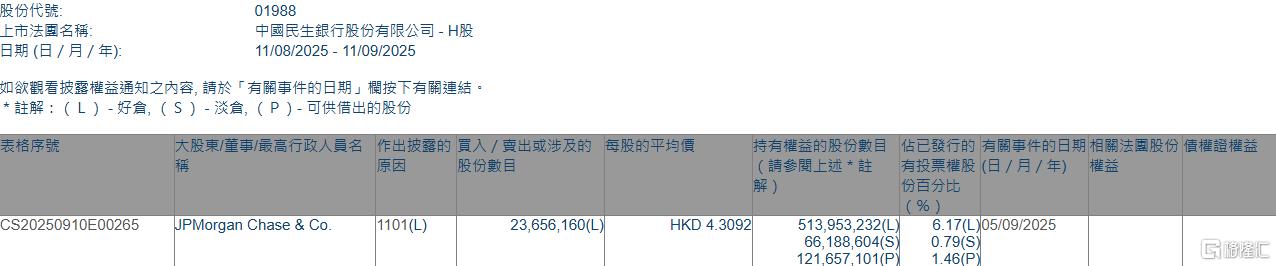
民生银行(01988.HK)获摩根大通增持2365.62万股
Ge Long Hui A P P· 2025-09-10 23:25
Group 1 - JPMorgan Chase & Co. increased its stake in China Minsheng Bank (01988.HK) by acquiring 23,656,160 shares at an average price of HKD 4.3092 per share, totaling approximately HKD 102 million [1][2] - Following this acquisition, JPMorgan's total holdings in China Minsheng Bank rose to 513,953,232 shares, increasing its ownership percentage from 5.89% to 6.17% [1][2]

今日重磅看点
Bei Jing Shang Bao· 2025-09-10 17:35
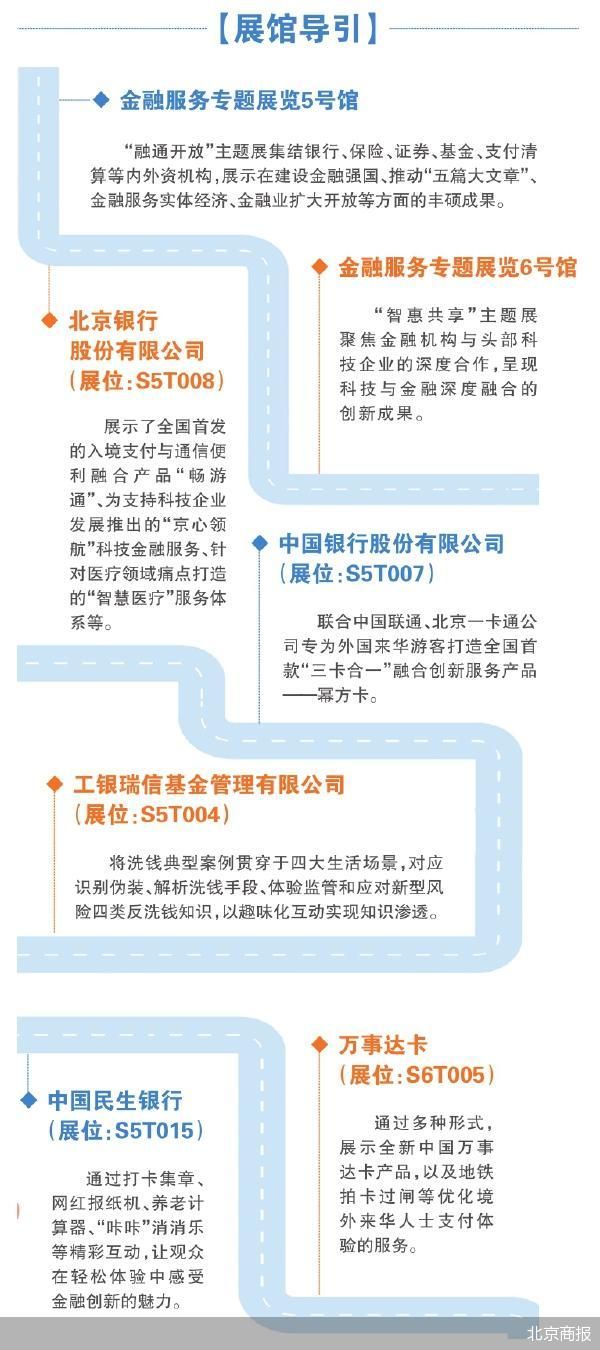
Group 1: Financial Services Exhibition Highlights - The exhibition features a theme of "融通开放" (Open Integration), showcasing achievements in building a strong financial nation and expanding financial services to the real economy [1] - Beijing Bank introduced innovative products such as "畅游通" for inbound payment and communication, "京心领航" for supporting tech enterprises, and a "智慧医疗" service system targeting healthcare pain points [2] - The "智惠共享" (Intelligent Sharing) theme focuses on deep cooperation between financial institutions and leading tech companies, highlighting the integration of technology and finance [3] Group 2: Collaborative Innovations - Bank of China, in collaboration with China Unicom and Beijing Yikatong, launched the first "三卡合一" (Three-in-One) service product for foreign tourists [4] - ICBC Credit Suisse Asset Management incorporated anti-money laundering education into four life scenarios, using interactive methods to enhance knowledge dissemination [5] - Various interactive experiences were provided to engage audiences in understanding financial innovations, including activities like stamp collection and games [7] Group 3: Upcoming Events - The 2025 Global Service Trade Entrepreneurs Summit will take place on September 11, 2025, focusing on intelligent driving and color integration [10] - The 2025 World Tourism Cooperation and Development Conference will also occur on September 11, 2025, emphasizing smart tourism and mutual benefits [10] - The International Education Cooperation Forum and the Fourth International Exhibition Economy Development Forum are scheduled for the same day, addressing future innovations and digital reconstruction of value chains [10]


摩根大通增持民生银行约2365.62万股 每股均价约4.31港元
Zhi Tong Cai Jing· 2025-09-10 11:20
Group 1 - Morgan Stanley increased its stake in Minsheng Bank by acquiring 23.656 million shares at an average price of 4.3092 HKD per share, totaling approximately 102 million HKD [1] - After the acquisition, Morgan Stanley's total shareholding in Minsheng Bank reached approximately 514 million shares, representing a stake of 6.17% [1]

摩根大通增持民生银行(01988)约2365.62万股 每股均价约4.31港元
智通财经网· 2025-09-10 11:15
Group 1 - Morgan Stanley increased its stake in Minsheng Bank by purchasing 23.656 million shares at an average price of 4.3092 HKD per share, totaling approximately 102 million HKD [1] - After the purchase, Morgan Stanley's total holdings in Minsheng Bank reached approximately 514 million shares, representing a stake of 6.17% [1]
中国民生银行首席经济学家温彬:全年5%增长目标有望达成,扩内需是下半年稳增长的关键
Sou Hu Cai Jing· 2025-09-10 10:47
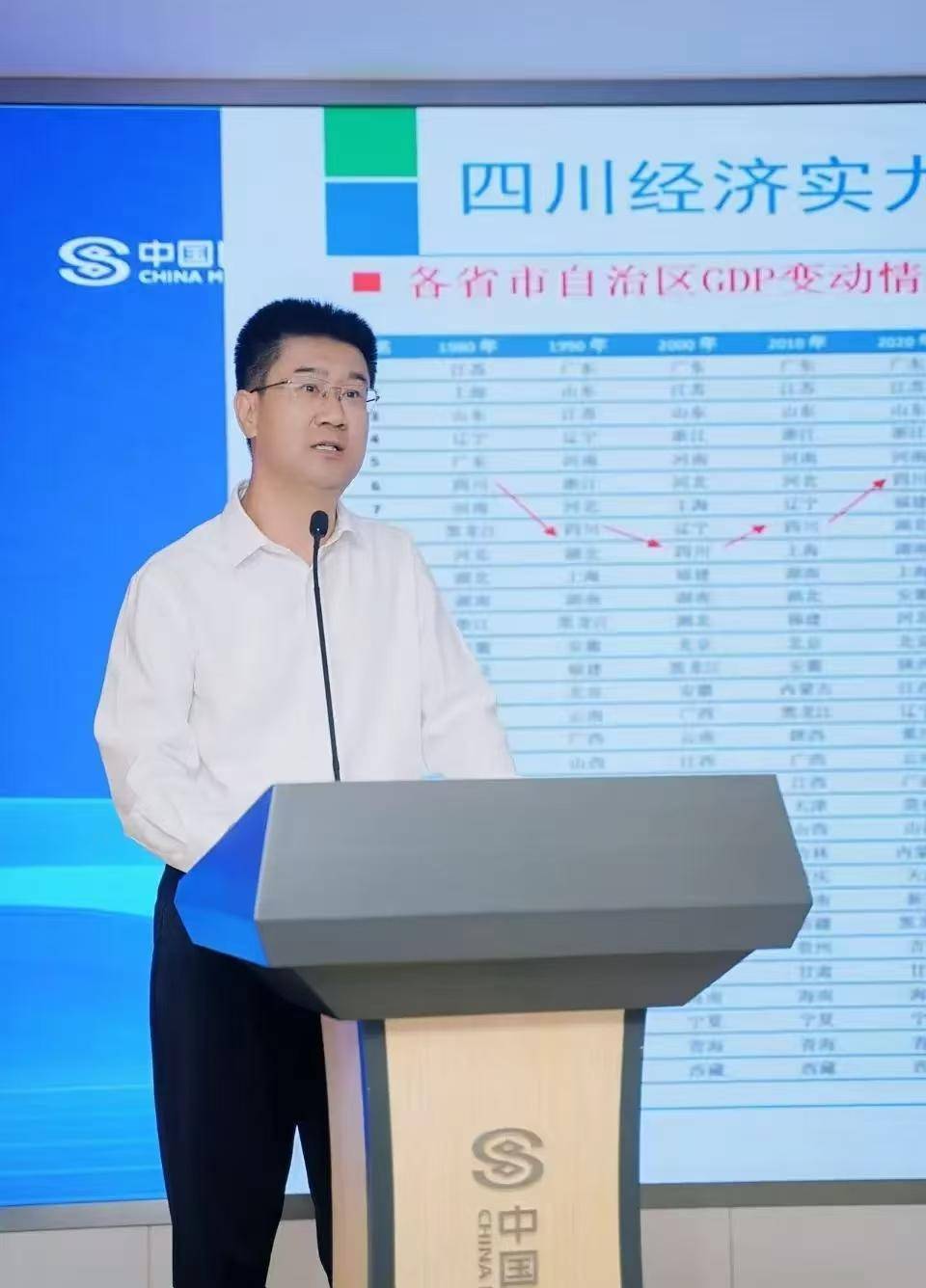
Core Viewpoint - The seminar highlighted the analysis and outlook of China's economic and financial situation for mid-2025, emphasizing the need for macroeconomic regulation and deepening reforms to enhance internal economic momentum in response to complex international challenges [1]. Economic Performance - In the first half of 2025, China's economy showed significant characteristics: consumption outperformed investment, and external demand was stronger than internal demand. The annual growth target of around 5% is expected to be achieved [5][6]. - The GDP growth rates were 5.4% in Q1 and 5.2% in Q2, leading to an overall growth of 5.3% in the first half. A growth rate of 4.7% in the second half would suffice to meet the annual target [5][6]. Regional Economic Development - Sichuan has emerged as the fifth-largest economy in China, with a continuously optimized industrial structure and enhanced competitiveness. Future efforts should focus on leveraging internal demand and upgrading industries to promote high-quality development [4][6]. Consumer and External Demand - Retail sales in May increased by 6.4% year-on-year, driven by holiday effects, promotional activities, and government subsidies for major consumer goods [6]. - Exports contributed 1.7 percentage points to economic growth in the first half, acting as a stabilizer amid slower domestic demand recovery [6][7]. Financial Indicators - The narrowing gap between M1 and M2 indicates a gradual recovery in corporate confidence, while the expansion of the gap between social financing and credit growth suggests that government bond issuance is a key driver of social financing growth [7][8]. Policy Focus for the Second Half - The policy direction for the second half of 2025 will prioritize domestic demand, with a focus on stimulating consumption and increasing infrastructure investment [8][9]. - Major projects in infrastructure, such as the Yarlung Tsangpo River hydropower station, are expected to play a crucial role in stabilizing investment growth [8]. Long-term Economic Strategy - To address the challenges posed by high savings rates and trade protectionism, reforms should focus on increasing consumption rates through income distribution reforms and enhancing social security systems [9][10]. - The establishment of a unified national market is essential for optimizing resource allocation and promoting new quality productivity [11]. Global Competitiveness - Chinese companies are encouraged to enhance their global perspective and operational capabilities while deepening their engagement in the domestic market to improve international competitiveness [11][12].
股份制银行板块9月10日涨0.21%,中信银行领涨,主力资金净流入6.13亿元
Zheng Xing Xing Ye Ri Bao· 2025-09-10 08:37
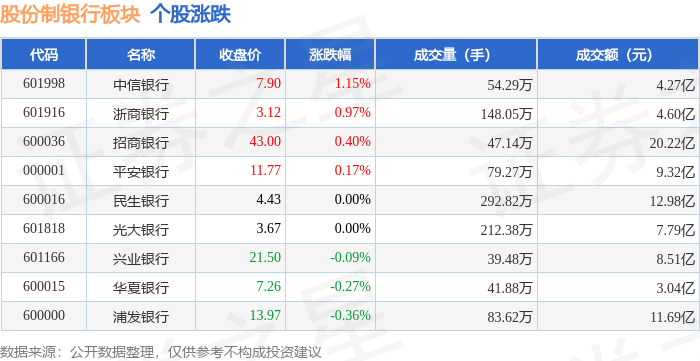
Core Insights - The banking sector saw a slight increase of 0.21% on September 10, with CITIC Bank leading the gains [1] - The Shanghai Composite Index closed at 3812.22, up 0.13%, while the Shenzhen Component Index closed at 12557.68, up 0.38% [1] Banking Sector Performance - CITIC Bank closed at 7.90, with a rise of 1.15% and a trading volume of 542,900 shares, amounting to a transaction value of 427 million yuan [1] - Other notable banks included Zhejiang Commercial Bank, which rose by 0.97% to 3.12, and China Merchants Bank, which increased by 0.40% to 43.00 [1] - The overall trading volume for the banking sector was significant, with total transactions reaching billions of yuan [1] Capital Flow Analysis - The banking sector experienced a net inflow of 613 million yuan from institutional investors, while retail investors saw a net outflow of 30.37 million yuan [1] - Major banks like China Merchants Bank and Shanghai Pudong Development Bank attracted significant institutional inflows of 308 million yuan and 149 million yuan, respectively [2] - Conversely, Minsheng Bank experienced a net outflow of 43.18 million yuan from institutional investors, indicating varied investor sentiment across the sector [2]





中国民生银行(01988.HK)2025年半年度A股权益分派 每股派0.136元
Ge Long Hui· 2025-09-09 14:39
Core Points - China Minsheng Bank (01988.HK) announced a profit distribution plan approved by the board on August 29, 2025, following authorization from the annual shareholders' meeting held on June 26, 2025 [1] - The distribution will be based on the total share capital of 43,782,418,502 shares, with a cash dividend of RMB 0.136 per share (including tax), totaling approximately RMB 5,954,408,916.27 [1] - A total of approximately RMB 4,822,848,756.97 will be distributed to A-share shareholders in cash [1]
民生银行(01988) - 中国民生银行股份有限公司2025年半年度A股权益分派实施公告
2025-09-09 14:10
香港交易及結算所有限公司及香港聯合交易所有限公司對本公告的內容概不負責,對其準確性 或完整性亦不發表任何聲明,並明確表示,概不對因本公告全部或任何部分內容而產生或因倚 賴該等內容而引致之任何損失承擔任何責任。 中國民生銀行股份有限公司 CHINA MINSHENG BANKING CORP., LTD. (在中華人民共和國註冊成立的股份有限公司) (股份代號:01988) 海外監管公告 本公告乃根據香港聯合交易所有限公司證券上市規則第13.10B條由中國民生銀行 股份有限公司(「本行」)作出。 茲載列本行在上海證券交易所網站及中國報章刊登之《中國民生銀行股份有限公 司2025年半年度A股權益分派實施公告》,僅供參閱。 承董事會命 中國民生銀行股份有限公司 董事長 高迎欣 中國,北京 2025年9月9日 於本公告日期,本行執行董事為高迎欣先生、王曉永先生及張俊潼先生;非執行 董事為劉永好先生、史玉柱先生、宋春風先生、趙鵬先生、梁鑫傑先生及林立先 生;獨立非執行董事為曲新久先生、溫秋菊女士、宋煥政先生、楊志威先生、程 鳳朝先生及劉寒星先生。 证券代码:600016 证券简称:民生银行 优先股简称:民生优 1 优先 ...
民生银行:2025年半年度A股权益分派实施公告
Zheng Quan Ri Bao· 2025-09-09 13:19
Group 1 - The core point of the announcement is that Minsheng Bank has declared a cash dividend of 0.136 yuan per share (tax included) for the first half of 2025 [2] - The record date for the dividend is set for September 15, 2025, while the ex-dividend date and the date of cash dividend distribution are both scheduled for September 16, 2025 [2]
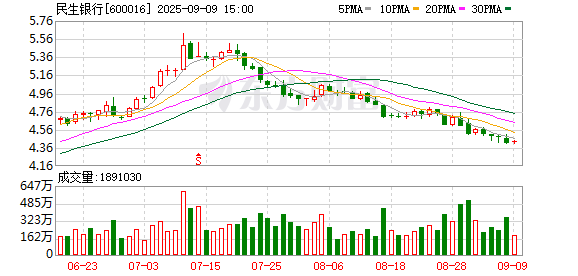
民生银行:拟实施中期分红,每股派发现金红利0.136元
Bei Jing Shang Bao· 2025-09-09 11:26
Group 1 - The core point of the article is that Minsheng Bank announced its cash dividend distribution plan for the first half of 2025, detailing the amount and payment date [1] - The total share capital of Minsheng Bank is 43.782 billion shares, and the cash dividend per share is set at RMB 0.136 (including tax), totaling RMB 5.954 billion in cash dividends [1] - The cash dividends distributed to A-share shareholders amount to approximately RMB 4.823 billion, with the payment date scheduled for September 16, 2025 [1]