CMBC(600016)

Search documents
我国系统重要性银行名单公布
新华网财经· 2026-02-14 01:10
Group 1 - The People's Bank of China and the National Financial Regulatory Administration have conducted an assessment for the 2025 systemically important banks, identifying 21 domestic banks, including 6 state-owned commercial banks, 10 joint-stock commercial banks, and 5 city commercial banks [3][4]. - The list aims to establish a comprehensive macro-prudential management system and strengthen the regulation of systemically important financial institutions [4]. - Systemically important banks are categorized into five groups based on their importance scores, with the first group including 11 banks such as China Minsheng Bank and China Everbright Bank, and the fourth group including major banks like Industrial and Commercial Bank of China and Bank of China [5]. Group 2 - The People's Bank of China and the National Financial Regulatory Administration will enhance the combined efforts of macro-prudential management and micro-prudential regulation to solidify additional supervision of systemically important banks, promoting their safe and sound operation to better serve the high-quality development of the real economy [5].






系统重要性银行名单出炉
Shang Hai Zheng Quan Bao· 2026-02-13 17:01
Core Viewpoint - The People's Bank of China has identified 21 domestic systemically important banks for the year 2025, aiming to enhance macro-prudential management and regulatory oversight of these institutions [1] Group 1: Identification of Systemically Important Banks - A total of 21 banks have been recognized as systemically important, including 6 state-owned commercial banks, 10 joint-stock commercial banks, and 5 city commercial banks [1] - The banks are categorized into five groups based on their systemic importance scores, with the first group containing 11 banks, the second group 4 banks, the third group 2 banks, the fourth group 4 banks, and the fifth group having no banks [1] Group 2: Breakdown of Bank Groups - Group 1 includes: China Minsheng Bank, China Everbright Bank, Ping An Bank, Huaxia Bank, Ningbo Bank, Jiangsu Bank, Beijing Bank, Nanjing Bank, Guangfa Bank, Zheshang Bank, and Shanghai Bank [1] - Group 2 consists of: Industrial Bank, China CITIC Bank, Shanghai Pudong Development Bank, and China Postal Savings Bank [1] - Group 3 includes: Bank of Communications and China Merchants Bank [1] - Group 4 comprises: Industrial and Commercial Bank of China, Bank of China, China Construction Bank, and Agricultural Bank of China [1] Group 3: Future Regulatory Actions - The People's Bank of China and the financial regulatory authority will implement additional regulatory measures as per the "Regulations on Additional Supervision of Systemically Important Banks (Trial)" to ensure the safe and sound operation of these banks [1] - The aim is to strengthen the macro-prudential management and micro-prudential regulatory synergy, promoting the healthy development of systemically important banks to better serve the high-quality development of the real economy [1]
21家系统重要性银行名单出炉!浙商银行新入选
Guang Zhou Ri Bao· 2026-02-13 15:09
Core Viewpoint - The People's Bank of China and the National Financial Regulatory Administration have published the list of systemically important banks for 2025, identifying 21 domestic banks, including 6 state-owned commercial banks, 10 joint-stock commercial banks, and 5 city commercial banks [1][2]. Group 1: Systemically Important Banks - The newly published list includes Zhejiang Commercial Bank as a new entrant among systemically important banks [1]. - The banks are categorized into five groups based on their systemic importance scores, with the first group containing 11 banks, the second group 4 banks, the third group 2 banks, the fourth group 4 banks, and the fifth group having no banks [1]. - The first group includes China Minsheng Bank, China Everbright Bank, Ping An Bank, Huaxia Bank, Ningbo Bank, Jiangsu Bank, Beijing Bank, Nanjing Bank, Guangfa Bank, Zhejiang Commercial Bank, and Shanghai Bank [1]. - The second group consists of Industrial Bank, China CITIC Bank, Shanghai Pudong Development Bank, and China Postal Savings Bank [1]. - The third group includes Bank of Communications and China Merchants Bank [1]. - The fourth group comprises Industrial and Commercial Bank of China, Bank of China, China Construction Bank, and Agricultural Bank of China [1]. - No banks are listed in the fifth group [1]. Group 2: Regulatory Measures - The People's Bank of China and the National Financial Regulatory Administration will implement additional regulatory measures for systemically important banks according to the "Regulations on Additional Supervision of Systemically Important Banks (Trial)" [2]. - The aim is to enhance macro-prudential management and micro-prudential supervision, ensuring the safe and sound operation of systemically important banks [2]. - This initiative is intended to better serve the high-quality development of the real economy [2].

我国系统重要性银行名单发布,共21家
Bei Ke Cai Jing· 2026-02-13 13:57
Core Viewpoint - The People's Bank of China and the National Financial Regulatory Administration have conducted an assessment of systemically important banks for 2025, identifying 21 domestic banks categorized into five groups based on their systemic importance scores [1] Group 1: Identification of Systemically Important Banks - A total of 21 domestic systemically important banks have been recognized, including 6 state-owned commercial banks, 10 joint-stock commercial banks, and 5 city commercial banks [1] - The banks are categorized into five groups based on their systemic importance scores, with the first group consisting of 11 banks, the second group containing 4 banks, the third group having 2 banks, the fourth group including 4 banks, and the fifth group having no banks [1] Group 2: Breakdown of Bank Groups - **First Group (11 banks)**: Includes China Minsheng Bank, China Everbright Bank, Ping An Bank, Huaxia Bank, Ningbo Bank, Jiangsu Bank, Beijing Bank, Nanjing Bank, Guangfa Bank, Zheshang Bank, and Shanghai Bank [1] - **Second Group (4 banks)**: Comprises Industrial Bank, China CITIC Bank, Shanghai Pudong Development Bank, and China Postal Savings Bank [1] - **Third Group (2 banks)**: Consists of Bank of Communications and China Merchants Bank [1] - **Fourth Group (4 banks)**: Includes Industrial and Commercial Bank of China, Bank of China, China Construction Bank, and Agricultural Bank of China [1] - **Fifth Group**: Currently has no banks included [1] Group 3: Future Regulatory Actions - The People's Bank of China and the National Financial Regulatory Administration will implement additional regulatory measures for systemically important banks according to the "Regulations on Additional Supervision of Systemically Important Banks (Trial)" [1] - The aim is to enhance macro-prudential management and micro-prudential supervision, ensuring the safe and sound operation of systemically important banks and better supporting the high-quality development of the real economy [1]
中国民生银行首席经济学家兼研究院院长温彬发表新春畅想
Xin Lang Cai Jing· 2026-02-13 13:17
Core Viewpoint - The article emphasizes the importance of building a modern financial system in China, focusing on serving the real economy and achieving high-quality development in the banking sector as part of the broader "14th Five-Year Plan" [5][10]. Group 1: Policy and Economic Context - In 2025, the Chinese banking industry adhered to a policy framework characterized by "seeking progress while maintaining stability" and "systematic integration" to enhance financial service quality in key areas [4][9]. - The year 2026 marks the beginning of the "14th Five-Year Plan," which is crucial for advancing the construction of a financial powerhouse in China [5][10]. Group 2: Goals and Strategies - The construction of a financial powerhouse requires a focus on a people-centered approach, serving the real economy, and contributing to international financial stability [5][10]. - The article highlights the necessity of providing high-quality international financial products and digital financial infrastructure to support global economic development and promote a community with a shared future for mankind [5][10]. Group 3: Leadership and Development - Strengthening the comprehensive leadership of the Party is deemed essential for ensuring that financial work remains focused on the people, risk prevention, and deepening structural reforms in financial supply [5][10]. - The commitment to a customer-centric approach and innovation as a driving force is emphasized, with a clear alignment to the goals of the "14th Five-Year Plan" [5][10].
我国系统重要性银行扩容,名单新增1家,分组有调整
2 1 Shi Ji Jing Ji Bao Dao· 2026-02-13 12:01
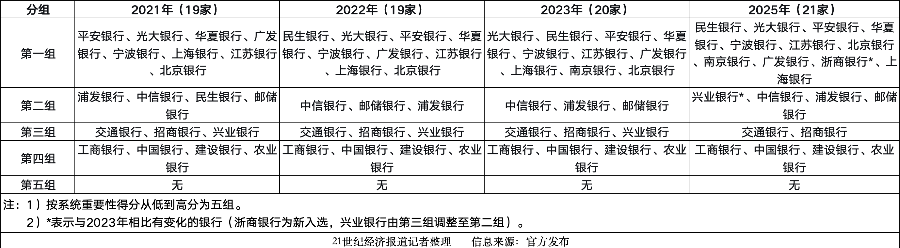
Core Viewpoint - The People's Bank of China and the National Financial Regulatory Administration announced the list of systemically important banks for 2025, identifying 21 banks, an increase of one from the previous assessment, indicating a slight expansion trend in the number of recognized banks [1][4]. Group Structure - The list of systemically important banks has shown a gradual increase over the years, with 19 banks recognized in both 2021 and 2022, 20 in 2023, and 21 in 2025, reflecting a consistent expansion [1][4]. - The fourth group remains stable, consistently comprising the four major banks: Industrial and Commercial Bank of China, Bank of China, China Construction Bank, and Agricultural Bank of China [2][4]. Group Classification - The 21 banks are categorized into five groups based on their systemic importance scores, with the fifth group remaining vacant. The first group increased from 10 to 11 banks, the second group rose from 3 to 4 banks, the third group decreased from 3 to 2 banks, and the fourth group maintained its count at 4 banks [4]. - The first group now includes 11 banks: China Minsheng Bank, China Everbright Bank, Ping An Bank, Huaxia Bank, Ningbo Bank, Jiangsu Bank, Beijing Bank, Nanjing Bank, Guangfa Bank, Zhejiang Commercial Bank, and Shanghai Bank. The second group consists of 4 banks: Industrial Bank, China CITIC Bank, Shanghai Pudong Development Bank, and China Postal Savings Bank. The third group has 2 banks: Bank of Communications and China Merchants Bank. The fourth group includes 4 banks: Industrial and Commercial Bank of China, Bank of China, China Construction Bank, and Agricultural Bank of China [4]. Key Changes - A significant change in this announcement is the inclusion of Zhejiang Commercial Bank in the first group, marking its first entry as a systemically important bank. Additionally, Industrial Bank has been moved from the third group to the second group [4]. Regulatory Framework - The assessment and publication of the list are part of the regulatory authorities' efforts to establish a comprehensive macro-prudential management system and strengthen the supervision of systemically important financial institutions [4][5]. - The People's Bank of China and the National Financial Regulatory Administration will continue to enhance the additional supervision of systemically important banks to promote their safe and sound operation, thereby better serving the high-quality development of the real economy [5].
我国系统重要性银行名单发布,新增浙商银行
证券时报· 2026-02-13 11:31
Core Viewpoint - The People's Bank of China and the National Financial Regulatory Administration released the list of systemically important banks for 2025, identifying 21 domestic banks, including 6 state-owned commercial banks, 10 joint-stock commercial banks, and 5 city commercial banks [1]. Group 1: List of Systemically Important Banks - The 2025 list includes Zhejiang Commercial Bank, which is newly added and placed in the first group, making it the 10th joint-stock commercial bank on the list [2]. - The list is categorized into five groups based on systemic importance scores, with the first group containing 11 banks, the second group 4 banks, the third group 2 banks, the fourth group 4 banks, and no banks in the fifth group [3]. Group 2: Regulatory Framework - Systemically important banks are characterized by their large scale, high complexity, and strong interconnections with the financial system, which significantly impacts economic and financial operations [4]. - The regulatory framework requires additional capital requirements for banks in different groups, ranging from 0.25% for the first group to 1.5% for the fourth group, with specific leverage ratio requirements also in place [4]. - The regulatory bodies aim to enhance macro-prudential management and micro-prudential supervision to ensure the safe and sound operation of systemically important banks, thereby supporting the high-quality development of the real economy [4].


最新21家系统重要性银行名单出炉
Di Yi Cai Jing Zi Xun· 2026-02-13 10:53
Core Viewpoint - The People's Bank of China and the National Financial Regulatory Administration have published the list of systemically important banks for 2025, identifying 21 domestic banks, with Zheshang Bank newly included, indicating an increase in its systemic importance [3][4]. Group 1: Systemically Important Banks - The 2025 list includes 21 systemically important banks: 6 state-owned commercial banks, 10 joint-stock commercial banks, and 5 city commercial banks [3]. - Zheshang Bank's inclusion in the list signifies its rising importance within the banking system [3]. - The banks are categorized into five groups based on their systemic importance scores, with the first group containing 11 banks, including Zheshang Bank, and the fifth group having no banks [3]. Group 2: Regulatory Framework - Systemically important banks are characterized by their large scale and significant role in the financial system, leading to stricter regulatory measures to ensure stability and prevent financial risks [4]. - The People's Bank of China and the National Financial Regulatory Administration will continue to enhance the additional regulatory framework for systemically important banks to promote their safe and sound operation [4].

人民银行、国家金融监管总局发布我国系统重要性银行名单,共计21家
Bei Jing Shang Bao· 2026-02-13 10:39
Core Viewpoint - The People's Bank of China and the National Financial Regulatory Administration have conducted an assessment of systemically important banks for 2025, identifying 21 domestic banks that play a crucial role in the financial system [1] Group 1: Identification of Systemically Important Banks - A total of 21 domestic banks have been recognized as systemically important, including 6 state-owned commercial banks, 10 joint-stock commercial banks, and 5 city commercial banks [1] - The banks are categorized into five groups based on their systemic importance scores, with the first group consisting of 11 banks, the second group having 4 banks, the third group with 2 banks, the fourth group containing 4 banks, and no banks in the fifth group [1] Group 2: Breakdown of Banks by Group - Group 1 includes: China Minsheng Bank, China Everbright Bank, Ping An Bank, Huaxia Bank, Ningbo Bank, Jiangsu Bank, Beijing Bank, Nanjing Bank, Guangfa Bank, Zheshang Bank, and Shanghai Bank [1] - Group 2 includes: Industrial Bank, China CITIC Bank, Shanghai Pudong Development Bank, and China Postal Savings Bank [1] - Group 3 includes: Bank of Communications and China Merchants Bank [1] - Group 4 includes: Industrial and Commercial Bank of China, Bank of China, China Construction Bank, and Agricultural Bank of China [1] Group 3: Future Regulatory Actions - The People's Bank of China and the National Financial Regulatory Administration will implement additional regulatory measures for systemically important banks according to the "Regulations on Additional Supervision of Systemically Important Banks (Trial)" [1] - The aim is to enhance macro-prudential management and micro-prudential supervision, ensuring the safe and sound operation of systemically important banks and better supporting the high-quality development of the real economy [1]
最新21家系统重要性银行名单出炉
第一财经· 2026-02-13 10:29
2026.02. 13 本文字数:734,阅读时长大约2分钟 作者 | 第一财经 杜川 我国系统重要性银行新增一家。 2月13日,2025年我国系统重要性银行名单公布。中国人民银行、国家金融监督管理总局开展了 2025年度我国系统重要性银行评估,认定21家国内系统重要性银行,其中国有商业银行6家、股份 制商业银行10家、城市商业银行5家。 第一财经记者注意到,与此前的名单相比,浙商银行新入选系统重要性银行,表明其系统重要性程度 有所上升。 在此次公布的名单中,按系统重要性得分从低到高分为五组:第一组11家,包括中国民生银行、中 国光大银行、平安银行、华夏银行、宁波银行、江苏银行、北京银行、南京银行、广发银行、浙商银 行、上海银行;第二组4家,包括兴业银行、中信银行、浦发银行、中国邮政储蓄银行;第三组2 家,包括交通银行、招商银行;第四组4家,包括中国工商银行、中国银行、中国建设银行、中国农 业银行;第五组暂无银行进入。 系统重要性银行是指银行中规模较大、地位重要的少数银行。因为其结构和业务复杂、与其他金融机 构关联性强,在金融体系中具有举足轻重的地位,往往对其采取更严格的监管措施,以保障其更加稳 健持续发展, ...