SIPG(600018)

Search documents
上港集团2025年归母净利润134亿元 同比下降10.4%
Zhi Tong Cai Jing· 2026-01-12 08:52
上港集团(600018)(600018.SH)披露2025年度业绩快报,2025年度实现营业总收入394.4亿元,同比增 长3.5%;归属于上市公司股东的净利润134亿元,同比下降10.4%。 ...

上港集团(600018.SH)2025年归母净利润134亿元 同比下降10.4%
智通财经网· 2026-01-12 08:49
智通财经APP讯,上港集团(600018.SH)披露2025年度业绩快报,2025年度实现营业总收入394.4亿元, 同比增长3.5%;归属于上市公司股东的净利润134亿元,同比下降10.4%。 ...
上港集团:2025年净利134亿元 同比下降10.4%
Ge Long Hui A P P· 2026-01-12 08:06
格隆汇1月12日丨上港集团(600018.SH)发布业绩快报,2025年营业总收入为394.4亿元,同比增长 3.5%;归属于上市公司股东的净利润为134.0亿元,同比下降10.4%。 ...
上港集团(600018.SH):预计2025年归母净利润为134.0亿元,同比下降10.4%
Ge Long Hui A P P· 2026-01-12 08:06
格隆汇1月12日丨上港集团(600018.SH)公布2025业绩快报,2025年营业总收入为394.4亿元,同比增长 3.5%;2025年归属于上市公司股东的净利润为134.0亿元,同比下降10.4%。 ...
上港集团(600018) - 2025 Q4 - 年度业绩
2026-01-12 08:00
Cargo Throughput - In 2025, the total cargo throughput reached 600 million tons, an increase from 580 million tons in 2024[2] - The container throughput for 2025 was 5,506.3 million TEUs, up from 5,150.6 million TEUs in 2024, marking a significant growth[2] Financial Performance - Total operating revenue for 2025 was RMB 39.44 billion, a 3.5% increase from RMB 38.12 billion in the previous year[4] - Operating profit decreased to RMB 17.55 billion, down 2.6% from RMB 18.01 billion in 2024[4] - Net profit attributable to shareholders was RMB 13.40 billion, reflecting a decline of 10.4% compared to RMB 14.95 billion in the prior year[4] - The basic earnings per share decreased to RMB 0.58, down 9.4% from RMB 0.64 in the previous year[4] Assets and Equity - Total assets increased by 3.8% to RMB 220.07 billion from RMB 212.06 billion at the beginning of the year[4] - Shareholders' equity attributable to the company rose by 5.7% to RMB 140.88 billion from RMB 133.31 billion[4] Operational Strategy - The company aims to enhance operational efficiency and maintain financial stability amid global trade challenges[5] Financial Data Integrity - The reported financial data is preliminary and subject to adjustments, with expected discrepancies not exceeding 10%[6]
上港集团:2025年营收394.4亿元,净利润同比降10.4%
Xin Lang Cai Jing· 2026-01-12 07:49
上港集团公告称,2025年货物吞吐量6.0亿吨,集装箱吞吐量5506.3万标准箱,均高于2024年。2025年营 业总收入394.4亿元,同比增长3.5%;营业利润175.5亿元,同比降2.6%;利润总额180.7亿元,同比降 3.5%;归属于上市公司股东的净利润134.0亿元,同比降10.4%。总资产2200.7亿元,较期初增长3.8%; 归属于上市公司股东的所有者权益1408.8亿元,较期初增长5.7%。上述数据为初步核算,未经审计。 ...
港口能级跃升+航线网络升级 中国港口经济“双轮驱动”助力外贸提质增效
Yang Shi Wang· 2026-01-10 07:59
Core Viewpoint - Shanghai Port's container throughput reached a record high of 55.06 million TEUs in 2025, marking a 6.9% year-on-year increase, maintaining its position as the world's largest port for 16 consecutive years [1] - Ningbo-Zhoushan Port has launched a new direct shipping route to Brisbane, Australia, reducing the travel time to 14 days [1] Group 1: Shanghai Port - Shanghai Port's container throughput surpassed 55.06 million TEUs in 2025, achieving a 6.9% increase compared to the previous year [1] - Yangshan Deep Water Port contributed significantly with a throughput of 28.706 million TEUs, reflecting a 10.4% year-on-year growth [1] Group 2: Ningbo-Zhoushan Port - The new shipping route from Ningbo to Brisbane will utilize 7 modern container ships, each with a capacity of 4,000 TEUs, and is expected to enhance trade efficiency [3] - The new route is projected to add approximately 3,600 TEUs of export throughput to Ningbo Port each month [3] - With the addition of this route, Ningbo-Zhoushan Port now has a total of 309 container shipping routes, including 256 international routes and 132 routes connecting to Belt and Road Initiative countries [3]

中国港口逆风破浪 吞吐量迭破纪录,重构全球航运棋局
2 1 Shi Ji Jing Ji Bao Dao· 2026-01-09 23:07
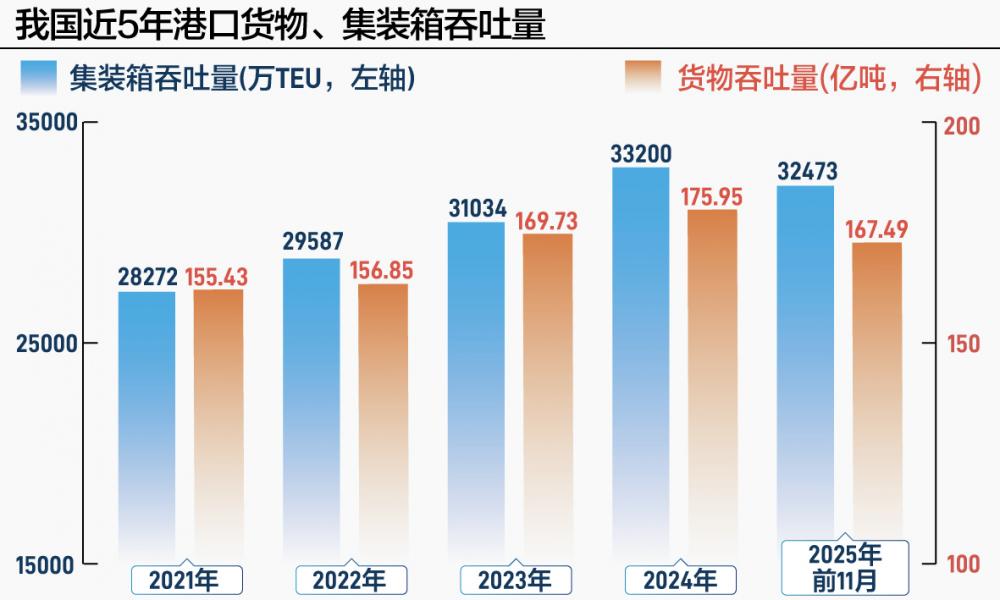
Core Insights - China's ports have demonstrated resilience and growth in cargo throughput despite global trade uncertainties, with major ports like Shanghai and Ningbo-Zhoushan maintaining their positions at the forefront of global shipping [1][3][4] Group 1: Performance Metrics - In the first eleven months of 2025, China's ports achieved a cargo throughput of 16.75 billion tons, marking a year-on-year increase of 4.4% [3] - Shanghai Port's container throughput reached 55.06 million TEUs, maintaining its status as the world's busiest port for the sixteenth consecutive year [8] - Ningbo-Zhoushan Port became the first global port to exceed 1.4 billion tons in annual cargo throughput [3][8] Group 2: Structural Changes and Trends - China's ports are transitioning from scale advantages to becoming supply chain hubs, enhancing their roles in logistics and distribution [2][4] - The growth in throughput is attributed to improved competitiveness in the global shipping system and the implementation of policies supporting smart and green shipping [3][4] Group 3: Market Expansion and Trade Dynamics - China's share of global container exports increased from 34% in 2019 to 38% in 2025, reflecting the resilience of Chinese manufacturing and technology [9] - New trade routes are being established, with ports like Beibu Gulf opening international routes to the Middle East and others expanding to emerging markets in Latin America and Africa [9][10] Group 4: Future Outlook and Innovations - The development of smart and green shipping policies is expected to accelerate the digitalization and automation of ports, enhancing their roles as intelligent hubs [16] - The establishment of new supply chain structures and trade routes will require ports to adapt and optimize their operations in response to geopolitical changes [12][15]




全国集装箱吞吐量前15港口出炉
2 1 Shi Ji Jing Ji Bao Dao· 2026-01-09 15:17
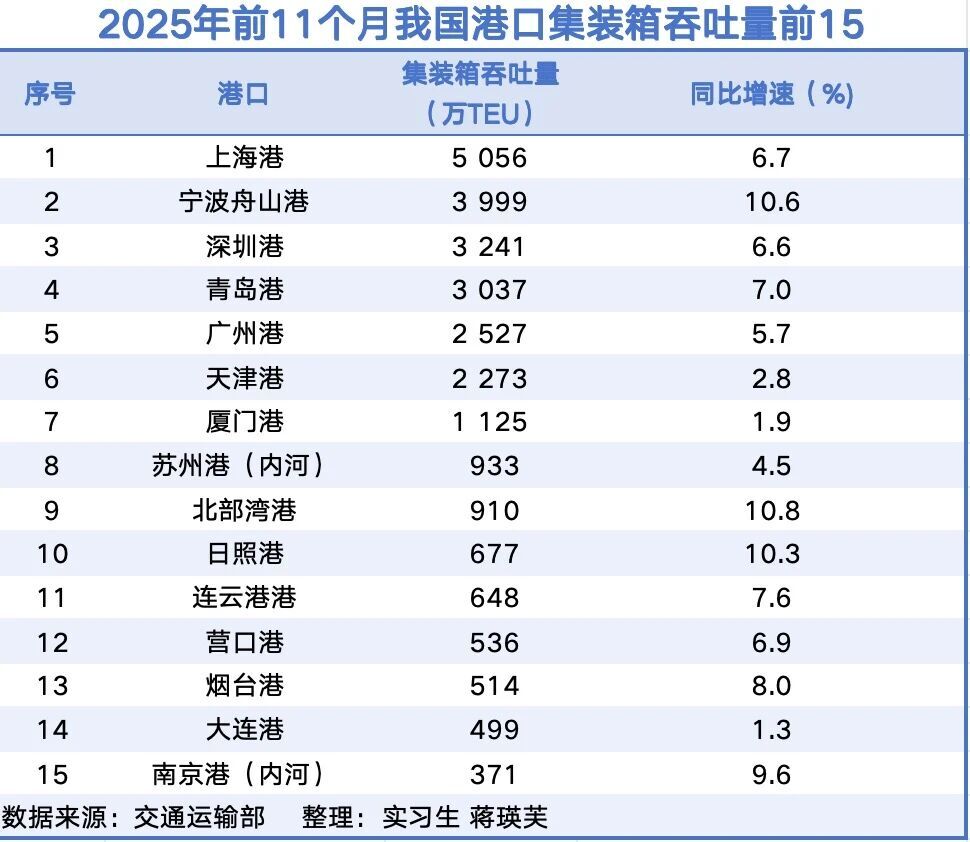
Core Insights - Despite global trade uncertainties, China's port throughput has shown resilient growth, with a total of 16.75 billion tons handled in the first eleven months of 2025, marking a 4.4% year-on-year increase [1][2] - Major ports like Shanghai and Ningbo-Zhoushan have maintained their positions as global leaders, with Ningbo-Zhoushan becoming the first port to exceed 1.4 billion tons in annual throughput and Shanghai retaining the top spot in container throughput for the sixteenth consecutive year [1][5] - The growth in port throughput is attributed to China's increasing competitiveness in the global shipping system and the implementation of policies related to free trade zones and smart and green shipping [2][3] Port Performance - In 2025, major ports in China have reported significant increases in container throughput, with Ningbo-Zhoushan at 39.99 million TEUs (10.6% increase), Shenzhen at 32.41 million TEUs (6.6% increase), and Qingdao at 30.37 million TEUs (7.0% increase) [2] - Emerging ports like Yangpu and Beibu Gulf have also shown remarkable growth, with Yangpu's container throughput increasing by 65% year-on-year [1][5] Economic Context - The stable growth in port cargo and container volumes indicates the resilience of China's economy and international trade, even amidst external instability [3][6] - China's share of global container exports has risen from 34% in 2019 to 38% in 2025, reflecting the competitiveness of Chinese manufacturing and technology [5][6] Trade Route Developments - Chinese ports are expanding into emerging markets, with new international shipping routes being established to regions like the Middle East, Latin America, and Africa [6][7] - The trade volume with ASEAN countries grew by 8.5%, and trade with the EU increased by 5.4% in the first eleven months of 2025 [6] Future Trends - The implementation of smart and green shipping policies is expected to enhance the port industry, with a focus on digitalization and automation [13] - The establishment of new shipping routes, such as the "Sea Defense Silk Road Fast Shipping" line, indicates a shift towards more efficient logistics and trade networks [7][12]


上港集团、山东港口董事长,围绕港港合作座谈!
Sou Hu Cai Jing· 2026-01-09 13:58
Group 1 - The core viewpoint emphasizes the collaboration between Shanghai Port Group and Shandong Port Group to enhance port and shipping service capabilities, aiming for mutual benefits and a new cooperative landscape of dual-direction connectivity and integrated land-sea operations [2][4]. - Shanghai Port Group is committed to high-quality development, reinforcing Shanghai's position as an international hub port, and aims to build a world-class shipping hub while supporting domestic and international dual circulation strategies [4]. - Since signing the strategic cooperation agreement, both parties have established a deeper, broader, and closer cooperative relationship, achieving positive results in building world-class ports [4]. Group 2 - Shandong Port Group views its collaboration with Shanghai Port Group as a core node in the supply chain, fulfilling national strategic missions and adapting to new development patterns [5]. - Shandong Port is focusing on three major constructions and racing in three major tracks to build a world-class comprehensive service system based on ports, transitioning from a "single port operator" to a "port comprehensive service provider" [5]. - Both parties aim to enhance resource complementarity, increase premium shipping routes, and innovate in promoting the development of port and shipping hub functions, thereby elevating cooperation to better serve national strategies [5].