
China Unicom(600050)

Search documents
中国联通张云勇:拥抱创新构建纵深安全防御体系
Zhong Guo Qing Nian Bao· 2025-11-10 04:41
Core Viewpoint - The rapid development of AI technology has significantly improved production efficiency but has also led to exponential growth in cybersecurity risks. Innovative models such as AI empowerment, end-to-end collaboration, standardization, and cross-industry integration can provide new solutions to overcome challenges in the security industry [1][2]. Group 1: Current Challenges in Cybersecurity - The landscape of threat perception and the offense-defense game is undergoing profound changes, with issues such as inconsistent intelligence data quality and poor interoperability being prominent pain points [1]. - The core strategy of China Unicom to address these challenges includes fully leveraging data value to build a deeper and broader threat perception system and establishing a robust security foundation for the intelligent era [1]. Group 2: Innovative Approaches and Collaborations - Since May 2022, China Unicom has moved beyond a "lone wolf" approach by taking on the role of a chain leader in the modern cybersecurity industry chain, focusing on enhancing core technical capabilities, improving basic security capabilities, and maintaining national cybersecurity [2]. - The company is committed to building national-level technological innovation platforms to promote deep integration of technological and industrial innovation, ensuring communication security, and constructing a platform for efficient collaboration within the industry chain [2].

从“地面”到“云端”,三大运营商硬核技术护航十五运会
2 1 Shi Ji Jing Ji Bao Dao· 2025-11-08 13:04
Core Viewpoint - The 15th National Games serves as a platform for showcasing athletic talent and advanced communication technology, with major telecom operators providing a comprehensive digital support system for the event [1] Group 1: Ultra HD Broadcasting - The three major telecom operators have utilized ultra HD broadcasting technology to break geographical barriers, enabling millions of viewers to experience the event in real-time [2] - China Unicom is the sole official partner for cloud broadcasting, employing a "Unicom Cloud + 5G backpack + 5G network slicing" solution to enhance broadcasting capabilities [2][3] - The broadcasting network covers 69 venues and supports 8K technology transmission, marking the largest scale of broadcasting network established for the National Games [3] Group 2: AI Integration - AI technology has been deeply integrated into event management, spectator services, and athlete training, enhancing the overall experience of the National Games [7] - China Unicom's cloud broadcasting platform uses AI algorithms to automatically edit highlight moments from the events, significantly reducing production time [7] - China Telecom has introduced an AI mascot that can interact with visitors, providing information and recommendations, thus enhancing the spectator experience [8] Group 3: Network Infrastructure - China Mobile has optimized 5G networks across 126 venues, adding 634 new 5G base stations to support high concurrent access during the event [4] - The deployment of a 5G-A network at Shenzhen Bao'an International Airport offers speeds 5-10 times faster than standard 5G, ensuring smooth live streaming for spectators [6] - A quantum encryption platform has been implemented in the power emergency command system, enhancing security against quantum computing attacks [6] Group 4: Long-term Benefits - The technological advancements demonstrated during the National Games are expected to benefit urban governance and long-term development beyond the event itself [9] - The MOC platform technology can be reused for city emergency command and various sporting events, promoting digital collaboration in the Guangdong-Hong Kong-Macao Greater Bay Area [9]


把“信号栏”变成“广告栏”,运营商的创新还是骚扰?
Guan Cha Zhe Wang· 2025-11-08 08:07
Core Viewpoint - The article discusses the recent trend of mobile operators in China replacing the operator name in the signal bar with promotional messages, which has raised concerns among users about privacy and the integrity of mobile services [1][5][13]. Group 1: Advertising in Signal Bars - Mobile operators have begun to modify the signal bar to display promotional messages related to local events, which users cannot turn off manually [1][5]. - This change is attributed to operators altering the global mobile communication standards, allowing them to push advertisements through the NITZ protocol instead of displaying the operator name from the SIM card [6][10]. - The new practice has been linked to the operators' need to find additional revenue streams amid declining average revenue per user (ARPU) in a saturated market [17][18]. Group 2: Regulatory and Compliance Issues - The modification of the signal bar for advertising purposes violates the 3GPP standards, which prioritize displaying the SIM card information over NITZ messages [10][13]. - Legal experts have indicated that this practice may infringe upon telecommunications regulations, as it constitutes forced advertising without user consent [13][19]. - There is a call for regulatory bodies to enhance compliance checks on operators to prevent such practices from becoming widespread [19][20]. Group 3: User Experience and Industry Response - Users have expressed dissatisfaction with the intrusive nature of these advertisements, which detract from the intended functionality of the signal bar [19]. - The article suggests that operators should focus on improving service quality and user experience rather than resorting to aggressive advertising tactics [18][20]. - There is a potential for operators to utilize the signal bar for practical notifications, such as data usage alerts, rather than commercial promotions [19].




央企战略新基金创立 三大运营商出资90亿元
Zhong Guo Jing Ying Bao· 2025-11-07 20:31
Core Insights - China Unicom announced an investment of 1.5 billion RMB in the Central Enterprise Strategic Emerging Industry Development Fund, acquiring a 2.94% stake [2][4] - The fund, initiated by the State-owned Assets Supervision and Administration Commission (SASAC), has a total size of 51 billion RMB and aims to support strategic emerging industries such as AI, new energy, and quantum technology [2][5] - The fund's investment period is set for 5 years, with a total management and exit period of 8 years, extendable to 15 years [2][5] Investment Strategy - The establishment of the fund aligns with China's economic development goals and the "14th Five-Year Plan," focusing on enhancing self-reliance in key technologies [3][5] - The fund aims to strengthen the industrial chain and promote the development of state-owned enterprises in strategic new industries [5][6] Participation of Major Telecom Operators - The three major telecom operators, including China Unicom, China Telecom, and China Mobile, are significant contributors to the fund, collectively holding nearly 21% of the fund's shares [7][9] - China Mobile's investment of 6 billion RMB gives it an 11.76% stake, making it the third-largest shareholder after China Guoxin and Beijing Financial Street Capital [7][9] Long-term Capital Support - The fund is designed to provide long-term capital support, differentiating itself from traditional short-cycle private equity and venture capital operations [5][6] - The involvement of state-owned enterprises in the fund is expected to enhance the speed of capacity and technology iteration in the industry [6][10] Focus on Emerging Technologies - The fund will prioritize investments in quantum technology, AI, and high-end equipment, aligning with the telecom operators' current investment strategies [10][11] - The integration of digital technology and green energy is also a focus area, supporting the operators' dual carbon goals [11][12] Transformation of Telecom Operators - The participation in the fund signifies a shift for telecom operators from traditional service providers to new information service providers, emphasizing the importance of capital in this transformation [12] - The fund is expected to accelerate the operators' layout in the "new quality productivity" sector, enhancing their capital evolution [12]
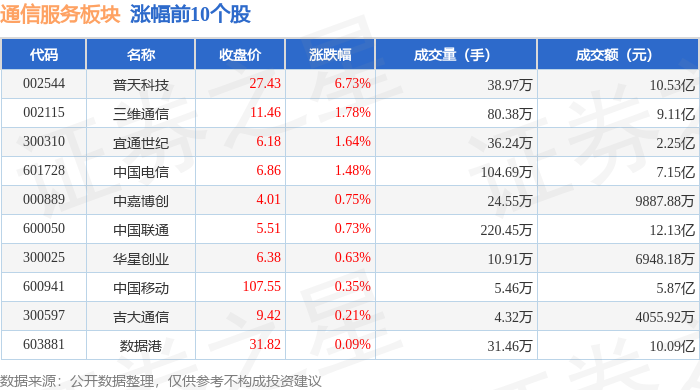
通信服务板块11月7日涨0.62%,普天科技领涨,主力资金净流出1.52亿元
Zheng Xing Xing Ye Ri Bao· 2025-11-07 08:41
Core Insights - The communication services sector saw a rise of 0.62% on November 7, with Putian Technology leading the gains [1] - The Shanghai Composite Index closed at 3997.56, down 0.25%, while the Shenzhen Component Index closed at 13404.06, down 0.36% [1] Stock Performance - The top-performing stocks in the communication services sector included: - Yintian Technology (002544) with a closing price of 27.43, up 6.73% and a trading volume of 389,700 shares [1] - Sanwei Communication (002115) closed at 11.46, up 1.78% with a trading volume of 803,800 shares [1] - Guantong Century (300310) closed at 6.18, up 1.64% with a trading volume of 362,400 shares [1] - Major stocks that experienced declines included: - Online and Offline (656000E) closed at 100.00, down 4.03% with a trading volume of 66,100 shares [2] - Century Hengtong (301428) closed at 35.02, down 3.13% with a trading volume of 34,300 shares [2] Capital Flow - The communication services sector experienced a net outflow of 152 million yuan from institutional investors and 135 million yuan from speculative funds, while retail investors saw a net inflow of 287 million yuan [2] - Notable capital flows for specific stocks included: - Putian Technology (002544) had a net inflow of 141 million yuan from institutional investors [3] - China Mobile (600941) saw a net inflow of 45.06 million yuan from institutional investors [3] - China Telecom (601728) had a net inflow of 31.81 million yuan from retail investors [3]


决胜“十四五” 打好收官战|绿色为底、算电协同——青海绿色算力产业发展观察
Xin Hua She· 2025-11-06 11:16
Group 1 - Qinghai Turing Town officially launched in Xining as a key green computing project in Qinghai Province, representing the province's commitment to developing the green computing industry [1] - The project is developed by H3C Group and aims to create an AI innovation community that integrates government, enterprises, innovation, and applications [1] - Qinghai's abundant water, solar, and wind resources provide a strong foundation for the development of clean energy and computing industries, with the province ranking fifth in water resources and second in solar radiation in China [1] Group 2 - Qinghai has implemented policies to transform its resource advantages into a clean energy development framework, with a focus on hydropower and large-scale clean energy bases [3] - As of September, Qinghai's clean energy installed capacity reached 72.52 million kilowatts, accounting for 93.8% of the province's total power capacity, with both installed capacity and generation exceeding 90% [3] - The computing industry in Qinghai is characterized as an eco-friendly industry with high energy capacity and near-zero emissions, which can help address green electricity consumption challenges and support AI and advanced manufacturing sectors [3] Group 3 - China Unicom's Sanjiangyuan National Big Data Base has invested 2.6 billion yuan, with a current computing capacity of 9,000 P, expected to reach 13,000 P by the end of the year [5] - The data center operates with high energy efficiency, achieving a Power Usage Effectiveness (PUE) below 1.2, which is 40% lower than the national average [5] - The Sanjiangyuan green electricity intelligent computing microgrid project integrates renewable energy sources with computing infrastructure, achieving 100% green electricity consumption and zero carbon emissions [5] Group 4 - As of September, Qinghai has built approximately 190,000 standard racks, with computing capacity increasing nearly 40 times in one year [5] - The province's green computing investment constitutes 40% of the fixed asset investment in the industrial park, with over 80% of computing projects powered by green electricity [5] - The establishment of a clean energy and green computing dispatch center has enabled real-time monitoring of energy generation and carbon emissions across the province [5]

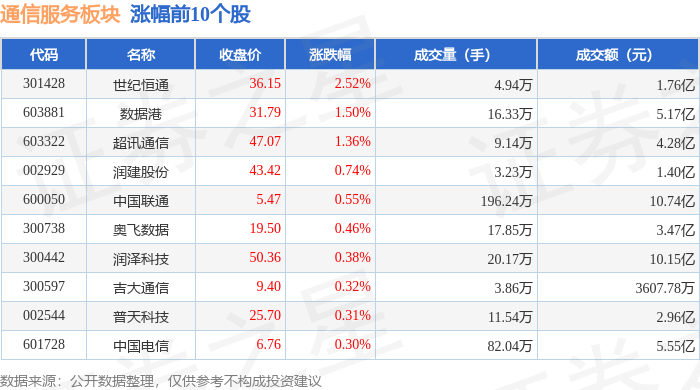
通信服务板块11月6日涨0.23%,世纪恒通领涨,主力资金净流出2.55亿元
Zheng Xing Xing Ye Ri Bao· 2025-11-06 08:50
Market Overview - The communication services sector increased by 0.23% on November 6, with Century Hengtong leading the gains [1] - The Shanghai Composite Index closed at 4007.76, up 0.97%, while the Shenzhen Component Index closed at 13452.42, up 1.73% [1] Top Gainers in Communication Services - Century Hengtong (301428) closed at 36.15, up 2.52% with a trading volume of 49,400 shares and a turnover of 176 million yuan [1] - Data Port (603881) closed at 31.79, up 1.50% with a trading volume of 163,300 shares and a turnover of 517 million yuan [1] - Super Communication (603322) closed at 47.07, up 1.36% with a trading volume of 91,400 shares and a turnover of 428 million yuan [1] Top Losers in Communication Services - Zhongfutong (300560) closed at 14.56, down 3.83% with a trading volume of 233,400 shares and a turnover of 341 million yuan [2] - Hengxin Oriental (300081) closed at 5.51, down 2.48% with a trading volume of 301,000 shares and a turnover of 166 million yuan [2] - Lian Technology (300603) closed at 10.71, down 1.47% with a trading volume of 111,700 shares and a turnover of 12 million yuan [2] Capital Flow Analysis - The communication services sector experienced a net outflow of 255 million yuan from institutional investors, while retail investors saw a net inflow of 267 million yuan [2] - Major stocks like China Telecom (601728) had a net inflow of 24.02 million yuan from institutional investors, but a net outflow of 63.54 million yuan from speculative funds [3] - Century Hengtong (301428) saw a net inflow of 14.68 million yuan from institutional investors, while retail investors had a net outflow of 16.96 million yuan [3]



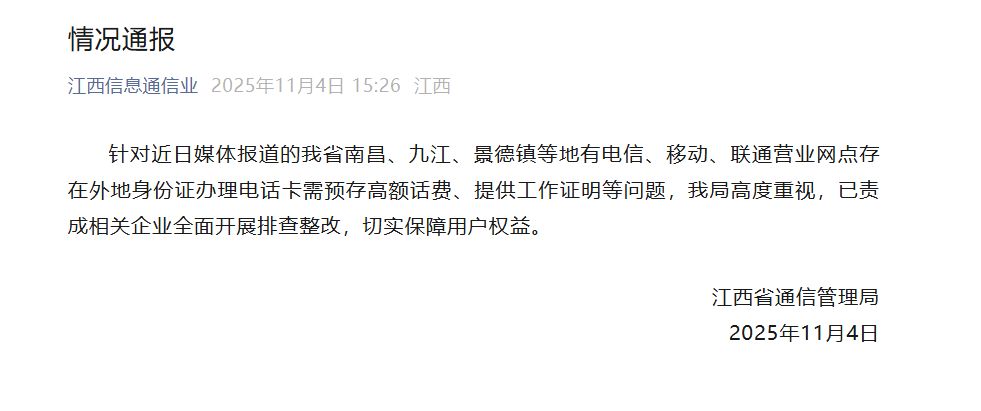
办电话卡需预存高额话费、提供工作证明等?官方通报:已责成相关企业全面开展排查整改
Mei Ri Jing Ji Xin Wen· 2025-11-06 06:43
Core Viewpoint - The Jiangxi Provincial Communication Administration has responded to media reports regarding the high barriers for obtaining phone cards with out-of-town ID cards, including the requirement for work proof and high prepayment amounts, emphasizing the need to protect user rights [1][4]. Group 1: Regulatory Response - The Jiangxi Communication Administration has mandated relevant companies to conduct thorough inspections and rectifications to ensure user rights are safeguarded [1]. - The administration's response indicates a proactive approach to address the issues raised by the media regarding the barriers for out-of-town residents [1]. Group 2: Operator Practices - In Jiangxi, mobile service providers such as China Mobile and China Unicom require out-of-town ID card holders to provide work proof, business licenses, or housing contracts, along with a prepayment of 500 yuan [4][5]. - Different operators have varying requirements; for instance, some locations may allow for a simplified process if the user can confirm local residency [4]. - In contrast, other provinces like Fujian and Gansu have more lenient requirements for out-of-town card applications, indicating regional disparities in practices [5]. Group 3: Expert Opinions - Liu Xingliang, a member of the Ministry of Industry and Information Technology's expert committee, highlighted that while real-name registration is regulated, the additional requirements imposed by operators lack a national legal basis [6]. - Liu suggested the establishment of a "basic standard for out-of-town card applications" to streamline the process and reduce unnecessary barriers for low-risk users [6]. - The recommendation includes a model for a unified set of basic materials required nationwide, with the possibility of local additions, to enhance user experience and rights [6].
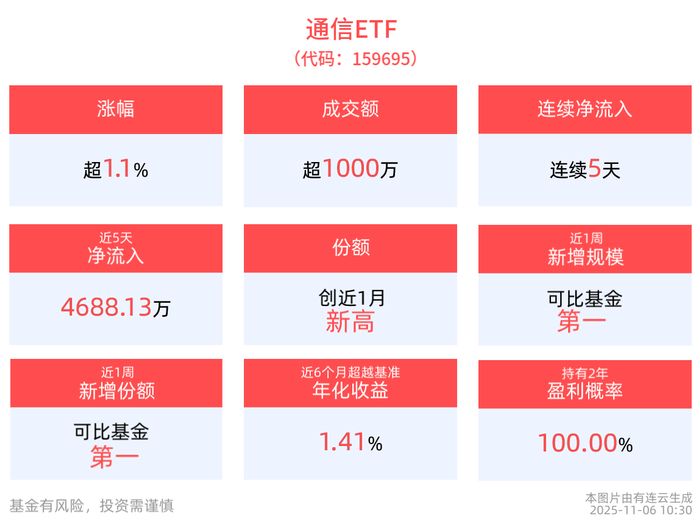
光模块持续受算力主线催化,通信ETF(159695)盘中涨超2%,近5天获得连续资金净流入
Xin Lang Cai Jing· 2025-11-06 03:05
Core Insights - The communication sector is experiencing significant growth, with the Guozheng Communication Index rising by 0.94% as of November 6, 2025, and notable increases in key stocks such as Shijia Photon and Ding Tong Technology [1][3] - The Communication ETF (159695) has shown a strong performance, with a 31.59% increase over the past three months, indicating robust investor interest [1][3] Market Performance - The Communication ETF recorded a turnover rate of 3.81% and a transaction volume of 11.05 million yuan, with a notable increase in scale by 30.67 million yuan over the past week, ranking first among comparable funds [3] - The ETF's net inflow over the past five days reached 46.88 million yuan, with a peak single-day inflow of 35.25 million yuan [3] Historical Returns - Over the past two years, the Communication ETF's net value has increased by 104.55%, placing it in the top 1.09% among 2,380 index equity funds [3] - The ETF has achieved a maximum monthly return of 33.97% since its inception, with the longest consecutive monthly gain of six months and an average monthly return of 7.18% [3] Industry Trends - The optical module market is benefiting from increased computational demand, with a projected market size growth of 54%, 69%, and 34% for the years 2025, 2026, and 2027, respectively, reaching 14.4 billion, 24.4 billion, and 32.7 billion USD [4] - The leading companies in the optical module market are expected to strengthen their market positions, with the top ten stocks in the Guozheng Communication Index accounting for 66.96% of the total weight [4][6] Key Stocks - The top ten weighted stocks in the Guozheng Communication Index include Zhongji Xuchuang, Xinyi Sheng, and ZTE, with Zhongji Xuchuang holding the highest weight at 17.40% [6] - The performance of these stocks varies, with Zhongji Xuchuang increasing by 1.58% and ZTE by 2.38% [6]



国内最大AI数字人公司申请上市,两年收入增长187%,却讲出了AI应用最难解的现实
3 6 Ke· 2025-11-06 00:16
Core Insights - Silicon-based Intelligence has submitted its prospectus to the Hong Kong Stock Exchange, aiming for an IPO as a leading player in the AI sector in China, with a revenue of 655 million yuan in 2024, capturing 32.2% of the domestic digital human market [2][4]. Group 1: Company Overview - Silicon-based Intelligence is the largest digital human company in China and ranks second globally, having delivered over 80,000 "Silicon-based labor forces" across various industries including telecommunications, finance, healthcare, education, and public services [4]. - The company’s revenue has grown significantly from 228 million yuan in 2022 to 655 million yuan in 2024, marking a 187% increase over two years [5]. Group 2: Revenue Sources - A substantial portion of the revenue growth is attributed to a single major client, China Unicom, which accounted for 90% of the revenue increase from 2022 to 2024, with its contribution rising from 36.9 million yuan in 2022 to 422 million yuan in 2024 [6][7]. - By the end of 2024, China Unicom is expected to represent 64.4% of Silicon-based Intelligence's total revenue [7]. Group 3: Client Strategy and Challenges - The company initially attempted to expand its client base by introducing a distribution model, increasing the number of distributors from 2 to 251 in 2023, but later reduced this number to 157 by the end of 2024 due to low retention rates among small clients [8][10]. - The average revenue per client, excluding China Unicom, was approximately 350,000 yuan, while the customer acquisition cost was 184,000 yuan, indicating a challenging profitability scenario [10][12]. Group 4: Market Dynamics - The company faces structural challenges in the AI B2B market, where small enterprises lack budgets for AI products, and large enterprises demand extensive customization, leading to compressed profit margins [17][18]. - The reliance on a few large clients limits pricing power and creates vulnerability in revenue streams, as evidenced by the declining gross margin from 45.8% in 2023 to 31.6% in the first half of 2025 [15][14]. Group 5: Broader Industry Implications - The situation of Silicon-based Intelligence reflects broader issues in the AI industry, where companies struggle to balance between serving small clients with high acquisition costs and large clients with demanding customization needs [18][19]. - The challenges faced by Silicon-based Intelligence highlight the difficulties in achieving sustainable profitability in the rapidly evolving AI landscape, despite being positioned in a high-growth sector [16][19].
