China Unicom(600050)

Search documents
中国联通举行2025北马首场跑手沙龙 5G-A网络将为赛事全程保驾护航中国联通
Xin Lang Cai Jing· 2025-11-05 11:16
Core Insights - The event highlighted the integration of China Unicom's 5G-A network with marathon sports, aiming to enhance the experience for runners and spectators [1][3][5] Group 1: Event Overview - The first salon event of the 2025 Beijing Marathon Expo was successfully held, featuring discussions on the future of 5G-A network applications in marathon events [1] - Key participants included executives from China Unicom and Huawei, along with seasoned marathon enthusiasts and media representatives [1][3] Group 2: Technological Integration - China Unicom has been actively promoting the integration of technology and sports, providing marathon services in six cities this year [3] - The 5G-A network coverage along the marathon route exceeded 90%, with a 95% satisfaction rate for the 20Mbps upload speed standard [5] - The introduction of wireless AI smart boards allows for real-time identification of app usage, optimizing network resource allocation [5] Group 3: User Experience - Participants expressed high expectations for the network experience during the marathon, with plans to utilize high-speed connections for live streaming and content creation [6] - The 2TB capacity of Unicom's cloud storage facilitates easy uploading and management of media content for users [6] - The integration of smart home products and fitness solutions into daily life showcases the extensive reach of Unicom's services [6] Group 4: Future Prospects - China Unicom plans to explore further integration of 5G-A and AI technologies in sports and urban lifestyles, aiming to enhance service quality and user experience [7]


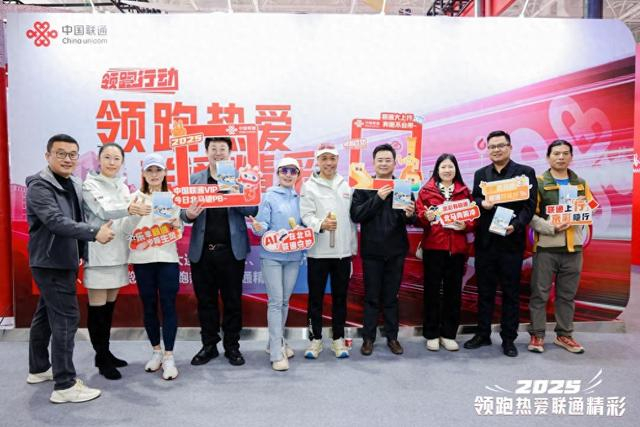
5G-A网络为北马赛事保驾护航
Zhong Guo Jing Ji Wang· 2025-11-05 08:40
Core Insights - China Unicom is actively integrating technology with sports, particularly in the marathon sector, to enhance user experience and brand influence [1][2] - The company has deployed a 5G-A network along the Beijing Marathon route, achieving over 90% coverage and a 95% satisfaction rate for the 20Mbps uplink standard [1] - The introduction of AI-driven network management allows for optimized resource allocation based on the type of applications used by connected devices [2] Group 1 - China Unicom is collaborating with Huawei to provide advanced 5G-A network services for marathon events, enhancing connectivity for runners and spectators [1] - The company has launched the "5G-A Regional Acceleration Package," offering peak download speeds of up to 3Gbps and upload speeds of 300Mbps, enabling real-time social media sharing for runners [2] - Future plans include integrating NWDAF network elements into the 5G core network to improve operational efficiency and service quality [2] Group 2 - The Beijing Marathon is seen as a dynamic representation of the city, with China Unicom aiming to explore further applications of 5G-A and AI in sports and urban lifestyles [2] - The initiative is part of China Unicom's broader strategy to strengthen its brand as "innovative, secure, and trustworthy" in the context of digital transformation [1]
办张电话卡,营业厅要工作证明、无犯罪证明、银行流水、房产证?江西省通信管理局最新通报
Mei Ri Jing Ji Xin Wen· 2025-11-04 10:51
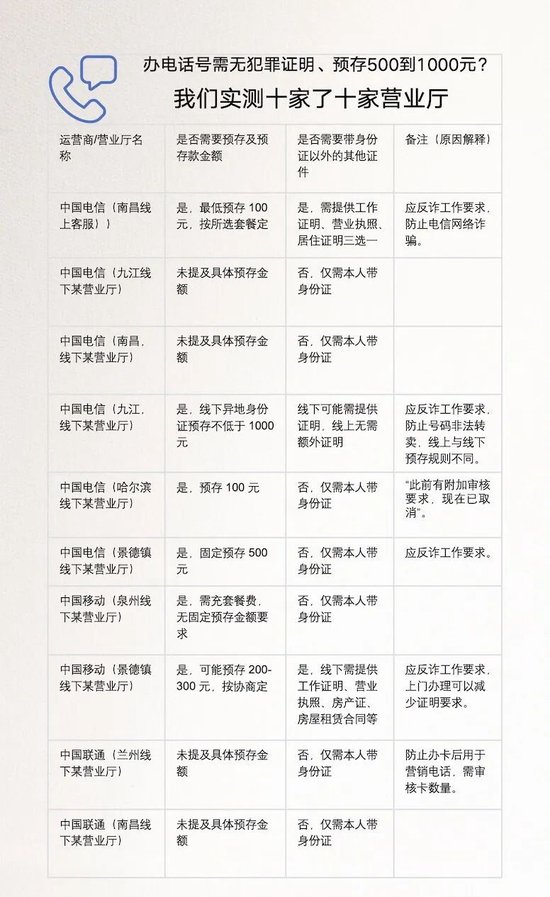
Core Viewpoint - The article highlights the discrepancies in requirements for obtaining a phone card across different regions in China, particularly focusing on the additional documentation and prepayment demands imposed by telecom operators in certain areas, which are justified by the need to combat fraud [1][4][5]. Group 1: Requirements for Obtaining Phone Cards - In some cities, telecom operators require additional documents such as "no criminal record," "work proof," or "bank statements," while others only require an ID [1][2]. - The prepayment amounts vary significantly, with some locations requiring deposits ranging from 100 to 1000 yuan depending on the operator and location [2][4]. - The requirements for obtaining a phone card are notably stricter in Jiangxi province compared to other provinces like Fujian, Gansu, and Heilongjiang, where the process is more lenient [3][4]. Group 2: Justifications and Regulations - Telecom operators cite "anti-fraud measures" as the reason for the additional requirements, although many staff members cannot provide specific policy documents to support these claims [4][5]. - The Ministry of Industry and Information Technology has established norms for real-name registration and identity verification, but there is currently no national regulation mandating the additional requirements such as "no criminal record" or high prepayment amounts [5]. - The Jiangxi Provincial Communication Administration has acknowledged the issues raised and is taking steps to investigate and rectify the situation to protect consumer rights [5].



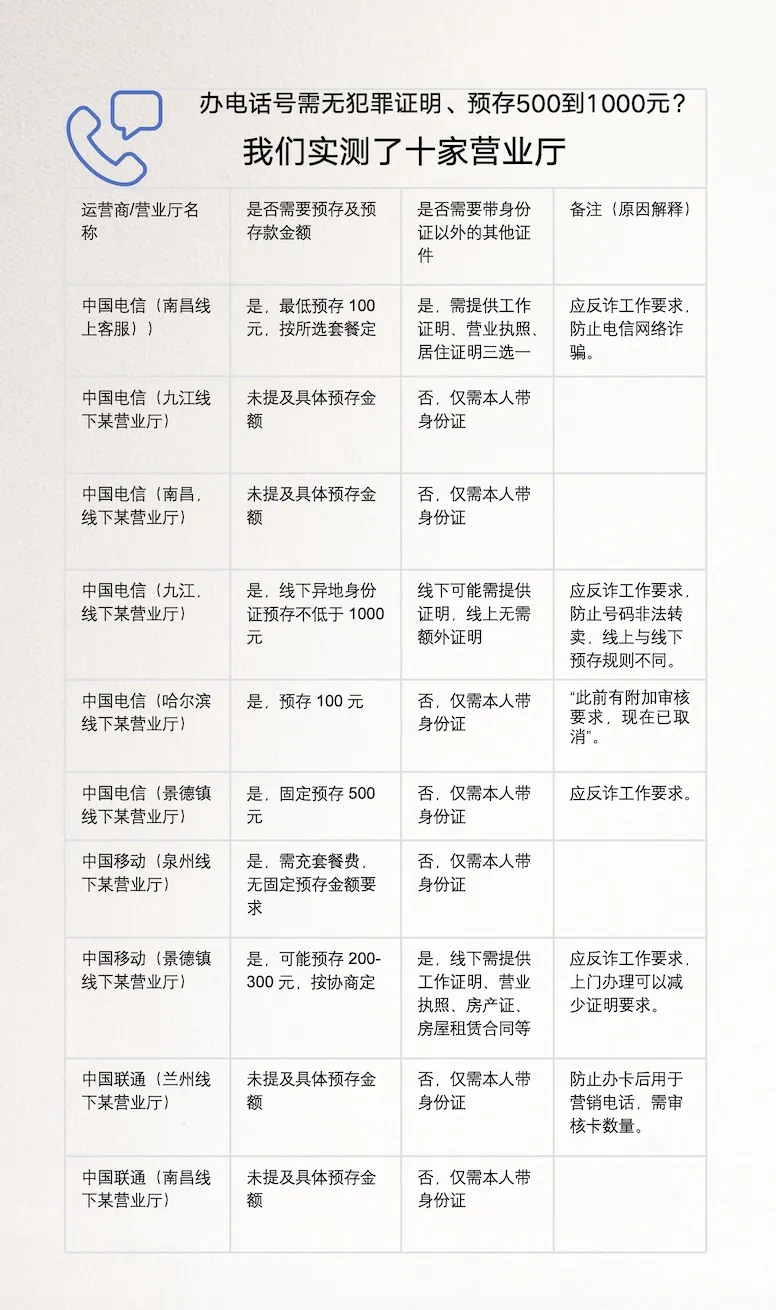
通信服务板块11月4日跌0.38%,数据港领跌,主力资金净流出7.86亿元
Zheng Xing Xing Ye Ri Bao· 2025-11-04 08:48
Core Viewpoint - The communication services sector experienced a decline of 0.38% on November 4, with Data Port leading the drop. The Shanghai Composite Index closed at 3960.19, down 0.41%, while the Shenzhen Component Index closed at 13175.22, down 1.71% [1]. Group 1: Stock Performance - The top gainers in the communication services sector included Hengshi Technology, which rose by 7.67% to a closing price of 10.81, and ST Xintong, which increased by 4.98% to 6.74 [1]. - Data Port was the biggest loser, falling by 3.75% to a closing price of 32.09, followed by ST Yitong, which dropped by 3.62% to 9.32 [2]. - The overall trading volume in the communication services sector showed significant activity, with Hengshi Technology achieving a transaction amount of 4.76 billion and China Mobile reaching 16.16 billion [1]. Group 2: Capital Flow - The communication services sector saw a net outflow of 786 million from institutional investors, while retail investors contributed a net inflow of 676 million [2]. - Major stocks like China Mobile and China Unicom experienced mixed capital flows, with China Mobile seeing a net inflow of 84.79 million from institutional investors but a net outflow from retail investors [3]. - The data indicates that retail investors were more active in the sector, as evidenced by the net inflow of 676 million, contrasting with the institutional outflow [2][3].


多行业领域中央企业发出产业协作发展新邀请
Zheng Quan Shi Bao Wang· 2025-11-04 08:37
Group 1: Modern Industrial System - The 20th Central Committee emphasizes building a modern industrial system with advanced manufacturing as the backbone and strengthening the foundation of the real economy [1] - The focus is on promoting collaborative development among large, medium, and small enterprises, and sharing opportunities with countries worldwide [1] Group 2: Energy Sector - The National Energy Group aims to implement the latest directives on building an "energy powerhouse," transitioning towards a strong, green, low-carbon, and market-oriented operation [2] - The group is advancing coal-based new materials and modern coal power industry chains, while also establishing a hydrogen energy alliance to enhance collaboration with global partners [2] Group 3: Information and Communication Industry - The information and communication sector is crucial for integrating the digital economy with the real economy, with major companies like China Telecom, China Unicom, and China Mobile extending their collaborative efforts [2] - China Telecom is promoting integrated innovation across various fields, forming a technology innovation alliance with over 60 enterprises to enhance technical synergy [2] Group 4: Agricultural Supply Chain - COFCO Group has established a global operational network connecting over 140 countries, with an annual operating volume of 18 million tons [3] - The group plans to deepen cooperation in five dimensions, including comprehensive agricultural services, stabilizing grain supply, enhancing global supply chain collaboration, and fostering technological innovation [3] Group 5: Central Enterprise Collaboration - The State-owned Assets Supervision and Administration Commission initiated a collaborative action for central enterprises to enhance industrial chain integration, organizing over 40 matching activities and releasing nearly 10,000 supply-demand lists [4]
中国联通品牌建设成果亮相第八届中国企业论坛品牌建设平行论坛
Ren Min Wang· 2025-11-04 02:32
Core Insights - China Unicom showcased multiple achievements in brand building, highlighting its significant progress in enhancing brand value and technological innovation at the 8th China Enterprise Forum [1][2] - The forum gathered leaders from central enterprises, local state-owned enterprises, and private companies to discuss brand building strategies in the new era [1] Brand Recognition - China Unicom's brand was recognized as an excellent group brand, with "Unicom Wo Pai" and "Unicom Cloud" awarded as excellent service and product brands, respectively [2] - This recognition reflects China Unicom's outstanding performance in brand building and market influence, with a total of four brands now included in the "Central Enterprise Brand Leading Action" results [2] AI Model Launch - The "Yuanjing Brand Value Artificial Intelligence Model" was officially launched, marking a new phase in the scientific and intelligent assessment of brand building for central enterprises [3][4] - This model leverages China Unicom's strengths in big data and artificial intelligence, filling a gap in domestic brand value assessment and pioneering AI-enabled brand evaluation [4] Data Management and Security - The model integrates multi-source data, intelligent algorithms, and brand theory, utilizing a high-quality dataset of 3.5 billion brand data points for real-time tracking and dynamic evaluation of brand performance [4] - China Unicom emphasizes data security and compliance through a tiered protection strategy and dynamic security measures, ensuring a robust data management framework [4] Future Strategy - China Unicom aims to deepen its brand building efforts, driven by innovation and technology, to enhance market competitiveness and social influence [5] - The company plans to implement a brand-strengthening strategy, leveraging its advantages in digital technology to create a globally competitive, world-class technology service brand [5]
国金证券期货宏观日报-20251103
SINOLINK SECURITIES· 2025-11-03 15:37
Investment Rating - The report provides a positive investment rating for the communication sector, indicating potential growth opportunities in the industry [33]. Core Insights - The communication sector has shown resilience and growth, with significant increases in revenue and market demand projected for the coming years [10][12]. - Key players in the sector, such as China Mobile and ZTE, are expected to maintain strong performance due to their strategic investments in technology and infrastructure [66]. - The report highlights the increasing importance of cloud services and AI technologies, which are anticipated to drive future growth in the communication industry [36][56]. Summary by Sections Market Performance - The communication sector has experienced a cumulative increase in stock prices, outperforming the broader market indices [3][4]. - The sector's performance is supported by robust demand for telecommunications services and advancements in technology [10]. Financial Metrics - Revenue growth for major companies in the sector is projected to continue, with significant year-on-year increases expected [41][48]. - Profit margins are also anticipated to improve, reflecting operational efficiencies and cost management strategies [49][50]. Company Analysis - China Mobile is highlighted as a leading player with a strong market position and consistent revenue growth, projected to reach significant earnings per share in the coming years [66]. - Other notable companies such as ZTE and Xin Yi Sheng are also expected to show strong financial performance, driven by their innovative product offerings and market expansion strategies [9][66].



离谱!多地办电话卡要工作证明、无犯罪证明、银行流水
Xin Lang Cai Jing· 2025-11-03 14:12
Core Viewpoint - The article discusses the discrepancies in requirements for obtaining a phone card across different regions in China, particularly focusing on the additional documentation and prepayment requirements imposed by telecom operators in Jiangxi province, which are not uniformly mandated by national regulations [1][6][9]. Group 1: Requirements for Obtaining Phone Cards - Telecom operators in Jiangxi have implemented stricter requirements for obtaining phone cards, including the need for documents such as a "no criminal record" certificate, work proof, or property documents, along with a prepayment of 500 to 1000 yuan [1][4][6]. - In contrast, regions like Fujian, Gansu, and Heilongjiang have more lenient requirements, often only requiring an ID and no additional documentation or prepayment [5][6][9]. - The inconsistency in requirements has led to confusion among consumers, with some operators providing conflicting information regarding what is necessary to obtain a phone card [6][8]. Group 2: Justification and Legality of Requirements - Operators justify the additional requirements as measures to combat telecom fraud, but the specific regulations backing these requirements are unclear and not uniformly enforced [1][6][9]. - Experts have pointed out that there is currently no national regulation that explicitly authorizes telecom operators to impose such additional conditions for obtaining phone cards, raising questions about the legality of these practices [1][7][9]. - The lack of a unified standard for phone card applications across different regions has been criticized, with suggestions for regulatory bodies to establish basic standards to streamline the process and reduce unnecessary burdens on consumers [9].
强化技术创新与合规建设,推动不良资产处置行业高质量发展
Huan Qiu Wang· 2025-11-03 10:54
Core Insights - The second summit on non-performing asset disposal and risk prevention was successfully held in Beijing, focusing on compliance and mission to explore new paths and strategies for the industry [1][2]. Group 1: Industry Overview - The summit emphasized the importance of non-performing asset disposal in maintaining national financial stability and its direct relation to the safety of the financial system and economic stability [5]. - Current economic challenges include external pressures from the U.S., necessitating a focus on technological advancement and domestic market development to enhance core competitiveness and resilience in supply chains [5]. - The rise in non-performing loans and rates indicates a need for solid economic foundations and attention to risks in certain sectors, highlighting the importance of effective asset disposal and risk prevention measures [6]. Group 2: Technological Innovation and Compliance - The summit discussed the role of intelligent economy in reshaping the asset disposal landscape, with a focus on innovation and compliance to optimize resource allocation and mitigate risks [6]. - Financial technology, including AI and blockchain, is seen as crucial for enhancing efficiency in asset disposal processes, addressing challenges such as pricing, recovery efficiency, and transparency [8]. - The integration of technology is expected to drive the industry towards greater intelligence, transparency, and compliance, creating new opportunities for asset management [8]. Group 3: Collaborative Efforts and Future Directions - The event served as a platform for over 300 participants from various sectors, including banking, asset management companies, and technology firms, to discuss collaborative strategies for the industry [14]. - The launch of the "Non-Performing Asset Disposal Industry White Paper" signifies a commitment to industry standards and best practices [9][11]. - Participants expressed a collective vision for enhancing industry self-regulation, deepening compliance awareness, and exploring innovative models for sustainable development in the non-performing asset sector [14].
电信运营商增长逻辑已变!
Zhong Guo Jing Ying Bao· 2025-11-03 03:53
Core Insights - The financial performance of China's three major telecom operators shows a mixed outlook, with revenue growth slowing down while profit growth remains positive [2][3][4] Revenue Performance - For the first three quarters of 2025, China Mobile, China Telecom, and China Unicom reported revenues of 794.7 billion, 394.3 billion, and 293 billion yuan respectively, with growth rates declining from 2.0%, 2.9%, and 3.0% in 2024 to 0.4%, 0.6%, and 1.0% [2] - Only China Mobile achieved a 2.5% year-on-year revenue growth in Q3 2025, while China Unicom's revenue remained flat and China Telecom's revenue decreased by 0.91% [2] Profitability - Net profits for the three operators reached 115.4 billion, 30.8 billion, and 20 billion yuan respectively, with growth rates of 4.0%, 5.0%, and 5.1%, although these rates have slowed compared to the previous year's figures [2][3] - The telecom industry as a whole saw a 0.9% year-on-year increase in telecom business revenue, totaling 1,327 billion yuan for the first three quarters of 2025 [2] Traditional Business Challenges - The decline in revenue growth is attributed to the weakness in traditional business segments, which have seen their revenue share drop from 92% in 2020 to 78% in Q3 2025 [3][4] - China Mobile has 1.009 billion mobile users, but its average revenue per user (ARPU) fell to 48 yuan, a 3% decrease from 49.5 yuan in 2024 [3] Emerging Business Growth - AI-related emerging businesses have become a significant profit driver, with China Unicom's AI-related revenue contributing over 60% to its "smart network" business, and its cloud revenue reaching 52.9 billion yuan, a 20.6% increase [6][7] - China Telecom's smart revenue surged by 62.3%, significantly outpacing its overall revenue growth of 0.59% [7] Investment in AI and R&D - The three operators have shifted their focus from traditional "pipeline thinking" to "computing power and service thinking," with R&D expenditures exceeding 22 billion yuan in the first three quarters of 2025, of which over 40% is allocated to AI-related investments [10][11] - The operators are expected to see long-term returns from these investments, despite short-term pressures on cash flow and profitability [10] Industry Transformation - The growth logic of the telecom industry is changing, with AI and computing power becoming central to future growth strategies [10][11] - The operators are forming a sustainable payment loop around "bandwidth + computing power + data + models," indicating a significant shift in the industry's revenue generation model [11]