China Unicom(600050)

Search documents
2025年中国联通算网融合CDN技术研究白皮书
Sou Hu Cai Jing· 2025-09-06 10:03
Group 1 - The white paper published by China Unicom Research Institute in August 2025 focuses on the integration of computing and networking (算网融合) CDN technology, analyzing the research background, development status of Unicom's CDN, key technologies, and future directions to provide industry references [1][5][8] - The Internet 2030 initiative promotes the construction of new digital infrastructure, with the integration of computing and networking as a key feature that empowers CDN development, especially with the increasing demand for differentiated services in emerging video applications [1][18] - As of May 2024, the proportion of active IPv6 users in China reached 72.70%, with significant improvements in the deployment of IPv6 nodes by CDN companies, laying a foundation for network development through IPv6+ technology [1][31][32] Group 2 - China Unicom's CDN development includes the launch of a new self-developed CDN product in July 2024, with nodes deployed in core data centers, covering all provinces and serving top enterprises [1][39] - The intelligent CDN development is planned in three stages: 1.0 focuses on building data center CDN; 2.0 utilizes MEC and BNC to develop edge CDN; 3.0 aims to integrate AI edge inference with CDN [1][40][41] - The edge CDN is categorized into three types: fixed network edge CDN, mobile network edge CDN, and integrated edge CDN, enhancing user experience through node sinking, intelligent scheduling, and tiered guarantees [1][45][48] Group 3 - Key technologies for the integration of computing and networking CDN include SRv6 routing optimization, application-aware CDN, and unified transport protocols, which enhance efficiency and reduce latency [2][29] - The SRv6 technology can reduce routing adjustment periods from three minutes to one second, achieving a latency reduction of 20% to 30% [2][29] - The application-aware CDN, based on APN technology, breaks the traditional separation between CDN and network, providing acceleration services at three "Mile" points to address operational pain points for telecom networks [2][29] Group 4 - The demand for bandwidth is expected to grow exponentially due to the rise of ultra-high-definition video applications, with 4K video requiring bandwidth between 22.5M to 75M and 8K video requiring 90M to 300M [1][43][44] - The rapid growth of internet data traffic, particularly driven by video services, necessitates the development of edge CDN solutions to alleviate pressure on backbone networks [1][44] - China Unicom aims to leverage its MEC operations to develop intelligent CDN solutions that support ultra-high-definition and low-latency content distribution [1][44][52]


算力专题:中国联通算网融合CDN技术研究白皮书
Sou Hu Cai Jing· 2025-09-06 04:40
Core Insights - The report titled "China Unicom's Computing and Network Integration CDN Technology Research White Paper (2025)" focuses on the development and application of CDN technology under the trend of computing and network integration, addressing the bandwidth and low-latency demands of emerging video applications such as ultra-high-definition 3D live streaming, XR, and cloud gaming [1][12]. Group 1: Research Background - "Internet 2030" outlines six key features, including full interconnectivity and computing-network integration, emphasizing the need to break down barriers between computing, data, and networks [1][17]. - CDN has evolved through three stages: traditional transmission, content distribution, and integration with network operations, necessitating collaboration with underlying networks for effective computing-network integration [1][22]. - As of May 2024, there are 794 million active IPv6 users in China, with 96.14% of typical CDN companies having completed IPv6 node upgrades, laying a foundation for CDN advancements [1][26][28]. Group 2: China Unicom CDN - Cloud Universe Technology Co., Ltd., a joint venture between China Unicom and Tencent, focuses on CDN and edge computing, supporting the construction and development of China Unicom's CDN network [1][32]. - China Unicom's CDN network has been established nationwide, serving top domestic internet companies and mobile manufacturers, with plans to expand to cover all prefecture-level cities within three years [1][35]. - The development of China Unicom's intelligent CDN is planned in three phases: 1.0 focuses on traditional content distribution, 2.0 leverages MEC and BNC for low-latency video services, and 3.0 aims to integrate AI edge inference with CDN and MEC for real-time content distribution [1][38]. Group 3: Key Technologies in Computing-Network Integration CDN - SRv6 routing optimization reduces dynamic acceleration latency by 20%-30% by slicing forwarding paths and constructing low-latency acceleration channels [1][25]. - Application-aware CDN utilizes APN technology to deeply integrate business distribution and network scheduling, addressing the traditional disconnect between CDN and networks [1][24]. - Unified transport protocols focus on QUIC and MoQ, providing standards for AIGC content distribution, supporting low latency and publish/subscribe models [1][29].

签约项目超2000亿!机器人、智能汽车集中亮相|直击2025智博会
Xin Lang Cai Jing· 2025-09-05 14:45
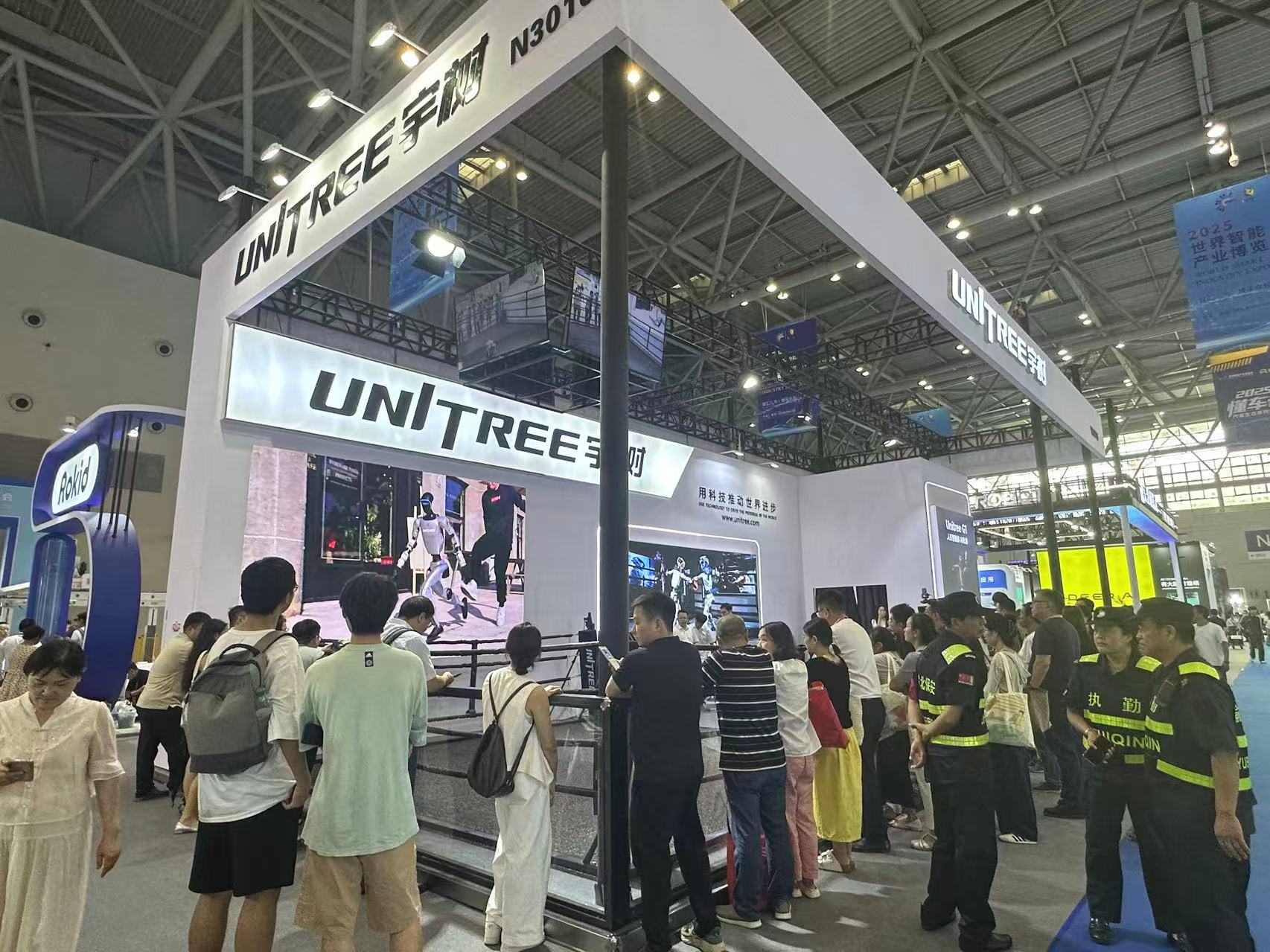
Group 1 - The 2025 World Intelligent Industry Expo (智博会) opened in Chongqing, focusing on "Artificial Intelligence+" and "Intelligent Connected New Energy Vehicles" [1] - Investment project contracts signed during the event exceeded 200 billion yuan, with over 120 billion yuan in concentrated on-site contracts [1] - Key projects include the Wanfu Aotexi Western Low-altitude Economy Base Project, Geely Technology Industry Manufacturing Project, and Huqing Semiconductor Material Production and Packaging Project [1] Group 2 - The expo featured five major sectors: Intelligent Connected New Energy Vehicles, Digital Cities, Intelligent Robots, Low-altitude Economy, and Smart Home, with over 550 domestic and international companies showcasing more than 3,000 innovative products across an exhibition area of over 100,000 square meters [1] - Local companies such as Yushu Technology, Yundongchu, Qiangnao Technology, and Qunhe Technology participated in the expo [1][3][4][5][6] Group 3 - Seven Teng Robotics, a local company, showcased third-generation explosion-proof quadruped and wheeled robots, focusing on emergency safety [11] - The company is exploring embodied intelligence in industrial chemical scenarios, utilizing Huawei's Ascend AI platform for its inspection robots [13] - Huawei's exhibition highlighted smart governance, smart economy, and smart society practices, along with core technologies like AI and ICT [13] Group 4 - The Sairus Group, a local enterprise, presented its exhibition area of over 10,000 square meters, featuring new energy vehicle products and advanced technologies [14] - Sairus demonstrated its "Automotive Industry Brain" ecosystem, showcasing a smart factory with over 3,000 robots and 100% automation in key processes [18] - The chairman of Sairus emphasized the profound impact of AI technology on the automotive industry across product forms, production methods, management models, and business logic [20] Group 5 - Tencent set up an interactive experience area featuring robots powered by its TAIROS platform, which integrates various AI models for industrial applications [20][22] - Major telecom operators, including China Telecom, China Mobile, and China Unicom, participated in the expo, showcasing advancements in AI and low-altitude economy services [22][25] - China Telecom's exhibition focused on cloud computing, AI, quantum technology, and digital industrial applications, with a notable computing power scale of 866 PFLOPS established by 2025 [23][26]





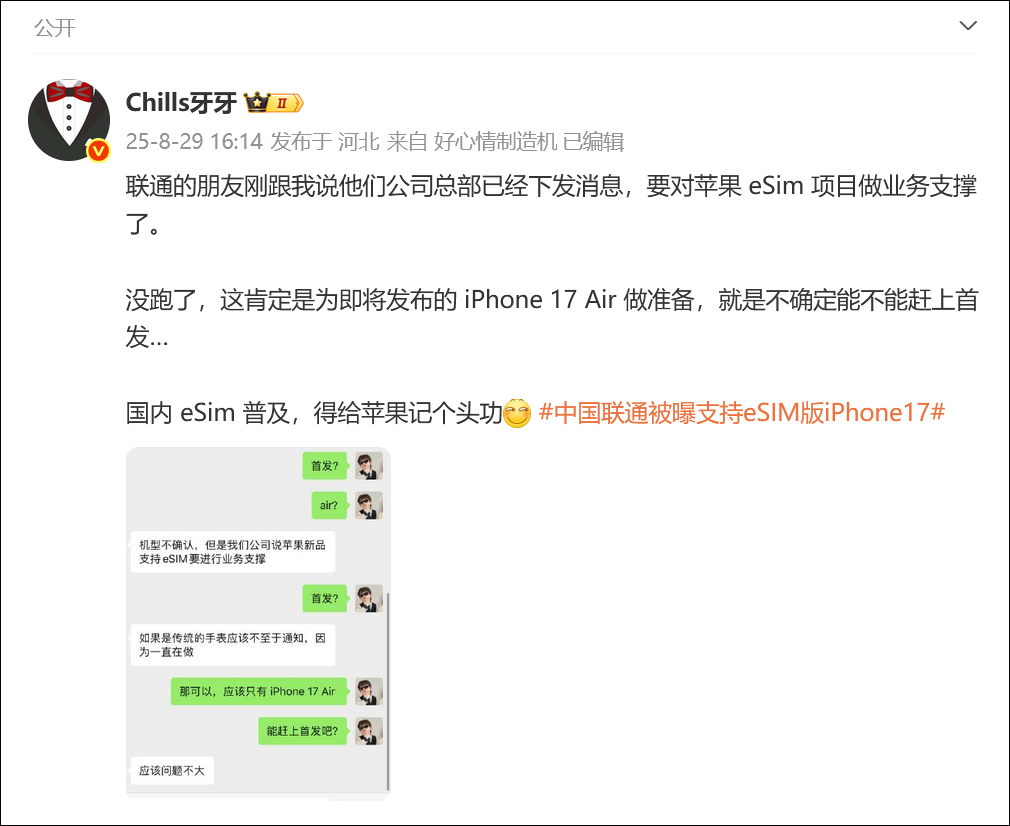
曝中国联通将支持eSIM版iPhone17
Guan Cha Zhe Wang· 2025-09-05 11:45
Core Viewpoint - Recent reports indicate that China Unicom has issued a notice to support the eSIM project for Apple, suggesting that eSIM functionality may soon be available for the Chinese version of Apple phones [1][3]. Group 1: China Unicom's eSIM Support - China Unicom has confirmed plans to support eSIM for the upcoming iPhone models, although it remains uncertain if the iPhone 17 series will completely lack a physical SIM card slot [3]. - Unicom staff mentioned that they are preparing for eSIM operations, but specific details and timelines are pending further notifications [3]. Group 2: eSIM Technology Overview - eSIM technology allows for embedded digital SIM capabilities, eliminating the need for physical SIM cards and enabling remote configuration for network connectivity, thus saving internal device space [3]. - In the U.S., Apple has already removed the SIM card slot starting with the iPhone 14, but the technology has not been widely adopted in other regions until now [3]. Group 3: iPhone 17 Series Expectations - Reports suggest that only the iPhone 17 Air model may support eSIM, while other models will retain traditional SIM card slots, possibly due to design constraints [5]. - The iPhone 17 Air is marketed as "5.5mm ultra-thin," but its battery capacity is limited to 2800mAh, falling short of 3000mAh [5]. - Apple is set to hold its fall launch event on September 10, with the iPhone 17 series expected to go on pre-sale on September 12, although the launch of the eSIM-enabled iPhone 17 Air in China may face delays due to infrastructure readiness [5].

高位加仓?富时中国A50指数九月调仓名单一览
天天基金网· 2025-09-05 11:11
Core Viewpoint - The article discusses the quarterly review changes of the FTSE China A50 index announced by FTSE Russell, highlighting the inclusion and exclusion of specific stocks and the implications for investment funds tracking the index [5][6]. Group 1: Index Changes - Four stocks, including BeiGene, NewEase, WuXi AppTec, and Zhongji Xuchuang, will be added to the FTSE China A50 index, while China Nuclear Power, China Unicom, Guodian NARI, and Wanhua Chemical will be removed [5]. - The newly added stocks belong to the innovative drug and CPO sectors, while the removed stocks are from traditional industries such as utilities and telecommunications [5]. - The newly included stocks have shown significant price increases this year, with NewEase and Zhongji Xuchuang rising over 200%, and BeiGene and WuXi AppTec around 90% [5]. Group 2: Market Impact - The estimated size of passive funds tracking the FTSE China A50 index exceeds $10 billion, indicating that changes in constituent stocks can lead to substantial capital flows, potentially in the hundreds of millions to billions [5]. - Investors have raised concerns about the inclusion of stocks perceived as overvalued and whether this adjustment is a strategy for foreign capital to take over high-priced stocks [6]. - The adjustment is based on market capitalization and liquidity criteria, with the review conducted quarterly, using data from the third Friday of February, May, August, and November [6].






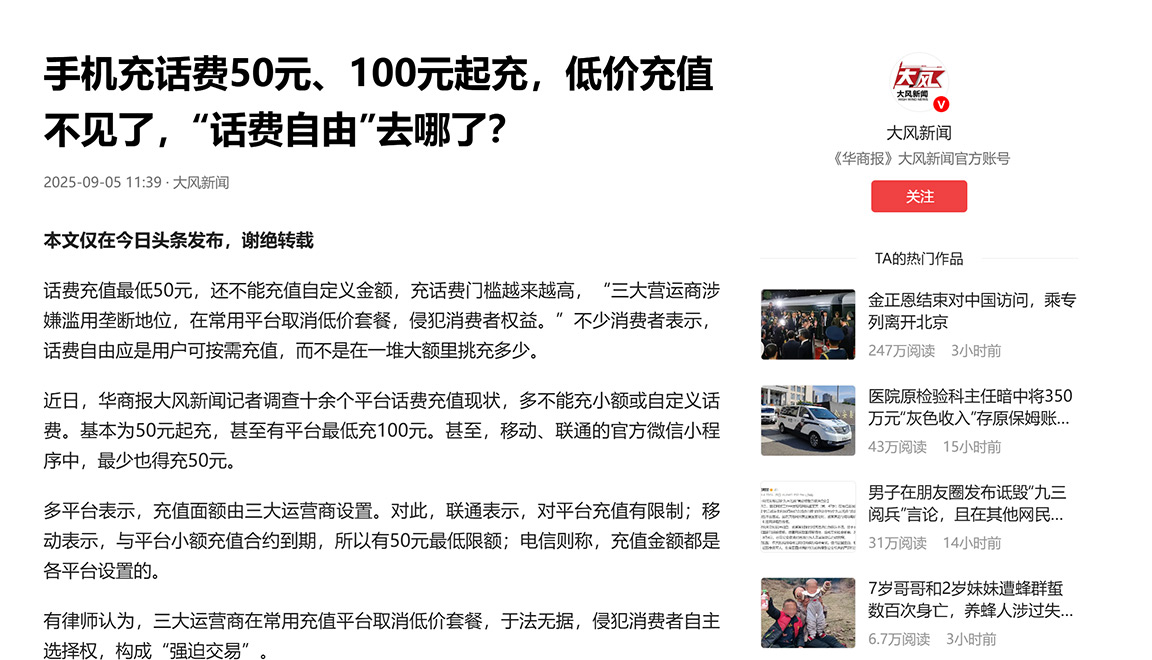
“充话费自由”去哪了?
Guan Cha Zhe Wang· 2025-09-05 09:54
Core Viewpoint - Recent changes in mobile recharge platforms have eliminated small denomination options like 10 yuan and 20 yuan, raising the minimum recharge amount to 50 yuan or even 100 yuan, which restricts consumer flexibility and autonomy in managing their communication expenses [1][3][8] Group 1: Consumer Impact - The increase in minimum recharge amounts disregards the basic rights and diverse needs of Chinese consumers, particularly affecting students and elderly users who typically require lower amounts for their communication needs [3][10] - Users who previously managed their expenses with small recharges now face a financial burden, as they are forced to pay larger sums upfront, which limits their financial flexibility [3][11] Group 2: Responsibility and Accountability - Payment platforms and telecom operators are deflecting responsibility for the new recharge limits, with each party blaming the other for the changes, indicating a lack of accountability in addressing consumer concerns [8][10] - Despite the technical capability to allow for custom recharge amounts, operators and platforms are unwilling to provide these options, suggesting a prioritization of profit over consumer rights [9][10] Group 3: Legal and Regulatory Considerations - The practice of setting high minimum recharge amounts may violate consumer protection laws, as it limits consumer choice and could be seen as a form of forced consumption [10][11] - Regulatory bodies are urged to investigate the situation thoroughly and take appropriate actions to ensure consumer rights are upheld, emphasizing the importance of consumer autonomy in the digital age [11]


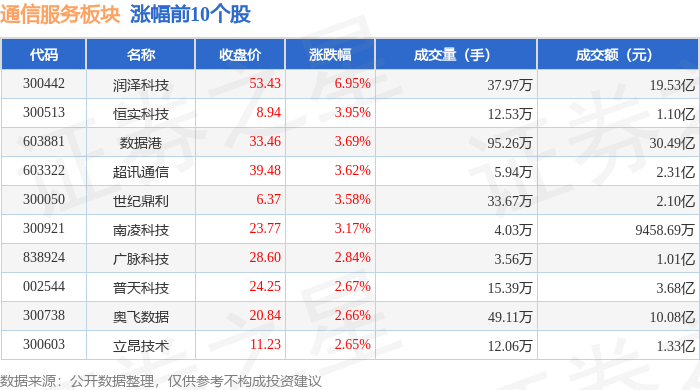
通信服务板块9月5日跌0.16%,三维通信领跌,主力资金净流出1.53亿元
Zheng Xing Xing Ye Ri Bao· 2025-09-05 09:07
Group 1 - The communication services sector experienced a decline of 0.16% on September 5, with Sanwei Communication leading the drop [1] - The Shanghai Composite Index closed at 3812.51, up 1.24%, while the Shenzhen Component Index closed at 12590.56, up 3.89% [1] - Notable gainers in the communication services sector included Runze Technology, which rose by 6.95% to a closing price of 53.43, and Hengshi Technology, which increased by 3.95% to 8.94 [1] Group 2 - Sanwei Communication saw a significant decline of 7.92%, closing at 11.05, with a trading volume of 3.1039 million shares and a transaction value of 3.444 billion [2] - Major players like China Telecom and China Mobile also experienced slight declines of 1.89% and 0.20%, respectively, with closing prices of 7.26 and 106.54 [2] - The communication services sector had a net outflow of 153 million in main funds, while retail investors saw a net inflow of 73.39 million [2]

通信行业资金流入榜:新易盛等10股净流入资金超亿元
Zheng Quan Shi Bao Wang· 2025-09-05 08:54
Market Overview - The Shanghai Composite Index rose by 1.24% on September 5, with 30 industries experiencing gains, led by the power equipment and communication sectors, which increased by 7.19% and 5.49% respectively [1] - The banking sector was the only industry to decline, with a drop of 0.99% [1] - Overall, there was a net inflow of 44.53 billion yuan into the market, with 20 industries seeing net inflows [1] Sector Performance - The power equipment industry had the highest net inflow of funds, totaling 21.02 billion yuan, contributing to its 7.19% increase [1] - The electronics sector also performed well, with a daily increase of 4.35% and a net inflow of 10.78 billion yuan [1] - Conversely, the retail trade sector saw the largest net outflow of funds, amounting to 1.595 billion yuan, followed closely by the banking sector with a net outflow of 1.553 billion yuan [1] Communication Industry Insights - The communication sector experienced a 5.49% increase, with a total net inflow of 1.249 billion yuan [2] - Out of 125 stocks in the communication sector, 115 rose, while 9 fell, including 1 that hit the daily limit down [2] - The top three stocks with the highest net inflow in the communication sector were Xinyi Technology (5.42 billion yuan), Runze Technology (3.14 billion yuan), and Zhongtian Technology (2.67 billion yuan) [2] Communication Sector Outflows - The communication sector also had notable outflows, with the top three stocks experiencing significant net outflows being Sanwei Communication (-4.53 billion yuan), China Unicom (-1.32 billion yuan), and Changxin Bochuang (-1.11 billion yuan) [3] - Sanwei Communication saw a decline of 7.92%, while China Unicom remained unchanged [3]


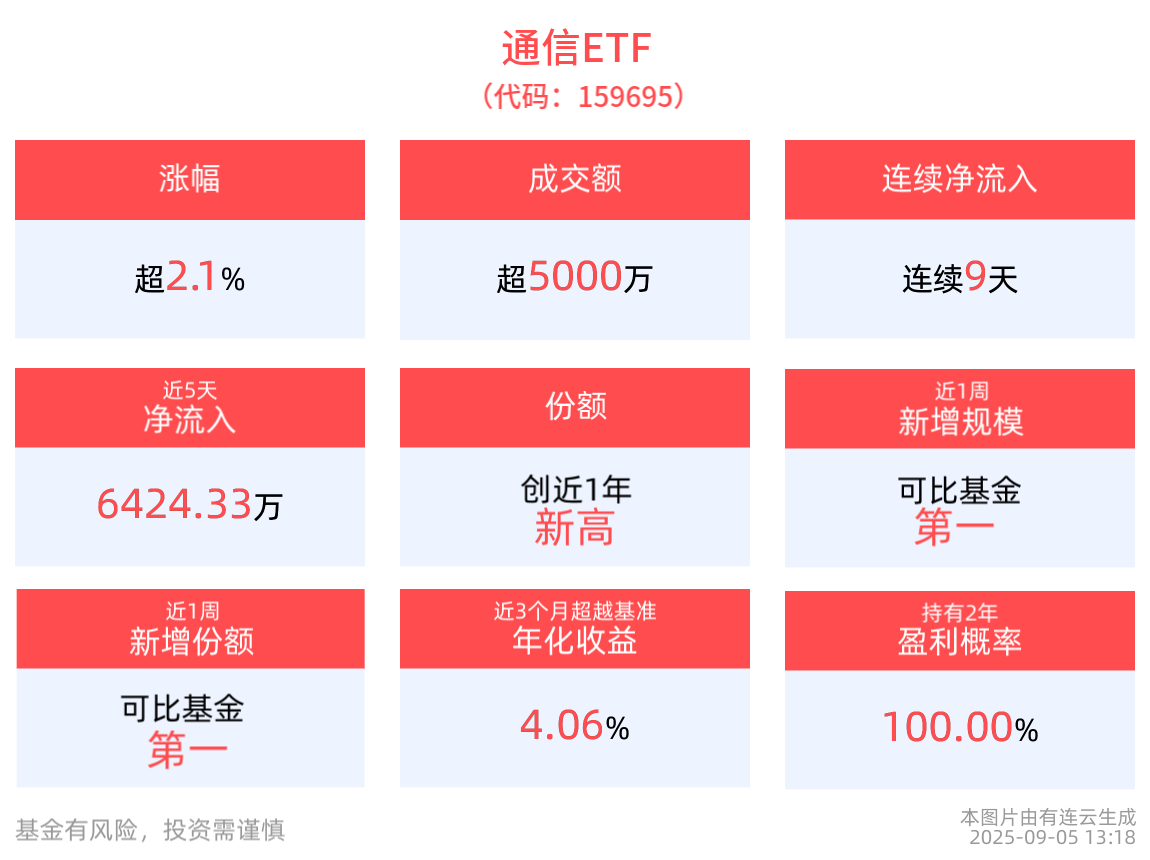
通信ETF(159695)午后上涨2.20%,近9天连续“吸金”超亿元
Xin Lang Cai Jing· 2025-09-05 06:05
Core Viewpoint - The communication sector is experiencing significant growth, with the National Communication Index rising by 1.90% and notable increases in individual stocks such as Dekoli and Zhongci Electronics [1][4]. Group 1: ETF Performance - The Communication ETF (159695) has increased by 2.20%, with a cumulative rise of 7.77% over the past two weeks as of September 4, 2025 [1][4]. - The ETF's trading volume was active, with a turnover rate of 23.05% and a transaction value of 57.993 million yuan [4]. - The ETF's scale grew by 31.8469 million yuan over the past week, ranking first among comparable funds, with the latest share count reaching 139 million, a one-year high [4]. Group 2: Financial Metrics - Leading optical module companies achieved a total revenue of 27.682 billion yuan in the first half of 2025, marking an 83.54% year-on-year increase, and a net profit of 8.837 billion yuan, up 127.88% [5]. - The gross margin for these companies was reported at 43.4%, with a net profit margin of 32.82% [5]. - The market for optical modules is expanding, with predictions indicating a 21% market share in Scale-up networks by 2030 [5]. Group 3: Key Stocks and Weightings - The top ten weighted stocks in the National Communication Index account for 64.43% of the index, with significant players including Xinyi, Zhongji Xuchuang, and ZTE [5]. - Notable stock performances include Zhongji Xuchuang rising by 3.35% and Xinyi increasing by 5.13%, while China Telecom and China Mobile saw declines of 2.03% and 0.35%, respectively [7].


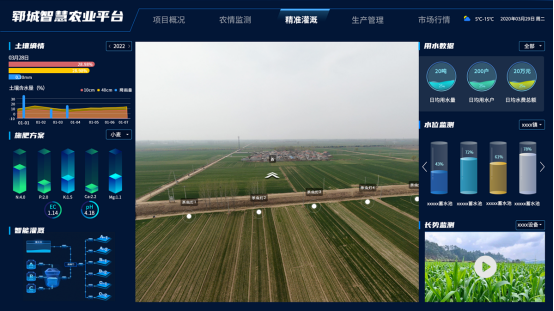
菏泽联通数字技术绘就智慧农业新图景
Qi Lu Wan Bao· 2025-09-05 03:18
Core Viewpoint - The article highlights the transformative impact of digital technology on traditional agriculture in Heze, showcasing how smart farming practices enhance productivity, efficiency, and consumer trust through data-driven solutions [1][3][8]. Group 1: Digital Transformation in Agriculture - The integration of IoT devices in Heze's agricultural fields has created a comprehensive monitoring network that collects vast amounts of data, enabling farmers to make informed decisions through the "Hui Zhong Tian APP" [3]. - The shift from traditional farming methods to data-driven practices has significantly improved agricultural productivity and risk management, marking a transition from "relying on the weather" to "working according to the weather" [3][5]. Group 2: Technological Innovations - The "Smart Watermelon Greenhouse" project utilizes AI algorithms and 5G technology to optimize the growing conditions for watermelons, resulting in a reduction of deformed fruit by over 20% and improved quality [5][6]. - The implementation of a full supply chain traceability system for watermelons enhances consumer trust by providing a unique "digital ID" for each fruit, allowing for complete transparency from seed to table [5][6]. Group 3: Market Connectivity and Economic Impact - The use of 5G networks in the asparagus industry in Heze facilitates real-time order processing and efficient supply chain management, leading to a significant increase in e-commerce orders [8]. - Heze's asparagus production accounts for 60% of the national market, with an annual output of 120,000 tons, supporting over 100,000 jobs in the region [8]. Group 4: Enhancing Farmers' Quality of Life - The "Digital Greenhouse" system allows farmers to remotely monitor and adjust environmental conditions, significantly improving operational efficiency and reducing stress [8]. - The digital applications in agriculture not only streamline production but also enhance the overall well-being and satisfaction of farmers, contributing to a sense of security and happiness in their work [8]. Group 5: Future Prospects - The company plans to continue advancing the application of 5G and IoT technologies in rural agriculture, aiming to inject more vitality into rural revitalization efforts [8].