China Spacesat(600118)

Search documents
调整不改热度,卫星产业ETF(159218)盘中成交额超4亿!太空淘金还行吗?
Sou Hu Cai Jing· 2026-01-19 04:16
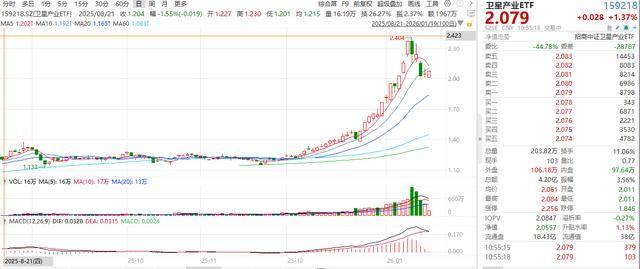
Core Viewpoint - The satellite industry ETF (159218) is experiencing a volatile upward trend, with trading volume exceeding 500 million yuan, indicating strong investor confidence in the long-term potential of the sector despite short-term fluctuations [1]. Group 1: Industry Developments - The commercial aerospace sector received a boost with Beijing Chuanweizhe's successful test of its manned spacecraft, which surpassed key performance indicators, marking a significant technological advancement and contributing to the maturation of the commercial aerospace industry chain [3]. - The National Space Administration has established a Commercial Aerospace Department, and the "2025-2027 High-Quality Safe Development Action Plan" aims to open national research projects and support the development of reusable rockets and smart satellites, indicating ongoing policy support for the industry [3]. - Local governments are also increasing support, with funds such as 4 billion yuan from Hainan and 500 million yuan from Jiuquan being allocated, alongside the accelerated construction of various rocket assembly bases and the implementation of launch subsidies and tax incentives [3]. Group 2: Market Dynamics - The recent adjustments in the commercial aerospace sector are viewed as temporary, with multiple driving factors suggesting that the market is merely taking a "midway break" rather than reaching the end of its growth cycle [3]. - The satellite industry ETF closely tracks the CSI Satellite Industry Index, which is considered the purest index for commercial aerospace, covering the entire industry chain including satellite communication, navigation, remote sensing, and aerospace materials, with the top ten weighted stocks accounting for over 64% of the index [4].


行业点评报告:美欧格陵兰岛博弈升温,商业航天发射密集
KAIYUAN SECURITIES· 2026-01-18 14:44
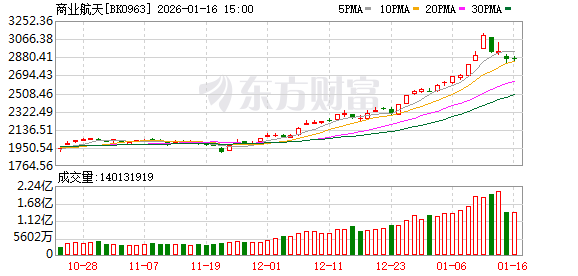
Investment Rating - The industry investment rating is "Positive" (maintained) [1] Core Views - The defense and military industry is currently experiencing a significant increase in demand, driven by geopolitical tensions and advancements in commercial aerospace technology [6][7] - The military index has shown strong performance, with an 8.04% increase over the past two weeks, outperforming the Shanghai and Shenzhen 300 index by 5.84 percentage points [5][14] - The current price-to-earnings ratio (PE-TTM) for the military sector is 85.05 times, indicating a relatively high valuation compared to historical levels [24] Summary by Sections Industry Performance - The military index has ranked 6th among 31 industries over the past two weeks, with aerospace equipment showing the best performance, increasing by 12.28% [15][19] - Year-to-date, the military index has risen by 45.10%, significantly outperforming the Shanghai and Shenzhen 300 index, which increased by 20.25% [16] Valuation - The military sector's current PE-TTM of 85.05 is at the 79.43 percentile since early 2015, reflecting a rise from 78.44 two weeks prior [24][25] - The sector is expected to see a recovery in fundamentals as the "14th Five-Year Plan" becomes clearer, suggesting high allocation value for the military sector [24] News Dynamics - Geopolitical tensions are escalating, particularly regarding Greenland and the Middle East, which may further drive demand for military products [6][26][28] - Significant advancements in commercial aerospace, including successful satellite launches and developments in reusable rocket technology, are expected to enhance the industry's growth prospects [7][31][32] Notable Stocks - Key beneficiaries in the military sector include companies involved in aerospace, satellite payloads, and materials manufacturing, such as Aerospace Power, Guolian Aviation, and China Satellite [9]




基金投资价值分析:招商中证卫星产业ETF投资价值分析:一键精准布局卫星全产业链
Guoxin Securities· 2026-01-18 12:36
- The CSI Satellite Industry Index (931594.CSI) selects up to 50 listed companies involved in satellite manufacturing and launching, ground equipment manufacturing, satellite navigation, satellite communication, and other related technological R&D and applications to reflect the overall performance of the satellite industry securities market [29][64] - The index's industry distribution is highly concentrated in the national defense and military industry, with a weight of 59.26%, followed by electronics (11.94%) and computers (11.49%) [31][64] - The index's R&D expenditure ratio is significantly higher than the overall market and the CSI Commercial Satellite Communication Industry Index, with 38% of its constituent stocks having an R&D expenditure ratio exceeding 20% [37][64] - The CSI Satellite Industry Index's 2024 revenue growth rate is projected at 18.12%, with expected growth rates of 11.23%, 15.9%, and 20.76% for 2025, 2026, and 2027, respectively. Net profit growth rates for 2025, 2026, and 2027 are estimated at 222.01%, 48.86%, and 32.34%, respectively [41][64] - Over the past year, the index achieved a return of 121%, with a one-month return of 53%, outperforming the CSI Commercial Satellite Communication Industry Index. It also demonstrated lower drawdown levels, showcasing better risk-return characteristics [50][64] - The index's compilation rules mandate that the combined weight of the satellite manufacturing and launching sectors must not fall below 50%, aligning with the current development phase of the industry, especially amid favorable conditions for rocket launches and satellite manufacturing [29][54][64]
招商中证卫星产业ETF投资值分析:键精准布局卫星全产业链
Guoxin Securities· 2026-01-18 07:17
- The **CSI Satellite Industry Index (931594.CSI)** selects up to 50 listed companies involved in satellite manufacturing and launching, ground equipment manufacturing, satellite navigation, satellite communication, and other related technological R&D and applications to reflect the overall performance of the satellite industry securities market [29][64] - The index's industry distribution is highly concentrated in the defense and military sector, with a weight of 59.26%. The proportion of constituent stocks with R&D expenditure exceeding 20% is 38%, which is significantly higher than the overall market level and the CSI Commercial Satellite Communication Industry Index [31][37][64] - The index's revenue growth rate for 2024 is projected at 18.12%, with expected growth rates for 2025, 2026, and 2027 at 11.23%, 15.9%, and 20.76%, respectively. Net profit growth rates for 2025, 2026, and 2027 are estimated at 222.01%, 48.86%, and 32.34%, respectively [41][64] - Over the past year, the index achieved a return of 121%, with a one-month return of 53%, outperforming the CSI Commercial Satellite Communication Industry Index. Additionally, it demonstrated lower drawdown levels, showcasing better risk-return characteristics [50][51][64] - The index's compilation rules mandate that the combined weight of the "satellite manufacturing + launching" foundational sectors must not be less than 50%, aligning with the current development phase of the industry amidst continuous favorable news in rocket launches and satellite manufacturing [29][54][64]
一键精准布局卫星全产业链——招商中证卫星产业ETF投资价值分析:基金投资价值分析
Guoxin Securities· 2026-01-18 07:10
- The CSI Satellite Industry Index (931594.CSI) selects no more than 50 listed companies involved in satellite manufacturing and launching, satellite ground equipment manufacturing, satellite navigation, satellite communication, and other technology R&D and application sectors to reflect the overall performance of listed companies in the satellite industry[29][64] - The index's industry distribution is mainly concentrated in the national defense and military industry, accounting for 59.26% of the weight, with electronic and computer industries accounting for 11.94% and 11.49%, respectively[31][64] - The index's constituent stocks have a higher R&D expenditure ratio compared to the overall market and the CSI Commercial Satellite Communication Industry Index, with 38% of constituent stocks having an R&D expenditure ratio exceeding 20%[37][64] - The CSI Satellite Industry Index's revenue growth rate for 2024 is 18.12%, with projected growth rates of 11.23%, 15.9%, and 20.76% for 2025, 2026, and 2027, respectively. The net profit growth rates for 2025, 2026, and 2027 are expected to be 222.01%, 48.86%, and 32.34%, respectively[41][64] - Over the past year, the CSI Satellite Industry Index achieved a return of 121%, with a 1-month return of 53%, outperforming the CSI Commercial Satellite Communication Industry Index. It also demonstrated lower drawdown levels and better risk-return characteristics[50][64] - The index's compilation scheme explicitly requires that the combined weight of the "satellite manufacturing + launch infrastructure sectors" should not be less than 50%, aligning with the current stage of industry development, especially with the recent favorable developments in rocket launches and satellite manufacturing[54][64]
澄清业务情况 多家商业航天概念公司回应
Zhong Guo Zheng Quan Bao· 2026-01-18 03:42
Group 1 - Several listed companies categorized under the commercial aerospace concept have recently issued announcements or statements clarifying their low association with commercial aerospace business and indicating that their stock prices have significantly deviated from fundamentals [2] - Since December 2025, some companies in the commercial aerospace sector have seen astonishing stock price increases, with Aerospace Development's stock rising over 200% in 30 consecutive trading days, triggering severe abnormal fluctuation standards [2] - Aerospace Development announced that its subsidiary engaged in low-orbit satellite operations generated less than 1% of the company's total revenue in the first three quarters of 2025, indicating minimal impact on overall performance [2] Group 2 - Companies such as Shaoyang Hydraulic clarified that their products do not directly serve commercial aerospace clients, with related orders being sporadic and amounting to less than 500,000 yuan, accounting for less than 0.2% of annual revenue [2] - Multiple companies, including Aerospace Power, North Navigation, Aerospace Engineering, Star Ring Technology, and Aerospace Changfeng, publicly stated that their main businesses do not involve commercial aerospace [2] - In response to investor inquiries, companies like Xingxing Technology and Jindi Co. expressed that they do not have current development plans in the commercial aerospace sector, while Keli Sensor and Bomin Electronics acknowledged their awareness of the commercial aerospace trend but have not established substantial commercial cooperation [3] Group 3 - The clarifications and risk warnings highlight a significant divergence between soaring stock prices and company fundamentals, with industry leader China Satellite reporting a rolling P/E ratio exceeding 2400 and a more than 96% year-on-year decline in net profit for 2024 after excluding non-recurring gains [5] - Companies like Aerospace Electronics and China Satcom also announced that their stock prices exhibit a "hot potato effect" and have severely detached from fundamentals, indicating a potential for significant short-term declines [5] - Market analysis suggests that while the long-term growth logic of the commercial aerospace industry is clear, short-term irrational speculation has inflated valuations of many stocks lacking substantial business support [5]


本周沪深两市成交额超17万亿元,创历史单周新高
Zhong Guo Jin Rong Xin Xi Wang· 2026-01-16 10:07
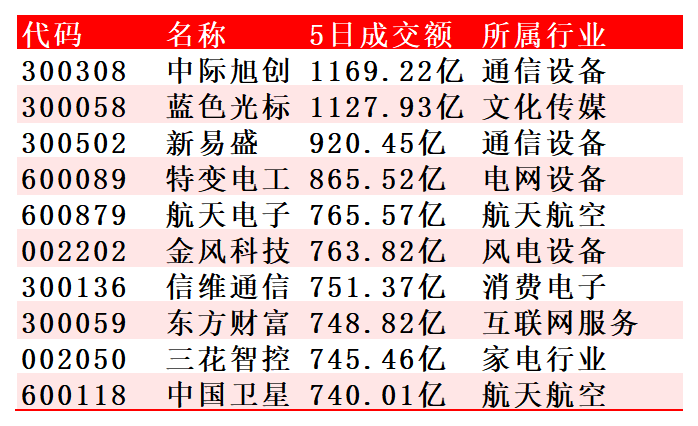
Group 1 - The A-share market experienced active trading this week, with total trading volume exceeding 17 trillion yuan, reaching 17.1 trillion yuan, setting a record for the highest weekly trading volume in history [1] - The average daily trading volume for the week was approximately 3.42 trillion yuan, marking the first time the average daily trading volume surpassed 3 trillion yuan [1] - The previous record for weekly trading volume was 14.8 trillion yuan, recorded during the week of August 25 to 29, 2025, with an average daily trading volume that did not exceed 3 trillion yuan [1] Group 2 - The stock with the highest trading volume this week was Zhongji Xuchuang, with a total trading volume of 116.922 billion yuan [2] - BlueFocus Media followed closely with a trading volume of 112.793 billion yuan, both stocks exceeding 100 billion yuan in trading volume for the week [2] - Other notable stocks in the top ten by trading volume included Aerospace Electronics, Goldwind Technology, China Satellite, and Xinwei Communication, all related to the commercial aerospace theme [1][2]



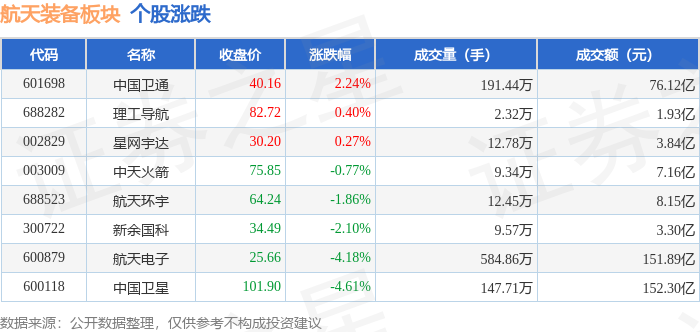
航天装备板块1月16日跌1.47%,中国卫星领跌,主力资金净流出28.11亿元
Zheng Xing Xing Ye Ri Bao· 2026-01-16 09:00
Core Viewpoint - The aerospace equipment sector experienced a decline of 1.47% on January 16, with China Satellite leading the drop, while the Shanghai Composite Index fell by 0.26% and the Shenzhen Component Index decreased by 0.18% [1] Group 1: Market Performance - The aerospace equipment sector's main stocks showed mixed performance, with China Satellite closing at 101.90, down 4.61%, and China Telecom rising by 2.24% to 40.16 [1] - The total net outflow of main funds in the aerospace equipment sector was 2.811 billion yuan, while retail investors saw a net inflow of 1.939 billion yuan [1] Group 2: Individual Stock Analysis - China Satellite had a significant net outflow of 1.729 billion yuan, accounting for 11.35% of its trading volume, while retail investors contributed a net inflow of 502 million yuan [2] - New Yu Guoke experienced a net outflow of 402 million yuan from main funds, with retail investors providing a net inflow of 446.85 million yuan, indicating strong retail interest [2] - The stock of Aerospace Electronics saw a net outflow of 570 million yuan from main funds, while retail investors contributed a net inflow of 438 million yuan [2]
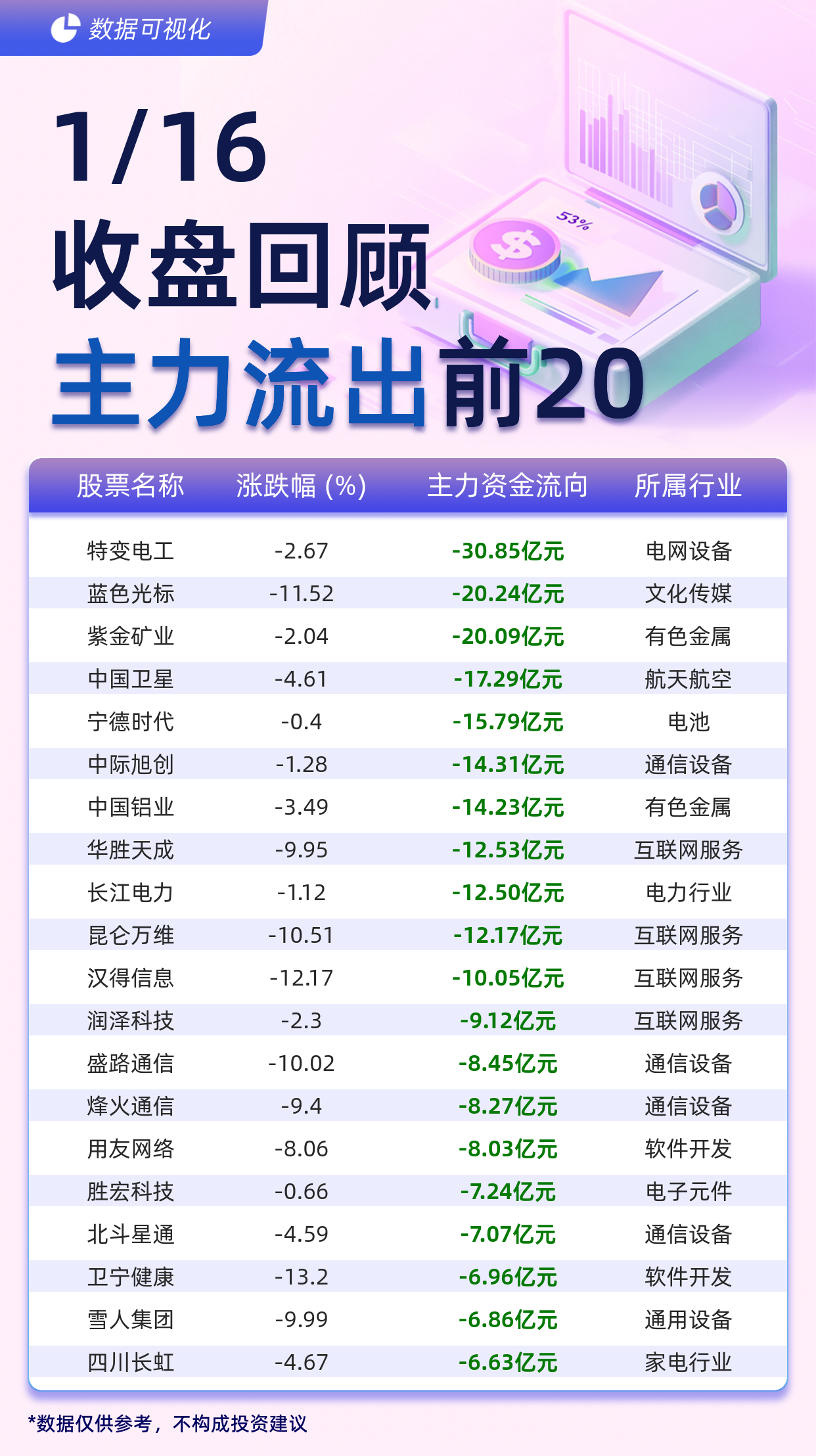
主力个股资金流出前20:特变电工流出30.85亿元、蓝色光标流出20.24亿元
Jin Rong Jie· 2026-01-16 07:40
Core Viewpoint - The data indicates significant outflows of capital from various stocks, with notable declines in share prices across multiple sectors, suggesting a bearish sentiment in the market. Group 1: Stock Performance and Capital Outflow - The top stock with the highest capital outflow is TBEA Co., Ltd. (特变电工), with an outflow of 3.085 billion yuan and a price drop of 2.67% [1][2] - BlueFocus Communication Group (蓝色光标) experienced a capital outflow of 2.024 billion yuan, with a significant price decline of 11.52% [1][2] - Zijin Mining Group (紫金矿业) saw an outflow of 2.009 billion yuan and a price decrease of 2.04% [1][2] - China Satellite Communications (中国卫星) had a capital outflow of 1.729 billion yuan, with a price drop of 4.61% [1][2] - Contemporary Amperex Technology Co., Ltd. (宁德时代) experienced an outflow of 1.579 billion yuan and a minor price decline of 0.4% [1][2] Group 2: Sector Analysis - The electric equipment sector, represented by TBEA Co., Ltd., shows a significant capital outflow, indicating potential challenges in this industry [2] - The cultural communication sector, represented by BlueFocus, is facing substantial capital withdrawal, reflecting investor concerns [2] - The non-ferrous metals sector, including companies like Zijin Mining and China Aluminum (中国铝业), is also experiencing notable outflows, suggesting a broader trend affecting commodity-related stocks [2][3] - The software development sector, represented by companies like Yonyou Network (用友网络) and Weining Health (卫宁健康), is witnessing significant capital outflows, indicating potential vulnerabilities in this area [3]



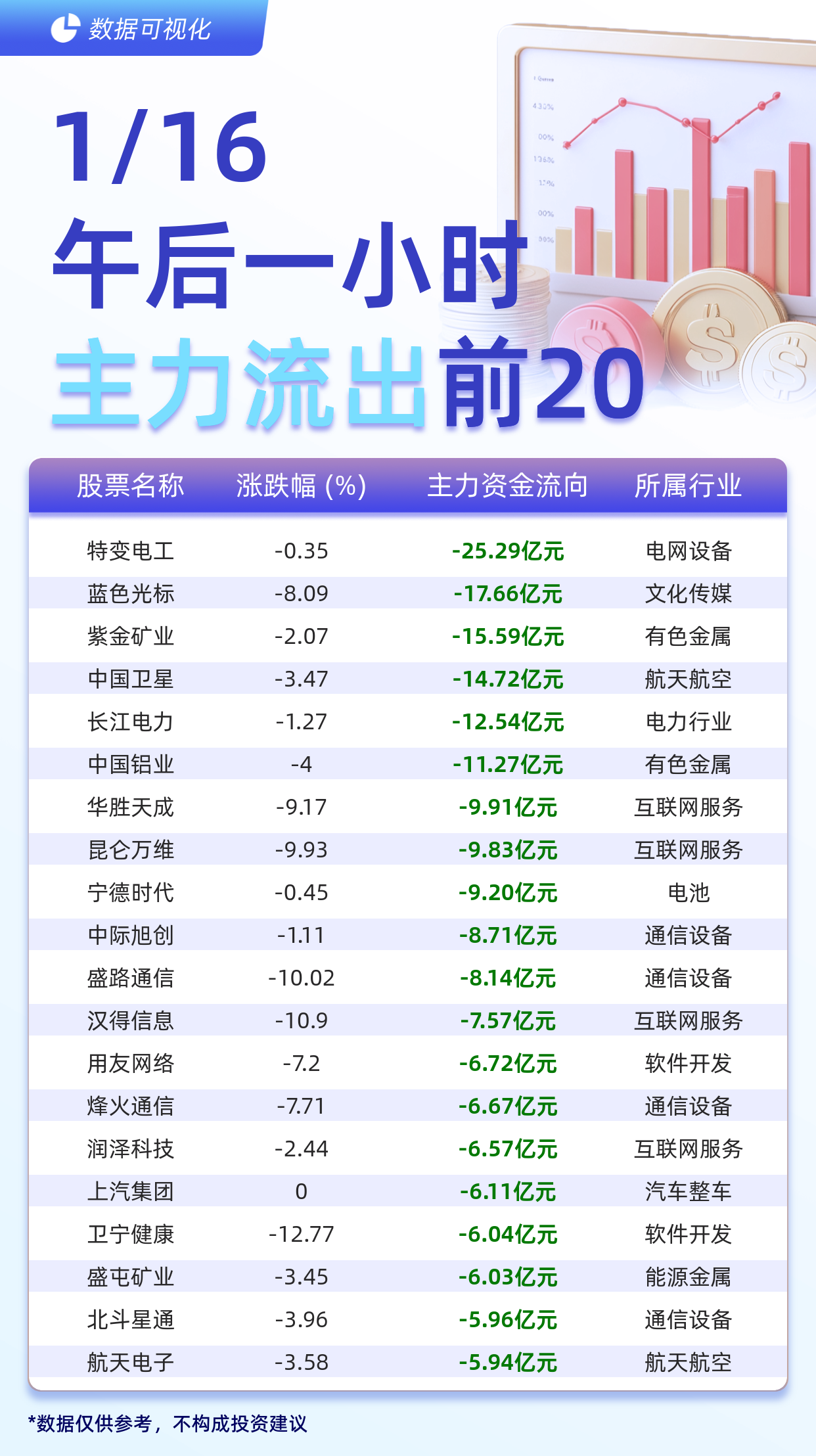
主力个股资金流出前20:特变电工流出25.29亿元、蓝色光标流出17.66亿元
Jin Rong Jie· 2026-01-16 06:38
Core Viewpoint - The data indicates significant outflows of capital from various stocks, with notable amounts leaving the market, suggesting a potential shift in investor sentiment and market dynamics [1][2][3] Group 1: Major Stocks with Capital Outflows - The stock with the highest capital outflow is TBEA Co., Ltd. (特变电工), experiencing a net outflow of 2.529 billion yuan, with a decline of 0.35% [2] - BlueFocus Communication Group Co., Ltd. (蓝色光标) follows with a capital outflow of 1.766 billion yuan and a drop of 8.09% [2] - Zijin Mining Group Co., Ltd. (紫金矿业) saw an outflow of 1.559 billion yuan, with a decrease of 2.07% [2] - China Satellite Communications Co., Ltd. (中国卫星) had a capital outflow of 1.472 billion yuan, down by 3.47% [2] - Yangtze Power Co., Ltd. (长江电力) experienced a 1.27% decline with an outflow of 1.254 billion yuan [2] Group 2: Sector Analysis - The electric power sector, represented by Yangtze Power, shows a capital outflow of 1.254 billion yuan, indicating potential concerns within the industry [2] - The non-ferrous metals sector, including companies like Zijin Mining and China Aluminum Corporation (中国铝业), is also facing significant outflows, with 1.559 billion yuan and 1.127 billion yuan respectively [2][3] - The internet services sector, represented by companies such as Huasheng Tiancheng (华胜天成) and Kunlun Wanwei (昆仑万维), shows substantial declines of 9.17% and 9.93% respectively, with outflows of 0.991 billion yuan and 0.983 billion yuan [2][3] Group 3: Additional Notable Stocks - Other companies with significant capital outflows include: - Ningde Times (宁德时代) with an outflow of 0.920 billion yuan and a decline of 0.45% [2] - Zhongji Xuchuang (中际旭创) with an outflow of 0.871 billion yuan and a decrease of 1.11% [2] - Han's Laser Technology Industry Group Co., Ltd. (汉得信息) with a capital outflow of 0.757 billion yuan and a drop of 10.9% [3]