
CBC(600132)

Search documents
重庆啤酒(600132) - 重庆啤酒股份有限公司2024年度内部控制评价报告
2025-04-02 12:31
公司代码:600132 公司简称:重庆啤酒 重庆啤酒股份有限公司 2024 年度内部控制评价报告 重庆啤酒股份有限公司全体股东: 根据《企业内部控制基本规范》及其配套指引的规定和其他内部控制监管要求(以下简称企业内 部控制规范体系),结合本公司(以下简称公司)内部控制制度和评价办法,在内部控制日常监督和专 项监督的基础上,我们对公司2024年12月31日(内部控制评价报告基准日)的内部控制有效性进行了 评价。 一. 重要声明 按照企业内部控制规范体系的规定,建立健全和有效实施内部控制,评价其有效性,并如实披露 内部控制评价报告是公司董事会的责任。监事会对董事会建立和实施内部控制进行监督。经理层负责 组织领导企业内部控制的日常运行。公司董事会、监事会及董事、监事、高级管理人员保证本报告内 容不存在任何虚假记载、误导性陈述或重大遗漏,并对报告内容的真实性、准确性和完整性承担个别 及连带法律责任。 公司内部控制的目标是合理保证经营管理合法合规、资产安全、财务报告及相关信息真实完整, 提高经营效率和效果,促进实现发展战略。由于内部控制存在的固有局限性,故仅能为实现上述目标 提供合理保证。此外,由于情况的变化可能导致内 ...

重庆啤酒(600132) - 重庆啤酒股份有限公司2024年非经营性资金占用及其他关联资金往来情况汇总表的专项审计报告
2025-04-02 12:31
关于重庆啤酒股份有限公司 非经营性资金占用及其他关联资金往来情况 汇总表的专项审计报告 目 录 1、 专项审计报告 2、 附表 委托单位:重庆啤酒股份有限公司 审计单位:天健会计师事务所(特殊普通合伙) 联系电话:0571-88216888 非经营性资金占用及其他关联资金往来情况的 专项审计说明 天健审〔2025 〕8-101 号 重庆啤酒股份有限公司全体股东: 我们接受委托,审计了重庆啤酒股份有限公司(以下简称重庆啤酒公司)2024 年度财务报表,包括 2024年 12 月 31 日的合并及母公司资产负债表,2024年度 的合并及母公司利润表、合并及母公司现金流量表、合并及母公司所有者权益变 动表,以及财务报表附注,并出具了审计报告。在此基础上,我们审计了后附的 重庆啤酒公司管理层编制的 2024 年度《非经营性资金占用及其他关联资金往来 情况汇总表》(以下简称汇总表)。 一、对报告使用者和使用目的的限定 本报告仅供重庆啤酒公司年度报告披露时使用,不得用作任何其他目的。我 们同意将本报告作为重庆啤酒公司年度报告的必备文件,随同其他文件一起报送 并对外披露。 重庆啤酒公司管理层的责任是提供真实、合法、完整的相 ...
重庆啤酒(600132) - 重庆啤酒股份有限公司第十届监事会第十三次会议决议公告
2025-04-02 12:30
证券代码:600132 证券简称:重庆啤酒 公告编号:临 2025-004 重庆啤酒股份有限公司 重庆啤酒股份有限公司第十届监事会第十三次会议通知于 2025 年 3 月 21 日发出, 会议于北京时间 2025 年 4 月 1 日下午 4 点在广州办公室以现场加视频会议的方式召开。 会议应出席监事 3 名,实际出席监事 3 名。本次会议由监事会主席匡琦先生主持。本次 会议的召开符合《公司法》及《公司章程》的规定,会议召开合法有效。经与会监事认真 审议,以书面表决方式审议通过了以下议案: 一、公司监事会 2024 年度工作报告; 表决结果:赞成 3 票,反对 0 票,弃权 0 票。 二、关于公司 2024 年计提事项的议案; 具体内容详见公司同日在上海证券交易所网站(www.sse.com.cn)披露的《重庆啤酒 股份有限公司关于 2024 年计提事项的公告》(公告编号:临 2025-005)。 表决结果:赞成 3 票,反对 0 票,弃权 0 票。 三、公司 2024 年年度报告及年度报告摘要; 具体内容详见公司于同日在上海证券交易所网站(www.sse.com.cn)披露的《重庆啤 酒股份有限公司 2024 ...
重庆啤酒(600132) - 重庆啤酒股份有限公司第十届董事会第二十次会议决议公告
2025-04-02 12:30
证券代码:600132 证券简称:重庆啤酒 公告编号:临 2025-003 重庆啤酒股份有限公司 第十届董事会第二十次会议决议公告 本公司董事会及全体董事保证本公告内容不存在任何虚假记载、误导性陈述或者重大遗漏,并对其 内容的真实性、准确性和完整性承担个别及连带责任。 重庆啤酒股份有限公司第十届董事会第二十次会议通知于 2025 年 3 月 21 日发出,会 议于北京时间 2025 年 4 月 1 日下午 2 点在广州办公室以现场加视频会议的方式召开。应出 席会议董事 9 名,实际出席会议董事 9 名。会议由董事长 João Abecasis 先生主持。公司监 事和高级管理人员列席了本次会议。本次会议的召开符合《中华人民共和国公司法》和《公 司章程》的规定,会议召开合法有效。经参与表决董事审议,以书面表决方式通过了以下议 案: 一、 关于公司 2024 年计提事项的议案; 具体内容详见公司同日在上海证券交易所网站(www.sse.com.cn)披露的《重庆啤酒股 份有限公司关于 2024 年计提事项的公告》(公告编号:临 2025-005)。 表决结果:赞成 9 票,反对 0 票,弃权 0 票。本议案已经公司 ...
重庆啤酒(600132) - 2024 Q4 - 年度财报
2025-04-02 12:30
Financial Performance - The company's operating revenue for 2024 was CNY 14,644,597,842.46, a decrease of 1.15% compared to 2023[23]. - The net profit attributable to shareholders for 2024 was CNY 1,114,593,043.58, down 16.61% from the previous year[23]. - The net profit attributable to shareholders after deducting non-recurring gains and losses was CNY 1,221,624,723.92, a decrease of 7.03% year-on-year[23]. - The net cash flow from operating activities for 2024 was CNY 2,542,046,725.49, reflecting a decline of 17.92% compared to 2023[23]. - The total assets at the end of 2024 were CNY 10,968,339,719.39, down 11.45% from the previous year[23]. - The net assets attributable to shareholders at the end of 2024 were CNY 1,185,220,264.01, a decrease of 44.62% compared to 2023[23]. - Basic earnings per share for 2024 decreased by 16.61% to CNY 2.30 compared to CNY 2.76 in 2023[24]. - The weighted average return on equity for 2024 was 60.17%, down 6.88 percentage points from 67.05% in 2023[24]. - The company reported a total cash balance of RMB 713,020.81, with RMB 76,048.59 frozen as collateral[90]. - The company reported a net profit of CNY 2,305,544,305.02 for the period, with operating income of CNY 14,644,597,842.46[116]. Dividends and Shareholder Returns - The company plans to distribute a cash dividend of CNY 0.90 per share for the 2024 fiscal year, totaling CNY 435,574,078.20[3]. - The total cash dividends distributed for the 2024 fiscal year will amount to CNY 1,161,530,875.20, which represents 104.21% of the net profit attributable to shareholders[3]. - The total cash dividends distributed over the last three accounting years amounted to CNY 3,774,975,344.40, with a cash dividend ratio of 304.86% based on the average annual net profit[177]. Operational Efficiency and Strategy - The company has 27 breweries and operates a centralized procurement model, enhancing operational efficiency across regions[70]. - The company aims to optimize its product structure and enhance brand diversification to address market competition[98]. - The company plans to enhance its product mix and sales models, focusing on the "international brand + local brand" strategy to optimize product structure[121]. - The company aims to accelerate the growth of high-end products and expand categories beyond beer, with a focus on growth markets and profitability in base markets[124]. - The company will continue to invest in modern channels, particularly convenience stores, to drive stable growth in 2025 through product structure optimization and new product launches[125]. Marketing and Brand Development - The company launched new products under various brands, including limited edition cans for the Carlsberg brand and new flavors for the Summer Fun brand[34][40]. - The company expanded its distribution network effectively, increasing the number of sales points through the "Big City 2.0 Project"[42]. - The U.S. brand signed local Olympic champions for endorsements, enhancing brand visibility and consumer engagement[44]. - The company engaged in various marketing activities, including collaborations with sports clubs and social media campaigns to boost brand awareness[36][38]. Environmental, Social, and Governance (ESG) Initiatives - The company improved its ESG rating from A to AA by MSCI, becoming one of only two companies in the food and beverage sector in A-shares to achieve this rating[54]. - The company achieved a 70% reduction in carbon emissions per hectoliter of beer compared to 2015, with a total reduction of 2,531 tons in 2024[56]. - The company recycled 100% of 1.67 million tons of spent yeast and 307,000 tons of spent grains in 2024, promoting a circular economy[56]. - The company improved its bottle return rate by 3.6% compared to 2022, recycling 31,346 tons of broken glass, equivalent to 125 million 330ml beer bottles[57]. - The company is committed to achieving net-zero emissions across the entire value chain by 2040 as part of its ESG initiatives[127]. Risk Management and Compliance - The company has implemented a hedging strategy to mitigate market risks associated with raw material price fluctuations, with a reported impact of CNY -11,287,155.44 on current profits from hedging settlements[113]. - The company actively respects and maintains the rights of stakeholders, including banks, employees, consumers, and suppliers, promoting mutual benefits[140]. - The company has implemented strict insider information management practices to prevent insider trading and ensure compliance with regulations[145]. - The company has committed to avoiding any potential competition with its controlling shareholder, Carlsberg, following a major asset restructuring completed at the end of 2020[146]. Workforce and Talent Management - The company employed a total of 6,861 staff, with 27 in the parent company and 6,834 in major subsidiaries[166]. - The workforce includes 1,883 production personnel, 3,066 sales personnel, and 1,403 technical personnel[167]. - The company has a structured remuneration policy for independent directors, which was approved by the shareholders' meeting[157]. - The employee compensation policy is linked to the company's economic performance and business results, with annual incentive assessments for management[169]. Future Outlook - The company maintains a cautiously optimistic outlook for the macroeconomic and beer industry prospects in 2025, anticipating a favorable development environment despite challenges such as intensified competition and cost fluctuations[121]. - Future guidance indicates a focus on innovation and new product development to drive growth in the upcoming fiscal year[150]. - The company is actively exploring potential mergers and acquisitions to accelerate growth and market penetration[151].
重庆啤酒(600132) - 重庆啤酒股份有限公司关于2024年度利润分配方案的公告
2025-04-02 12:30
关于 2024 年度利润分配方案的公告 董事会及全体董事保证本公告内容不存在任何虚假记载、误导性陈述或者重大遗漏, 并对其内容的真实性、准确性和完整性承担个别及连带责任。 重要内容提示: 重庆啤酒股份有限公司(以下简称"公司"或"本公司")拟向全体股东派 发 2024 年度现金红利每股人民币 0.90 元(含税)。 本次年度利润分配以实施权益分派股权登记日登记的总股本为基数,具 体日期将在权益分派实施公告中明确。 在实施权益分派的股权登记日前公司总股本发生变动的,拟维持每股分 配比例不变,相应调整分配总额,并将在相关公告中披露。 本次年度利润分配方案需提交股东大会审议后方可实施。 证券代码:600132 证券简称:重庆啤酒 公告编号:临 2025-006 重庆啤酒股份有限公司 本公司不触及《上海证券交易所股票上市规则(2024 年 4 月修订)》第 9.8.1 条第一款第(八)项规定的可能被实施其他风险警示的情形。 一、利润分配方案的内容 (一)利润分配方案的具体内容 截至 2024 年 12 月 31 日,公司母公司报表中期末未分配利润为人民币 995,551,815.53 元。经董事会决议,公司 2024 ...
重庆啤酒去年营收146.45亿元,高档产品销量占比升至48.9%,非现饮渠道借罐装实现份额增长
Cai Jing Wang· 2025-04-02 11:57
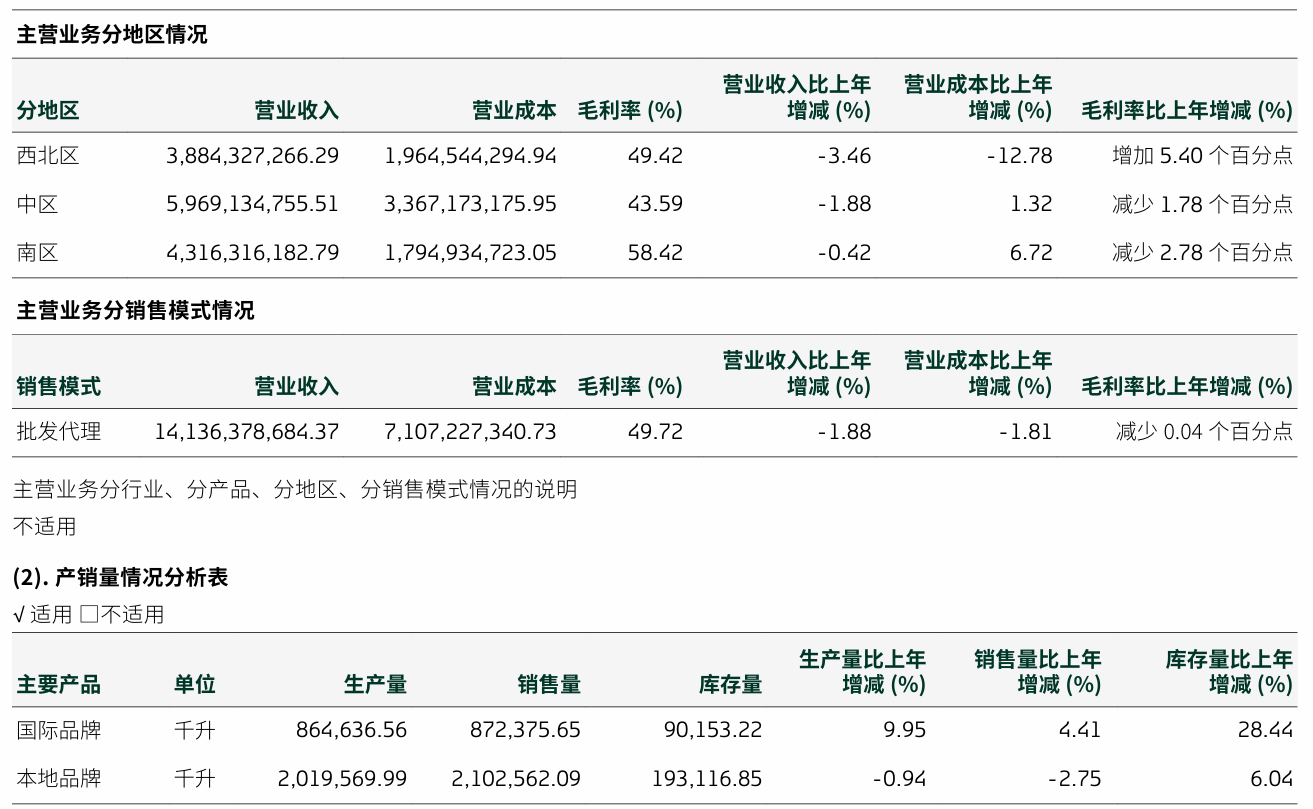
4月2日,重庆啤酒发布2024年财报。披露公司去年营收下滑1.15%至146.45亿元,归母扣非净利润减少7.03%至12.22亿元。营业利润31.85亿元。啤酒业务毛利率49.71%,每百升营 收492元,加权平均净资产收益率达60.17%。 公司全年啤酒销量达297.49万千升,实现了领先行业的稳健表现。其中,高档产品(8元及以上)销量为145.72万千升,同比增长1.37%,占比提升至48.9%。 分品牌统计,国际品牌收入增长0.58%至53.08亿元,本地品牌收入减少3.3%至88.62亿元。 | | | | | 营业收入比上年 | 营业成本比上年 | | | --- | --- | --- | --- | --- | --- | --- | | 分地区 | 营业收入 | 营业成本 毛利率(%) | | 增减 (%) | 増減 (%) | モ | | 西北区 | 3,884,327,266.29 | 1,964,544,294.94 | 49.42 | -3.46 | - 12.78 | | | 中区 | 5,969,134,755.51 | 3,367,173,175.95 | 43.59 | - ...

啤酒竞争格局生变:龙头倒退,黑马紧追
21世纪经济报道· 2025-03-31 05:49
Core Viewpoint - The beer industry in China is experiencing a decline in sales volume, with major players facing challenges, while some smaller brands are showing growth in both sales and profitability [1][2][4]. Sales Performance - In 2024, major beer companies in China reported sales volume changes: Budweiser APAC down 11.8%, Qingdao Beer down 5.86%, China Resources Beer down 2.5%, Chongqing Beer down 0.75%, Yanjing Beer up 1.6%, and Zhujiang Beer up 2.62% [2][4]. - The overall beer production in China decreased by 0.6% in 2024, indicating a decline in consumer sentiment towards daily fast-moving consumer goods [2]. Market Dynamics - The gap in market share among major players has narrowed, with leading companies like China Resources, Qingdao, and Budweiser all experiencing declines in revenue and sales, while Yanjing and Zhujiang have continued to grow beyond industry levels [4]. - Zhujiang Beer saw a nearly 37% increase in net profit, while Yanjing Beer’s net profit surged by over 50% [4]. Premiumization Trends - Yanjing Beer achieved total sales exceeding 4 million kiloliters in 2024, with its flagship product Yanjing U8 selling close to 700,000 kiloliters, marking a growth rate of over 30% for two consecutive years [5]. - Zhujiang Beer reported a nearly 14% increase in sales of high-end beer products in 2024 [5]. Challenges for Leading Brands - Budweiser APAC faced a 1.4% decline in revenue per hectoliter in China, while Qingdao Beer’s sales of mid-to-high-end products dropped by 2.65% [6]. - Despite overall revenue and sales declines, leading beer companies emphasize that their premium products continue to grow, with China Resources Beer reporting that mid-range and above beer sales exceeded 50% of total sales for the first time [7]. Pricing and Profitability - The ton price for major brands in 2024 was as follows: China Resources Beer over 3,300 yuan, Qingdao Beer over 4,200 yuan, Budweiser APAC over 5,300 yuan, Chongqing Beer over 5,200 yuan, while Yanjing and Zhujiang Beer were around 3,100 yuan and 3,800 yuan respectively [9]. - Despite slight revenue declines, China Resources and Qingdao Beer still reported revenues exceeding 36 billion yuan and 32 billion yuan respectively, indicating a significant lead over smaller competitors [11]. Future Outlook - The beer industry, while facing volume declines, still has potential for slow growth if price increases can outpace volume decreases [11].



毁约变脸,一审被判赔3.5亿元:嘉士伯败北背后,谁在收割民族品牌红利?
商业洞察· 2025-03-29 09:35
以下文章来源于深氪新消费 ,作者朱末 深氪新消费 . 深氪新消费成立于2016年,聚焦新经济,关注新消费、新零售等领域的商业进化。 作者:朱末 来源:深氪新消费(ID:xinshangye2016) 围绕山城啤酒的包销纠纷事件,有了新进展。 日前,重庆啤酒(600132.SH)公告了重庆市第五中级人民法院对公司与重庆嘉威啤酒有限公 司(以下简称"重庆嘉威")合同纠纷案的一审判决结果,法院判决重庆啤酒赔偿重庆嘉威损失 3.5亿元。 针对这个判决,3月14日,重庆啤酒的控股股东嘉士伯发表了一篇5000字长文,直言一审判 决"显失公正",且详细披露了与重庆嘉威之间合作的来龙去脉,对重庆嘉威此前提出的"雪 藏"山城品牌的说法进行否认。 很快,重庆嘉威针对嘉士伯的多个观点进行反驳。 嘉威表示,虽然嘉士伯、重啤的声明言辞激烈,但与历史、与事实、与双方合作协议严重不 符,并从合作关系定性、"山城"品牌使用期限、"山城"啤酒品牌被边缘化等八个方面针对嘉士 伯中国此前声明的关键点一一做出有力的回击。 回顾两方的声明,"山城"啤酒是诉讼源头。早年间,重庆啤酒通过注入"山城"商标使用权,获 得重庆嘉威33%股份,双方还签订了为期2 ...
啤酒行业系列报告(一):高端化进入中场,大单品规模初成
Guohai Securities· 2025-03-27 09:34
Investment Rating - The report does not explicitly state an investment rating for the beer industry, but it discusses the high-end market growth and potential investment opportunities in this segment. Core Insights - The high-end beer market in China has entered a mid-stage of development, with significant growth in large single products and an expanding premium price segment [3][9]. - The report predicts a slowdown in the high-end trend from 2023 to 2024, with an optimistic CAGR of 7.33% for beer prices in China from 2022 to 2027 [4][6]. - The overall beer market has stabilized, with low-price competition failing to generate growth, making high-end upgrades the long-term driver for price increases in the industry [5][9]. Summary by Sections Industry Price and Volume Review - The beer industry in China has undergone three phases: growth (2000-2012), contraction (2013-2017), and a decline in production (2018-2023) [11][24]. - During the growth phase, revenue increased from 446 billion to 1612 billion CNY, with a CAGR of 11.3% driven by volume growth [11]. - The contraction phase saw a slight decline in revenue, with a CAGR of -0.7%, as low-end price wars failed to yield significant market share [11][24]. - The current phase (2018-2023) is characterized by a focus on high-end products, with revenue growth returning to 1863 billion CNY, reflecting a CAGR of 4.8% [11][24]. High-End Market Review - The high-end market has expanded significantly, with major domestic manufacturers developing large single products that have reached scales exceeding 400,000 tons [3][9]. - The competition in the high-end segment remains dynamic, with the potential for major shifts in market share as brands establish their flagship products [3][9]. - The report emphasizes that the high-end market's growth is supported by an increase in middle-income consumers and urbanization, which enhances purchasing power [35][36]. Price Forecasting - The report forecasts that the average price of beer in China will grow at a CAGR of approximately 7.33% from 2022 to 2027, aligning with historical trends observed in the U.S. beer market [4][6][73]. - The price increase is attributed to structural upgrades in product offerings and the ability of manufacturers to implement price increases effectively [70][71]. Competitive Landscape - The competitive landscape has shifted from volume-based competition to brand strength and product differentiation, particularly in the high-end segment [80]. - The report notes that the high-end beer market is increasingly dominated by younger consumers who prioritize quality over price, indicating a shift in consumer preferences [38][43]. Long-Term Drivers - The core consumer demographic (ages 20-50) is identified as a long-term driver of beer consumption, with changes in consumer preferences and income levels influencing demand [19][22]. - The report highlights that the growth of the middle class and urbanization are critical factors supporting the transition to premium beer consumption [35][36].
