大单品

Search documents
霸王茶姬:困于“伯牙”?
3 6 Ke· 2025-12-03 13:57
Core Viewpoint - Bawang Chaji, a tea brand focusing on milk tea, has faced declining revenue and profits since its NASDAQ listing in April 2025, with a significant drop in same-store GMV and overall financial performance [1][4][5]. Financial Performance - In Q3 2025, Bawang Chaji reported a net revenue of 3.208 billion yuan, a 9.4% decrease from 3.541 billion yuan in Q3 2024, and a continuous decline from the previous two quarters [1][4]. - The company's operating profit for Q3 2025 was 454.4 million yuan, with an operating profit margin of 14.2%, down from 794.3 million yuan and 22.4% in the same quarter of 2024 [4]. - Adjusted net profit for Q3 2025 was 502.8 million yuan, a 22.23% decrease from 646.6 million yuan in Q3 2024, with a net profit margin of 12.4% [4]. Business Model and Market Strategy - Bawang Chaji's revenue from franchise tea houses in Q3 2025 was 2.8116 billion yuan, down from 3.299 billion yuan in the same quarter of 2024, attributed to price sensitivity among consumers due to delivery platform subsidy wars [1][4]. - The company has maintained a "big single product, high repurchase" strategy, focusing on its flagship product "Boya Juexian," which has generated significant sales but faces challenges in sustaining consumer interest without new product introductions [2][9]. Market Competition - The competitive landscape for new tea drinks has intensified, with brands like Heytea and Nayuki expanding into lower-tier cities and increasing competition [7]. - Bawang Chaji has rapidly opened stores, reaching a total of 7,338 locations by September 30, 2025, with 6,971 being franchise stores, which may dilute per-store revenue [7][20]. Product Development and Innovation - The company has been slow in product innovation, with only eight new products launched in 2025, including variations of its flagship product, which may hinder its ability to attract repeat customers [9][10]. - Bawang Chaji plans to enhance its product matrix and introduce a 4.0 menu to explore new consumption scenarios and improve brand experience [14]. International Expansion - Bawang Chaji has successfully expanded internationally, with 262 overseas stores as of Q3 2025, particularly in Southeast Asia, where it has seen a 75.3% year-over-year increase in overseas GMV [16][17]. - The brand has become popular in Malaysia, leveraging local partnerships and marketing strategies to achieve record sales [17]. Customer Engagement and Retention - The company has achieved 11 consecutive quarters of profitability, with a stable cash flow and no interest-bearing debt, indicating a healthy financial position despite domestic market challenges [20]. - As of September 30, 2025, Bawang Chaji had 222 million registered members, a 36.7% increase year-over-year, and a low store closure rate of 0.3% [20].
休闲零食赛道:从渠道变革到10亿级大单品之路
Di Yi Cai Jing· 2025-10-27 06:49
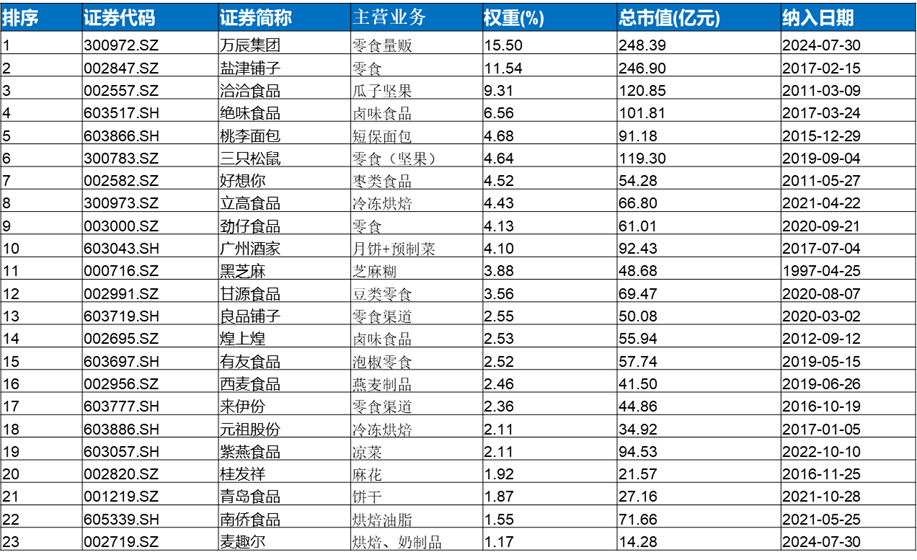
Overview of the Snack Food Sector - The A-share snack food sector has 23 companies, with Wancheng Group leading at a weight of 15.5% and a total market value of 24.8 billion [1][2] - The top 20 companies in the snack food sector have a combined market value of approximately 150 billion, significantly lower than the liquor sector, where Kweichow Moutai alone exceeds 2 trillion [2] Industry Characteristics - Snack foods are inherently less addictive compared to alcoholic beverages, and brands are still in the early stages of consumer recognition [3][5] - The snack food industry is characterized by high dependence on distribution channels, with traditional supermarkets shrinking at an annual rate of 8% [6][9] - The snack food sector has a market size exceeding 1 trillion, but the top ten companies only hold about 20% market share, much lower than the liquor and dairy sectors [7] Market Challenges - The snack food index has underperformed the overall consumer index from 2021 to 2024 due to three main pressures: shrinking traditional retail channels, low margins in bulk sales, and a price war leading to reduced profits [9][13] - The average price drop in the snack food industry reached 12% in 2023, with a corresponding 5% increase in sales volume, resulting in a profit squeeze [13] - Online price transparency has intensified competition, with leading companies experiencing a decline in online gross margins by 8-10 percentage points [13] Company Types and Performance - Domestic snack companies can be categorized into channel-based and product-based companies, with the former relying heavily on distribution channels and the latter focusing on product differentiation [14][16] - Product-based companies like Salted Fish and Jin Zai Food have shown faster growth, while channel-based companies like Liangpin Shop and Lai Yi Fen have faced significant declines [17] Case Studies - Three squirrels have seen a revenue rebound starting in Q4 2023, with Douyin channel revenue reaching 2.188 billion in 2024, a year-on-year increase of 81.7% [21] - However, they face challenges such as high traffic costs and low offline distribution margins, with a gross margin of only 15-18% [24] - Salted Fish's "Big Demon King" single product achieved over 100 million in monthly sales in March 2025, indicating successful product differentiation [42] Future Outlook - Channel-based companies should focus on cost-effective branding, while product-based companies should aim for super single products in niche categories [49] - The competition will increasingly involve both comprehensive snack brands and channel brands, necessitating a strong brand identity to withstand competition from private label products [49]

调研速递|劲仔食品接受投资者网上提问 9大要点解读
Xin Lang Cai Jing· 2025-09-22 08:20
Core Viewpoint - The company, Jinzhai Food, held a performance briefing on September 19, 2025, discussing various aspects such as channel development, R&D progress, and operational planning [1] Group 1: Channel Development and Marketing - The company adheres to a "big single product, all-channel" strategy, reinforcing traditional distribution channels while enhancing modern channel management and developing suitable products for emerging channels [1] - Marketing expenses are focused on improving core channel displays and brand recognition through offline efforts, while online strategies emphasize consumer communication [1] Group 2: R&D Progress and New Product Planning - The company maintains high R&D investment and has established multiple research platforms, launching several health snacks such as nitrogen-packed deep-sea anchovies rich in DHA [1] - New products are developed based on channel demands to support channel growth [1] Group 3: Operational Planning for the Second Half of the Year - The company plans to strengthen channel and brand development, enhance product quality, organizational capability, and supply chain efficiency [1] - Emphasis will be placed on increasing channel penetration and service capabilities, reinforcing the positioning of "delicious and healthy snacks" through word-of-mouth marketing [1] Group 4: Raw Material Costs and Supply Chain Management - The company leverages its geographical advantages for strategic inventory during the fishing season and expands global quality raw material bases for anchovies [1] - For quail eggs, the company optimizes the upstream supply chain to cultivate high-quality egg sources [1] Group 5: Volume Channel Development - The company collaborates with major snack specialty systems, experiencing rapid growth in volume channels in the first half of the year [1] - The focus remains on sustainable health development through product innovation, category upgrades, and deepened cooperation to enhance market expansion and profitability [1] Group 6: Overseas Market Planning - The company has established an international trade department, with products sold in over 30 countries and regions, employing a strategy that focuses on key areas, markets, and categories for overseas market development [1] Group 7: Performance and Stock Price Relationship - The company believes in a stable fundamental base with steady growth in major categories, aiming to enhance market scale through channel development and product innovation in the second half of the year [1] Group 8: Differentiated Upgrades in Poultry Products - The company plans to upgrade all products to "antibiotic-free" quail eggs, with the "seven doctors" soft-boiled quail eggs currently primarily available through online self-operated channels, with future plans for broader channel coverage [1]
劲仔食品(003000) - 003000劲仔食品投资者关系管理信息20250922
2025-09-22 07:50
Group 1: Marketing and Sales Strategy - The company adheres to a "big product, all-channel" development strategy, focusing on differentiated strategies for traditional and emerging channels to enhance terminal coverage [2] - Marketing expenses will be directed towards core channel displays and brand recognition, both online and offline, to adapt to changing consumer trends [3] - The company aims to strengthen channel construction and enhance service capabilities to ensure sustainable development across various channels [3] Group 2: Financial Performance - In the first half of the year, the company achieved revenue of CNY 1.124 billion and a net profit of CNY 112 million [7] - The company is implementing a share repurchase plan to stabilize stock prices amid market fluctuations [3] - The company’s gross margin is under pressure due to rising raw material costs, particularly for anchovies and quail eggs [4] Group 3: Research and Development - The company maintains high R&D investment, focusing on health-oriented products such as low-salt and preservative-free snacks [3] - New product launches include DHA-rich deep-sea fish and antibiotic-free quail eggs, aimed at enhancing market competitiveness [3] - The company is developing differentiated products to meet channel demands, including popular items like "Jingmen Explosive Belly" and "Zhou Shuangshuang" crispy marinated peanuts [3] Group 4: International Expansion - The company has established an international trade department to expand into over 30 countries, including Japan, Korea, and Southeast Asia [6] - The overseas revenue growth rate exceeded 40% in the first half of the year, although the base remains small [6] - The company is focusing on key regions and product categories for market development in international markets [6] Group 5: Competitive Positioning - The company is addressing industry competition in poultry products by upgrading to high-end, differentiated products like antibiotic-free quail eggs [7] - The market feedback for these new products is positive, with plans to expand their reach across more channels [7] - The company aims to leverage its core channels to enhance market scale and counteract negative impacts from industry price wars [7]
“大单品兑现”锚定百亿蓝海,艾美疫苗拥有确定性和成长性
Xin Lang Cai Jing· 2025-08-28 01:14
Core Viewpoint - The biotechnology sector in Hong Kong is experiencing a surge, with companies like Ai Mei Vaccine gaining significant attention due to their stable performance and innovative technologies [1] Group 1: Company Performance - Ai Mei Vaccine reported steady revenue growth for the first half of 2025, with key innovative products nearing market launch, leading to expectations of improved performance and valuation [1][2] - The company has four major innovative products entering the market, including the 13-valent pneumococcal conjugate vaccine, which has a significant market potential in China, projected to exceed RMB 20 billion by 2030 [2][3] Group 2: Product Development - Ai Mei Vaccine is advancing in the rabies vaccine sector with multiple products, including a serum-free rabies vaccine and an mRNA rabies vaccine, positioning itself as a leader in a market expected to reach RMB 20 billion by 2030 [3] - The company holds 20 vaccine candidates in development across 12 disease areas, with 23 clinical approvals and 24 clinical trials ongoing, including seven innovative vaccines [3] Group 3: Market Potential and Valuation - The 13-valent pneumococcal conjugate vaccine is anticipated to capture a significant market share, with a penetration rate in China estimated at 25.9%, compared to over 80% in the U.S., indicating substantial growth opportunities [2] - DBS Bank's report suggests that Ai Mei Vaccine's current stock price is at the lower end of its peers' valuation range, with a projected fair target price of HKD 8.3 per share by 2026, indicating a potential upside of nearly 600% [4]
泸州老窖(000568) - 000568泸州老窖投资者关系管理信息20250519
2025-05-19 11:15
Group 1: Industry Challenges and Recovery - The liquor industry is currently facing significant challenges due to a consumption environment impact, but there is potential for recovery as economic vitality is released [2][3] - The company believes that the domestic consumption capacity remains strong, supported by a complete industrial system and robust economic resilience [2] Group 2: Market Expansion Strategies - The company has developed the "Bay Area Light" product series to penetrate the Greater Bay Area market and has established strategic partnerships with various commercial organizations [2] - Future work will focus on expanding market presence, enhancing sales team capabilities, and ensuring channel profitability [3] Group 3: Product Development and Consumer Trends - The company is adapting to consumer demographic shifts, with a focus on low-alcohol products, which currently account for nearly 50% of the revenue from Guojiao 1573 [4] - The average age for heavy drinking consumption is around 28 years, with 85% of consumers over 50 preferring stability in their choices [3] Group 4: Brand Building and Marketing - The company has established a clear "dual brand, three product lines, and major products" branding strategy, significantly enhancing brand recognition and value [4] - The company plans to launch a co-branded liquor with "The Three-Body Problem" in June, indicating a focus on innovative marketing strategies [4] Group 5: Financial Performance and Shareholder Returns - The company has set a cash dividend plan for 2024-2026, ensuring that the total cash dividends will not be less than 65%, 70%, and 75% of the net profit attributable to shareholders, respectively, with a minimum of RMB 8.5 billion each year [4] - The company aims to maintain stable revenue growth during the industry adjustment period, with a focus on high-quality development [4] Group 6: Digital Transformation and Operational Efficiency - The company is leading digital transformation in the industry, shifting from a channel-driven strategy to a consumer-focused approach [5] - Emphasis on enhancing product digitalization and operational management capabilities to support precise marketing decisions [5]

啤酒行业系列报告(一):高端化进入中场,大单品规模初成
Guohai Securities· 2025-03-27 09:34
Investment Rating - The report does not explicitly state an investment rating for the beer industry, but it discusses the high-end market growth and potential investment opportunities in this segment. Core Insights - The high-end beer market in China has entered a mid-stage of development, with significant growth in large single products and an expanding premium price segment [3][9]. - The report predicts a slowdown in the high-end trend from 2023 to 2024, with an optimistic CAGR of 7.33% for beer prices in China from 2022 to 2027 [4][6]. - The overall beer market has stabilized, with low-price competition failing to generate growth, making high-end upgrades the long-term driver for price increases in the industry [5][9]. Summary by Sections Industry Price and Volume Review - The beer industry in China has undergone three phases: growth (2000-2012), contraction (2013-2017), and a decline in production (2018-2023) [11][24]. - During the growth phase, revenue increased from 446 billion to 1612 billion CNY, with a CAGR of 11.3% driven by volume growth [11]. - The contraction phase saw a slight decline in revenue, with a CAGR of -0.7%, as low-end price wars failed to yield significant market share [11][24]. - The current phase (2018-2023) is characterized by a focus on high-end products, with revenue growth returning to 1863 billion CNY, reflecting a CAGR of 4.8% [11][24]. High-End Market Review - The high-end market has expanded significantly, with major domestic manufacturers developing large single products that have reached scales exceeding 400,000 tons [3][9]. - The competition in the high-end segment remains dynamic, with the potential for major shifts in market share as brands establish their flagship products [3][9]. - The report emphasizes that the high-end market's growth is supported by an increase in middle-income consumers and urbanization, which enhances purchasing power [35][36]. Price Forecasting - The report forecasts that the average price of beer in China will grow at a CAGR of approximately 7.33% from 2022 to 2027, aligning with historical trends observed in the U.S. beer market [4][6][73]. - The price increase is attributed to structural upgrades in product offerings and the ability of manufacturers to implement price increases effectively [70][71]. Competitive Landscape - The competitive landscape has shifted from volume-based competition to brand strength and product differentiation, particularly in the high-end segment [80]. - The report notes that the high-end beer market is increasingly dominated by younger consumers who prioritize quality over price, indicating a shift in consumer preferences [38][43]. Long-Term Drivers - The core consumer demographic (ages 20-50) is identified as a long-term driver of beer consumption, with changes in consumer preferences and income levels influencing demand [19][22]. - The report highlights that the growth of the middle class and urbanization are critical factors supporting the transition to premium beer consumption [35][36].