
Xingfa Chem(600141)

Search documents
碳酸锂价格创一年新高!化工板块继续猛攻,化工ETF(516020)涨超2%!行业拐点将至?
Xin Lang Cai Jing· 2025-12-17 05:26
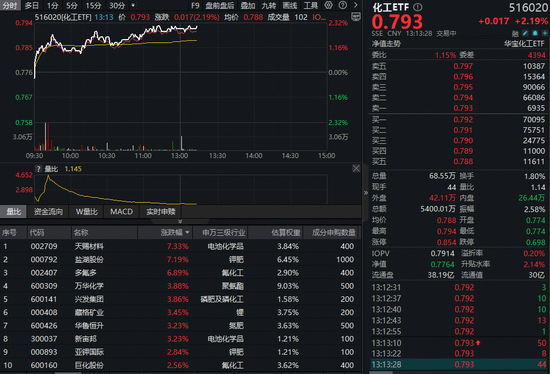
Core Viewpoint - The chemical sector is experiencing a strong upward trend, with the chemical ETF (516020) showing significant gains, particularly in lithium battery materials, potassium fertilizers, and fluorine chemicals [1][8]. Group 1: Market Performance - The chemical ETF (516020) opened with a steady increase, reaching a maximum intraday gain of 2.32% and closing with a gain of 2.19% [1][8]. - Key stocks in the sector, such as Tianqi Lithium and Salt Lake Potash, saw increases exceeding 7%, while other companies like Wanhu Chemical and Xingfa Group rose over 3% [1][8]. Group 2: Price Movements - Lithium carbonate prices rose by 1,170 CNY to 97,100 CNY per ton, marking a new high in over a year, with a cumulative increase of 4,440 CNY over the past five days [10]. - Lithium hydroxide prices increased by 1,100 CNY to 85,500 CNY per ton, also reaching a new high, with a five-day cumulative increase of 3,630 CNY [10]. Group 3: Valuation Insights - The chemical sector is currently viewed as having a favorable cost-performance ratio, with the chemical ETF's underlying index price-to-book ratio at 2.33, positioned at the 39.92 percentile over the past decade [3][10]. Group 4: Future Outlook - The demand for chemical products is expected to grow, driven by various industries including real estate, automotive, and textiles, despite anticipated pressure on real estate demand by 2025 [11]. - The chemical industry is transitioning from a phase of scale expansion to high-quality growth, aided by policy collaboration and self-regulation within the industry [11].





化工行业2026年度投资策略:周期破晓,关注反内卷政策与国产替代两大主线
Huaan Securities· 2025-12-17 02:53
Investment Strategy Overview - The report emphasizes two main investment themes for the chemical industry: anti-involution policies and domestic substitution, which are expected to drive recovery and growth in the sector [4][5][6] Anti-Involution and Cycle Recovery - The report suggests that the chemical industry is at a turning point, with anti-involution measures leading to a recovery in the cycle. Key areas include the peak of new capacity in organic silicon, the end of PTA capacity expansion, and a rebound in prices for certain chemicals due to supply chain disruptions [4][5] - The China Chemical Product Price Index (CCPI) has decreased significantly, dropping to 3865 points by November 30, 2025, down 16.37% from early 2024 and 10.71% from the beginning of 2025 [4][20] Domestic Substitution as a Growth Driver - Domestic substitution is highlighted as a key growth driver, with significant support from national policies for bio-based materials and advancements in technology leading to a more robust domestic supply chain [4][6] - The report identifies several companies positioned to benefit from these trends, including KaiSai Bio and RuiFeng New Materials, which are making strides in bio-based materials and lubricant additives, respectively [5][6] Market Dynamics and Price Recovery - The report notes that while the chemical market is experiencing a downturn, certain segments are expected to see price recovery due to improved supply-demand dynamics and reduced capacity expansion [4][22] - Specific chemical products have shown varied price movements, with some experiencing significant declines while others are stabilizing or recovering [22] Manufacturing Sector Recovery - The manufacturing sector is showing signs of recovery, which is anticipated to support the chemical industry. The report mentions that the real estate market is stabilizing, and automotive production has increased, indicating a potential uptick in demand for chemical products [25][33] Capital Expenditure Trends - Capital expenditure growth in the chemical industry is slowing, with a notable decline in new projects. The report indicates that the total construction in progress for the chemical sector was 327.57 billion yuan in Q3 2025, down 17.64% year-on-year [34][39] Inventory and Consumption Trends - High inventory levels in the chemical sector are being addressed as consumer demand begins to recover. The report suggests that the inventory-to-revenue ratio for the basic chemical industry was 0.62 in Q3 2025, indicating a slight increase from the previous year [41][42] Profitability and Financial Performance - The report highlights a recovery in profitability for the chemical industry, with gross margins and return on equity (ROE) showing improvement in Q3 2025 compared to previous periods [56][60] - Specific sub-sectors, such as agrochemicals and fluorochemicals, have demonstrated significant profit growth, with some exceeding 100% year-on-year increases [55][56]


兴发集团20251212
2025-12-15 01:55
Summary of Xingfa Group's Conference Call Company Overview - Xingfa Group is a leading global fine phosphorus chemical company focused on green circular development and international operations. The company emphasizes comprehensive utilization of phosphorus resources and aims for a multi-variety circular economy, deeply developing by-products to achieve scale economies across the entire value chain [3][4]. Financial Performance - In the first three quarters of 2025, Xingfa Group reported revenue of 23.781 billion yuan, a year-on-year increase of 7.8%. The net profit attributable to shareholders was 1.118 billion yuan, showing slight growth. In Q3 alone, revenue reached 9.1 billion yuan, up nearly 6% year-on-year and approximately 24% quarter-on-quarter. The net profit for Q3 was 575 million yuan, reflecting a year-on-year increase of 16.17% and a quarter-on-quarter growth of 42% [2][4][5]. Business Segments Performance - **Mining and Selection**: Revenue of 2.618 billion yuan, accounting for 11% of total revenue, with a profit contribution of nearly half and a gross margin of 75% [6]. - **Specialty Chemicals**: Revenue of approximately 4 billion yuan, with a profit contribution of around 26% [6]. - **New Energy Materials**: Revenue of 700 million yuan, representing 3% of total revenue, with Q3 revenue of 350 million yuan, showing a nearly 50% quarter-on-quarter increase [6]. - **Pesticides**: Revenue of 4 billion yuan, accounting for 17% of total revenue, with a profit contribution of nearly 18% [6]. - **Silicone**: Revenue of 2.1 billion yuan, making up 10% of total revenue, with noticeable improvement in industry collaboration [6]. - **Fertilizers**: Revenue of 3.2 billion yuan, accounting for 14% of total revenue, with a profit contribution of 5%-9%. This segment is under pressure due to export quota issues and rising sulfur prices [6]. Future Outlook - The company expects overall profits for 2026 to be in the range of 2.4 to 3 billion yuan, showing significant improvement compared to 2025 [7]. - The mining segment plans to increase capacity to 13 million tons by the end of the 14th Five-Year Plan [8]. - The specialty chemicals and new energy segments are projected to grow by 10%-20% [31]. - The fertilizer segment is expected to stabilize, with no worse conditions anticipated for the following year despite current pressures [8]. Industry Insights - A recent phosphorus fertilizer market seminar proposed measures to stabilize supply and prices, which may temporarily suppress sulfur prices but could keep them high in the long term due to international factors [8][10]. - The company anticipates that the export window for phosphorus fertilizers will be pushed back in 2026, reflecting a stronger focus on domestic supply security [13]. - The overall phosphorus market is in a tight balance, with demand driven by fertilizers, yellow phosphorus, and increasing needs from the new energy sector [27][28]. Strategic Partnerships and Innovations - Xingfa Group has signed a three-year contract with BYD for the annual processing of 80,000 tons of lithium iron phosphate, ensuring stable revenue [17][18]. - The company plans to expand its production capacity for lithium iron phosphate, with new facilities expected to come online in 2026 [14][19]. - Innovations in the specialty chemicals sector include the introduction of high-margin new products, which are expected to contribute significantly to profits [31][33]. Cost Management and Competitive Position - The company is currently in a marginal profit state, with fixed costs decreasing as production capacity is maximized. It maintains a strong competitive advantage in the industry, as many peers are still operating at a loss [16]. - Automation and upstream supply chain integration are key strategies for reducing costs in the silicone segment, with potential cost savings of approximately 500 yuan per ton [21][22]. Conclusion - Overall, Xingfa Group is positioned for stable growth across its various business segments, with a strong focus on innovation and strategic partnerships. The company is optimistic about its performance in 2026, driven by a balanced portfolio and favorable market conditions [31][33].
硫磺价格走高,磷复肥工业协会:为保供春耕,磷肥2026年8月前不安排出口
Guan Cha Zhe Wang· 2025-12-13 02:19
Group 1 - The current spring plowing preparation for fertilizers is at a critical stage, with a focus on stabilizing the supply and price of phosphate fertilizers [1] - A meeting was held to analyze the phosphate fertilizer market situation and discuss measures for supply assurance and price stabilization [1][3] - There is a consensus among key phosphate fertilizer production and circulation enterprises on the need for enhanced supply and price control measures [3] Group 2 - Recent fluctuations in the phosphate fertilizer market have negatively impacted winter storage and spring plowing preparations, attributed to rising production costs and increased short-term demand [3] - Recommendations include maintaining high production rates without reducing output, avoiding exports until August 2026, and ensuring domestic market supply [3] - Industry associations are urged to guide enterprises in conducting sales at reasonable prices and to prevent hoarding and price gouging [3] Group 3 - Sulfur prices have surged significantly, reaching a near ten-year high of 4115 yuan/ton, with a year-on-year increase of nearly 200% [4] - China is the largest sulfur importer, with approximately 50% of its consumption relying on imports, and the sulfur production for 2024 is projected at 11.07 million tons [4] - The rise in sulfur prices poses challenges for the stability of the domestic fertilizer market, especially as the spring plowing season approaches [4][5] Group 4 - The recent spike in sulfur prices is primarily due to global supply shortages and rising external prices, with Russia's production being significantly affected [5] - The average import price of sulfur in China increased from $175.79/ton in January to $314.94/ton in October, marking a 79.21% increase [5] - The increase in sulfur prices has led to a rise in industrial-grade monoammonium phosphate prices, which saw a monthly increase of approximately 500 yuan/ton [5]

看好全球供给反内卷大周期,看好全球AI需求大周期——2026年化工策略报告:化工进入击球区:-20251212



Guohai Securities· 2025-12-12 11:36
Core Insights - The chemical industry is entering a favorable phase driven by demand, value, and supply dynamics [5][6][7] - Global supply constraints and the exit of European capacities are expected to enhance the market environment for the chemical sector [7] Demand Drivers - Key opportunities identified in various sectors include: - Gas turbine upstream: companies like Zhenhua Co., Yingliu Co., Longda Co., and Wanze Co. [5] - Refrigerants and fluorinated liquids: companies such as Juhua Co., New Zhoubang, and Runhe Materials [5] - Energy storage supply chain: including Chuanheng Co., Xingfa Group, Yuntianhua, Batian Co., and others [5] - Semiconductor materials: companies like Yanggu Huatai, Wanrun Co., Dinglong Co., and others [5] Value Drivers - Potential for increased dividend yields in sectors such as: - Coal chemical: Hualu Hengsheng, Luxi Chemical, and Baofeng Energy [6] - Oil refining: Hengli Petrochemical, Satellite Chemical, and Sinopec [6] - Phosphate fertilizers: Yuntianhua, Yuntu Holdings, and others [6] Supply Drivers - Domestic anti-involution policies and the exit of European production capacities are expected to support the chemical industry: - PTA and polyester filament: companies like Xin Fengming and Tongkun Co. [7] - Tire manufacturing: including Sailun Tire, Zhongce Rubber, and others [7] Key Companies and Profit Forecasts - Selected companies with profit forecasts include: - Zhenhua Co. (Net profit forecast for 2025: 6.04 billion, PE: 21.8) [8] - Yingliu Co. (Net profit forecast for 2025: 4.08 billion, PE: 42.7) [8] - Longda Co. (Net profit forecast for 2025: 1.06 billion, PE: 34.9) [8] - Wanze Co. (Net profit forecast for 2025: 2.37 billion, PE: 32.9) [8] - Juhua Co. (Net profit forecast for 2025: 48.14 billion, PE: 24.4) [8] Industry Cycle Insights - The chemical industry is expected to enter a new cycle, with demand recovery and supply-side reforms driving growth [14][21] - The chemical price index has shown signs of recovery, indicating a potential upturn in the market [20][21]
2026年大化工行业投资策略:稳健配置+涨价品种,聚焦四大投资方向
Soochow Securities· 2025-12-11 11:29
Investment Direction 1: Dividend Strategy - Recommended companies include China National Offshore Oil Corporation (CNOOC), China Petroleum & Chemical Corporation (Sinopec), and China National Petroleum Corporation (PetroChina) with an expected Brent oil price range of $60-70 per barrel in 2026 [2][3] - CNOOC is committed to maintaining a dividend payout ratio of no less than 45% from 2025 to 2027, while PetroChina benefits from domestic natural gas market reforms [2][3] Investment Direction 2: Capital Allocation to Undervalued Chemical Leaders - Recommended companies include Wanhua Chemical, Baofeng Energy, Satellite Chemical, and Hualu Hengsheng, which are expected to benefit from industry barriers related to cost, technology, and market [2][3] - The report suggests prioritizing capital allocation to chemical ETFs and leading companies as their performance is expected to stabilize [2][3] Investment Direction 3: Price Increases Driven by Downstream Demand - Traditional demand sectors such as food additives, pesticides, and fertilizers are highlighted, with companies like New Hope Liuhe and Jiangshan Chemical expected to benefit from stable growth in demand [2][3] - Emerging demand in phosphorous and fluorine chemicals is driven by the needs of new energy battery and AI cooling applications, with companies like Chuanheng Chemical and Juhua Co. being key players [2][3] Investment Direction 4: Domestic Anti-Competition Driving Price Increases - The report emphasizes the focus on large refining and chemical companies such as Hengli Petrochemical and Rongsheng Petrochemical, which are expected to benefit from anti-competitive measures in the domestic market [2][3] - The organic silicon sector is entering the end of its expansion cycle, with major companies like Sinan Silicon Material adjusting industry operating rates [2][3] - The soda ash industry is facing capacity controls and the need to phase out outdated production, with companies like Boyuan Chemical under observation [2][3] Oil Price Analysis - The report anticipates a Brent oil price range of $60-70 per barrel in 2026, with a slight oversupply expected [11][12] - OPEC+ has postponed production increases for Q1 2026, indicating a cautious approach to market conditions [11][12] - The report highlights geopolitical factors, including the ongoing Russia-Ukraine conflict and U.S.-Venezuela relations, which may impact oil supply dynamics [12][13] Three Major Oil Companies Insights - CNOOC is focused on increasing reserves and production while reducing costs, while PetroChina is benefiting from natural gas market reforms [34][36] - Sinopec is concentrating on domestic refining and chemical anti-competition developments [34][36] - The overall profitability of the three major oil companies is expected to be supported by the anticipated oil price stabilization [34][36]



兴福电子拟4.8亿投建电子级磷酸项目 加码半导体核心材料持续优化产业布局
Chang Jiang Shang Bao· 2025-12-10 23:44
Core Viewpoint - Company plans to invest 480 million yuan to build a 40,000 tons/year electronic-grade phosphoric acid project, enhancing its position in the semiconductor wet electronic chemicals sector [1][2] Group 1: Financial Performance - For the first three quarters of 2025, company achieved revenue of 1.063 billion yuan, a year-on-year increase of 26.67%, and a net profit attributable to shareholders of 165 million yuan, up 24.67% year-on-year [1] - The company has seen a steady increase in market share for electronic-grade phosphoric acid, reaching nearly 70% in the domestic semiconductor sector [1][3] Group 2: Strategic Expansion - The investment in the new project aims to meet the growing market demand for electronic-grade phosphoric acid and enhance the company's competitiveness in the electronic chemicals industry [2][3] - The project is set to commence construction on December 15, 2025, with a construction period of 13 months [2] Group 3: Product and Technology Development - Company plans to acquire proprietary technology and equipment for the production of photoinitiators used in photoresists, investing approximately 46.27 million yuan [4] - The proprietary technology is developed by the Hubei Three Gorges Laboratory, which collaborates with various universities and institutions [4][5] Group 4: Market Position and Clientele - Company has established a strong presence in the semiconductor supply chain, serving major clients such as TSMC, SK Hynix, and SMIC [3] - The strategic layout in the Yichang New Materials Industrial Park is aimed at expanding product scale and accelerating high-quality development [3][5]
一“芯”难求 + 全球抢单 中国锂电产业链开启新一轮“价值跃迁”
Shang Hai Zheng Quan Bao· 2025-12-10 17:57
Core Viewpoint - The lithium battery industry is experiencing significant price increases and supply chain adjustments due to rising raw material costs and strong demand, particularly in the energy storage and electric vehicle sectors [3][4][5]. Industry Trends - Dejia Energy announced a 15% price increase for its battery products starting December 16 due to rising production costs from upstream raw materials [3]. - Contemporary Amperex Technology Co., Ltd. (CATL) and other leading companies are securing long-term agreements to lock in upstream capacity and supply chains, emphasizing the importance of capacity acquisition for future growth [3][4]. - The lithium battery supply chain is currently characterized by a "full production and sales" state, with companies like Penghui Energy and Tianji Co. reporting strong demand and rising prices for their products [4]. Market Demand - Global power battery installation reached 811.7 GWh in the first three quarters of this year, a 34.7% increase from the previous year, while the energy storage market saw a 90.7% year-on-year growth [5]. - The rapid growth in renewable energy installations and the expansion of AI data centers are driving increased demand for energy storage solutions [5]. Long-term Contracts - The industry is witnessing a surge in long-term contracts, with significant agreements such as a 10-year strategic partnership between Haibosi and CATL for a minimum of 200 GWh of procurement [6]. - Other notable contracts include a collaboration between Hicharge Energy and CRRC Zhuzhou Electric Locomotive Research Institute for at least 120 GWh of energy storage products [6]. Price Dynamics - The price of battery-grade lithium carbonate has surged to 92,750 RMB per ton, a 23% increase from the previous month, while the price of lithium hexafluorophosphate has exceeded 180,000 RMB per ton [4]. - The tight supply and high demand have led to longer delivery times, with some companies reporting that delivery schedules extend into the first half of next year [4]. Technological Advancements - The industry is undergoing a "quality upgrade" driven by technological advancements, with companies like CATL launching fifth-generation lithium iron phosphate batteries that improve energy density and cycle life [9][10]. - High-density lithium iron phosphate products are becoming a focus, with expectations that their market share will increase significantly by 2026 [9]. Capacity Expansion - Companies are accelerating capacity expansion to meet growing demand, with Fulin Precision Engineering planning to invest 4 billion RMB to build a new production line for lithium iron phosphate [8]. - Dragon Power Technology is also raising funds to expand production capacity in response to customer needs [8]. Globalization Efforts - Leading companies are pursuing global expansion strategies, with firms like Hunan YN planning production capacity in Spain and Dragon Power Technology nearing full production at its Indonesian facility [10]. - The industry is shifting from scale competition to value competition, aiming for high-quality development as new products are launched and recycling systems are improved [10].





干货来啦!一文了解磷化工产业链
Xin Lang Cai Jing· 2025-12-10 13:59
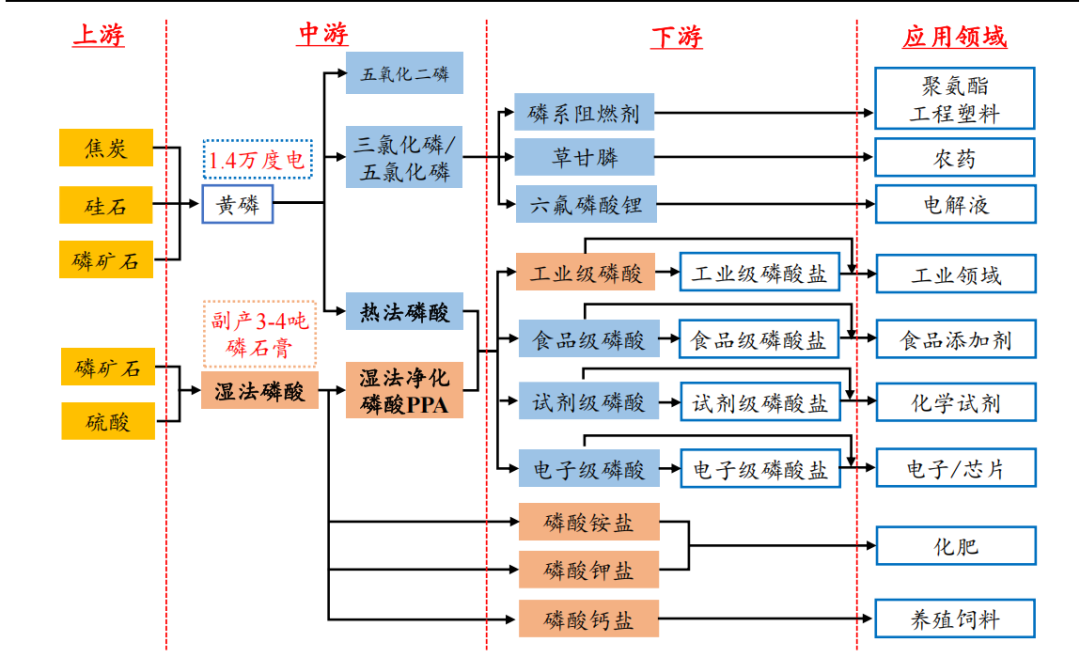
Industry Overview - Phosphate rock is a key upstream raw material, with yellow phosphorus and phosphoric acid as important intermediates, and downstream products primarily used in agriculture and industry [3][4] - The phosphate chemical industry chain includes phosphate rock and sulfur as upstream materials, with phosphoric acid produced through various processes [4] Resource End - China ranks second globally in phosphate rock reserves, with significant deposits located in Yunnan, Hubei, Sichuan, and Guizhou [6] - The total phosphate rock reserves in China are approximately 3.69 billion tons, with a low average grade of 16.85%, indicating over-exploitation and resource wastage [9][10] Production Capacity - Domestic phosphate rock production is the highest globally, but there has been a trend of decreasing output since 2018 [7] - Major phosphate rock producers include Hubei, Guizhou, Yunnan, and Sichuan, with a total production capacity of 1,450 million tons by Yuntianhua and 950 million tons by Guizhou Kaipin [11] Product Demand - Approximately 60% of phosphate rock is used for producing phosphate fertilizers, with a growing demand for high-efficiency and high-value utilization [13] - The main phosphate fertilizers include monoammonium phosphate (MAP) and diammonium phosphate (DAP), which are essential for crop growth [14][15] Phosphoric Acid Production - The phosphoric acid industry in China has a low concentration of production capacity, with a total capacity of 618 million tons, including 270 million tons of thermal phosphoric acid and 348 million tons of wet phosphoric acid [25] - The wet phosphoric acid production process is gaining traction due to its lower energy consumption and environmental impact compared to thermal methods [24][27] Environmental Considerations - The production of yellow phosphorus is characterized by high energy consumption and pollution, with limited new capacity being added [18] - The treatment and utilization of by-products such as phosphogypsum and fluorosilicic acid are becoming critical for the sustainable development of the phosphate chemical industry [32] Future Outlook - The industry is expected to focus on expanding the production capacity of wet phosphoric acid and functional phosphate salts, moving towards a more refined and specialized manufacturing approach [36] - The demand for feed-grade phosphate salts is anticipated to grow due to the increasing scale of aquaculture and livestock farming in China [37]



硫磺价格涨至近十年高位:下游磷肥保供稳价,钛白粉集体跟涨
Xin Lang Cai Jing· 2025-12-10 13:45
Core Viewpoint - The recent surge in sulfur prices has reached a nearly ten-year high, significantly increasing cost pressures for downstream industries such as phosphate fertilizers, which are crucial for food security in China [1][2]. Group 1: Sulfur Price Trends - Sulfur prices have been on the rise since last year, with a notable spike in October 2023. As of December 5, the price of granular sulfur at the Yangtze River port reached 4,115 RMB/ton, marking a nearly 200% year-on-year increase [1]. - The average import price of sulfur in China rose from $175.79/ton in January to $314.94/ton in October, reflecting a 79.21% increase [2]. - Recent contracts from Qatar, Kuwait, and the UAE for December sulfur have reached FOB $495/ton, surpassing historical highs [3]. Group 2: Impact on Downstream Industries - Sulfur is primarily used to produce sulfuric acid, with phosphate fertilizers being the largest consumer, accounting for over half of sulfur consumption [3]. - The price of industrial-grade monoammonium phosphate (MAP) has surged since November, with an increase of approximately 500 RMB/ton, leading to a current average price of around 6,500 RMB/ton, a year-on-year increase of 12.07% [3]. - The domestic sulfuric acid market average price reached 930 RMB/ton by the end of November, up 124% from the beginning of the year [3]. Group 3: Company Responses and Market Adjustments - Yuntianhua has called for measures to mitigate the impact of rising sulfur costs, ensuring sufficient supply of phosphate fertilizers and stabilizing market prices [1]. - The phosphate fertilizer industry is expected to see a reduction in production capacity utilization, projected to drop to 50.86%, a decrease of 5.8 percentage points year-on-year [3]. - The rising sulfur prices have prompted the titanium dioxide industry to initiate its sixth round of price increases this year, with leading companies raising prices by up to 700 RMB/ton [4]. Group 4: Future Market Outlook - The domestic sulfur market is anticipated to experience a volatile upward trend, with no new domestic sulfur production facilities planned and tight import conditions expected to persist [4]. - The demand for sulfur is likely to remain strong as phosphate fertilizer production resumes and winter storage needs increase [4]. - Global sulfur production is expected to grow slowly due to supply constraints, particularly in high-sulfur crude oil regions like the Middle East [5].