
BTG Hotels(600258)

Search documents
社会服务行业2025Q2基金持仓分析报告:重仓比例回落,维持低位布局
Wanlian Securities· 2025-08-19 07:52
Investment Rating - The industry is rated as "stronger than the market" with an expected relative increase of over 10% compared to the market index in the next six months [38]. Core Insights - The heavy holding ratio for the social service industry in Q2 2025 is 0.09%, a decrease of 0.03 percentage points from the previous quarter, ranking 30th among 31 first-level industries, indicating a position at the bottom of the industry [11][35]. - The current heavy holding ratio is significantly below the five-year historical average of 0.49%, suggesting substantial room for rebound [11][35]. - The education sector shows a rebound in interest, while the hotel and restaurant sector remains at a low holding ratio [18][35]. - The implementation and optimization of the national visa-free policy is expected to continue boosting the tourism market, alongside new opportunities arising from the establishment of duty-free shops [35]. Summary by Sections Heavy Holding Ratio Analysis - In Q2 2025, there are 344 funds heavily invested in the social service industry, a decrease of 59 funds from the previous quarter, with a total market value of 6.225 billion yuan, down by 1.786 billion yuan [11][35]. - The heavy holding ratio for the hotel and restaurant sector is at 0.02%, down 0.01 percentage points, while the tourism and scenic area sector is at 0.03%, showing a slight decline [18][35]. Sector Performance - The professional services sector has seen a decrease in heavy holding ratio to 0.03%, while the education sector has slightly increased to 0.01% [18][35]. - The hotel and restaurant sector's heavy holding ratio has been declining since reaching a peak in Q2 2022 [18][35]. Individual Stock Performance - The top ten stocks in the social service sector have a combined heavy holding ratio of 0.072%, down 0.03 percentage points from Q1 2025 [27][28]. - Notable increases in heavy holding ratios were observed for stocks such as Dou Shen Education and Changbai Mountain, while significant decreases were noted for Huace Detection and Su Shi Testing [30][31].


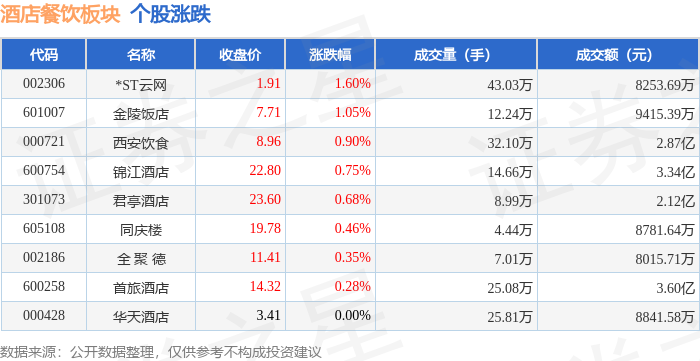
酒店餐饮板块8月18日涨0.58%,*ST云网领涨,主力资金净流出5389.14万元
Zheng Xing Xing Ye Ri Bao· 2025-08-18 08:39
证券之星消息,8月18日酒店餐饮板块较上一交易日上涨0.58%,*ST云网领涨。当日上证指数报收于 3728.03,上涨0.85%。深证成指报收于11835.57,上涨1.73%。酒店餐饮板块个股涨跌见下表: | 代码 | 名称 | 收盘价 | 涨跌幅 | 成交量(手) | 成交额(元) | | --- | --- | --- | --- | --- | --- | | 002306 | *ST云网 | 1.91 | 1.60% | 43.03万 | 8253.69万 | | 601007 | 金陵饭店 | 7.71 | 1.05% | 12.24万 | 9415.39万 | | 000721 | 西安饮食 | 8.96 | 0.90% | 32.10万 | 2.87亿 | | 600754 | 锦江酒店 | 22.80 | 0.75% | - 14.66万 | 3.34亿 | | 301073 | 君喜酒店 | 23.60 | 0.68% | 8.99万 | 2.12亿 | | 605108 | 同庆楼 | 19.78 | 0.46% | 4.44万 | 8781.64万 | | 002186 | 全聚德 ...





北京首旅酒店(集团)股份有限公司 关于发行超短期融资券、短期融资券、中期票据获得批准的公告
Zhong Guo Zheng Quan Bao - Zhong Zheng Wang· 2025-08-16 06:02
Group 1 - The company has approved the issuance of debt financing instruments, including super short-term financing bonds, short-term financing bonds, and medium-term notes, with a total amount not exceeding RMB 4 billion [1] - The company received acceptance notifications from the China Interbank Market Dealers Association, confirming the registration amounts for super short-term financing bonds (RMB 2 billion), short-term financing bonds (RMB 1 billion), and medium-term notes (RMB 1 billion), all valid for 2 years from the date of the notification [2] - The main underwriter for these financing instruments is China Merchants Bank [2]
北京首旅酒店(集团)股份有限公司关于发行超短期融资券、短期融资券、中期票据获得批准的公告
Shang Hai Zheng Quan Bao· 2025-08-15 19:13
Core Points - Beijing Shoulu Hotel Group Co., Ltd. has received approval to issue debt financing instruments totaling up to RMB 4 billion [1][2] - The company plans to issue short-term financing bonds, medium-term notes, and ultra-short-term financing bonds based on actual operating conditions [1] - The registration for ultra-short-term financing bonds is set at RMB 2 billion, short-term financing bonds at RMB 1 billion, and medium-term notes at RMB 1 billion, all valid for two years from the date of the acceptance notice [2] Group 1 - The company held its annual shareholders' meeting on April 25, 2025, where the proposal for debt financing tools was approved [1] - The total amount for the debt financing tools is capped at RMB 4 billion, which will be issued in one or multiple tranches [1] - The underwriting for these instruments will be handled by China Merchants Bank Co., Ltd. [2] Group 2 - The acceptance notice for the registration of the financing instruments was issued by the China Interbank Market Dealers Association [2] - The registration amounts are specifically allocated: RMB 2 billion for ultra-short-term financing bonds, RMB 1 billion for short-term financing bonds, and RMB 1 billion for medium-term notes [2] - The registration is valid for two years, allowing the company flexibility in timing the issuance [2]
首旅酒店: 北京首旅酒店(集团)股份有限公司关于发行超短期融资券、短期融资券、中期票据获得批准的公告
Zheng Quan Zhi Xing· 2025-08-15 11:28
Core Viewpoint - Beijing Shoulv Hotel Group Co., Ltd. has received approval for the issuance of short-term financing instruments, including super short-term financing bonds, short-term financing bonds, and medium-term notes, with a total amount not exceeding RMB 40 billion [1][2]. Group 1 - The company held its 2024 annual shareholders' meeting on April 25, 2025, where it approved the proposal to register and issue debt financing instruments [1]. - The total registered amount for super short-term financing bonds is RMB 2 billion, valid for 2 years from the date of the acceptance notice, underwritten by China Merchants Bank [2]. - The registered amount for short-term financing bonds is RMB 1 billion, also valid for 2 years from the acceptance notice, underwritten by China Merchants Bank [2]. - The registered amount for medium-term notes is RMB 1 billion, valid for 2 years from the acceptance notice, underwritten by China Merchants Bank [2].
首旅酒店(600258) - 北京首旅酒店(集团)股份有限公司关于发行超短期融资券、短期融资券、中期票据获得批准的公告
2025-08-15 10:35
证券代码:600258 证券简称:首旅酒店 编号:临 2025-033 北京首旅酒店(集团)股份有限公司 2 关于发行超短期融资券、短期融资券、中期票据 获得批准的公告 本公司董事会及全体董事保证本公告内容不存在任何虚假记载、误导性陈述 或者重大遗漏,并对其内容的真实性、准确性和完整性承担法律责任。 北京首旅酒店(集团)股份有限公司(以下简称"公司"或"首旅酒店") 于 2025 年 4 月 25 日召开的 2024 年年度股东会,审议通过了《关于注册发行银 行间债券市场债务融资工具的议案》,同意公司申请注册发行超短期融资券、短 期融资券、中期票据(以下合称"债务融资工具"),发行总金额不超过人民币 40 亿元。公司将根据实际经营情况,在中国银行间市场交易商协会注册有效期 内,在注册额度范围内择机一次或分期发行。具体内容详见 2025 年 4 月 26 日 公司在《中国证券报》、《上海证券报》和上海证券交易所网站(www.sse.com.cn) 上刊登的《北京首旅酒店(集团)股份有限公司 2024 年年度股东会决议公告》 (公告编号:临 2025-026)。 公司于近期接到中国银行间市场交易商协会发出的《接受 ...
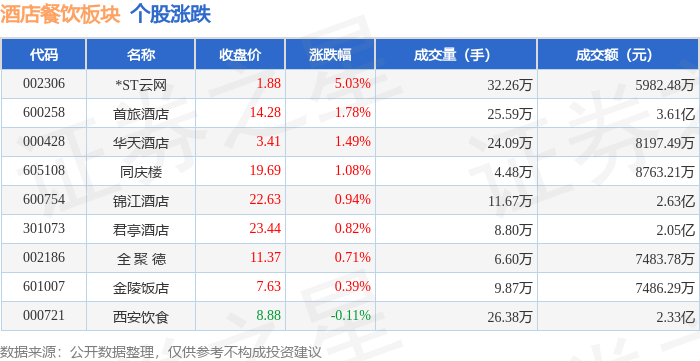
酒店餐饮板块8月15日涨1.17%,*ST云网领涨,主力资金净流入418万元
Zheng Xing Xing Ye Ri Bao· 2025-08-15 08:37
Market Overview - On August 15, the hotel and catering sector rose by 1.17% compared to the previous trading day, with *ST Yunwang leading the gains [1] - The Shanghai Composite Index closed at 3696.77, up 0.83%, while the Shenzhen Component Index closed at 11634.67, up 1.6% [1] Stock Performance - The following stocks in the hotel and catering sector showed notable performance: - *ST Yunwang: Closed at 1.88, up 5.03% with a trading volume of 322,600 shares and a turnover of 59.82 million yuan [1] - Shoulv Hotel: Closed at 14.28, up 1.78% with a trading volume of 255,900 shares and a turnover of 361 million yuan [1] - Huatian Hotel: Closed at 3.41, up 1.49% with a trading volume of 240,900 shares and a turnover of 81.97 million yuan [1] - Other notable stocks include Tongqinglou, Jinjiang Hotel, and Junting Hotel, with varying degrees of increase [1] Capital Flow - The hotel and catering sector experienced a net inflow of 4.18 million yuan from institutional investors, while retail investors contributed a net inflow of 16.05 million yuan [1] - The following details highlight the capital flow for specific stocks: - *ST Yunwang: Institutional net inflow of 19.30 million yuan, retail net outflow of 9.30 million yuan [2] - Shoulv Hotel: Institutional net inflow of 15.02 million yuan, retail net outflow of 6.92 million yuan [2] - Huatian Hotel: Retail net inflow of 0.65 million yuan despite institutional net outflow [2] - Other stocks like Xianyin Food and Junting Hotel showed significant retail inflows despite institutional outflows [2]

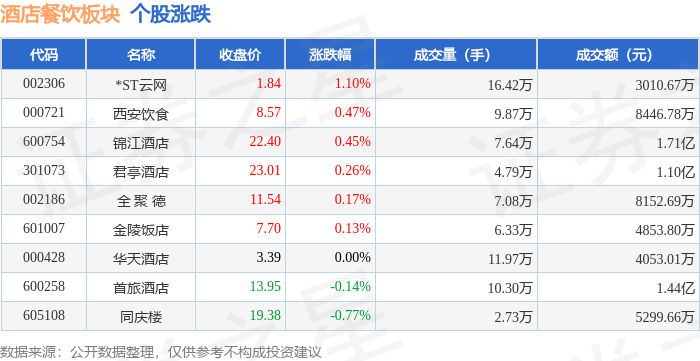
酒店餐饮板块8月12日涨0.14%,*ST云网领涨,主力资金净流出1195.62万元
Zheng Xing Xing Ye Ri Bao· 2025-08-12 08:31
| 代码 | 名称 | 主力净流入(元) | 主力净占比 游资净流入 (元) | | 游资净占比 散户净流入 (元) | | 散户净占比 | | --- | --- | --- | --- | --- | --- | --- | --- | | 301073 君亭酒店 | | 1136.69万 | 10.35% | -614.57万 | -5.60% | -522.12万 | -4.76% | | 002306 *ST云网 | | 325.62万 | 10.82% | -222.58万 | -7.39% | -103.04万 | -3.42% | | 605108 | 同庆楼 | 156.55万 | 2.95% | -262.61万 | -4.96% | 106.05万 | 2.00% | | 000721 西安饮食 | | 14.89万 | 0.18% | -25.12万 | -0.30% | 10.23万 | 0.12% | | 002186 全聚德 | | -11.01万 | -0.13% | -295.57万 | -3.63% | 306.57万 | 3.76% | | 000428 华天酒店 | | ...

旅游热带动业绩增长 酒店类上市公司加大扩张力度
Xin Hua Wang· 2025-08-12 05:48
Core Insights - The hotel industry in China has seen significant performance growth in the first half of 2023, driven by a surge in tourism [1][2] - Companies are expanding their operations and enhancing their restaurant businesses to capitalize on the tourism boom [1] Performance Recovery - In the first half of 2023, the domestic tourism market showed a recovery, with 2.384 billion domestic tourist trips, a year-on-year increase of 63.9%, and domestic tourism revenue reaching 2.3 trillion yuan, up 95.9% [2] - Jinling Hotel reported a revenue of 887 million yuan, a 34.7% increase, and a net profit of 31.18 million yuan, up 916.61% [2] - Junting Hotel achieved a revenue of 221 million yuan, a 57.13% increase, with a net profit of 20.09 million yuan, up 36.4% [2] - Jinjiang Hotels reported a revenue of 6.806 billion yuan, a 32.15% increase, and a net profit of 523 million yuan, returning to profitability [2] - Shoulu Hotels recorded a revenue of 3.608 billion yuan, a 54.76% increase, with a net profit of 280 million yuan, also returning to profitability [2] - Huazhu Group's Q2 revenue was 5.5 billion yuan, a 63.5% increase, with 8,750 hotels in operation, including 4,872 economy hotels [3] Deepening Transformation - Companies are not only benefiting from market recovery but are also deepening their business transformations [4] - Jinling Hotel is innovating in restaurant operations and has successfully hosted over 600 important events [4] - Jinjiang Hotels is advancing digital transformation, enhancing its information management, and increasing direct sales through a digital platform, with effective membership reaching 18.972 million [4] - Junting Hotel is optimizing its brand positioning through property, product, technology, and management upgrades, emphasizing local cultural elements [4] Expansion of Stores - The overall chain rate of domestic hotels was about 39% by the end of 2022, indicating significant room for growth compared to over 60% in developed countries [5] - Huazhu Group opened 374 hotels and closed 216 in Q2, resulting in a net increase of 158 hotels, with 1,054 new hotel contracts signed [5] - Junting Hotel plans to invest 210 million yuan to open multiple high-quality hotels in Chongqing [5] - Leading chain hotels are expanding to increase market share and optimize costs through scale [5]

旅游“出圈” 上市酒店企业跑出复苏加速度
Xin Hua Wang· 2025-08-12 05:47
Group 1 - The hotel industry is experiencing a strong recovery in 2023, driven by the release of pent-up demand for travel and tourism, leading to improved financial performance for major hotel companies [1][2] - Shoulv Hotel (首旅酒店) expects to turn a profit in 2023, with a projected net profit of between 770 million to 830 million yuan, representing a year-on-year increase of 1.352 billion to 1.412 billion yuan, or a growth of 232% to 243% [1] - Huazhu Group reported that its RevPAR (Revenue per Available Room) reached 122% of 2019 levels in 2023, with an ADR (Average Daily Rate) of 299 yuan, up 26.6% year-on-year [2] Group 2 - The average RevPAR is a key indicator reflecting the operational quality and profitability trends of hotels, which has shown significant improvement in 2023 [1] - The tourism industry is expected to continue its strong performance into 2024, with projections of over 6 billion domestic tourist trips and 6 trillion yuan in domestic tourism revenue [3] - Jinjiang Hotels is actively expanding its management services and partnerships to enhance long-term competitiveness and financial performance [4] Group 3 - The hotel management and operations of Lingnan Holdings are also recovering rapidly, focusing on brand expansion and capitalizing on the recovery of business and tourism markets [2] - The success of the TV drama "Blossoms" has boosted the visibility of Jinjiang Hotels' historical properties, leading to increased interest and occupancy [4] - Dongwu Securities highlights that leading hotel companies are showing cash cow attributes with continuous growth in total revenue and profitability levels [5]