
Shanghai Jahwa(600315)

Search documents
净利暴增149%!上海家化三季报业绩创双位数高增
Xin Lang Zheng Quan· 2025-10-27 09:40
Core Insights - Shanghai Jahwa reported a significant increase in Q3 revenue, reaching 1.483 billion yuan, a 28.29% year-on-year growth, with net profit soaring by 149.12% to 140 million yuan, indicating strong profitability improvement [1][2] - For the first three quarters, total revenue was 4.961 billion yuan, up 10.83% year-on-year, while net profit also increased by 149.12% to 405 million yuan, showcasing sustained high growth [1][2] Financial Performance - Q3 revenue reached 1.483 billion yuan, a 28.29% increase from 1.156 billion yuan in the same period last year [1] - Net profit for Q3 was 140 million yuan, compared to 56 million yuan in the previous year, marking a 149.12% increase [1] - For the first nine months, total revenue was 4.961 billion yuan, a 10.83% increase year-on-year, and net profit was 405 million yuan, also up 149.12% [1] Business Strategy and Market Position - The company's growth is attributed to improved operational efficiency and collaboration across various business segments, leveraging a diversified brand matrix and targeted market strategies [1][2] - The beauty segment saw a remarkable 2.7 times increase in revenue, with online sales contributing over half of domestic revenue for the first time [2] Product Innovations and Marketing - New product launches, such as the portable mosquito repellent and the refreshing scented shower gel, have successfully driven online sales and brand recognition [2][3] - The company has focused on brand-driven growth, enhancing marketing efforts through increased media exposure, resulting in a 50% rise in visibility [2] Brand Performance Highlights - The "Yuze" brand maintained rapid growth, with its core barrier repair series contributing significantly to sales, supported by high-profile endorsements [3] - "Bai Ca Ji" achieved explosive growth with its new product, the "New Seven White Whitening Mud Mask," leading in e-commerce sales [3] - "Gao Fu" launched a new series and successfully drove sales through targeted marketing campaigns, achieving high engagement rates [4] - "Qi Chu" leveraged celebrity endorsements and social media to enhance brand visibility and consumer engagement [5]

品牌工程指数 上周涨4.14%
Zhong Guo Zheng Quan Bao· 2025-10-26 22:33
Market Performance - The market experienced a rebound last week, with the CSI Xinhua National Brand Index rising by 4.14% to 2037.67 points [1][2] - The Shanghai Composite Index increased by 2.88%, the Shenzhen Component Index by 4.73%, the ChiNext Index by 8.05%, and the CSI 300 Index by 3.24% [2] Strong Stock Performances - Notable strong performers included: - Zhongji Xuchuang (up 32.23%) - Shiyuan Technology (up 14.54%) - Sunshine Power (up 14.37%) [2] - Other stocks with significant gains included: - Anji Technology and Wowo Bio (both up over 10%) - SMIC and Zhaoyi Innovation (both up over 9%) [2] Year-to-Date Stock Performance - Since the beginning of the second half of the year, Zhongji Xuchuang has surged by 239.03%, leading the gains [3] - Sunshine Power has increased by 145.06%, while other stocks like Lanke Technology and Yiwei Lithium Energy have risen over 70% [3] Market Outlook - According to Fangzheng Fubang Fund, liquidity remains a crucial driver for market development, and future capital inflow will significantly impact market trends [4] - The fund suggests focusing on sectors with solid fundamentals and reasonable valuations, rather than chasing high-performing stocks with poor earnings [4] - Long-term investment opportunities may lie in technology companies with real technological barriers that align with national strategies [4] - Kangmand Capital anticipates a volatile market in the short term due to uncertainties, but the core logic for an upward trend remains unchanged [4] - Xingshi Investment notes that positive incremental information could stabilize market expectations and emotions, with a potential shift in economic momentum towards technology and consumption [4]




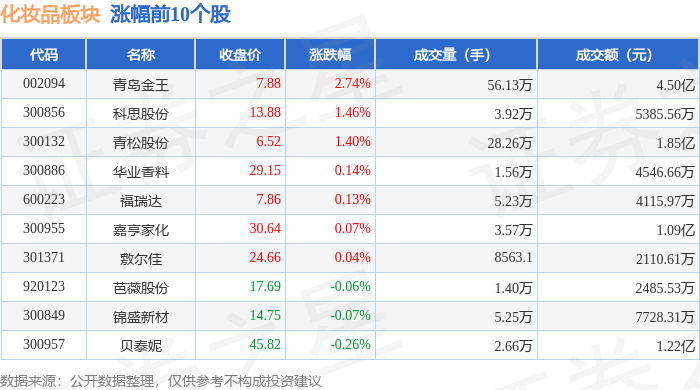
化妆品板块10月22日跌0.72%,拉芳家化领跌,主力资金净流出1229.05万元
Zheng Xing Xing Ye Ri Bao· 2025-10-22 08:26
Core Insights - The cosmetics sector experienced a decline of 0.72% on October 22, with LaFang JiaHua leading the drop [1] - The Shanghai Composite Index closed at 3913.76, down 0.07%, while the Shenzhen Component Index closed at 12996.61, down 0.62% [1] Market Performance - Qingdao Jinwang (002094) saw a closing price of 7.88, with an increase of 2.74% and a trading volume of 561,300 shares, amounting to 450 million yuan [1] - Other notable performers included Kesheng Co. (300856) with a closing price of 13.88, up 1.46%, and Yusong Co. (300132) at 6.52, up 1.40% [1] - LaFang JiaHua (603630) closed at 22.55, down 1.83%, with a trading volume of 39,800 shares and a turnover of 90.79 million yuan [2] Capital Flow - The cosmetics sector experienced a net outflow of 12.29 million yuan from institutional investors and 12.90 million yuan from retail investors, while there was a net inflow of 25.19 million yuan from individual investors [2] - The capital flow for individual stocks showed that Qingdao Jinwang had a net inflow of 30.74 million yuan from institutional investors, while LaFang JiaHua had a net outflow of 7.07 million yuan [3] - Other stocks like Kesheng Co. and Yusong Co. also experienced varying degrees of net inflow and outflow from different investor categories [3]




化妆品板块10月21日跌0.03%,拉芳家化领跌,主力资金净流出1149.16万元
Zheng Xing Xing Ye Ri Bao· 2025-10-21 08:28
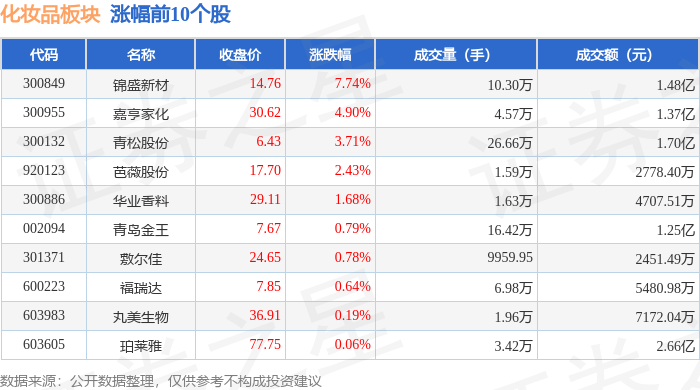
Core Insights - The cosmetics sector experienced a slight decline of 0.03% on October 21, with Lafang Jiahua leading the drop [1] - The Shanghai Composite Index closed at 3916.33, up 1.36%, while the Shenzhen Component Index closed at 13077.32, up 2.06% [1] Group 1: Stock Performance - Jinsheng New Material (300849) saw a significant increase of 7.74%, closing at 14.76 with a trading volume of 103,000 shares and a turnover of 148 million yuan [1] - Jiaheng Jiahua (300955) rose by 4.90%, closing at 30.62 with a trading volume of 45,700 shares and a turnover of 137 million yuan [1] - Qing Song Co. (300132) increased by 3.71%, closing at 6.43 with a trading volume of 266,600 shares and a turnover of 170 million yuan [1] - Lafang Jiahua (603630) declined by 2.67%, closing at 22.97 with a trading volume of 61,500 shares and a turnover of 141 million yuan [2] - Shanghai Jahwa (600315) fell by 1.85%, closing at 27.09 with a trading volume of 96,400 shares and a turnover of 262 million yuan [2] Group 2: Capital Flow - The cosmetics sector experienced a net outflow of 11.49 million yuan from institutional investors, while retail investors saw a net inflow of 19.36 million yuan [2] - The main capital inflow was observed in brands like Banlaya (603605) with a net inflow of 10.38 million yuan, while Jinsheng New Material (300849) had a net outflow of 11.78 million yuan [3] - Retail investors showed a significant net inflow in Furuida (600223) with 7.23 million yuan, while the outflow from institutional investors was 3.19 million yuan [3]


上海家化跌2.03%,成交额1.68亿元,主力资金净流出30.75万元
Xin Lang Cai Jing· 2025-10-21 05:58
Core Points - Shanghai Jahwa's stock price decreased by 2.03% on October 21, trading at 27.04 CNY per share with a market capitalization of 18.177 billion CNY [1] - Year-to-date, Shanghai Jahwa's stock has increased by 59.91%, with a recent 5-day increase of 1.69% and a 20-day decrease of 1.99% [2] - The company reported a revenue of 3.478 billion CNY for the first half of 2025, representing a year-on-year growth of 4.75%, and a net profit of 266 million CNY, up 11.66% year-on-year [2] Financial Performance - As of June 30, 2025, Shanghai Jahwa's total shareholder count was 37,800, an increase of 10.15% from the previous period [2] - The company has distributed a total of 3.595 billion CNY in dividends since its A-share listing, with 344 million CNY distributed over the last three years [3] Shareholding Structure - As of June 30, 2025, Hong Kong Central Clearing Limited is the second-largest circulating shareholder, holding 32.7782 million shares, an increase of 15.0639 million shares from the previous period [3] - New shareholder,招商产业精选股票A, holds 3.4 million shares, ranking as the ninth-largest circulating shareholder [3]
上海家化:公司家居清洁类产品的营销推广正有序开展
Zheng Quan Ri Bao Wang· 2025-10-20 12:13
Core Viewpoint - Shanghai Jahwa (600315) is actively promoting its home cleaning products, indicating a strategic focus on expanding its market presence in this category [1] Group 1 - The company is engaging in orderly marketing and promotion of its home cleaning products [1]
美容护理行业10月20日资金流向日报
Zheng Quan Shi Bao Wang· 2025-10-20 09:11
Market Overview - The Shanghai Composite Index rose by 0.63% on October 20, with 26 out of 28 sectors experiencing gains, led by the communication and coal industries, which increased by 3.21% and 3.04% respectively [1] - The market saw a net outflow of 4.601 billion yuan in major funds, with 12 sectors recording net inflows, primarily in the communication sector, which attracted 4.397 billion yuan [1] Sector Performance - The communication sector had the highest net inflow of funds, contributing to its 3.21% increase, while the coal sector followed with a net inflow of 1.148 billion yuan [1] - Conversely, the non-ferrous metals sector experienced the largest net outflow, totaling 4.699 billion yuan, followed by the computer sector with a net outflow of 2.390 billion yuan [1] Beauty and Personal Care Industry - The beauty and personal care sector declined by 0.38%, with a net outflow of 24.996 million yuan [2] - Among the 29 stocks in this sector, 15 saw gains while 12 experienced declines [2] - The top net inflow stock was Shanghai Jahwa, with an inflow of 22.996 million yuan, followed by Liangmianzhen and Jiaheng Jiahua with inflows of 12.992 million yuan and 6.235 million yuan respectively [2] Individual Stock Performance - The stocks with the highest net outflows included Proya, Aimeike, and Huaxi Biology, with outflows of 26.186 million yuan, 23.826 million yuan, and 9.397 million yuan respectively [2] - A detailed table of stock performance indicates various changes in price and turnover rates, highlighting the dynamics within the beauty and personal care sector [3]



大消费行业周报(10月第3周):海南离岛免税政策5大调整落地-20251020
Century Securities· 2025-10-20 00:44
Investment Rating - The report does not explicitly state an investment rating for the industry, but it suggests focusing on the duty-free retail sector and the ice and snow economy as potential investment opportunities. Core Insights - The recent adjustments to the Hainan duty-free shopping policy are expected to enhance the attractiveness of Hainan as a free trade port, expanding the range of duty-free goods and increasing consumer participation [2][3]. - The early onset of the snow season in Xinjiang is anticipated to benefit the ice and snow economy, with government initiatives aiming for a total output value of 200 billion yuan by 2030 [2][3]. - The report highlights the performance of various sectors within the consumer industry, noting significant stock price changes among leading companies [2][3]. Summary by Sections Market Weekly Review - The consumer sector showed mixed performance, with food and beverage, retail, and home appliances experiencing gains, while beauty care and textiles saw declines [2][3]. - Notable stock performances included Kuaijishan (+11.08%) and Dongbei Group (+8.97%) leading the gains, while Jinzi Ham (-17.80%) and Biyi Co. (-19.63%) faced significant losses [2][3]. Industry News and Key Company Announcements - The Hainan duty-free policy adjustments include expanding the range of duty-free goods to 47 categories and allowing more consumer participation [2][3]. - The ice and snow industry is projected to exceed 1 trillion yuan by 2025, driven by upcoming major events and government support [2][3]. - Various companies reported significant revenue growth, such as Spring Breeze Power with a 28.56% increase in Q3 revenue [2][3].


品牌工程指数 上周收报1956.62点
Zhong Guo Zheng Quan Bao· 2025-10-19 22:33
Core Viewpoint - The market experienced a correction last week, but certain stocks within the brand index showed resilience, indicating potential investment opportunities in sectors like electronics, new energy, new consumption, and real estate as uncertainties ease [1][4]. Market Performance - The market indices saw declines: Shanghai Composite Index down 1.47%, Shenzhen Component down 4.99%, ChiNext down 5.71%, and CSI 300 down 2.22%. The brand index fell 3.58% to 1956.62 points [2]. - Notable gainers in the brand index included Shanghai Jahwa up 9.42%, Changbai Mountain up 7.19%, and Darentang up 5.34%. Other stocks like Luzhou Laojiao and Yiling Pharmaceutical also saw gains exceeding 4% [2]. Stock Performance Since H2 - Since the beginning of the second half of the year, Zhongji Xuchuang has surged 156.40%, leading the gains, followed by Sunshine Power at 114.27%. Other significant performers include Lanke Technology and Yiwei Lithium Energy, both up over 60% [3]. Market Outlook - Looking ahead, the market is expected to maintain upward momentum as uncertainties gradually diminish. Liquidity is anticipated to remain supportive, with domestic interest rates low and overseas liquidity remaining loose, encouraging investment in Chinese equity assets [4][5]. - The current market environment is characterized by a shift in investment styles, with a focus on sectors that offer higher investment certainty, particularly in electronics, new energy, new consumption, and real estate [5].


品牌工程指数上周收报1956.62点
Zhong Guo Zheng Quan Bao· 2025-10-19 20:13
Group 1 - The core index of the Xinhua National Brand Project reported 1956.62 points, with several constituent stocks rising against the market trend [1] - Shanghai Jahwa increased by 9.42%, leading the gains among constituent stocks, followed by Changbaishan at 7.19% and Darentang at 5.34% [1] - The overall market saw declines, with the Shanghai Composite Index down 1.47% and the Shenzhen Component Index down 4.99% [1] Group 2 - Since the second half of the year, Zhongji Xuchuang has risen by 156.40%, ranking first in gains, followed by Sunshine Power at 114.27% [2] - The market is expected to maintain upward momentum, with liquidity driving potential growth and fundamental support gradually increasing [2] - Domestic interest rates remain low, and overseas liquidity is expected to remain loose, indicating continued capital allocation towards Chinese equity assets [2] Group 3 - Recent market adjustments are attributed to a decline in global market risk appetite and a shift in investment style towards defensive sectors [3] - The current market environment is characterized by high levels, increased uncertainty, and a slowdown in previous catalysts, leading to cautious trading [3] - Investors are encouraged to seek opportunities in sectors with higher investment certainty, particularly in electronics, new energy, new consumption, and real estate [3]
