
Shanghai Jahwa(600315)

Search documents
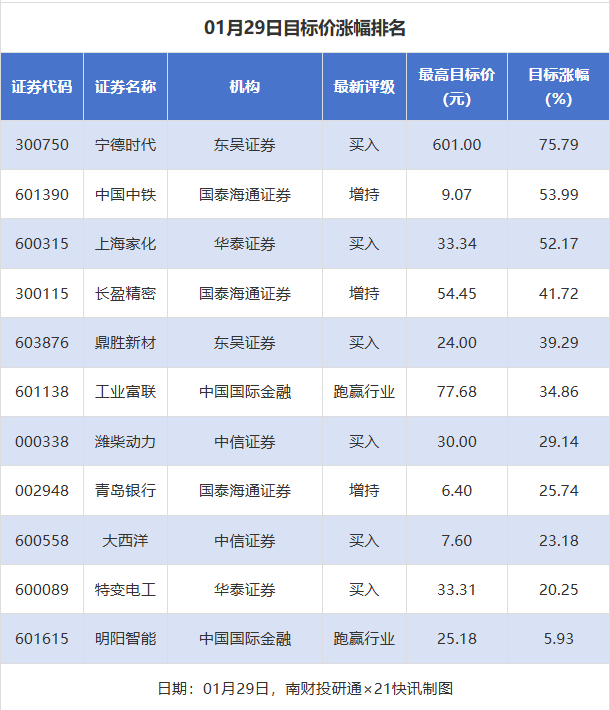
10股目标价涨幅超20%,宁德时代达75%
2 1 Shi Ji Jing Ji Bao Dao· 2026-01-30 02:20
Core Viewpoint - The brokerage firms have set target prices for listed companies, with 10 stocks showing a target price increase of over 20% based on the latest closing prices [1] Group 1: Target Price Increases - A total of 11 target price adjustments were made by brokerages for listed companies [1] - The companies with the highest target price increases include CATL (Ningde Times) at 75.79%, China Railway at 53.99%, and Shanghai Jahwa at 52.17% [1] - These companies belong to the battery, infrastructure, and cosmetics industries respectively [1]



27股获推荐 宁德时代目标价涨幅达75%丨券商评级观察
2 1 Shi Ji Jing Ji Bao Dao· 2026-01-30 01:26
Group 1 - The core viewpoint of the article highlights the target price increases for several listed companies, with notable gains for Ningde Times, China Railway, and Shanghai Jahwa, reflecting strong market confidence in these sectors [1][2]. Group 2 - On January 29, the companies with the highest target price increases were Ningde Times (75.79%), China Railway (53.99%), and Shanghai Jahwa (52.17%), indicating significant bullish sentiment in the battery, infrastructure, and cosmetics industries respectively [1][2]. - A total of 27 listed companies received broker recommendations on January 29, with Qingdao Bank receiving the most recommendations at 5, followed by Mingyang Smart Energy and Ruoyuchen with 2 each [1][3]. - Three companies had their ratings upgraded on January 29, including TBEA, which was upgraded from "Hold" to "Buy" by Huatai Securities, reflecting improved outlooks for these firms [4][6]. - Five companies received initial coverage on January 29, with Qingdao Bank rated "Recommended" by Guolian Minsheng Securities, indicating new interest from analysts in these stocks [6][7].


上海家化:预计2025年净利为2.4亿元至2.9亿元
Bei Jing Shang Bao· 2026-01-29 12:29
北京商报讯(记者张君花)1月29日,上海家化(600315)发布2025年年度业绩预盈公告称,公司预计实 现归母净利润2.4亿元至2.9亿元。2025年,上海家化主营业务增长、毛利率提升、非经常性收益增加等 促使业绩预盈。 ...
上海家化预计2025年归母净利润实现扭亏为盈
Zheng Quan Ri Bao Zhi Sheng· 2026-01-29 09:40
Core Viewpoint - Shanghai Jahwa expects to achieve a net profit of between 240 million and 290 million yuan in 2025, marking a turnaround from losses to profits due to growth in core business, improved gross margins, and increased non-recurring income [1] Group 1 - In 2025, Shanghai Jahwa's strategic focus will be on core brands, brand building, online presence, and operational efficiency, which will drive the company's performance [1] - The company has successfully launched several billion-yuan products, enhancing the competitiveness of its core brands and accelerating brand momentum [1] - The CEO emphasized that in the online era, flagship products are crucial for establishing brand recognition and building a product matrix for long-term development [1] Group 2 - In the fourth quarter of 2025, Shanghai Jahwa established a Billion-Yuan Product Club to leverage brand resources and operational experience to create a matrix of blockbuster products [2] - The club aims to expand the billion-yuan product matrix through a complete incubation process to drive company growth [2]
上海家化(600315):改革成效显现
HTSC· 2026-01-29 03:34
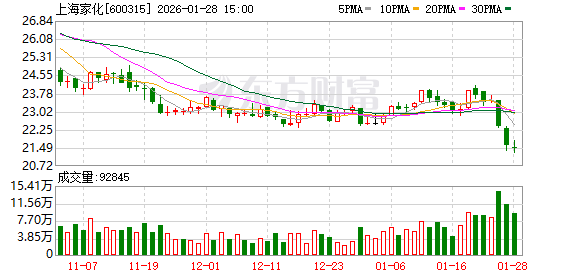
Investment Rating - The investment rating for the company is maintained as "Buy" with a target price of RMB 33.34 [1]. Core Insights - The company is expected to achieve a net profit attributable to shareholders of RMB 240 to 290 million in 2025, marking a turnaround from losses in the previous year. 2025 is viewed as a critical year for the company's strategic reform, focusing on core brands, brand building, online presence, and efficiency [1][6]. - The company has successfully developed three major products that have generated over RMB 100 million in sales each, demonstrating the effectiveness of its strategy combining category breakthroughs, major product cultivation, and marketing innovation [1][8]. - The company has adjusted its revenue forecasts for 2025-2027, now projecting revenues of RMB 6.407 billion, RMB 7.379 billion, and RMB 8.219 billion respectively, reflecting increases of 12.84%, 15.16%, and 11.38% [10]. Financial Performance - The company is projected to have a net profit of RMB 273.22 million in 2025, with an expected EPS of RMB 0.41. This is a significant recovery from a loss of RMB 833.09 million in 2024 [5][10]. - The company's return on equity (ROE) is expected to improve from -12.45% in 2024 to 3.93% in 2025, indicating a positive trend in profitability [5][10]. - The price-to-earnings (PE) ratio is projected to decrease from -17.32 in 2024 to 52.80 in 2025, reflecting a shift towards profitability [5][10]. Market Performance - The company's stock closed at RMB 21.46 as of January 28, with a market capitalization of RMB 14.426 billion. The stock has traded within a range of RMB 15.60 to RMB 28.92 over the past 52 weeks [2]. - The company has seen significant growth in its online sales channels, with notable performances on platforms like Douyin and Taobao, indicating strong brand momentum [7][9].
未知机构:上海家化预告25年归母净利2429亿元26年新品储备丰富组织效率提升-20260129
未知机构· 2026-01-29 02:05
Company and Industry Summary Company: Shanghai Jahwa Key Points from the Earnings Forecast - **Earnings Forecast for 2025**: Shanghai Jahwa anticipates a net profit attributable to shareholders of 240-290 million yuan for 2025, with a non-recurring net profit of 38-56 million yuan, indicating a turnaround from losses in the previous year. The non-recurring gains are primarily attributed to changes in the fair value of financial assets and investment income [1][1][1] - **Q4 Performance Expectations**: For Q4, the company expects a net loss attributable to shareholders between -165 to -115 million yuan, and a non-recurring net loss between -193 to -175 million yuan. This performance is below expectations due to increased investments in brand building and losses from joint ventures such as Sephora and Pianzaihuang [1][1][1] - **Strategic Reforms Impact**: The strategic reforms implemented in 2025 have shown significant results, achieving a double-digit revenue growth target. Excluding the overseas Tomi Star business, domestic operations have experienced high double-digit growth [1][1][1] - **Profitability Metrics**: The estimated net profit margin for 2025 is approximately 4%, with a non-recurring net profit margin of about 1%, both indicating a return to profitability year-on-year. The gross margin is expected to improve significantly due to product mix optimization, while the sales expense ratio is slightly elevated due to strategic increases in brand building costs and a higher proportion of online and Douyin channel sales [1][1][1] 2026 Outlook - **Revenue Growth Strategy**: The company plans to focus on core products with a revenue target of continued double-digit growth. Domestic offline sales are expected to remain stable, while online sales are projected to grow by 30-40%. The Tomi Star business is anticipated to recover to single-digit growth, with profit growth expected to outpace revenue growth [1][1][1] - **Product Launches**: Key product launches for 2026 include: - **Yuze**: Following the success of the dry-sensitive cream, the company aims for the oil-sensitive cream to exceed 100 million yuan, along with new products like the special moisturizing cream and physical sunscreen. - **Baicaoji**: Expanding the mud mask category with high-end whitening and anti-aging products, targeting over 100 million yuan in sales. - **Liushen**: Upgrading the packaging of floral water and launching new shower gels and outdoor mosquito repellents [1][1][1] Additional Strategic Initiatives - **Establishment of Billion Yuan Product Club**: Each core brand will have an independent team responsible for billion-yuan products, with plans to recruit younger talent [2][2][2] - **In-house Douyin Team**: The Douyin content operation team has been internalized, significantly improving content operation efficiency [2][2][2] - **Profit Margin Improvement**: The expected gross margin has significant room for improvement due to the increased proportion of new products and efficiency gains from existing products. The sales expense ratio is anticipated to stabilize or slightly narrow due to improvements in single-channel efficiency and the mix of online and Douyin sales [2][2][2]
未知机构:上海家化25年业绩预告25Q4持续投入品牌建设期待26年盈利能力向好东财新-20260129
未知机构· 2026-01-29 02:05
Company and Industry Summary Company: Shanghai Jahwa Key Financial Performance - For the year 2025, Shanghai Jahwa is projected to achieve a net profit attributable to shareholders of 240-290 million yuan, with a non-recurring net profit of 38-56 million yuan, marking a return to profitability year-on-year [1] - In Q4 2025, the company expects a net loss attributable to shareholders of -165 to -115 million yuan, and a non-recurring net loss of -193 to -175 million yuan, indicating a narrowing of losses compared to previous periods, albeit slightly below prior expectations [1] 2026 Goals - The company aims for revenue growth of over 10% in double digits for 2026, with profits expected to grow at a rate faster than revenue [1] Brand Investment Strategy - Significant investment in brand building during Q4 2025 is noted, aimed at fostering long-term growth [1] - New product launches such as Baicaojijian's Xian Cao Oil and Meijiajing's Propolis Repair Cream are part of the strategy to enhance brand visibility and establish a foundation for long-term development [1] Core Brand Development - The company plans to focus on three core brands: Baicaojijian, Yuze, and Liushen, with an emphasis on niche categories to create billion-yuan single products that drive sustained growth [2] Product Highlights - Baicaojijian's Big White Mud and Xian Cao Oil are rapidly growing and driving brand growth [3] - Yuze's Dry Sensitive Cream has surpassed 100 million yuan in sales in 2025, while the Oil Sensitive Cream is nearing the billion-yuan mark; a new product, "Special Moisturizing Cream," featuring exclusive fermented Artemisia oil essence, is set to launch in January 2026 [3] - Liushen's mosquito repellent products performed well in 2025, with plans to expand into niche markets for infants and outdoor scenarios to further modernize and digitize the brand [3] Market Performance - High-frequency data from Douyin indicates that the core brands are on a high growth trajectory, with Baicaojijian, Yuze, and Liushen showing year-on-year growth rates of 529%, 88%, and 39% respectively, leading to a combined GMV of 80 million yuan, a year-on-year increase of 262% [3] Investment Outlook - The rapid growth of single products is seen as a validation of the company's product development capabilities and the efficiency improvements following organizational adjustments [3] - Future focus will be on the pace of improvement in the company's profitability [3]
上海家化2025年业绩预盈公告:品牌驱动重回增长轨道
Xin Jing Bao· 2026-01-28 12:07
Core Viewpoint - Shanghai Jahwa is expected to achieve a net profit of between 240 million to 290 million yuan for the year 2025, marking a turnaround from losses in the previous year, driven by growth in core business, improved gross margins, and increased non-recurring income [1] Group 1: Strategic Focus and Brand Development - 2025 is a critical year for Shanghai Jahwa's strategic reform, emphasizing "focusing on core brands, brand building, online presence, and efficiency," which has successfully driven a brand-driven growth model [1] - The company has launched several billion-yuan products and potential new products that have significantly enhanced the competitiveness of core brands and accelerated brand momentum [1][2] - The establishment of a billion-yuan product club in Q4 2025 aims to leverage brand resources and operational experience to create a matrix of blockbuster products [2] Group 2: Product Innovation and Market Response - Several new products have shown strong potential to become billion-yuan products, including the Six God refreshing fragrance shower gel and the second-generation Yuze dry-sensitive cream, which have successfully targeted young consumers [3] - The launch of the first high-concentration essence oil by the Baicaoji brand has topped sales charts on major e-commerce platforms, demonstrating the company's growing capability in product incubation [3][4] Group 3: Research and Development Enhancements - Shanghai Jahwa is committed to deepening research and development, focusing on skincare technology and raw material innovation, with the opening of the "Shanghai Jahwa Innovation Center - Synthetic Biology" in March 2025 [4] - The company has registered multiple new cosmetic raw materials and launched the first skin glycation level quantification and imaging device in the industry, filling a significant gap in non-invasive skin testing [4] Group 4: Efficiency and Supply Chain Innovations - The company has initiated an e-commerce supply chain innovation project to explore new paths for direct e-commerce factory dispatch, significantly shortening the distribution chain and enhancing efficiency [5] - In 2026, the company plans to continue its growth trajectory by focusing on a clear combination of "brand - blockbuster products - channels," with key brands like Yuze, Six God, and Baicaoji driving growth [5][6]
上海家化:2025年年度业绩预盈公告
Zheng Quan Ri Bao· 2026-01-28 10:47
Core Viewpoint - Shanghai Jahwa announced a profit forecast for the year 2025, expecting a net profit attributable to shareholders of the parent company to be between 240 million and 290 million yuan, indicating a turnaround from loss to profit compared to the same period last year [2] Group 1 - The company anticipates a significant improvement in financial performance for the year 2025 [2] - The projected net profit range of 240 million to 290 million yuan represents a notable recovery from previous losses [2]
上海家化(600315.SH)发预盈,预计2025年归母净利润2.4亿元到2.9亿元,扭亏为盈
智通财经网· 2026-01-28 09:53
智通财经APP讯,上海家化(600315.SH)发布公告,公司预计2025年年度实现归属于母公司所有者的净 利润2.4亿元到2.9亿元,与上年同期(法定披露数据)相比,将实现扭亏为盈。 ...