Shanghai Jahwa(600315)

Search documents
上海家化:截至2025年9月30日,公司普通股股东总数为29608户
Zheng Quan Ri Bao Wang· 2025-11-17 14:13
证券日报网讯上海家化(600315)11月17日在互动平台回答投资者提问时表示,截至2025年9月30日, 公司普通股股东总数为29,608户。 ...

化妆品行业跟踪报告:大盘平稳,国货领先、高端改善
Haitong Securities International· 2025-11-17 06:05
Investment Rating - The report suggests a positive investment outlook for the cosmetics industry, highlighting strong growth potential for specific companies [29]. Core Insights - The 2025 Double 11 event showed steady double-digit growth, with total GMV reaching RMB 1.695 trillion, a 14% increase from 2024. Instant retail demonstrated significant growth, with comprehensive e-commerce and community group buying also contributing positively [29][4]. - The beauty category maintained robust growth across multiple platforms, with skincare and makeup categories achieving growth rates between 5-15%. Domestic brands like PROYA and Winona performed particularly well, with PROYA maintaining the top position in Tmall's beauty rankings [29][14][17]. - The report emphasizes the trend of full-chain integration and one-stop services across platforms, with Tmall achieving its best growth in four years, driven by high-value user contributions from 88VIP [29][8]. Summary by Sections Double 11 Performance - The 2025 Double 11 event recorded a total GMV of RMB 1.695 trillion, marking a 14% increase from the previous year. Instant retail grew significantly, with GMV for comprehensive e-commerce at RMB 1.6191 trillion, and community group buying at RMB 90 billion [4][29]. - Tmall's performance was highlighted as the best in four years, with significant contributions from 88VIP and other platforms like JD.com and Douyin also showing strong growth [11][12]. Brand Performance - Companies such as Guangzhou Ruoyuchen Technology Co., Ltd. and Shanghai Chicmax Cosmetic Co., Ltd. reported impressive growth during Double 11, with Zhenjia's GMV increasing by 80% year-on-year and Feicui's GMV growing 35 times [25][29]. - The report notes that domestic brands excelled in the beauty category, with PROYA and other brands maintaining strong positions in the market [22][29]. Investment Recommendations - The report recommends focusing on high-growth brands such as Ruoyuchen, Chicmax, and Mao Geping, as well as companies with stable fundamentals like Dentium and Shanghai Jahwa United. It also identifies companies expected to bottom out, such as PROYA and Lafang [29][38].



化妆品医美行业周报:双11国货天猫抖音持续霸榜,整体稳中有进-20251116
Shenwan Hongyuan Securities· 2025-11-16 12:44
Investment Rating - The report maintains a "Positive" outlook on the cosmetics and medical beauty industry, highlighting strong performance in the sector [2]. Core Insights - The cosmetics and medical beauty sector outperformed the market, with the Shenwan Beauty Care Index rising by 3.7% from November 7 to November 14, 2025, surpassing the market average [3][4]. - The Double 11 shopping festival saw significant sales for domestic brands, with Proya leading sales on Tmall for three consecutive years, indicating a sustained rise of domestic brands [9][30]. - Proya has re-entered the men's skincare market, launching a new product line aimed at addressing various skincare needs, which is seen as a strategic move to enhance revenue and compete with international brands [30]. - Marubi Biotech announced plans for an H-share listing in Hong Kong to strengthen its capital base and international strategy, following similar moves by other domestic beauty brands [31]. Summary by Sections Industry Performance - The Shenwan Beauty Care Index increased by 3.7%, with the cosmetics index up by 2.5% and personal care index up by 3.7%, indicating strong sector performance [3][4]. - The Double 11 sales event resulted in high single-digit growth in online GMV for beauty products, second only to home appliances and clothing [9]. Key Company Developments - Proya's Q3 2025 revenue reached 7.098 billion yuan, a year-on-year increase of 1.89%, with a net profit of 1.026 billion yuan, reflecting a stable performance despite a slight decline in Q3 [10][11]. - Marubi Biotech's revenue for the first three quarters of 2025 was 2.45 billion yuan, a 25.51% increase year-on-year, indicating strong growth potential [31]. Market Trends - The cosmetics retail sector saw a 9.6% year-on-year growth in October 2025, driven by the Double 11 shopping festival, which boosted consumer demand [25][27]. - Domestic brands are gaining market share, with Proya and other local brands performing well against international competitors [34]. E-commerce Insights - Data from October 2025 shows that Proya achieved a GMV of 21.5 billion yuan across Tmall and Douyin, despite a 9% decline year-on-year, indicating resilience in a competitive market [24]. - The report highlights the importance of e-commerce channels for domestic brands, which are leveraging their advantages in pricing and local market insights to capture market share [34].

化妆品板块11月14日跌1.06%,芭薇股份领跌,主力资金净流出7529.05万元
Zheng Xing Xing Ye Ri Bao· 2025-11-14 08:58
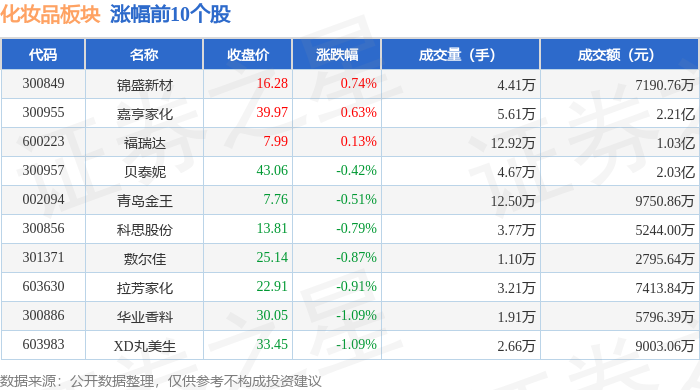
Market Overview - The cosmetics sector experienced a decline of 1.06% on November 14, with Bawei Co. leading the drop [1] - The Shanghai Composite Index closed at 3990.49, down 0.97%, while the Shenzhen Component Index closed at 13216.03, down 1.93% [1] Individual Stock Performance - Notable performers included: - Jinsong New Material (300849) with a closing price of 16.28, up 0.74% [1] - Jiahen Home Care (300955) at 39.97, up 0.63% [1] - Furuida (600223) at 7.99, up 0.13% [1] - Stocks that declined included: - Bawei Co. (920123) at 17.68, down 3.49% [2] - Shuiyang Co. (300740) at 21.02, down 2.28% [2] - Shanghai Jahwa (600315) at 24.20, down 1.63% [2] Capital Flow Analysis - The cosmetics sector saw a net outflow of 75.29 million yuan from institutional investors, while retail investors had a net inflow of 58.41 million yuan [2] - The overall capital flow for individual stocks showed mixed results, with some stocks experiencing significant outflows from institutional investors [3] Detailed Capital Flow for Selected Stocks - Tian Cai Ya (603605) had a net inflow of over 10.27 million yuan from institutional investors, while it faced a net outflow of 20.13 million yuan from retail investors [3] - Jinsong New Material (300849) saw a net inflow of 4.11 million yuan from institutional investors but a net outflow of 4.36 million yuan from retail investors [3] - Jiahen Home Care (300955) experienced a net outflow of 3.05 million yuan from institutional investors, with a significant net inflow of 16.17 million yuan from retail investors [3]



深度 | CDA2025观察:美妆医研共创迈向新高度
FBeauty未来迹· 2025-11-13 14:44
Core Insights - The beauty industry is undergoing a technological transformation, with the integration of medical research driving value upgrades in cosmetics. This dual integration of medicine and beauty is defining a new competitive logic in the industry [3][6][24]. Industry Trends - The 20th China Dermatology Association (CDA) conference showcased over 10,000 dermatologists and more than 100 companies, including both domestic and international beauty brands, highlighting the industry's focus on scientific collaboration [3][4]. - The concept of "medical-research co-creation" emerged as a key theme, with brands actively participating in discussions on how to contribute to the skin science system, moving from mere users of research to active participants in scientific understanding and industry standards [7][24]. Brand Innovations - Winona, a brand known for its scientific foundation, showcased its "NUTE" principle at CDA 2025, which emphasizes clinical needs, unique mechanisms, technology empowerment, and credible evidence in product development [10]. - HBN, a domestic skincare brand, initiated the establishment of a group standard for "Cosmetic Efficacy Evidence Weight Assessment Guidelines," aiming to shift the industry from experience-driven to evidence-based competition [11][13]. - Estee Lauder's Clinique presented a white paper on the causes and distribution patterns of post-inflammatory hyperpigmentation, demonstrating the brand's commitment to scientific validation [14][16]. Research and Development - The integration of research and clinical application is evident in the initiatives taken by brands like Giant Bio and Zhenyan Bio, which are expanding the boundaries of medical-research co-creation through innovative collagen products and clinical studies [20][22]. - The collaboration between brands and medical experts is evolving, with companies like Ximu Yuan conducting extensive research on sensitive skin, showcasing a shift from being mere users of research to contributors to scientific inquiry [24][25]. Future Outlook - The CDA conference highlighted a significant shift in the beauty industry towards a more scientific and collaborative approach, with brands, medical institutions, and research organizations forming a new ecosystem that emphasizes shared data and mutual advancement [47][48]. - The focus on original ingredient research is becoming a core strategy for leading domestic brands, as they aim to differentiate themselves from homogenized competition [38][39].



化妆品板块11月13日涨0.2%,锦盛新材领涨,主力资金净流出5656.82万元
Zheng Xing Xing Ye Ri Bao· 2025-11-13 08:51
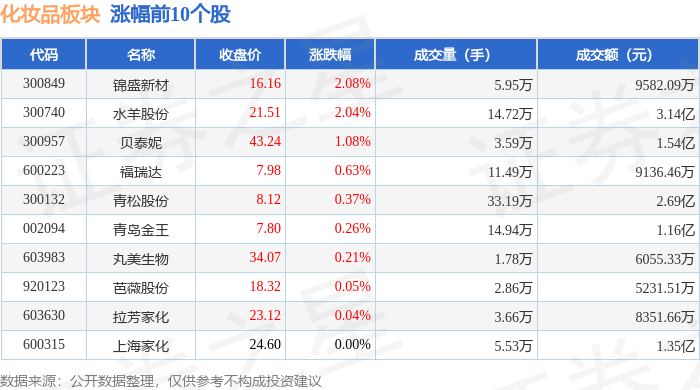
Market Overview - The cosmetics sector increased by 0.2% on November 13, with Jinsheng New Materials leading the gains [1] - The Shanghai Composite Index closed at 4029.5, up 0.73%, while the Shenzhen Component Index closed at 13476.52, up 1.78% [1] Individual Stock Performance - Jinsheng New Materials (300849) closed at 16.16, up 2.08% with a trading volume of 59,500 shares and a transaction value of 95.82 million yuan [1] - Shuiyang Co. (300740) closed at 21.51, up 2.04% with a trading volume of 147,200 shares and a transaction value of 314 million yuan [1] - Beitaini (300957) closed at 43.24, up 1.08% with a trading volume of 35,900 shares and a transaction value of 154 million yuan [1] - Other notable stocks include Furuida (600223) at 7.98 (+0.63%), Qingsong Co. (300132) at 8.12 (+0.37%), and Qingdao Kingway (002094) at 7.80 (+0.26%) [1] Capital Flow Analysis - The cosmetics sector experienced a net outflow of 56.57 million yuan from institutional investors and 32.11 million yuan from retail investors, while individual investors saw a net inflow of 88.67 million yuan [2] - The capital flow for individual stocks shows that Shuiyang Co. had a net inflow of 21.64 million yuan from institutional investors, while other stocks like Huaye Fragrance (300886) and Kesheng Co. (300856) faced net outflows [3]

化妆品板块11月12日涨0.24%,嘉亨家化领涨,主力资金净流出6685.81万元
Zheng Xing Xing Ye Ri Bao· 2025-11-12 08:51
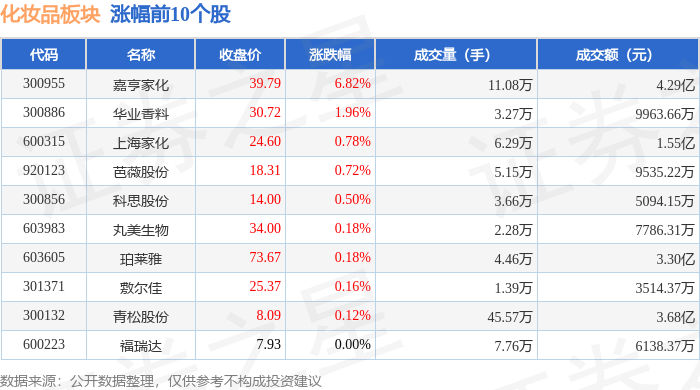
Market Overview - The cosmetics sector increased by 0.24% on November 12, with Jiaheng Jiahua leading the gains [1] - The Shanghai Composite Index closed at 4000.14, down 0.07%, while the Shenzhen Component Index closed at 13240.62, down 0.36% [1] Individual Stock Performance - Jiaheng Jiahua (300955) closed at 39.79, up 6.82% with a trading volume of 110,800 shares and a turnover of 429 million yuan [1] - Huaye Fragrance (300886) closed at 30.72, up 1.96% with a trading volume of 32,700 shares and a turnover of 99.64 million yuan [1] - Shanghai Jahwa (600315) closed at 24.60, up 0.78% with a trading volume of 62,900 shares and a turnover of 15.5 million yuan [1] - Other notable stocks include Bawei Co. (920123) at 18.31, up 0.72%, and Kesheng Co. (300856) at 14.00, up 0.50% [1] Capital Flow Analysis - The cosmetics sector experienced a net outflow of 66.86 million yuan from institutional investors, while retail investors saw a net inflow of 2.95 million yuan [2] - The overall capital flow indicates a mixed sentiment, with institutional investors withdrawing funds while retail investors are entering the market [2] Detailed Capital Flow by Stock - Qing Song Co. (300132) had a net inflow of 5.60 million yuan from institutional investors, while it faced a net outflow of 7.23 million yuan from speculative funds [3] - Shanghai Jahwa (600315) saw a net inflow of 5.19 million yuan from institutional investors but a net outflow of 8.56 million yuan from retail investors [3] - Other stocks like Huaye Fragrance (300886) and Kesheng Co. (300856) also showed varied capital flows, indicating differing investor sentiments across the sector [3]
上海家化的转机,福瑞达们的困局
Xin Lang Cai Jing· 2025-11-12 05:46
Core Insights - The Chinese beauty industry is at a critical juncture, transitioning from rapid growth driven by channels and traffic to a focus on brand value and operational excellence [1] - Recent financial reports from leading domestic beauty companies reveal a divide: some are struggling with transformation pains, while others are rebounding due to strong brand value [1] Group 1: Performance Challenges - Beitaini reported a revenue of 3.464 billion yuan for the first three quarters of 2025, a year-on-year decline of 13.78%, with a net profit of 272 million yuan, down 34.45% [2] - In Q3, Beitaini's revenue was 1.092 billion yuan, a decline of 9.95%, but net profit increased by 136.55% to 25.22 million yuan due to cost-cutting and a shift to high-quality growth [3] - Beitaini's operating costs decreased by 15.75% to 889 million yuan, while sales expenses were 1.838 billion yuan, down 8.55% [6] - Furuida's revenue for the first three quarters was 2.597 billion yuan, down 7.34%, with a net profit of 142 million yuan, a decrease of 17.19% [7] - The brand Yailabo's revenue fell by 28.93% in Q3, indicating a significant decline from its peak performance in 2023 [11] Group 2: Successful Turnarounds - Shanghai Jahwa achieved a revenue of 4.961 billion yuan in the first three quarters of 2025, a 10.8% increase, with net profit soaring by 149.1% to 405 million yuan [12] - The company reported a Q3 revenue of 1.482 billion yuan, up 28.3%, reversing a previous decline [12] - The turnaround is attributed to a strategic focus on core brands and effective brand activation under new CEO Lin Xiaohai, emphasizing brand value as a growth strategy [15][18] Group 3: Industry Trends - The beauty industry is shifting towards a focus on brand value and ecosystem building, moving away from reliance on external factors like channels and marketing [19][23] - New brands face challenges due to the fragmentation of channels and rising costs, leading to a need for deeper brand connections with consumers [19][21] - Established brands like Shanghai Jahwa demonstrate resilience through strong brand recognition and emotional connections with consumers, allowing for rapid recovery when strategic adjustments are made [22] - The industry must prioritize building a multi-brand ecosystem and sustainable financial practices, as seen in Beitaini's recent focus on profitability [24]
商贸零售行业11月投资策略暨三季报总结:三季度行业仍处低位复苏,个股分化趋势依旧突出
Guoxin Securities· 2025-11-11 08:49
Investment Rating - The report maintains an "Outperform" rating for the retail sector [3][58]. Core Insights - The retail industry is experiencing a low-level recovery with significant differentiation among individual stocks. The overall growth rate for the industry has shown a slight decline in the third quarter, with retail sales in the first nine months of 2025 reaching 365,877 billion yuan, a year-on-year increase of 4.5% [1][13]. - The beauty and personal care sector is facing pressure on profitability due to changes in e-commerce platform rules and a lack of innovative products. The gold and jewelry sector is performing well, driven by stable sales of fixed-price products. The cross-border e-commerce sector is showing positive growth, while offline retail continues to face challenges [2][34][42]. Summary by Sections Overall Industry Performance - The retail sector's growth has been relatively stable, with a year-on-year increase of 4.5% in retail sales for the first nine months of 2025. The growth rate has declined in the second half of the year due to a decrease in consumer purchasing power and the tapering of stimulus policies [1][13]. Beauty and Personal Care - The beauty sector's sales reached 328.82 billion yuan in the first three quarters of 2025, growing by 3.9% year-on-year. However, profitability has been under pressure due to weak product launches and changes in promotional strategies [22][28]. Gold and Jewelry - The gold and jewelry sector saw a significant year-on-year growth of 11.5% in retail sales, totaling 276.81 billion yuan in the first three quarters of 2025. The sector benefits from a low base from the previous year and rising gold prices, although profitability has faced challenges [34][41]. Cross-Border E-commerce - Cross-border e-commerce has shown a stable growth trajectory, with a total import and export value of approximately 2.06 trillion yuan in the first three quarters of 2025, reflecting a year-on-year increase of 6.4%. The sector's revenue grew by 15.15% in Q3 2025, driven by strong operational resilience among leading companies [42][48]. Offline Retail - The offline retail sector remains under pressure, with a year-on-year increase of only 3.5% in retail sales for the first three quarters of 2025. The overall revenue for the offline retail sector declined by 15.9% in Q3 2025, indicating ongoing challenges in the market [50][54].


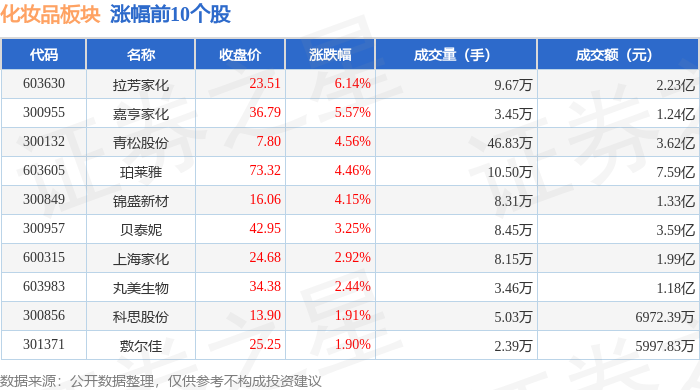
化妆品板块11月10日涨3.13%,拉芳家化领涨,主力资金净流入1.52亿元
Zheng Xing Xing Ye Ri Bao· 2025-11-10 08:49
Core Viewpoint - The cosmetics sector experienced a notable increase of 3.13% on November 10, with Lafang Jiahua leading the gains [1] Group 1: Market Performance - The Shanghai Composite Index closed at 4018.6, up 0.53%, while the Shenzhen Component Index closed at 13427.61, up 0.18% [1] - Lafang Jiahua's stock price rose by 6.14% to 23.51, with a trading volume of 96,700 shares and a transaction value of 223 million [1] - Other notable performers included: - Jiahen Jiahua: 5.57% increase, closing at 36.79 with a transaction value of 124 million [1] - Qingsong Co.: 4.56% increase, closing at 7.80 with a transaction value of 362 million [1] - Proya: 4.46% increase, closing at 73.32 with a transaction value of 759 million [1] Group 2: Fund Flow Analysis - The cosmetics sector saw a net inflow of 152 million from institutional investors, while retail investors experienced a net outflow of 179 million [1] - Key fund flows for selected companies included: - Lafang Jiahua: 22.32 million net inflow from institutional investors, with a net outflow of 11.42 million from retail investors [2] - Beitaini: 34.32 million net inflow from institutional investors, with a net outflow of 13.48 million from retail investors [2] - Shanghai Jahwa: 24.72 million net inflow from institutional investors, with a net outflow of 30.62 million from retail investors [2]