
Shanghai Jahwa(600315)

Search documents
中国化妆品 - 2026 展望:重启更高质量增长;投资回报率改善利好品牌龙头-China Cosmetics_ 2026 Outlook_ Reset for higher-quality growth; improving ROI favors branded leaders
2026-01-20 03:19
Summary of the China Cosmetics 2026 Outlook Industry Overview - The report focuses on the **China Cosmetics** industry, projecting trends and company performances leading into 2026 [3][9]. Key Trends Trend 1: Higher-Quality Channels - **Tmall's Growth**: Anticipated sustained growth in Gross Merchandise Value (GMV) on Tmall, supported by platform strengths such as better product returns and subsidies, increased user loyalty, and stronger brand collaborations [3][4]. - **Government Regulations**: Implementation of stricter tax enforcement limiting promotional costs to 30% of sales for cosmetics, potentially increasing traffic acquisition costs and impacting sales on traffic-dependent platforms like Douyin [3][4]. Trend 2: Product Innovation - **Consumer Preferences**: Shift towards reliability, proven efficacy, and brand trust due to the absence of a dominant ingredient cycle [4][5]. - **Ingredient Trends**: Companies are innovating with new ingredients like PDRN in skincare products, with notable examples including L'Oreal and Proya. Helena Rubinstein has increased the Pro-Xylane content in its flagship product from 30% to 50% [4][5]. Company Insights Mao Geping Cosmetics (MGP) - **Performance**: Upgraded from Neutral to Buy, with expected sales and net income CAGR of 23% and 22% from 2025 to 2027, respectively. MGP is positioned as a local premium player in the Chinese beauty market [9][10]. - **Market Position**: MGP has shown resilience with a 34% sales CAGR from 2021 to 2025 despite market headwinds, supported by a strong omni-channel strategy and consumer engagement [9][10]. Giant Biogene - **Market Leadership**: Recognized as a global leader in recombinant collagen, despite facing a projected sales decline of 21% and 8% in 2H25E and 1H26E, respectively [14][15]. - **Recovery Outlook**: Expected gradual recovery starting in 2H26E, with a projected sales growth of 12% to 17% in 2027, driven by strong product pipelines and market position in skin repair [14][15]. Shanghai Jahwa - **Turnaround Strategy**: Focused on core brands and online channels, achieving significant growth in key cosmetics brands, with Dr. Yu and Herborist showing 40% and 150% growth, respectively [19][20]. - **Future Projections**: Anticipated CAGR of 2% for personal care and cosmetics segments from 2025 to 2027, with cosmetics expected to contribute 35% of total revenue by 2027 [22][19]. Valuation and Risks - **MGP Valuation**: Target price set at HK$105 based on a 28x 2027E P/E, reflecting a premium due to its high growth profile [11][12]. - **Giant Biogene Valuation**: Target price of HK$46 based on a 22x 2027E P/E, with risks including competition and product development challenges [15][16]. - **Jahwa Valuation**: Target price of RMB 28 based on a 30x 2027E P/E, with risks related to overseas business performance and execution in online channels [20][21]. Conclusion - The China cosmetics industry is poised for growth driven by higher-quality channels and product innovation. Companies like MGP, Giant Biogene, and Shanghai Jahwa are positioned to capitalize on these trends, although they face various risks that could impact their performance.

国补高基数下12月社零同增0.9%
HTSC· 2026-01-20 02:02
Investment Rating - The report maintains a "Buy" rating for the consumer discretionary sector, highlighting structural investment opportunities [5][10]. Core Insights - The report indicates that in December, the total retail sales of consumer goods increased by 0.9% year-on-year to 4.5 trillion yuan, with a month-on-month decline of 0.4 percentage points, primarily due to high base effects from durable goods like automobiles and home appliances [7][9]. - The report emphasizes the importance of the new round of trade-in policies for 2026, which focus on core home appliance categories and expand into new categories like smart glasses and products for the elderly, supporting demand in these segments [7]. - The report suggests that consumer sentiment remains strong, particularly in sectors like emotional consumption, technology consumption, and undervalued high-dividend stocks, recommending a focus on domestic brands and global brand expansion [10]. Summary by Sections Retail Sales Performance - In December, retail sales of food and beverages grew by 2.2% and 0.7% respectively, with urban and rural retail sales increasing by 0.7% and 1.7% year-on-year [8]. - Online retail sales of physical goods in December increased by 0.8% year-on-year, with a total annual growth of 5.2%, accounting for 26.1% of total retail sales [8]. Consumer Categories - The report notes a structural differentiation in consumer categories, with home appliances, building materials, and furniture experiencing declines of 18.7%, 11.8%, and 2.2% respectively due to high base effects and trade-in policy impacts [9]. - Conversely, communication equipment saw a significant increase of 20.9% year-on-year, while emotional and self-care products like sports and entertainment goods and cosmetics grew by 9.0% and 8.8% respectively [9]. Investment Recommendations - The report identifies four main investment themes: 1. Rise of domestic brands and global brand expansion, recommending companies like Pop Mart, Shangmei, and Anta Sports [10]. 2. Technology consumption empowered by AI, recommending companies like Midea Group and Haier Smart Home [10]. 3. Emotional consumption, recommending companies like Gu Ming and Yum China [10]. 4. Undervalued high-dividend blue-chip leaders, recommending companies like Li Ning and Shenzhou International [10]. Company-Specific Insights - For Smoore International (6969 HK), the report forecasts a revenue of 10.21 billion yuan for Q1-3 2025, with a year-on-year growth of 21.8%, and maintains a "Buy" rating with a target price of 27.00 HKD [48]. - For Juzhibio (2367 HK), the report highlights the approval of a new collagen product, projecting significant sales potential and maintaining a "Buy" rating with a target price of 85.00 HKD [49]. - For Pop Mart (9992 HK), the report notes a revenue increase of 245-250% in Q3 2025, driven by strong performance in both domestic and international markets, maintaining a "Buy" rating with an updated target price of 410 HKD [51].




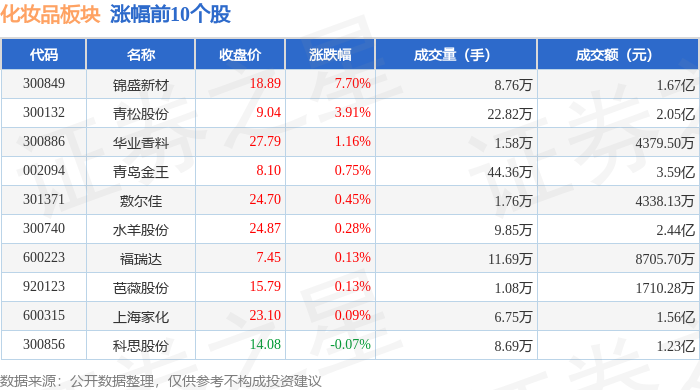
化妆品板块1月19日涨0.09%,锦盛新材领涨,主力资金净流出5088.16万元
Zheng Xing Xing Ye Ri Bao· 2026-01-19 08:58
Group 1 - The cosmetics sector experienced a slight increase of 0.09% on January 19, with Jinsheng New Materials leading the gains [1] - The Shanghai Composite Index closed at 4114.0, up by 0.29%, while the Shenzhen Component Index closed at 14294.05, up by 0.09% [1] - Jinsheng New Materials saw a closing price of 18.89, with a significant increase of 7.70%, and a trading volume of 87,600 shares, amounting to a transaction value of 167 million yuan [1] Group 2 - The cosmetics sector faced a net outflow of 50.88 million yuan from institutional investors, while retail investors saw a net inflow of 42.92 million yuan [2] - The trading data indicates that LaFang Family, with a closing price of 22.58, experienced a decline of 3.30%, with a trading volume of 70,600 shares and a transaction value of 161 million yuan [2] - The individual stock performance shows that Beitaini had a net inflow of 25.48 million yuan from institutional investors, but a net outflow of 39.58 million yuan from retail investors [3]



上海家化:化妆品调研要点-三大品牌为 2026 年核心支柱;产品创新势头延续;给予 “买入” 评级
2026-01-16 02:56
Summary of Shanghai Jahwa United (600315.SS) Conference Call Company Overview - **Company**: Shanghai Jahwa United - **Industry**: Cosmetics Key Takeaways 1. Brand Outlook & Key Initiatives for 2026 - Shanghai Jahwa identifies three brands as key growth pillars for skincare by 2026: Herborist, Dr.Yu, and Liushen - Herborist aims to exceed Rmb1 billion in sales, driven by products like "Dabai Mud" (Rmb300 million) and "Herbal Oil" (Rmb100 million) with projected high double-digit growth [1][2] - Dr.Yu also targets over Rmb1 billion in sales, focusing on sensitive skin creams and new product launches, including a large-molecule sunscreen and Artemisia annua essence [2] - Liushen expects significant growth from its Mosquito Repellent Egg, projected to reach Rmb100 million in sales by 2025, with over 50% growth anticipated [2] 2. Channel Strategy - The company expects Douyin's growth to surpass Tmall's in 2026, enhancing channel efficiency through in-house content creation [1][6] - Current sales distribution: Herborist (60% online), Dr.Yu (80% online), and Liushen (80% offline) with plans to reduce offline sales to 70% by 2026 [9] 3. Profitability and ROE Outlook - After a projected loss in 2024 and a bottoming out in 2025, profit growth is expected to outpace revenue growth in 2026, supported by economies of scale and cost optimization [1][6] - The company plans to achieve growth without significant capital expenditure or increased headcount, leveraging existing factory capacity [6] 4. Long-Term Ambition - Shanghai Jahwa aims for Rmb20 billion in revenue, targeting top-three market share in niche categories like mud, oil, and shower gel [1][7] - Specific long-term targets include Liushen at 10% CAGR, Herborist and Dr.Yu each at Rmb3 billion, and Shuangmei at Rmb1 billion [7] 5. Financial Projections - 12-month price target set at Rmb28, representing a 20.2% upside from the current price of Rmb23.29 [10] - Revenue projections for 2026 estimate Rmb7.1 billion, with EBITDA expected to grow significantly [10] 6. Key Risks - Potential impairment losses from overseas business due to shrinking demand and competition [9] - Risks associated with store closures for Herborist if offline sales continue to decline [9] - Lower-than-expected sales growth for Dr.Yu and execution challenges in online channels [9] Additional Insights - The company is strategically focusing on less competitive niche segments to enhance market share and profitability [1] - Management emphasizes the importance of brand and product development in the near term to achieve long-term goals [1][6]
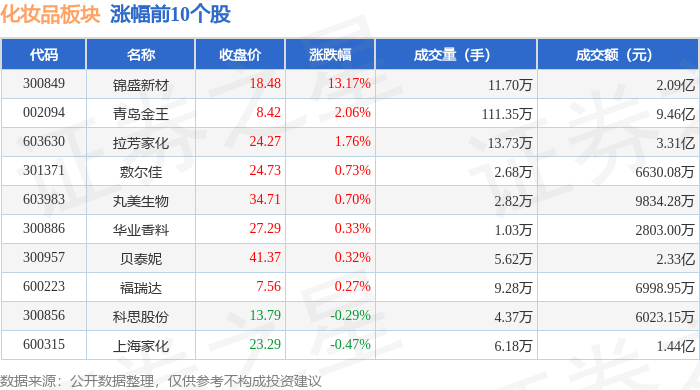
化妆品板块1月15日跌0.36%,水羊股份领跌,主力资金净流出1186.31万元
Zheng Xing Xing Ye Ri Bao· 2026-01-15 08:58
Market Overview - The cosmetics sector experienced a decline of 0.36% on January 15, with Shuiyang Co. leading the drop [1] - The Shanghai Composite Index closed at 4112.6, down 0.33%, while the Shenzhen Component Index closed at 14306.73, up 0.41% [1] Individual Stock Performance - Jinsheng New Material (300849) saw a significant increase of 13.17%, closing at 18.48 with a trading volume of 117,000 shares and a turnover of 209 million yuan [1] - Qingdao Kingway (002094) increased by 2.06%, closing at 8.42 with a trading volume of 1,113,500 shares [1] - Lafang Home (603630) rose by 1.76%, closing at 24.27 with a trading volume of 137,300 shares [1] - Other notable performances include Fulejia (301371) up 0.73%, Marubi Biological (603983) up 0.70%, and Betaini (300957) up 0.32% [1] Capital Flow Analysis - The cosmetics sector saw a net outflow of 11.86 million yuan from institutional investors and 53.27 million yuan from retail investors, while retail investors had a net inflow of 65.13 million yuan [2] - The capital flow for individual stocks indicates that Lafang Home had a net inflow of 77.73 million yuan from institutional investors, while Betaini had a net inflow of 14.81 million yuan [3] - Conversely, Shuiyang Co. experienced a net outflow of 5.39 million yuan from institutional investors [2][3]



中国美妆 2026 年展望:重启高质量增长;ROI 改善利好品牌龙头;上调美即(MGP)至买入(原中性);上海家化-China Cosmetics_ 2026 Outlook_ Reset for higher-quality growth; improving ROI favors branded leaders; Buy MGP (upgrading from Neutral)_Giant_Jahwa
2026-01-13 11:56
Summary of China Cosmetics Sector Conference Call Industry Overview - The China cosmetics sector is expected to experience a reset for higher-quality growth in 2026, moving away from reliance on high-cost Key Opinion Leaders (KOLs) and focusing on popular core SKUs. This shift has led to a contraction in Net Profit Margin (NPM) due to deleveraging impacts, despite improvements in Return on Investment (ROI) [1][2]. Key Trends and Insights - **Consumer Acquisition Costs**: Monitoring new consumer acquisition costs will be critical, especially as channel migration benefits diminish and the ingredient cycle remains ambiguous. Anti-involution policies will also play a significant role [1]. - **Branding Strategy**: Branding is anticipated to be the most effective strategy for consumer engagement and new product launches in 2026. Companies with high repurchase rates and cost-efficient omni-channel strategies are better positioned for success [1][2]. - **Market Dynamics**: The cosmetics market is expected to grow at a normalized rate, with growth projected at less than 1x GDP growth. The market is forecasted to see a 2.1% increase in beauty spending in 2026, with a mix of onshore and offshore market performance [17][18]. Company-Specific Insights - **Mao Geping Cosmetics (MGP)**: Upgraded from Neutral to Buy with a target price increase from HK$89 to HK$105, reflecting a 27% upside. The company is noted for strong branding and a balanced channel presence, with a forecasted sales and net income CAGR of 23% and 22% from 2025 to 2027, respectively [2][9]. - **Giant Biogene**: Maintained as Buy, with a target price lowered from HK$71 to HK$46, indicating a 36% upside. The company is expected to recover with new skincare products and a focus on medical aesthetics, projecting sequential growth of -8%/+12%/+17% YoY for 1H26E/2H26E/2027E [2][9]. - **Shanghai Jahwa**: Target price reduced from RMB 31 to RMB 28, with a 22% upside. The company is on a turnaround trajectory with improving margins and cash flow [2][9]. - **Proya Cosmetics**: Remains Neutral as the company is expected to moderate organic growth while awaiting more execution on white space exploration [2][9]. - **Botanee Biotech**: Neutral rating with early signs of a potential turnaround but lacking clear growth drivers [2][9]. - **Bloomage Biotech**: Maintained as Sell due to downside risks in skincare and muted growth in medical aesthetics amid a mature product cycle [2][9]. Market Performance and Projections - **E-commerce Trends**: Tmall is expected to maintain strong growth momentum, supported by anti-involution measures. Douyin's performance has been softer than expected, with a significant decline in KOL channel performance [19][21]. - **Sales Growth Expectations**: The cosmetics sector is projected to see sustained GMV growth on Tmall, while Douyin is expected to experience a narrowing gap in growth rates compared to Tmall [20][21]. Conclusion - The China cosmetics sector is poised for a shift towards higher-quality growth in 2026, with branding and strategic channel management becoming increasingly important. Companies that adapt to these changes and focus on core products are likely to outperform in the evolving market landscape [1][2][19].


流量失灵,美妆品牌换战场了
3 6 Ke· 2026-01-12 11:49
Core Insights - The beauty industry is undergoing a significant transformation as consumers prioritize product ingredients and efficacy over marketing narratives and brand stories [1][2] - The competition among companies is shifting from traditional marketing to a focus on scientific validation and technical authority, particularly regarding core ingredients [1][3] Group 1: Industry Dynamics - The battle for defining the "ingredient king" is exemplified by the prolonged conflict between Huaxi Biological and Juzhi Biological over recombinant collagen, highlighting the industry's shift towards scientific discourse [1][2] - Companies are increasingly engaged in disputes over intellectual property and scientific narratives, as seen in the conflict between medical company Aierfu and skincare brand Zhanmeiya, which revolves around the storytelling of scientific advancements [3] Group 2: Market Competition - The competition for established, cash-generating scientific products is illustrated by the dispute between Shuiyang Co. and Ruoyu Chen over the agency rights for the Spanish brand "Mestique," which has shown remarkable growth in the Chinese market [5][6] - The financial performance of companies varies significantly, with some experiencing revenue growth alongside increased R&D spending, while others face declining revenues despite high R&D investments [6][7] Group 3: Consumer Behavior - A significant shift in consumer preferences is noted, with 58.8% of consumers prioritizing product ingredients in their purchasing decisions, indicating a growing demand for transparency and efficacy [15][21] - The rise of the "ingredient party" has led to increased scrutiny of product claims, pushing companies to provide credible testing reports and validate their ingredients [15][21] Group 4: Future Trends - The beauty industry's future is marked by a "scientific arms race," with brands striving to establish their authority in scientific research and ingredient validation [8][16] - Companies are exploring unique natural ingredients and integrating skincare with makeup, reflecting a trend towards holistic beauty solutions [20][21]
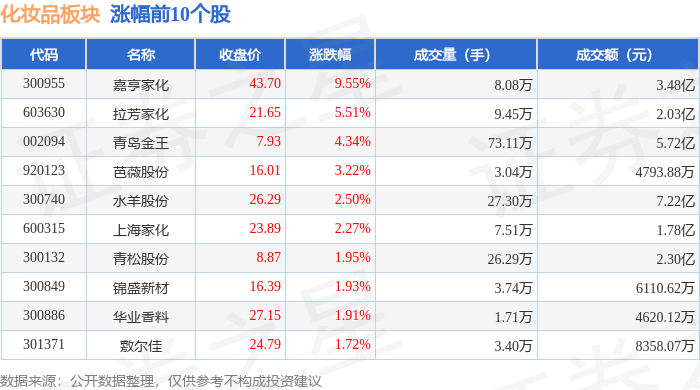
化妆品板块1月12日涨2.16%,嘉亨家化领涨,主力资金净流出7896.75万元
Zheng Xing Xing Ye Ri Bao· 2026-01-12 09:10
Group 1 - The cosmetics sector increased by 2.16% on January 12, with Jiaheng Jiahua leading the gains [1] - The Shanghai Composite Index closed at 4165.29, up 1.09%, while the Shenzhen Component Index closed at 14366.91, up 1.75% [1] - Jiaheng Jiahua's stock price rose by 9.55% to 43.70, with a trading volume of 80,800 shares and a transaction value of 348 million yuan [1] Group 2 - The net outflow of main funds in the cosmetics sector was 78.97 million yuan, while retail investors saw a net inflow of 130 million yuan [1] - Qingdao Jinwang had a main fund net inflow of 26.14 million yuan, but also experienced a retail net outflow of 22.06 million yuan [2] - Lafang Jiahua saw a main fund net inflow of 3.31 million yuan, with retail investors experiencing a net outflow of 8.27 million yuan [2]
上海家化20260109
2026-01-12 01:41
Summary of Shanghai Jahwa Conference Call Company Overview - **Company**: Shanghai Jahwa - **Key Brands**: Yuze, Baicaojie, Liushen Industry Insights - **E-commerce Growth**: Significant growth in online channels, particularly on Douyin, with GMV for Yuze, Baicaojie, and Liushen brands exceeding 50% growth in Q4 2025 [2][3] - **Market Position**: Core platforms like Tmall and Douyin outperformed overall market growth, with strong performance on platforms like JD and Vipshop [3] Core Business Strategies - **Focus on Core Brands**: In 2026, Shanghai Jahwa will concentrate on core brands and product innovation, aiming to add 1 to 5 new billion-yuan products [2][3] - **Product Development**: Introduction of new products such as Baicaojie Xian Cao Oil and Xian Cao Mud, and upgrading Liushen mosquito repellent to version 3.0 [2][3] - **Expansion into New Categories**: Plans to enter the baby and child product category [2][4] Product Highlights - **Baicaojie Xian Cao Oil**: Positioned as a key product for 2026, featuring traditional Chinese medicine ingredients like ginseng and reishi, targeting anti-aging and moisturizing effects [2][5] - **Yuze Brand Focus**: Continued emphasis on dry-sensitive and oil-sensitive creams, with new product launches including SPF 50 sunscreen and artemisinin-based essence [2][4][7] - **Liushen Brand Goals**: Aiming for single-digit growth offline while expecting higher growth online, with a focus on the mosquito repellent product line [3][8] Marketing and Sales Strategies - **Influencer Marketing**: Yuze plans to increase the proportion of influencer marketing, expanding from top-tier to mid-tier influencers to enhance brand visibility [8] - **Sales Performance**: Strong performance during the 2025 Double Eleven shopping festival, with confidence in meeting revenue and profit guidance for 2026 [3][9] Financial and Operational Efficiency - **Cost Management**: Strategies to improve profit margins through revenue growth, operational cost sharing, and internalizing content marketing teams to optimize channel rates [3][10] - **Brand Profitability**: Focus on enhancing profitability for core beauty brands through scale effects and efficiency improvements [10] Other Notable Brands - **Gao Fu and Others**: Notable improvements in Gao Fu's online operations, attracting younger consumers, while brands like Shuang Mei showed significant growth [9] - **Product Upgrades**: Smaller brands like Meijiajing and Qichu are also undergoing product upgrades and new launches to adapt to market trends [9] Conclusion Shanghai Jahwa is strategically positioned for growth in 2026, focusing on core brands, innovative product development, and enhanced marketing strategies to capture market share and improve profitability across its diverse brand portfolio.
化妆品板块1月9日涨1.29%,水羊股份领涨,主力资金净流出3172.78万元
Zheng Xing Xing Ye Ri Bao· 2026-01-09 09:01
Market Overview - The cosmetics sector increased by 1.29% on January 9, with Shuiyang Co., Ltd. leading the gains [1] - The Shanghai Composite Index closed at 4120.43, up 0.92%, while the Shenzhen Component Index closed at 14120.15, up 1.15% [1] Individual Stock Performance - Shuiyang Co., Ltd. (300740) closed at 25.65, up 5.90% with a trading volume of 223,500 shares and a transaction value of 561 million yuan [1] - Qingsong Co., Ltd. (300132) closed at 8.70, up 2.47% with a trading volume of 253,700 shares [1] - Beitaini (300957) closed at 41.20, up 1.85% with a trading volume of 163,500 shares and a transaction value of 261 million yuan [1] - Other notable stocks include Furuida (600223) at 7.53 (+1.76%), Jiaheng Jiahua (300955) at 39.89 (+1.68%), and Huaye Fragrance (300886) at 26.64 (+1.06%) [1] Capital Flow Analysis - The cosmetics sector experienced a net outflow of 31.72 million yuan from institutional investors and 34.45 million yuan from speculative funds, while retail investors saw a net inflow of 66.18 million yuan [2] - Individual stock capital flows indicate that Qindao Jinwang (002094) had a net inflow of 13.96 million yuan from institutional investors, while it faced a net outflow of 1.23 million yuan from speculative funds [3] - Other stocks like Qingsong Co., Ltd. (300132) and Beitaini (300957) also showed mixed capital flows, with varying levels of net inflows and outflows from different investor categories [3]

