HLGF(600346)

Search documents
2025年上半年中国合成纤维产量为3890.1万吨 累计增长5%
Chan Ye Xin Xi Wang· 2025-08-20 03:40
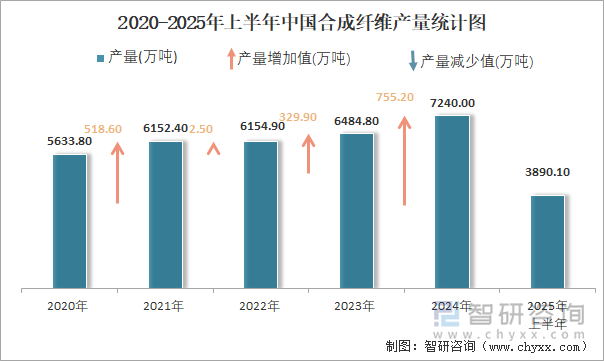
Group 1 - The core viewpoint of the article highlights the growth potential of China's synthetic fiber industry, with a projected production increase of 4.5% year-on-year by June 2025, reaching 6.75 million tons [1] - In the first half of 2025, China's cumulative synthetic fiber production is expected to reach 38.901 million tons, reflecting a cumulative growth of 5% [1] - The article references several listed companies in the synthetic fiber sector, including Hengyi Petrochemical, Rongsheng Petrochemical, and Xin Fengming, indicating a focus on key players in the industry [1] Group 2 - The report titled "2025-2031 China Synthetic Fiber Industry Market Status Survey and Development Trend Analysis" by Zhiyan Consulting provides insights into the market dynamics and future trends of the synthetic fiber industry [1] - Zhiyan Consulting is recognized as a leading industry consulting firm in China, specializing in comprehensive industry research and providing tailored consulting services [2] - The data utilized in the article is sourced from the National Bureau of Statistics and organized by Zhiyan Consulting, ensuring reliability and accuracy [3]


低位品种·化工ETF(159870)5天净流入近11.7亿份,最新规模超53亿断层第一
Sou Hu Cai Jing· 2025-08-20 03:25
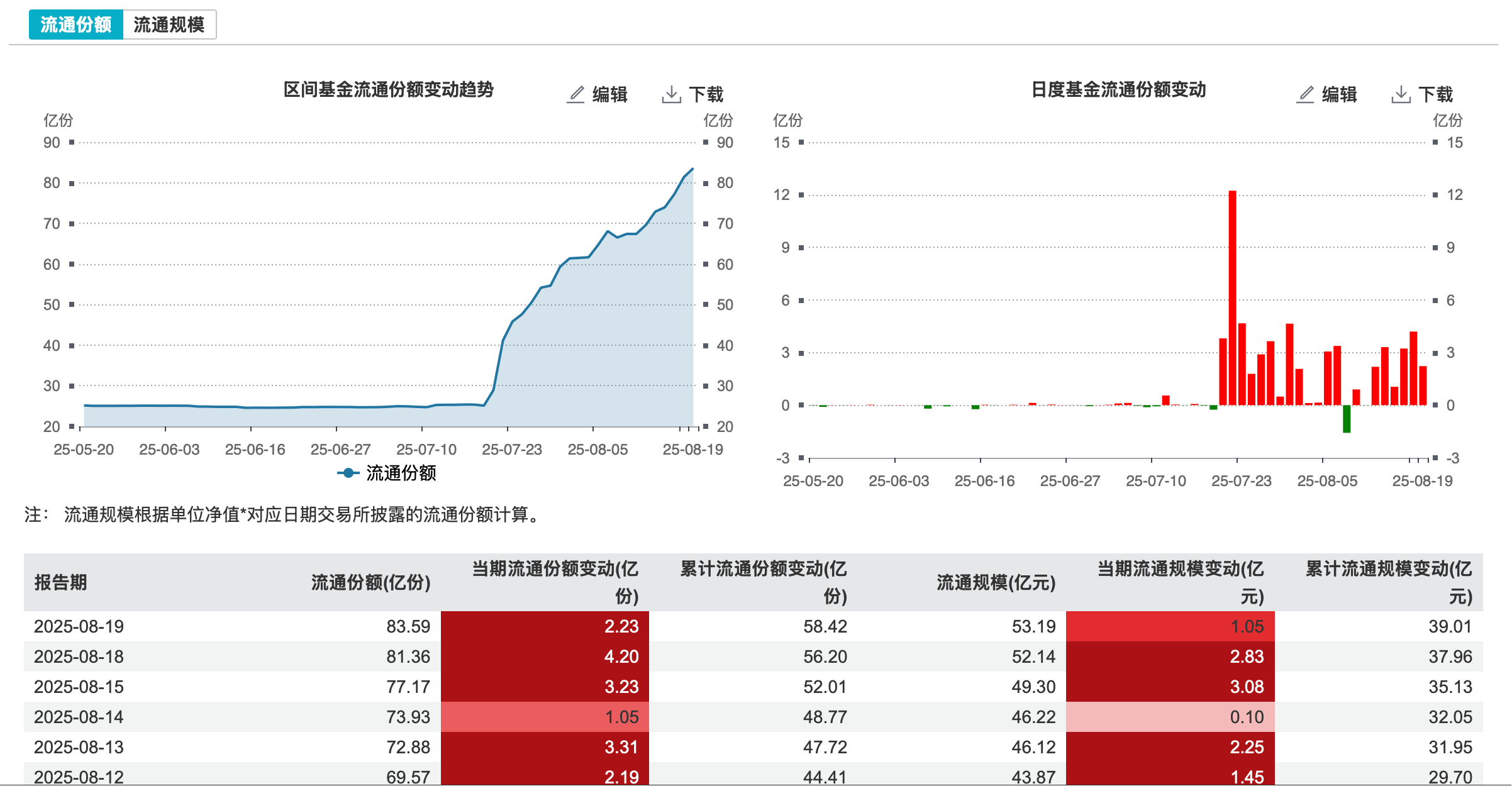
Group 1 - As of August 19, 2023, the National Social Security Fund has invested in 89 stocks among the top ten circulating shareholders, with the basic chemical industry being the most favored, holding 11 stocks with a total market value of 4.075 billion yuan [1] - Minsheng Securities suggests looking for stocks with good performance in the second quarter, particularly in the new materials industry benefiting from AI capital investment and industry leaders in segments affected by U.S. tariff conflicts [1] - The export window for phosphate fertilizer is approaching, with high demand expected to continue. The export guidance indicates that exports may occur in phases, with the first batch concentrated from May to September, and the total export quota for 2025 is expected to decrease compared to last year [1] Group 2 - As of August 20, 2025, the CSI Sub-Industry Chemical Theme Index (000813) increased by 0.39%, with notable stock performances including Lianhong New Science (up 10.01%) and Yuntianhua (up 4.84%) [2] - The Chemical ETF (159870) rose by 0.63%, with a latest price of 0.64 yuan and a net subscription of 100 million shares during the trading session [2] - The CSI Sub-Industry Chemical Theme Index tracks the performance of large and liquid listed companies in the chemical sector, reflecting the overall performance of these companies [4] Group 3 - As of July 31, 2025, the top ten weighted stocks in the CSI Sub-Industry Chemical Theme Index include Wanhua Chemical, Salt Lake Potash, and Juhua Co., with these stocks accounting for 43.54% of the total index weight [5]



恒力石化股价小幅回落 上半年净利润同比下降24.09%
Sou Hu Cai Jing· 2025-08-19 15:27
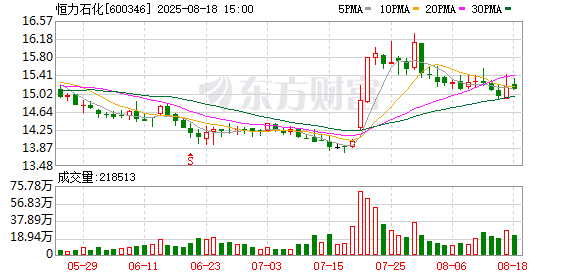
Core Viewpoint - Hengli Petrochemical's stock price experienced a decline, reflecting challenges in the petrochemical industry and a forecasted drop in profits for the first half of 2025 [1] Company Overview - Hengli Petrochemical's main business includes the production and sales of refining, aromatics, and olefins, establishing a complete industrial chain from crude oil to new chemical materials [1] - The company focuses on the consumer market and new materials, aiming to build an integrated chemical enterprise [1] Financial Performance - The company disclosed an earnings forecast on August 18, predicting a net profit attributable to shareholders of 3.05 billion yuan for the first half of 2025, a year-on-year decrease of 24.09% [1] - The forecasted net profit excluding non-recurring items is 2.296 billion yuan, representing a year-on-year decline of 35.18% [1] - The announcement indicated that the petrochemical industry's demand continues to show weak recovery, with significant downturns in the aromatics and oil products industry chain [1] Market Activity - On August 19, the stock closed at 15.01 yuan, down 0.73% from the previous trading day, with a trading volume of 187,740 hands and a transaction amount of 283 million yuan [1] - The intraday stock price fluctuated between 15.00 yuan and 15.28 yuan, with an amplitude of 1.85% [1] - On the same day, there was a net outflow of 2.2882 million yuan in main funds, with a cumulative net outflow of 70.7956 million yuan over the past five trading days [1]
恒力石化:关于2024年度第二期短期融资券(科创票据)兑付完成的公告
Zheng Quan Ri Bao Zhi Sheng· 2025-08-19 13:14
证券日报网讯 8月19日晚间,恒力石化发布公告称,公司于2024年8月16日在全国银行间市场成功发行 了2024年度第二期短期融资券(科创票据)。本期短期融资券发行总额10亿元人民币,票面利率 2.15%,期限为365日,兑付日期为2025年8月20日。截至本公告日,公司已完成2024年度第二期短期融 资券(科创票据)兑付工作,本息兑付总额为102,150万元人民币。 (编辑 任世碧) ...
恒力石化(600346) - 恒力石化关于2024年度第二期短期融资券(科创票据)兑付完成的公告
2025-08-19 11:36
截止本公告日,公司已完成2024年度第二期短期融资券(科创票据)兑付工 作,本息兑付总额为102,150万元人民币。 特此公告。 证券代码:600346 证券简称:恒力石化 公告编号:2025-049 恒力石化股份有限公司 关于2024年度第二期短期融资券(科创票据) 兑付完成的公告 本公司董事会及全体董事保证本公告内容不存在任何虚假记载、误导性陈述 或者重大遗漏,并对其内容的真实性、准确性和完整性承担法律责任。 恒力石化股份有限公司(以下简称"公司")于2024年8月16日在全国银行间 市场成功发行了2024年度第二期短期融资券(科创票据)。本期短期融资券发行 总额10亿元人民币,票面利率2.15%,期限为365日,兑付日期为2025年8月20日。 具体内容详见公司于2024年8月21日在指定信息披露媒体及上海证券交易所网站 (www.sse.com.cn)披露的《关于2024年度第二期短期融资券(科创票据)发行 结果的公告》(公告编号:2024-046)。 恒力石化股份有限公司 恒力石化股份有限公司董事会 2025 年 8 月 20 日 ...
炼化及贸易板块8月19日跌0.55%,统一股份领跌,主力资金净流出3.91亿元
Zheng Xing Xing Ye Ri Bao· 2025-08-19 08:37
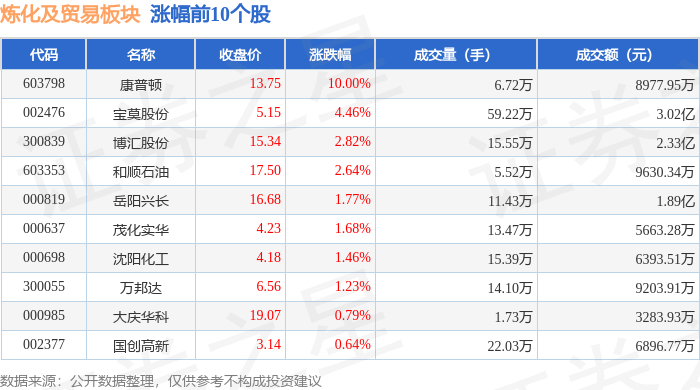
Market Overview - The refining and trading sector experienced a decline of 0.55% on August 19, with Unified Corporation leading the drop [1] - The Shanghai Composite Index closed at 3727.29, down 0.02%, while the Shenzhen Component Index closed at 11821.63, down 0.12% [1] Stock Performance - Notable gainers in the refining and trading sector included: - Kangzhidun (603798) with a closing price of 13.75, up 10.00% [1] - Yucao Co. (002476) with a closing price of 5.15, up 4.46% [1] - Bohui Co. (300839) with a closing price of 15.34, up 2.82% [1] - Major decliners included: - Unified Corporation (600506) with a closing price of 22.21, down 3.18% [2] - Hengyi Petrochemical (000703) with a closing price of 6.05, down 2.10% [2] - Yuxin Co. (002986) with a closing price of 12.48, down 1.65% [2] Capital Flow - The refining and trading sector saw a net outflow of 391 million yuan from main funds, while retail investors contributed a net inflow of 240 million yuan [2] - The sector's capital flow details indicate: - Kangzhidun (603798) had a net inflow of 26.49 million yuan from main funds [3] - Unified Corporation (000819) had a net inflow of 20.99 million yuan from main funds [3] - Yucao Co. (002476) had a net inflow of 16.84 million yuan from main funds [3]


恒力石化股价微跌0.33% 上半年净利润预计30.5亿元
Sou Hu Cai Jing· 2025-08-18 15:56
Group 1 - The core point of the article highlights that Hengli Petrochemical's stock price closed at 15.12 yuan on August 18, with a slight decline of 0.05 yuan, representing a drop of 0.33% [1] - The company is a leading player in the petrochemical industry in China, with its main business covering oil refining, aromatics, olefins, PTA, and polyester new materials [1] - Hengli Petrochemical released a performance forecast indicating an expected net profit of approximately 3.05 billion yuan for the first half of 2025, which reflects a year-on-year decrease of about 24.09% [1] Group 2 - The company attributes the performance decline to weak domestic petrochemical demand, downturn in the aromatics and oil products industry chain, and fluctuations in international oil prices [1] - On August 18, the net inflow of main funds was 3.4935 million yuan, while the net outflow over the past five days reached 67.9557 million yuan [1]
恒力石化(600346.SH)发预减,预计上半年归母净利润30.5亿元,同比减少24.09%
智通财经网· 2025-08-18 14:49
Core Viewpoint - Hengli Petrochemical (600346.SH) expects a significant decline in net profit for the first half of 2025, projecting a decrease of approximately 24.09% year-on-year [1] Financial Performance - The company anticipates a net profit attributable to shareholders of around 3.05 billion yuan, down by approximately 968 million yuan compared to the same period last year, reflecting a year-on-year decrease of about 24.09% [1] - After excluding non-recurring gains and losses, the expected net profit is around 2.30 billion yuan, which represents a decrease of approximately 1.25 billion yuan year-on-year, equating to a decline of about 35.18% [1] Operational Factors - In the second quarter, the company conducted planned maintenance on its ethylene unit, leading to a reduction in the load rate of the ethylene unit, which negatively impacted the production volume and unit cost level of olefin products [1]
恒力石化: 恒力石化2025年半年度业绩预告的自愿性披露公告
Zheng Quan Zhi Xing· 2025-08-18 14:08
Group 1 - The company forecasts a net profit of approximately 30.50 billion yuan, representing a decrease of about 9.68 billion yuan or 24.09% compared to the same period last year [2][3] - The profit is expected to be around 22.96 billion yuan, which is a decrease of approximately 12.46 billion yuan or 35.18% year-on-year [2][3] - The main reasons for the performance change include a weak recovery in domestic petrochemical demand and significant declines in the aromatics and oil products sectors compared to the same period last year [2][3] Group 2 - In the second quarter, the company conducted planned maintenance on its ethylene unit, leading to a decline in the unit's load rate, which affected the production and cost levels of olefin products [3] - The company has been focusing on optimizing operations, flexible management, and risk control, maintaining a leading position in the industry despite the challenges [3]
恒力石化:预计2025年上半年净利润为30.5亿元左右
Mei Ri Jing Ji Xin Wen· 2025-08-18 14:01
Core Viewpoint - Hengli Petrochemical expects a net profit of approximately 3.05 billion yuan for the first half of 2025, representing a decrease of about 968 million yuan or a year-on-year decline of approximately 24.09% [2] Industry Summary - The overall demand for petrochemicals in China continued to show a weak recovery trend in the first half of this year, following the pattern from the second half of last year [2] - The aromatic and oil product industry chains experienced a significant decline in profitability compared to the same period last year, while the olefins, PTA, and downstream polyester new materials industry chains maintained relatively stable profitability [2] - International oil prices experienced significant volatility in the second quarter due to global geopolitical and tariff events, posing challenges to the company's operational stability and raw material cost inventory management [2]