
HLGF(600346)

Search documents
石油ETF(561360)涨1.24%,半日成交额1.77亿元
Xin Lang Cai Jing· 2026-02-11 03:45
Group 1 - The core viewpoint of the article highlights the performance of the Oil ETF (561360), which rose by 1.24% to 1.473 yuan with a trading volume of 177 million yuan as of the midday close [1] - Major holdings in the Oil ETF include China National Petroleum, which increased by 0.56%, China National Offshore Oil Corporation up by 0.52%, and Sinopec up by 0.31% [1] - The Oil ETF's performance benchmark is the CSI Oil and Gas Industry Index return, managed by Guotai Fund Management Company, with a return of 45.33% since its establishment on October 23, 2023, and a return of 14.42% over the past month [1] Group 2 - Notable stock performances within the ETF include Henglian Petrochemical rising by 6.29%, Rongsheng Petrochemical increasing by 4.38%, and Intercontinental Oil and Gas up by 3.61%, while China Merchants Energy fell by 1.54% and COSCO Shipping Energy dropped by 0.53% [1]





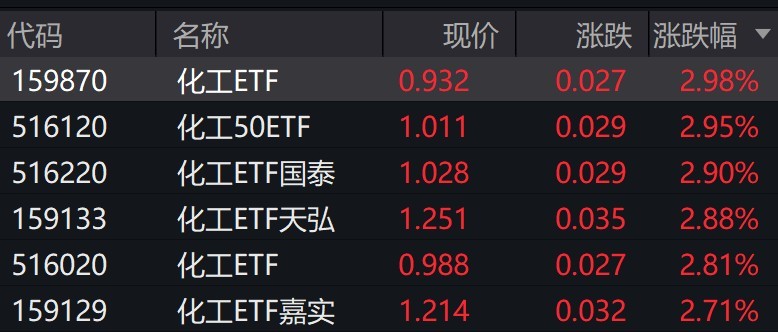
化工概念股走强,化工相关ETF涨近3%
Mei Ri Jing Ji Xin Wen· 2026-02-11 03:09
Group 1 - Chemical concept stocks strengthened, with Hengli Petrochemical rising over 6%, and Wanhua Chemical and Yuntianhua both increasing over 4% [1] - Chemical-related ETFs rose nearly 3% due to market influences [1] Group 2 - In the agricultural chemical sector, the spring farming preparation for fertilizers is gradually starting, leading to a traditional demand peak in the fertilizer market, with recent structural price increases in domestic fertilizers [2] - In the textile and apparel sector, from March to April each year, downstream textile companies concentrate on purchasing chemical fiber raw materials to meet production needs for spring and summer clothing and home textiles, with low inventory chemical fiber varieties expected to show price elasticity [2]




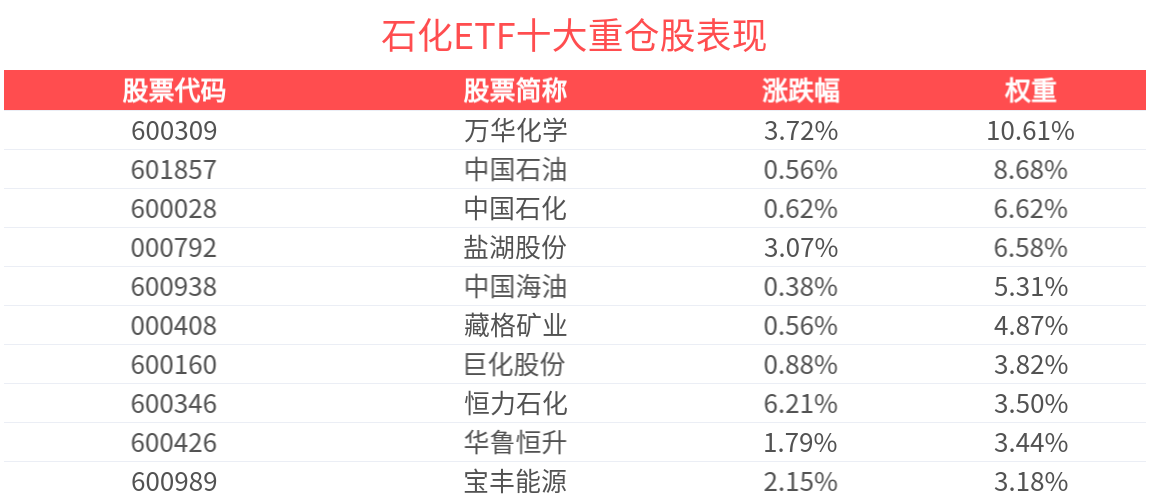
有色金属、石化等周期概念板块爆发,石化ETF(159731)涨2.35%
Sou Hu Cai Jing· 2026-02-11 03:06
Group 1 - The core viewpoint of the articles highlights the strong performance of cyclical sectors such as petrochemicals, precious metals, and agriculture, with the Petrochemical ETF (159731) rising by 2.35% and individual stocks like Tongkun Co. and Xin Fengming increasing by 7.06% and 6.96% respectively [1] - The Petrochemical ETF has seen continuous net inflows over the past four days, totaling 76.6445 million, with its latest share count reaching 1.768 billion and total assets hitting 1.805 billion, both marking all-time highs since inception [1] - Huazhang Securities notes that lithium prices are experiencing a high-level decline, while demand in the energy storage sector is exceeding expectations, leading to a recovery in the lithium battery industry and a shift in market sentiment regarding lithium demand [1] Group 2 - The Petrochemical ETF (159731) closely tracks the CSI Petrochemical Industry Index, benefiting from both basic chemicals and oil & petrochemical sectors, and includes high dividend and high growth assets [2] - Key weighted stocks in the ETF include Wanhua Chemical (global MDI leader), China Petroleum (domestic oil and gas leader), China Petrochemical (domestic refining leader), and Salt Lake Potash (domestic potassium fertilizer leader) [2] - The table lists the performance and weight of key stocks within the ETF, with Wanhua Chemical showing a rise of 3.72% and holding a weight of 10.61% [4]


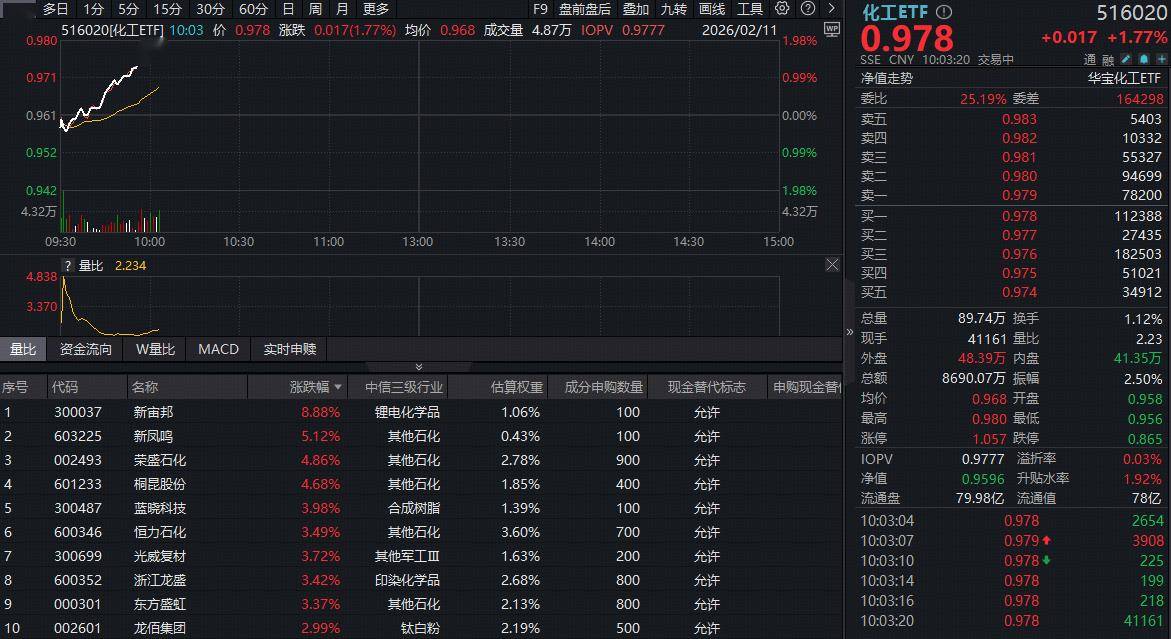
ETF盘中资讯|外资巨头频频唱多!化工板块开盘猛拉,化工ETF(516020)涨近2%!景气拐点或至?
Sou Hu Cai Jing· 2026-02-11 02:38
Group 1 - The chemical sector is experiencing a rebound, with the chemical ETF (516020) showing a significant increase of 1.77% as of the report, peaking at a 1.98% rise during the trading session [1][2] - Key stocks in the sector include New Chemical Materials, which surged over 8%, and other notable gainers such as New Fengming, Rongsheng Petrochemical, and Tongkun Co., all showing increases of over 4% [1][2] - Recent reports from major foreign investment firms, including UBS and Morgan Stanley, have upgraded their outlook on the Chinese chemical industry, predicting a new upward cycle from 2026 to 2028 due to multiple positive factors [1][3] Group 2 - Guohai Securities suggests that the re-evaluation of the Chinese chemical industry could lead to a significant slowdown in global capacity expansion, potentially transforming the industry from a cash-consuming entity to a cash-generating one [3] - The chemical ETF (516020) tracks the CSI sub-sector chemical industry index, covering popular themes such as AI computing power, de-involution, robotics, and new energy [3]


外资巨头频频唱多!化工板块开盘猛拉,化工ETF(516020)涨近2%!景气拐点或至?
Xin Lang Cai Jing· 2026-02-11 02:15
Group 1 - The chemical sector continues to rebound, with the Chemical ETF (516020) showing a maximum intraday increase of 1.98% and a current increase of 1.77% as of the report [1][7] - Key stocks in the petrochemical and lithium battery sectors have seen significant gains, with New Zhou Bang rising over 8%, Xin Feng Ming increasing over 5%, and several others like Rongsheng Petrochemical and Tongkun Co. rising over 4% [1][7] - Recent reports from major foreign investment firms, including UBS and Morgan Stanley, are optimistic about the Chinese chemical industry, predicting a new upward cycle from 2026 to 2028 due to multiple positive factors [1][9] Group 2 - Guohai Securities suggests that the re-evaluation of the Chinese chemical industry could lead to a significant slowdown in global chemical capacity expansion, enhancing potential dividend yields and transforming the industry from a cash-consuming entity to a cash-generating one [3][9] - The Chemical ETF (516020) tracks the CSI sub-sector chemical industry theme index, covering popular themes such as AI computing power, anti-involution, robotics, and new energy, making it an efficient way to invest in the sector [3][9]
——石油化工2025年报业绩前瞻:油价中枢回落,2025Q4聚酯价差改善,上游业绩承压、下游景气分化
Shenwan Hongyuan Securities· 2026-02-10 09:14
Investment Rating - The report maintains a neutral outlook on the oil and petrochemical industry, indicating that the industry is expected to perform in line with the overall market [3][12]. Core Insights - The report highlights a decline in crude oil prices in Q4 2025, with Brent crude averaging $63.1 per barrel, down 7.4% quarter-on-quarter and 14.7% year-on-year [3][4]. - The petrochemical sector is experiencing a mixed performance, with upstream operations facing pressure while downstream profitability is showing signs of improvement [3]. - The report forecasts a tightening supply-demand balance in the polyester sector, suggesting potential for improved market conditions [3]. Summary by Sections Price Trends - In Q4 2025, Brent crude oil prices averaged $63.1 per barrel, with a range of $59-66 per barrel. Gasoline and diesel prices were adjusted downwards by 325 CNY/ton and 340 CNY/ton respectively [3][4]. - Key petrochemical products showed varied price movements, with notable declines in prices for polyethylene and polypropylene, down 16% and 14.2% year-on-year respectively [4]. Price Differentials - The report notes that the price differential for crude oil catalytic cracking increased to 1374 CNY/ton, up 12.5% quarter-on-quarter, while the differential for ethylene from naphtha decreased by 20.1% [5][6]. - The price differential for PX and PTA expanded, indicating improved margins in the polyester chain [5][6]. Company Performance Forecasts - The report provides earnings forecasts for key companies in the sector, predicting a net profit of 27 billion CNY for China National Petroleum Corporation (CNPC), down 16% year-on-year, while China National Offshore Oil Corporation (CNOOC) is expected to see a profit of 30 billion CNY, up 41% year-on-year [3][7]. - Other companies such as Hengli Petrochemical and Rongsheng Petrochemical are also highlighted, with expected profits of 1.7 billion CNY and 250 million CNY respectively [3][7]. Investment Recommendations - The report recommends focusing on high-quality companies in the polyester sector, such as Tongkun Co. and Wan Kai New Materials, as well as large refining companies like Hengli Petrochemical and Rongsheng Petrochemical due to expected improvements in cost structures [3]. - It also suggests maintaining a positive outlook on offshore oil service companies like CNOOC and Haiyou Engineering, anticipating continued high demand in offshore capital expenditures [3].

石油化工2025年报业绩前瞻:油价中枢回落,2025Q4聚酯价差改善,上游业绩承压、下游景气分化
Shenwan Hongyuan Securities· 2026-02-10 08:10
Investment Rating - The report maintains an "Overweight" rating for the petrochemical industry, indicating a positive outlook compared to the overall market performance [3]. Core Insights - The report highlights a decline in crude oil prices in Q4 2025, with Brent crude averaging $63.1 per barrel, down 7.4% quarter-on-quarter and 14.7% year-on-year [3]. - The report anticipates a mixed performance across the petrochemical sector, with upstream performance under pressure while downstream sectors show signs of improvement [3]. - Key companies in the industry are expected to experience varied profit margins, with some facing significant declines while others show resilience [3]. Summary by Sections Price Trends - Brent crude oil price in Q4 2025 was $63.1 per barrel, down 7.5% from Q3 and 14.8% year-on-year [4]. - Key petrochemical products such as methanol and polypropylene saw price declines of 8.2% and 8.3% respectively in Q4 2025 compared to Q3 [4]. Price Differentials - The report notes that the price differential for crude oil catalytic cracking increased by 12.5% quarter-on-quarter, reaching 1374 RMB/ton [5]. - The price differential for PX-Nafta increased by 7.6% quarter-on-quarter, indicating a positive trend for certain segments [6]. Company Performance Forecasts - China National Petroleum Corporation (CNPC) is projected to have a net profit of 27 billion RMB in Q4 2025, a decrease of 16% year-on-year [3]. - Sinopec is expected to face significant impairment pressures, with a projected net profit of only 500 million RMB, down 92% year-on-year [3]. - The report forecasts a net profit of 14 billion RMB for Satellite Chemical, reflecting a 41% decline year-on-year but a 38% increase quarter-on-quarter [3]. Investment Recommendations - The report recommends focusing on high-quality companies in the polyester sector, such as Tongkun Co., and bottle-grade PET producers like Wankai New Materials [3]. - It suggests monitoring large refining companies like Hengli Petrochemical and Rongsheng Petrochemical due to expected improvements in cost structures [3]. - The report also highlights the potential of offshore oil service companies, recommending firms like CNOOC Services and Offshore Oil Engineering for their strong performance outlook [3].
石油ETF(561360)开盘涨0.07%,重仓股中国石油涨0.37%,中国海油涨0.59%
Xin Lang Cai Jing· 2026-02-10 03:29
Group 1 - The core viewpoint of the article highlights the performance of the Oil ETF (561360), which opened with a slight increase of 0.07% at 1.453 yuan [1] - The major holdings of the Oil ETF include China National Petroleum Corporation, which rose by 0.37%, China National Offshore Oil Corporation, which increased by 0.59%, and Sinopec, which saw a rise of 0.15% [1] - The ETF's performance benchmark is the CSI Oil and Gas Industry Index return, managed by Guotai Fund Management Co., Ltd., with a return of 44.70% since its establishment on October 23, 2023, and a return of 13.93% over the past month [1] Group 2 - Other notable stock performances within the ETF include Jereh Group, which fell by 0.34%, and China Merchants Energy, which decreased by 0.25%, while Guanghui Energy remained unchanged [1] - The article provides a detailed overview of the ETF's performance metrics, indicating a diverse range of stock movements among its holdings [1]
石油化工行业周报(2026/2/2—2026/2/8):长丝原料成本支撑稳固,节后刚需补库行情可期-20260209
Shenwan Hongyuan Securities· 2026-02-09 11:17
Investment Rating - The report maintains a positive investment outlook for the polyester sector, particularly recommending high-quality companies in the polyester filament and bottle chip segments [6][13]. Core Insights - The report highlights that the cost support for polyester filament remains solid, with expectations for inventory replenishment post-holiday. The operating rate of polyester filament has significantly decreased, laying a foundation for recovery after the Spring Festival [6][7]. - Polyester filament inventory has been consistently declining since the beginning of 2026, with downstream textile raw material inventory also at low levels, indicating a strong demand for replenishment after the holiday [7][11]. - The price spread of polyester filament has improved significantly, with cost support expected to remain strong due to stable raw material prices and proactive supply adjustments [11][13]. Summary by Sections Supply and Demand Dynamics - The operating rate of polyester filament has dropped to 79.65%, down approximately 16 percentage points from previous highs, as companies conduct maintenance ahead of the holiday [6]. - Downstream textile operating rates have fallen to 25.15%, marking a low for the year, which is expected to lead to a rigid demand for inventory replenishment post-holiday [6][7]. Price Trends - As of February 6, 2026, the price spreads for polyester filament POY, FDY, and DTY are 1375, 1575, and 2475 CNY/ton respectively, indicating a recovery in price spreads since late January 2026 [11]. - The PTA price, a key raw material for polyester filament, remains high, with limited downward pressure expected, providing solid support for filament prices throughout the year [11][13]. Company Recommendations - The report recommends focusing on high-quality companies in the polyester filament sector such as Tongkun Co., Ltd. and in the bottle chip sector like Wankai New Materials. It also suggests monitoring leading refining companies such as Hengli Petrochemical and Rongsheng Petrochemical due to expected improvements in cost structures [13][15].

石油化工行业周报:长丝原料成本支撑稳固,节后刚需补库行情可期-20260209
Shenwan Hongyuan Securities· 2026-02-09 07:46
Investment Rating - The report maintains a positive outlook on the polyester filament industry, indicating a "Buy" recommendation for quality companies in this sector [5][14]. Core Insights - The cost support for polyester filament raw materials remains solid, with expectations for a post-holiday inventory replenishment trend. The industry is currently in a seasonal lull before the Spring Festival, but proactive supply adjustments are laying the groundwork for recovery after the holiday [5][6]. - As of February 6, 2026, the operating rate for downstream textile production has dropped to 25.15%, while the operating rate for polyester filament has decreased to 79.65%. This decline is attributed to seasonal maintenance and self-regulated production cuts, effectively alleviating supply pressure [5][6]. - Inventory levels for polyester filament (POY/FDY/DTY) are at historical lows, with respective days of inventory at 12.7, 15.8, and 19.4 days. Downstream raw material inventory has also fallen to a historical low of 8.74 days, indicating a clear need for replenishment post-holiday [5][7]. - The price spread for polyester filament has significantly improved since late January 2026, with POY/FDY/DTY spreads recovering to 1375, 1575, and 2475 CNY/ton respectively. The PTA cost support remains robust, with no major new PTA facilities expected to come online in 2026, suggesting a tight supply-demand balance that will continue to support filament prices [5][12]. Summary by Sections Upstream Sector - Brent crude oil prices have decreased, with the closing price on February 6, 2026, at 68.05 USD/barrel, down 3.73% from the previous week. The WTI price was 63.55 USD/barrel, down 2.55% [21]. - As of January 30, 2026, U.S. commercial crude oil inventories stood at 420 million barrels, a decrease of 3.455 million barrels from the previous week, marking a 4% decline compared to the past five years [23]. Refining Sector - The comprehensive price spread for major refined products in Singapore increased to 15.63 USD/barrel as of February 6, 2026, reflecting a rise of 6.2 USD/barrel from the previous week [60]. - The price spread for gasoline (RBOB) against WTI crude oil was 18.4 USD/barrel, up 1.8 USD/barrel from the previous week, although still below the historical average of 24.5 USD/barrel [63]. Polyester Sector - The profitability of PTA has increased, while the profitability of polyester filament has decreased. As of February 4, 2026, the average price of PX in Asia was 904.93 USD/ton, down 1.78% week-on-week [5][14]. - The overall performance of the polyester industry is currently average, with expectations for gradual improvement as new production capacities are expected to taper off in the coming years [5][14].