JAC(600418)

Search documents
汽车行业资金流入榜:飞龙股份等12股净流入资金超亿元
Zheng Quan Shi Bao Wang· 2025-12-25 09:10
| 300680 | 隆盛科技 | 6.83 | 16.14 | 12977.94 | | --- | --- | --- | --- | --- | | 600418 | 江淮汽车 | 0.96 | 1.68 | 10047.22 | | 002048 | 宁波华翔 | 5.78 | 6.76 | 9735.31 | | 002870 | 香山股份 | 10.01 | 9.35 | 9106.44 | | 301005 | 超捷股份 | 20.00 | 22.26 | 8872.54 | | 300100 | 双林股份 | 5.70 | 4.17 | 8428.72 | | 000887 | 中鼎股份 | 1.01 | 2.84 | 6366.29 | | 603179 | 新泉股份 | 4.22 | 2.72 | 5346.92 | | 603009 | 北特科技 | 3.86 | 3.09 | 5121.11 | | 002472 | 双环传动 | 4.57 | 3.66 | 5061.48 | 汽车行业资金流出榜 沪指12月25日上涨0.47%,申万所属行业中,今日上涨的有25个,涨幅居前的行业为国防 ...



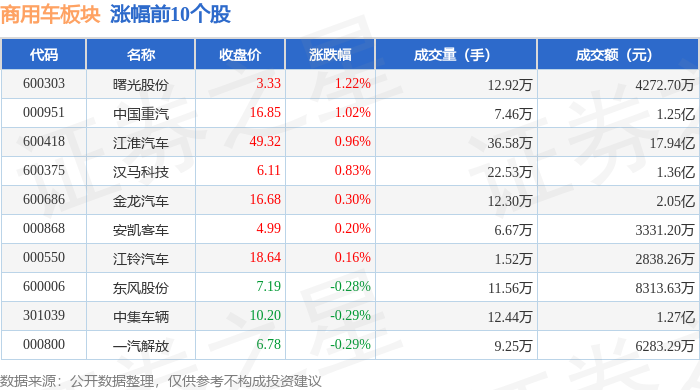
商用车板块12月25日涨0.05%,曙光股份领涨,主力资金净流出3546.76万元
Zheng Xing Xing Ye Ri Bao· 2025-12-25 09:07
Group 1 - The commercial vehicle sector saw a slight increase of 0.05% on December 25, with Shuguang Co. leading the gains [1] - The Shanghai Composite Index closed at 3959.62, up by 0.47%, while the Shenzhen Component Index closed at 13531.41, up by 0.33% [1] - Key stocks in the commercial vehicle sector included Shuguang Co. with a closing price of 3.33, up by 1.22%, and China National Heavy Duty Truck Group with a closing price of 16.85, up by 1.02% [1] Group 2 - The commercial vehicle sector experienced a net outflow of 35.47 million yuan from institutional investors, while retail investors saw a net inflow of 23.6 million yuan [2] - Major stocks with significant net inflows from retail investors included Jianghuai Automobile with 90.02 million yuan and Ankai Bus with 54.19 million yuan [3] - Conversely, stocks like FAW Jiefang and Ankai Bus experienced notable net outflows from institutional investors, with FAW Jiefang seeing an outflow of 8.39 million yuan [3]


车企年末掀起“百亿融资战”
Sou Hu Cai Jing· 2025-12-25 03:52
Core Viewpoint - The Chinese automotive industry is experiencing a significant "billion financing battle" as companies prepare for future market competition, with over 10 billion yuan raised in just two months [2][8]. Group 1: Financing Activities - In November and December, four major financing events occurred, including Deep Blue Auto's third round of financing expected to raise approximately 6.122 billion yuan, JAC Motors' 3.5 billion yuan private placement approved by the CSRC, and BAIC Blue Valley's 6 billion yuan refinancing project also approved [2]. - Polestar secured a total of approximately 1.2 billion USD in financing, including 300 million USD in equity and 600 million USD in loans, addressing its cash flow and debt pressures [7]. Group 2: Market Trends and Projections - The latest data from the China Association of Automobile Manufacturers indicates that in November, sales of new energy vehicles reached 1.823 million units, with a penetration rate of 53.2% [8]. - Predictions suggest that by 2026, domestic automobile sales may exceed 28 million units, with new energy vehicles potentially surpassing 20 million units next year [8]. Group 3: Strategic Financing Objectives - Traditional automakers like Deep Blue, BAIC Blue Valley, and JAC Motors are focusing on financing for new platform development, next-generation vehicle development, smart driving technology, and brand building [10]. - JAC Motors plans to invest over 4.2 billion yuan in its new energy passenger vehicle project and related body parts project, aiming for an annual production capacity of 200,000 new energy vehicles [12]. Group 4: Competitive Landscape - The current financing wave reflects a strategic move by established players to secure their positions in the market, while smaller brands may struggle to keep up due to limited financing options [8][10]. - Polestar, despite its previous ambitions, is facing challenges with a net loss of 1.558 billion USD and a significant decline in gross margin, highlighting the need for a sustainable business model and core technology [14]. Group 5: Future Implications - The recent financing activities signal the end of the initial chaotic phase in the automotive industry, marking the beginning of a new era focused on technological depth, capital strength, and operational efficiency [14].


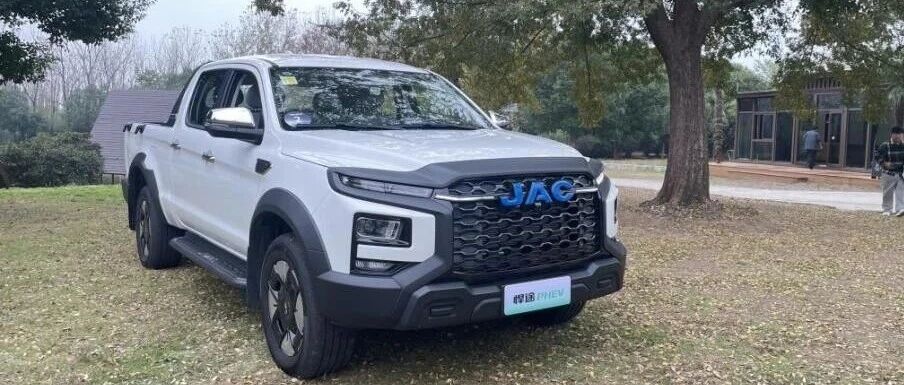
试驾混动巨兽——悍途PHEV,不只拉货,更是生活!| 头条
第一商用车网· 2025-12-25 03:32
Core Viewpoint - The article discusses the launch of the Jianghuai Hantu PHEV, the world's first "thousand-torque hybrid pickup," which aims to redefine the utility and versatility of pickups in diverse driving scenarios, addressing the limitations of traditional fuel pickups and pure electric pickups [1][20]. Group 1: Product Features - The Hantu PHEV features a "three-source power" structure, combining a 2.0T GDI hybrid engine with front and rear electric motors, and an innovative 4DHT decoupled hybrid transmission, allowing for seamless switching between multiple driving modes [3][5]. - The vehicle can operate in pure electric, range-extending, direct drive, and hybrid modes, providing a versatile driving experience tailored to various conditions, with a cost of approximately 0.1 yuan per 100 kilometers in pure electric mode [5][7]. - The Hantu PHEV achieves a peak torque of 1000 N·m and can accelerate from 0 to 100 km/h in just 5.9 seconds, showcasing its powerful performance capabilities [5][9]. Group 2: Driving Experience - The driving experience of the Hantu PHEV is likened to that of an SUV, with excellent power performance, chassis tuning, and overall comfort, making it suitable for both urban commuting and off-road adventures [7][9]. - The vehicle's cabin noise levels are impressively low, with a quietness of 38 decibels at rest, and superior wind noise control during high-speed driving, enhancing the overall driving experience [9][11]. - The Hantu PHEV offers two rear suspension options, catering to different user needs, with the tested model featuring a leaf spring suspension that performs well in off-road conditions [11][12]. Group 3: Smart Features - The Hantu PHEV is equipped with advanced smart features, including a 10.25-inch digital instrument panel and a 10.4-inch central control screen, providing a modern and tech-savvy user experience [16][18]. - It includes 18 L2-level driver assistance functions, significantly reducing the driving burden on highways [16]. - The vehicle's V2L (Vehicle-to-Load) capability allows for external power supply up to 15 kW, making it a mobile workstation for various applications, such as charging drones or powering outdoor equipment [18]. Group 4: Conclusion - The Hantu PHEV successfully combines the ruggedness and practicality of traditional pickups with advanced hybrid technology and smart features, offering a comprehensive solution for urban commuting, outdoor adventures, and as a mobile power station [20].
百亿融资落子2026,大厂二代新能源品牌进行反攻
Sou Hu Cai Jing· 2025-12-25 02:49
Core Viewpoint - The capital game in the Chinese new energy vehicle (NEV) market is intensifying, with major players like Deep Blue, JAC Motors, and BAIC Blue Valley securing significant financing to enhance their competitive positions as the market matures and policy incentives wane [1][3][4]. Group 1: Financing and Investment - Deep Blue plans to raise approximately 6.122 billion yuan through capital increase [1] - JAC Motors has received approval for a 3.5 billion yuan private placement [1] - BAIC Blue Valley's 6 billion yuan refinancing project has also been approved [1] Group 2: Market Dynamics - The NEV market is transitioning from an exploratory phase to a deep cultivation phase, with sales exceeding 14.78 million units and a penetration rate surpassing 47% by November 2025 [6] - Traditional manufacturers are leveraging decades of experience in cost control and lifecycle management to gain an edge as the market slows down [4][6] Group 3: Competitive Landscape - New energy brands are shifting from passive followers to more proactive players, aiming to catch up in technology and service capabilities [3][4] - The competitive focus is now on product reliability and long-term ownership costs rather than just technological innovation [11][12] Group 4: Financial Performance - In Q3 2025, Zeekr's gross margin reached 19.2%, NIO's was 14.7%, and Xpeng's was 13.1%, indicating traditional manufacturers are establishing advantages in cost control and scale [7] Group 5: Strategic Initiatives - JAC Motors is investing 1 billion yuan in body parts projects to enhance self-sufficiency and reduce reliance on external suppliers [9] - The rise of brands like Hongmeng Zhixing and Xiaomi is not displacing traditional manufacturers but rather integrating their manufacturing expertise into new ventures [9]
江淮汽车12月23日现1笔大宗交易 总成交金额210.7万元 溢价率为-6.00%
Xin Lang Cai Jing· 2025-12-23 10:25
Group 1 - Jianghuai Automobile's stock closed down 0.79% at 47.69 yuan on December 23, with a significant block trade of 47,000 shares totaling 2.107 million yuan [1] - The first transaction price was 44.83 yuan for 47,000 shares, resulting in a transaction amount of 2.107 million yuan, with a premium rate of -6.00% [1] - The buyer was from China Merchants Securities Co., Ltd., and the seller was from Dongguan Securities Co., Ltd. [1] Group 2 - In the last three months, Jianghuai Automobile has recorded four block trades with a total transaction amount of 12.9042 million yuan [1] - Over the past five trading days, the stock has increased by 0.72%, while the net outflow of main funds totaled 330 million yuan [1]
Luxury EV built with Huawei outsells Porsche's Panamera and BMW's 7 Series in China
Yahoo Finance· 2025-12-23 09:30
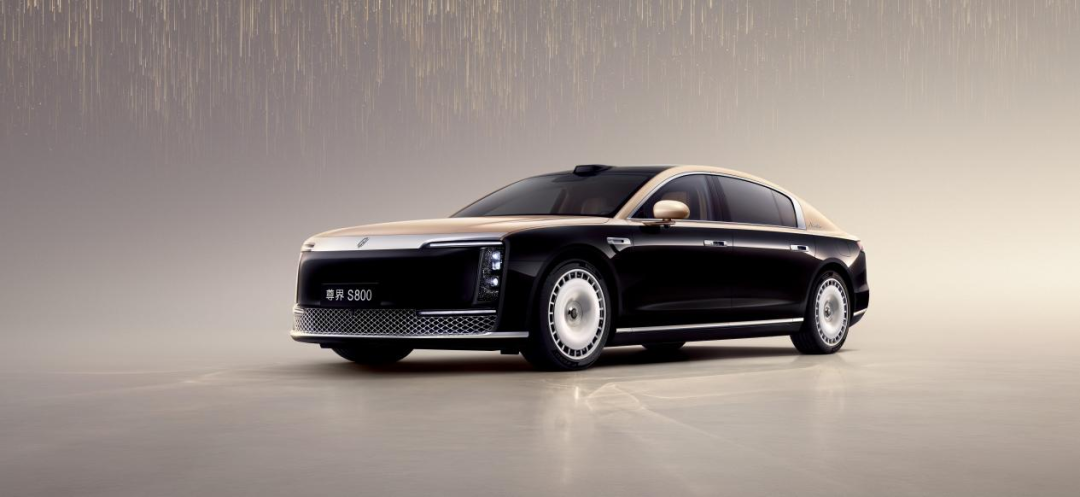
Core Insights - Chinese electric vehicles (EVs) are gaining significant traction in the luxury segment, with the Maextro S800 outselling established models like Porsche's Panamera and BMW's 7 Series in China [1][2] Group 1: Sales Performance - The Maextro S800, co-developed by Huawei and JAC Group, recorded 2,145 deliveries in mainland China last month, surpassing the combined sales of the Panamera and 7 Series [1][3] - The S800 is now the top-selling car in the 700,000 yuan-plus price segment in mainland China [2] - Prior to the S800's launch, the luxury car segment in China was dominated by international brands [4] Group 2: Market Dynamics - The S800 debuted in late May and offers both pure electric and extended-range editions, marking a shift in the luxury car market previously dominated by petroleum-powered vehicles [4] - Chinese EV makers, including BYD and Leapmotor, have successfully captured the mass market, leading to a decline in market share for foreign brands like Volkswagen and General Motors [5] - Approximately 60% of new cars sold to mainland customers are now battery-powered or plug-in hybrid models, indicating a significant shift towards electric vehicles [5]
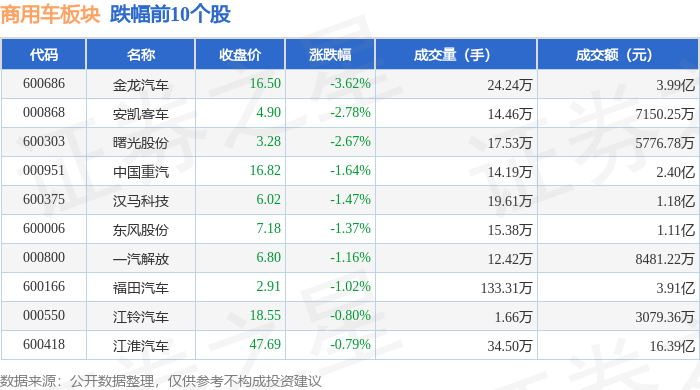
商用车板块12月23日跌1.04%,金龙汽车领跌,主力资金净流出3.16亿元
Zheng Xing Xing Ye Ri Bao· 2025-12-23 09:01
Market Overview - The commercial vehicle sector experienced a decline of 1.04% on December 23, with Jinlong Automobile leading the drop [1] - The Shanghai Composite Index closed at 3919.98, up 0.07%, while the Shenzhen Component Index closed at 13368.99, up 0.27% [1] Individual Stock Performance - Jinlong Automobile (600686) closed at 16.50, down 3.62% with a trading volume of 242,400 shares [1] - Ankai Bus (000868) closed at 4.90, down 2.78% with a trading volume of 144,600 shares [1] - Shuguang Co. (600303) closed at 3.28, down 2.67% with a trading volume of 175,300 shares [1] - China National Heavy Duty Truck Group (000951) closed at 16.82, down 1.64% with a trading volume of 141,900 shares [1] - Hanma Technology (600375) closed at 6.02, down 1.47% with a trading volume of 196,100 shares [1] - Dongfeng Motor (600006) closed at 7.18, down 1.37% with a trading volume of 153,800 shares [1] - FAW Jiefang (000800) closed at 6.80, down 1.16% with a trading volume of 124,200 shares [1] - Foton Motor (600166) closed at 2.91, down 1.02% with a trading volume of 1,333,100 shares [1] - Jiangling Motors (000550) closed at 18.55, down 0.80% with a trading volume of 16,600 shares [1] - JAC Motors (600418) closed at 47.69, down 0.79% with a trading volume of 345,000 shares [1] Fund Flow Analysis - The commercial vehicle sector saw a net outflow of 316 million yuan from main funds, while retail investors contributed a net inflow of 279 million yuan [1] - Among individual stocks, Ankai Bus had a main fund net inflow of 5.08 million yuan, while Jinlong Automobile experienced a net outflow of 12.92 million yuan [2] - Shuguang Co. had a main fund net inflow of 3.65 million yuan, while Hanma Technology saw a net outflow of 1.91 million yuan [2] - Jiangling Motors had a net outflow of 2.93 million yuan from main funds, but a net inflow of 3.57 million yuan from retail investors [2]


【快讯】每日快讯(2025年12月23日)
乘联分会· 2025-12-23 08:40
Domestic News - Guangzhou's 14th Five-Year Plan aims to accelerate the automotive industry's "curve overtaking," focusing on electric vehicle transformation, brand renewal, and international market expansion, targeting a trillion-level smart connected new energy vehicle industry cluster [7] - Haikou's 14th Five-Year Plan emphasizes the development of smart connected vehicles and other emerging industries, enhancing energy infrastructure and expanding new consumption fields [8] - China's electric vehicle charging infrastructure reached 19.322 million units by November 2025, a 52% year-on-year increase, with public charging facilities at 4.625 million units, up 36% [9] - The "Shenzhen-Hong Kong Automotive Fast Pass Plan" has been implemented, allowing for expedited customs procedures for exported new energy vehicles, reducing port stay time and storage costs by over 70% [10] - Geely Auto announced the completion of the privatization of Zeekr, making it a wholly-owned subsidiary [12] - Li Auto has partnered with Air China to offer a program where new car owners can accumulate flight mileage based on driving distance [13] - Jianghuai Automobile Group has opened a subsidiary in Italy, marking a significant step in its global development strategy [14] - EVE Energy's headquarters and AI robotics center project has commenced construction, with a total investment of approximately 1 billion yuan [15] International News - Thailand's automotive production in November increased by 11.06% year-on-year, reaching 130,222 units, while domestic sales rose by 20.65% [16] - Germany's automotive exports to the U.S. fell by nearly 14% in the first three quarters of the year, significantly impacted by new tariff policies [17] - Malaysia's automotive sales in November grew by 5.5% year-on-year, driven by the impending expiration of tax exemptions and year-end promotions [18] - Uber has partnered with Baidu to conduct trials of autonomous taxis in London, with plans to launch a pilot project in the first half of 2026 [19] Commercial Vehicles - Xidi Intelligent Driving has officially listed on the Hong Kong Stock Exchange, becoming the first company focused on intelligent driving for commercial vehicles [20] - Foton Ouhui has launched a new L4 level intelligent driving bus, showcasing its technological advancements and market competitiveness [22] - Jiushi Intelligent's manufacturing base in Huai'an has officially commenced production, supporting the global RoboVan industry with advanced technology and operational experience [23] - FAW Liberation's new factory in Foshan has officially started production, enhancing its presence in the southern new energy commercial vehicle market [24]




以智能重构尊贵,尊界S800成为中国企业家的移动智库
Xin Lang Cai Jing· 2025-12-22 11:19
Core Insights - Huawei and JAC Motors have collaborated to create the luxury vehicle, ZunJie S800, which aims to redefine luxury through innovation and break into the high-end market [2][17] - The ZunJie S800 has achieved significant pre-launch success, with over 18,000 units reserved in just 175 days and a stable monthly delivery rate of 2,000 units, setting a new record for growth in the Chinese luxury car segment [2][17] - The overall luxury car market in China is experiencing a downturn, with total sales of luxury cars priced over 1 million yuan projected at 128,000 units for 2024, highlighting the significance of ZunJie S800's entry [2][17] Industry Transformation - The luxury car market in China is undergoing a transformation driven by the electrification wave, which diminishes the advantages of traditional fuel vehicles, and the rise of smart technology, creating a new starting line for all brands [4][19] - Despite some domestic brands attempting to position themselves as "luxury," most remain perceived as "mid-to-high-end," leaving the ultra-luxury market largely untapped by Chinese brands [4][19] - High-net-worth individuals are shifting from "symbolic consumption" to "value co-creation," with a growing demand for technology in their purchases, as evidenced by a decline in luxury car sales despite an increase in affluent households [4][19] Product Features and Market Reception - The ZunJie S800 emphasizes "tech luxury," incorporating advanced technologies such as Huawei's ADS 4 driving assistance system and comprehensive safety features, which resonate with consumer demands for safety and innovation [6][21] - The vehicle's design and features cater to the needs of high-end users, providing a luxurious and private space for business discussions, which has led to it becoming a "social card" among entrepreneurs [7][22] - Personalization features, such as a makeup mirror for female entrepreneurs and thoughtful amenities like heated cup holders and a mini-fridge, enhance the user experience and appeal to specific consumer needs [8][23] Strategic Collaboration and Market Positioning - The partnership between Huawei and JAC Motors represents a new approach to breaking into the high-end automotive market, which has historically been dominated by foreign brands [11][26] - The ZunJie S800 is positioned not just as a product but as a tribute to the evolution of the Chinese automotive industry, reflecting the spirit of innovation and resilience among Chinese entrepreneurs [13][28] - The vehicle's launch is seen as a significant step in overcoming the barriers that have historically prevented Chinese brands from competing in the ultra-luxury segment [11][26]