ZZPZH(600436)

Search documents
片仔癀“中药茅”光环褪色 非经常性收益粉饰下的主业困局
Cai Jing Wang· 2025-10-23 10:57
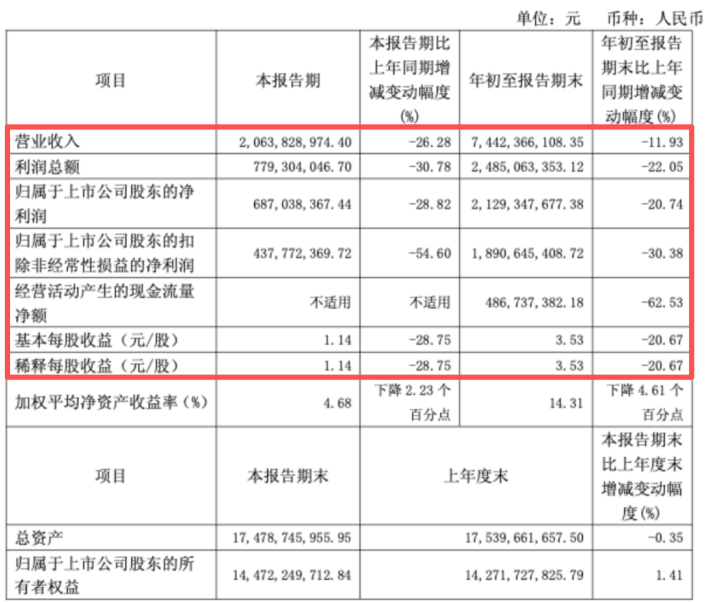
Core Viewpoint - The recent quarterly report of Pianzaihuang revealed significant declines in revenue and profit, raising concerns about the company's core profitability and growth sustainability, leading to a sharp drop in stock price and market capitalization [1][3][9]. Financial Performance - For the first three quarters, the company reported revenue of 7.44 billion yuan, a year-on-year decrease of 11.93%, and a net profit of 2.13 billion yuan, down 20.74% [2]. - In Q3 alone, revenue was 2.06 billion yuan, down 26.28%, and net profit was 687 million yuan, down 28.82% [2][9]. - The non-recurring net profit saw a drastic decline of 54.6%, indicating a severe drop in core profitability [9][10]. Cost and Margin Issues - The pharmaceutical manufacturing segment, which accounts for a significant portion of revenue, experienced a revenue decline of 12.93%, with core product sales (liver disease medication) down 9.41% while costs rose by 20.64% [3][4]. - The gross margin for the core product has narrowed to 61.11%, reflecting increased cost pressures [3]. - The company has faced challenges from rising raw material costs and changes in healthcare policies, impacting profit margins [3][4]. Market Dynamics - There is evidence of price erosion in the market, with unofficial sales prices for Pianzaihuang products dropping significantly below official prices, indicating challenges in market price control [4][6]. - The company's contract liabilities have decreased, suggesting reduced enthusiasm from distributors, while inventory levels have surged by 24.02% [6][7]. Strategic Challenges - The company has struggled to diversify its revenue streams, with significant reliance on a single core product, which has led to a lack of growth in other business segments [8][9]. - The long-term pricing strategy of raising product prices has begun to show negative consequences, impacting sales and market perception [3][8]. Research and Development - Pianzaihuang is advancing its R&D efforts, with ongoing clinical trials for new drugs, but these initiatives are unlikely to have a significant impact on the current year's financial performance [12][13]. - The company has increased its R&D expenditure by 24.42% year-on-year, reflecting a commitment to innovation despite financial pressures [13].


10月23日医疗健康(980016)指数跌0.3%,成份股特宝生物(688278)领跌
Sou Hu Cai Jing· 2025-10-23 09:56
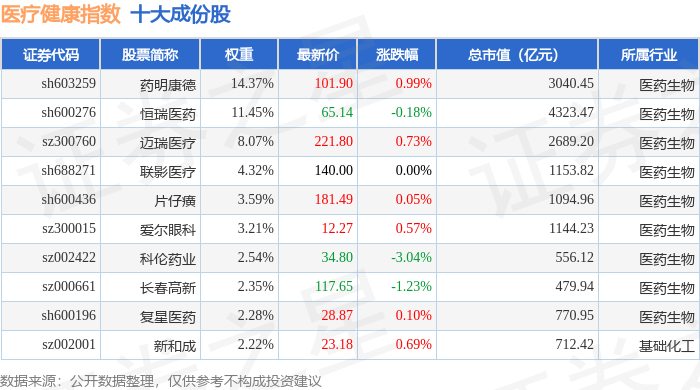
Core Viewpoint - The Medical Health Index (980016) closed at 6646.6 points, down 0.3%, with a trading volume of 19.922 billion yuan and a turnover rate of 0.75% on October 23 [1] Group 1: Index Performance - Among the constituent stocks of the Medical Health Index, 16 stocks rose while 31 stocks fell, with Kanglong Chemical leading the gainers at 1.55% and Te Bao Biological leading the decliners at 6.07% [1] - The top ten constituent stocks of the Medical Health Index include: - WuXi AppTec (14.37% weight, latest price 101.90, market cap 304.045 billion yuan) - Hengrui Medicine (11.45% weight, latest price 65.14, market cap 432.347 billion yuan) - Mindray Medical (8.07% weight, latest price 221.80, market cap 268.920 billion yuan) [1] Group 2: Capital Flow - The net outflow of main funds from the constituent stocks of the Medical Health Index totaled 1.072 billion yuan, while retail investors saw a net inflow of 955 million yuan [3] - Detailed capital flow for key stocks includes: - Mindray Medical: Main net inflow of 66.9479 million yuan, retail net inflow of 3.6088 million yuan - Te Bao Biological: Main net inflow of 29.0966 million yuan, retail net outflow of 41.3737 million yuan [3]




市场波动加剧,资金布局“补涨”!中药ETF(560080)连续16日“吸金”超6亿元,最新规模首超30亿元!机构:看好中药下半年经营改善
Xin Lang Cai Jing· 2025-10-23 07:42
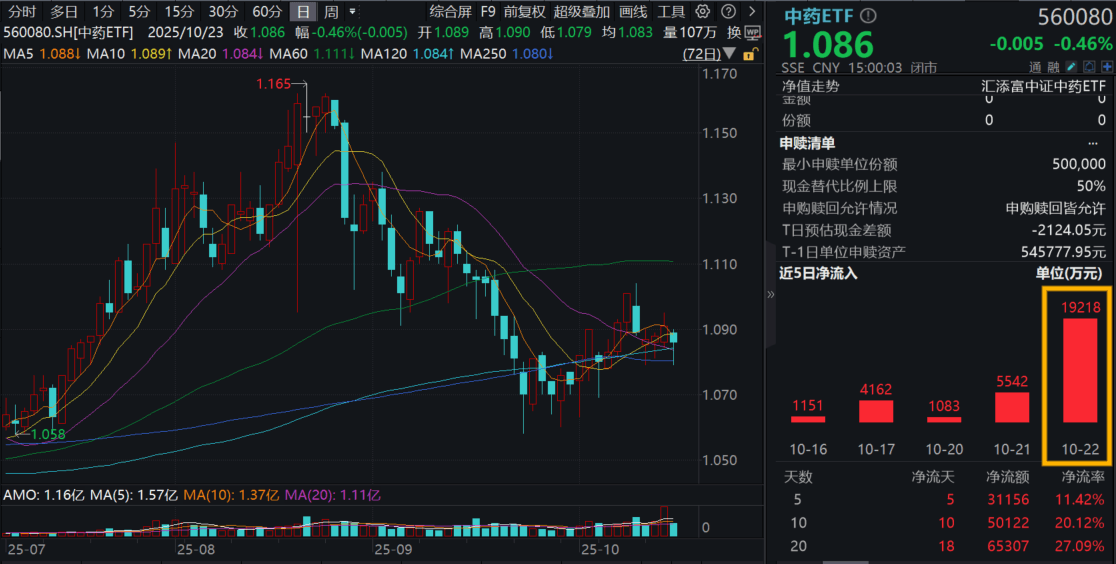
Core Viewpoint - The Chinese medicine sector is experiencing a mixed performance, with the Chinese medicine ETF (560080) showing significant net inflows and a growing fund size, despite the overall index performance being negative for the year [1][4]. Group 1: Market Performance - The Chinese medicine ETF (560080) saw a slight decline of 0.46% with a total trading volume of 116 million yuan on the day [1]. - The ETF has attracted a net inflow of 192 million yuan yesterday, ranking it among the top 9 in the market, and has seen a total net inflow exceeding 600 million yuan over the past 16 days [1]. - The Chinese medicine index has a year-to-date return of -2.53%, with a decline of 8.13% projected for 2024 [3]. Group 2: Valuation Metrics - As of October 22, the TTM price-to-earnings (PE) ratio of the Chinese medicine ETF (560080) is 25.22, indicating that the index is cheaper than 77% of the time over the past decade [4]. - The current PE ratio is close to the calculated opportunity value, suggesting a favorable valuation for potential investment [4]. Group 3: Company Performance - The component stocks of the Chinese medicine ETF exhibited mixed results, with companies like Yunnan Baiyao and Pianzaihuang showing slight increases, while others like Zhongsheng Pharmaceutical and Darentang experienced declines exceeding 4% [5]. - The performance of major brands in the OTC market is expected to improve, with companies like Huazhong Sanjiu, Dong'e Ejiao, and Yunnan Baiyao being highlighted as stable performers [8]. Group 4: Industry Outlook - The Chinese medicine sector is under short-term pressure due to various factors, but there is optimism for operational improvements in the second half of the year [7]. - The market is closely monitoring the impact of external policies, including price governance and the collection of traditional Chinese medicine, which may influence future performance [7][9]. - The industry is expected to benefit from a recovery in consumer demand, driven by macroeconomic improvements and an aging population [10].


一代“神药”,也卖不动了
投中网· 2025-10-23 06:30
Core Viewpoint - The article discusses the significant decline in the performance of Pizhou Huang, a company once celebrated for its rapid growth and high market valuation, highlighting its recent financial struggles and the challenges it faces in maintaining its previous growth model [5][9][24]. Financial Performance - In the third quarter of 2025, Pizhou Huang reported a revenue of 20.64 billion yuan, a year-on-year decrease of 26.28%, and a net profit of 6.87 billion yuan, down 28.82% [5][10]. - For the first three quarters of 2025, total revenue was 74.42 billion yuan, representing an 11.93% decline, while net profit fell by 20.74% to 21.29 billion yuan [5][10]. - The company's core pharmaceutical manufacturing segment saw a revenue drop of 12.93%, with a gross margin decrease of 7.51 percentage points to 59.38% [10][11]. Market Dynamics - Pizhou Huang's market value has decreased significantly, from a peak of 290 billion yuan to 111.8 billion yuan, losing nearly 180 billion yuan in market capitalization [5][9]. - The company is experiencing a shift in consumer behavior, with reduced demand for its products as middle-class consumers tighten their spending [7][24]. Product Performance - The core product, a liver disease medication, generated 38.80 billion yuan in revenue, down 9.41% year-on-year, while another key product, the Angong Niuhuang Wan, saw a dramatic revenue drop of 65.20% to 934.36 million yuan [13][24]. - The company has faced challenges in maintaining its pricing strategy, with actual market prices for its products falling below official retail prices, indicating a disconnect between supply and demand [24][25]. Cost Structure - The rising costs of raw materials, particularly natural ingredients like cow bile and musk, have significantly impacted profit margins, with cow bile prices soaring from approximately 350,000 yuan per kilogram in 2019 to around 1.7 million yuan per kilogram in 2025 [22][23]. - The company has historically relied on price increases to offset rising costs, having raised prices over 20 times since its listing in 2003, but this strategy has begun to falter [23][24]. Strategic Response - In response to declining sales, Pizhou Huang plans to explore new market channels, including traditional medicine, aesthetic medicine, and high-end elderly care, to create new consumption scenarios [25].

片仔癀(600436):片仔(600436):业绩短期承压,静待成本端改善
Guotou Securities· 2025-10-23 05:05
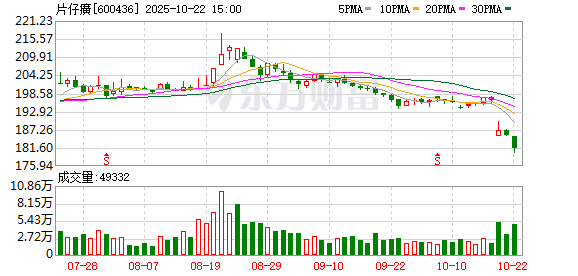
Investment Rating - The investment rating for the company is "Accumulate-A" with a 6-month target price of 190.55 CNY, compared to the current stock price of 181.40 CNY as of October 22, 2025 [4]. Core Views - The company is experiencing short-term pressure on performance, with a significant decline in revenue and net profit for the first three quarters of 2025. Revenue decreased by 11.93% year-on-year to 74.42 billion CNY, and net profit fell by 20.74% to 21.29 billion CNY [1][2]. - The decline in revenue is attributed to various business segments facing pressure, particularly in the pharmaceutical manufacturing sector, which saw a revenue drop of 12.93% [2]. - There is an expectation of gradual relief from cost pressures due to a decrease in the price of natural cow bile, a key raw material for the company's products [3]. Summary by Sections Financial Performance - For Q3 2025, the company reported a revenue of 20.64 billion CNY, down 26.28% year-on-year, and a net profit of 6.87 billion CNY, down 28.82% [1]. - The gross margin for the main business was 39.05%, a decrease of 6.49 percentage points year-on-year, primarily due to high raw material costs [2]. Business Segments - The pharmaceutical manufacturing segment generated 40.16 billion CNY in revenue, a decline of 12.93%, with liver disease medications accounting for 38.80 billion CNY, down 9.41% [2]. - The pharmaceutical distribution segment's revenue was 28.87 billion CNY, down 8.45%, while the cosmetics segment saw a revenue drop of 23.82% to 4.00 billion CNY [2]. Cost and Supply Chain - The price of natural cow bile has decreased from 170,000 CNY/kg to 140,000 CNY/kg since August 2025, which is expected to alleviate cost pressures as high-priced raw materials are consumed [3]. - The company is also benefiting from a pilot program allowing the import of cow bile for traditional Chinese medicine production, which may improve supply dynamics [3]. Product Strategy and Marketing - The company is focusing on its strategic product, the Pizhonghuang pill, while expanding its product line to include health foods and cosmetics, with notable sales growth in its flagship beauty product [4][8]. - Marketing efforts have increased, with the establishment of 525 national medicine halls and partnerships with major pharmacy chains, enhancing market coverage [8]. Future Outlook - Revenue growth is projected to be -11.7% in 2025, followed by 10.5% in 2026 and 7.3% in 2027. Net profit growth is expected to be -19.6% in 2025, with a recovery to 6.7% in 2026 and 12.2% in 2027 [9].
片仔癀“中药茅”光环褪色:渠道失守、扣非腰斩 非经常性收益粉饰下的主业困局
Hua Xia Shi Bao· 2025-10-23 00:00
Core Viewpoint - The recent quarterly report of Pianzaihuang reveals significant declines in revenue and profit, raising concerns about the company's core profitability and growth sustainability, leading to a sharp drop in stock price and market capitalization [2][3][12]. Financial Performance - For the third quarter, Pianzaihuang reported revenue of 20.64 billion yuan, a year-on-year decrease of 26.28%, and a net profit attributable to shareholders of 6.87 billion yuan, down 28.82% [3][4][12]. - The company has experienced three consecutive quarters of negative revenue growth, marking the first time in nearly 20 years that both revenue and net profit have declined in the first three quarters [3][4]. - The non-recurring net profit saw a drastic decline of 54.6%, indicating a severe deterioration in core profitability [12]. Cost and Margin Issues - The decline in revenue is attributed to reduced sales in the pharmaceutical manufacturing sector and a drop in gross margin, with key raw material costs remaining high [5][9]. - The gross margin for the core product, a liver disease medication, has significantly narrowed due to rising costs, with revenue from this product down 9.41% while costs increased by 20.64% [4][5]. Market Dynamics - There is a notable shift in the pricing structure, with unofficial channel prices dropping nearly 30% below official prices during promotional events, indicating challenges in market price control [6][8]. - The company's contract liabilities have decreased significantly, reflecting reduced prepayments from distributors, suggesting a decline in their purchasing enthusiasm [8]. Strategic Challenges - Pianzaihuang's reliance on a single core product for revenue generation poses risks, as other business segments, including cosmetics and pharmaceutical distribution, have not shown significant growth [10][12]. - The company is facing pressure to balance cost control and pricing strategies while rebuilding distributor confidence and developing a competitive second growth curve [10][12]. Investment and R&D - The company reported a substantial increase in investment income, which contributed positively to its financial results, but this reliance on non-operating income raises concerns about the sustainability of its earnings [13][12]. - Pianzaihuang is advancing its R&D efforts, with ongoing clinical trials for new drugs, although the financial impact of these initiatives is expected to be minimal in the short term [15].
回收市场“退烧”,业绩“褪色”:片仔癀的提价策略失灵了
Bei Ke Cai Jing· 2025-10-22 11:56
Core Viewpoint - After disclosing the third-quarter report, the company's stock price has experienced a continuous decline, dropping over 60% from its peak, indicating significant market challenges and performance issues [1][2]. Financial Performance - In the first three quarters of 2025, the company reported a revenue of 74.42 billion yuan, a year-on-year decrease of 11.93%, and a net profit attributable to shareholders of 21.29 billion yuan, down 20.74% year-on-year [4]. - The pharmaceutical manufacturing sector's revenue decline is the primary reason for the company's poor overall performance, with the core product "Pian Zai Huang" facing significant cost pressures [4][5]. - The company's pharmaceutical manufacturing revenue reached 40.16 billion yuan, a year-on-year decrease of 12.93%, while the main business costs increased by 6.81% year-on-year, leading to a reduction in gross profit margin by 7.51 percentage points [5]. Product Performance - The core product for liver disease treatment generated a revenue of 38.8 billion yuan, down 9.41% year-on-year, while cardiovascular medication revenue plummeted by 65.2% to 93.44 million yuan [6]. - The cost of the liver disease medication was 15.09 billion yuan, reflecting a year-on-year increase of 20.64%, resulting in a gross margin of 61.11%, down 9.68 percentage points [7]. Pricing Strategy - The company's pricing strategy, which had previously supported growth, is now failing, as evidenced by the inability to fully pass on cost increases to consumers, leading to suppressed market demand [2][11]. - The company raised the retail price of its main product, Pian Zai Huang, from 590 yuan to 760 yuan in May 2023, marking the largest price increase in history, but this has not translated into sustained sales growth [12][14]. Market Dynamics - The prices of Pian Zai Huang products have seen a decline in the second-hand market, with current buyback prices ranging from 450 to 500 yuan, indicating a cooling market [16]. - During recent e-commerce promotional events, the retail price of Pian Zai Huang has fallen below the official price, with some online platforms offering it for as low as 547 yuan per piece [17][18].
片仔癀参投中金医疗基金;Chobani获融资;八马茶业预计月底上市
Sou Hu Cai Jing· 2025-10-22 11:06
Financing Dynamics - Pianzaihuang Pharmaceutical Co., Ltd. announced an investment of RMB 2 billion in the CICC Medical Fund, representing 20% of the fund's target size, focusing on the healthcare sector including traditional Chinese medicine and biomedicine [3] - Chobani raised $650 million (approximately RMB 4.6 billion) in its latest funding round, aiming to expand its product lines and processing capabilities, with a valuation now at $20 billion [5] Listing Dynamics - Bama Tea announced a global offering of 9 million shares, aiming to raise approximately HKD 428 million (around RMB 39 million) for expanding production capacity [7] Acquisition Dynamics - Kering Group announced a strategic cooperation with L'Oréal, involving a €4 billion acquisition of Kering's high-end fragrance brand Creed and exclusive rights for future beauty products from Gucci, Bottega Veneta, and Balenciaga [9] - Meili Tianyuan announced the acquisition of 100% of Shiyuanli for RMB 1.25 billion, aiming to enhance its brand portfolio in the high-end beauty service sector [11] - Birkenstock signed an agreement to acquire its long-term distributor in Australia, ensuring continuity in contracts and operations, with an annual sales revenue of approximately €55 million [15] Personnel Dynamics - Paul Smith Foundation appointed Taylor Thompson as the first American resident designer, aiming to provide guidance and workspace for emerging designers [19] - Kim Jones was appointed as the creative director for Bosideng's new Areal high-end urban line, marking his return to the fashion industry [22] - Zalando appointed Thomas Schwulera, a former executive from L'Oréal, as the vice president of the beauty category, focusing on strategic growth [25]

漳州高鑫润信大健康基金完成备案
FOFWEEKLY· 2025-10-22 10:21
Core Viewpoint - The establishment of the Zhangzhou Gaoxin Runxin Health Industry Investment Partnership Fund, with a total scale of 1 billion yuan, aims to invest in the healthcare sector, focusing on equity investments in non-listed companies, particularly in growth and early-stage projects [1]. Group 1 - The fund is initiated by CITIC Jin Investment Management Co., Ltd. along with several other investment and development companies [1]. - The primary investment areas include pharmaceuticals, medical devices, healthcare supply chains, health food and supplements, synthetic biology, chemical materials, and consumer healthcare [1]. - The fund is particularly focused on equity investments in non-listed enterprises, emphasizing growth-stage and early-stage entrepreneurial projects [1].


片仔癀“中药茅”光环褪色:渠道失守、扣非腰斩,非经常性收益粉饰下的主业困局
Hua Xia Shi Bao· 2025-10-22 09:41
Core Viewpoint - The recent quarterly report of Pianzaihuang reveals significant declines in revenue and net profit, raising concerns about the company's core profitability and growth sustainability [2][3][10]. Financial Performance - For the first three quarters, Pianzaihuang reported revenue of 7.44 billion yuan, a year-on-year decrease of 11.93%, and a net profit of 2.13 billion yuan, down 20.74% [2][4]. - In Q3 alone, the company’s revenue was 2.06 billion yuan, a decline of 26.28%, and net profit was 687 million yuan, down 28.82% [3][10]. - The non-recurring net profit saw a drastic drop of 54.6%, indicating a severe deterioration in core profitability [10]. Cost and Margin Issues - The company's core pharmaceutical manufacturing segment, which accounts for a significant portion of revenue, experienced a revenue decline of 12.93%, with a notable increase in costs [5][9]. - The gross margin for the core product, a liver disease medication, fell to 61.11% due to rising costs, which increased by 20.64% [5][9]. - The overall cash flow from operating activities decreased by 62.53%, indicating financial strain [8]. Market Dynamics - Pianzaihuang's pricing strategy has faced challenges, with unofficial channel prices dropping nearly 30% below official prices during promotional events [6][8]. - The company’s contract liabilities decreased significantly, reflecting reduced enthusiasm from distributors [8]. Product and Business Segment Performance - The pharmaceutical manufacturing sector's revenue dropped by 12.93%, while the cosmetics segment saw a 23.82% decline [9]. - The heart and brain medication segment's revenue plummeted by 65.20%, highlighting the company's heavy reliance on a single core product [9]. Investment and R&D Developments - Pianzaihuang reported a substantial increase in investment income, which rose by 819.32% in Q3, contributing positively to overall performance [11]. - The company is advancing its R&D efforts, with a new traditional Chinese medicine entering phase III clinical trials, although this will not significantly impact the current financial year [13][14].