
ZZPZH(600436)

Search documents
挖掘新增长点 中医药龙头加速布局产业基金
Zheng Quan Ri Bao Zhi Sheng· 2025-08-07 16:39
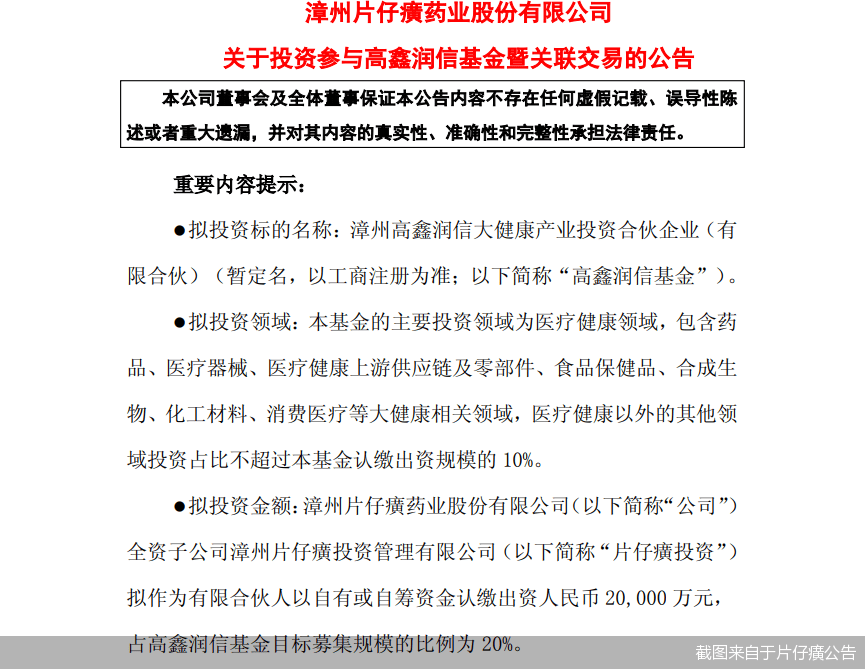
本报记者 李婷 8月7日,漳州片仔癀药业股份有限公司(以下简称"片仔癀")发布公告称,全资子公司片仔癀投资拟作 为有限合伙人以自有或自筹资金认缴出资人民币2亿元,占高鑫润信基金目标募集规模的比例为20%。 "公司基于大健康产业链上下游考虑,立足现有发展需求,积极寻找新增长点,增强产业协同效应,提 升持续竞争能力,在确保主营业务发展的前提下,拟投资高鑫润信基金。"片仔癀董秘办相关人士对 《证券日报》记者表示。 资料显示,高鑫润信基金主要投资领域为医疗健康领域,包含药品、医疗器械、医疗健康上游供应链及 零部件、食品保健品、消费医疗等大健康相关领域,医疗健康以外的其他领域投资占比不超过基金认缴 出资规模的10%。 事实上,除了此次参与高鑫润信基金,片仔癀在产业投资领域动作频频。此前,公司就曾尝试通过投资 并购来拓展业务版图。 中国医药健康发展促进专家委员会主任委员申勇对《证券日报》记者表示:"片仔癀的挑战主要包括对 核心单品依赖较大、多元化发展成果不够显著、在渠道品牌建设方面依然存在区域不平衡等。通过布局 产业基金,片仔癀既能够实现产业链上下游延伸挖掘,同时有望在医院外市场、大健康、新药等领域开 拓新项目,挖掘新增 ...

频繁设立基金 片仔癀热衷投资
Bei Jing Shang Bao· 2025-08-07 15:39
Core Viewpoint - The company Pianzaihuang is actively investing in health-related industry funds to enhance its strategic development and competitiveness in the pharmaceutical sector [1][2][4]. Investment Activities - Pianzaihuang's subsidiary, Pianzaihuang Investment, plans to invest 200 million yuan in the Gaoxin Runxin Fund, representing 20% of the fund's target size [1][2]. - The Gaoxin Runxin Fund focuses on the healthcare sector, including pharmaceuticals, medical devices, and health-related supply chains, with non-healthcare investments capped at 10% [2]. - Since August of the previous year, Pianzaihuang has participated in multiple fund investments, including a similar 200 million yuan investment in the Yuanshan Health Industry Fund [2][3]. Financial Performance - In 2024, Pianzaihuang reported revenue of approximately 10.79 billion yuan, a year-on-year increase of 7.25%, and a net profit of about 2.98 billion yuan, up 6.42% [4]. - The company's gross margin decreased to 42.74% in 2024 from 46.76% the previous year, attributed to rising costs of key raw materials [4]. - In Q1 of this year, Pianzaihuang's revenue fell by 0.92% year-on-year to around 3.14 billion yuan, while net profit grew by 2.59% to about 1 billion yuan [4]. Strategic Outlook - The company aims to adapt to industry trends and improve risk management strategies, focusing on strategic reserves of key raw materials to enhance profit levels [5]. - Experts suggest that diversifying into emerging fields like synthetic biology and consumer healthcare through fund investments could provide new growth opportunities and reduce reliance on traditional products [5].
当“不差钱”的片仔癀投资“上瘾”
Sou Hu Cai Jing· 2025-08-07 13:31
Core Viewpoint - The company "Pian Zai Huang," known as the "Moutai of Medicine," is shifting its focus towards private equity investments due to low returns on its substantial cash reserves, which have led to a need for new growth engines [2][11]. Investment Strategy - Pian Zai Huang's wholly-owned subsidiary, Zhangzhou Pian Zai Huang Investment Management Co., plans to invest 200 million RMB in the Gao Xin Run Xin Fund, representing 20% of the fund's target size [2][4]. - The company has significantly increased its participation in private equity investments since 2024, establishing multiple funds including the Yuan Shan Fund and the Ying Ke Health Fund [7][8]. - The company aims to enhance its competitive edge and find new growth points by investing in the health industry, which includes pharmaceuticals, medical devices, and health-related sectors [4][10]. Financial Performance - As of the end of 2024, Pian Zai Huang's total deposits reached 6.554 billion RMB, but the interest income was only 36.8579 million RMB, resulting in a low yield of 0.56% [2][11]. - The company's revenue for 2024 was 10.788 billion RMB, with a year-on-year growth of 7.25%, while net profit grew by only 6.42% [10]. - The gross margin for its liver disease medication decreased to 67.91%, down 10.88 percentage points from the previous year, contributing to performance pressure [10]. Market Position - Pian Zai Huang's market capitalization has seen significant fluctuations, peaking near 300 billion RMB in 2021, but has since faced a decline, with stock prices dropping for four consecutive years [9][10]. - The company has also engaged in direct stock investments, holding shares in several listed companies, which have contributed to its financial performance [8][13]. Industry Trends - There is a growing trend among pharmaceutical companies to participate as limited partners (LPs) in private equity, with several firms, including Yunnan Baiyao and others, following a similar strategy to leverage their cash reserves for investment opportunities [14][15].
再度与关联方设立基金,中药龙头片仔癀热衷投资
Sou Hu Cai Jing· 2025-08-07 12:01
Core Viewpoint - The company Pianzaihuang has been actively investing in various health industry funds, indicating a strategic move to enhance its competitive edge and explore new growth opportunities in the healthcare sector [1][4][6]. Investment Activities - On August 7, Pianzaihuang announced that its wholly-owned subsidiary, Pianzaihuang Investment Management Co., plans to invest 200 million yuan in the Gao Xin Run Xin Health Industry Investment Partnership, accounting for 20% of the fund's target size [1][4]. - Since August of the previous year, Pianzaihuang has participated in multiple fund investments, including a similar 200 million yuan investment in the Yuanshan Health Industry Investment Fund, also representing 20% of the target size [4][5]. - In April of this year, the company announced another 200 million yuan investment in the Zhaoying Huikang Equity Investment Partnership, maintaining the same 20% stake [5]. Strategic Rationale - The investments are part of a forward-looking strategy to ensure stable development of the company's core business while leveraging the resources and management expertise of professional investment institutions [4][6]. - The focus of the Gao Xin Run Xin Fund includes pharmaceuticals, medical devices, and other health-related sectors, with non-health investments capped at 10% of the fund's total contributions [4]. Financial Performance - Pianzaihuang's revenue growth has slowed, with 2024 revenue reported at approximately 10.79 billion yuan, a year-on-year increase of 7.25%, and net profit of about 2.98 billion yuan, up 6.42% [6]. - In the first quarter of this year, the company experienced a revenue decline of 0.92%, with revenue around 3.14 billion yuan [6]. Industry Insights - Experts suggest that Pianzaihuang's repeated fund investments are aimed at expanding its business and enhancing competitiveness, particularly in emerging fields like synthetic biology and consumer healthcare [6][7]. - Engaging in fund investments allows the company to utilize idle funds for potential projects, improving capital efficiency and establishing closer ties with other enterprises in the industry chain [6][7].

迎战基孔肯雅热:IVD企业24小时研发出检测盒,中药巨头紧急调配古方
Hua Xia Shi Bao· 2025-08-07 10:44
Group 1: Epidemic Overview - The recent outbreak of Chikungunya fever in southern China has led to nearly 3,000 new cases reported in just one week, primarily in Guangdong province, affecting over ten cities [1][3] - The majority of cases are concentrated in Foshan, accounting for 95% of the total cases in Guangdong, with no severe cases or deaths reported so far [3] Group 2: Government Response and Guidelines - The National Health Commission has released the "Chikungunya Fever Diagnosis and Treatment Plan (2025 Edition)," emphasizing that the disease is preventable, controllable, and treatable [3][6] - The plan incorporates traditional Chinese medicine (TCM) approaches, highlighting the role of TCM in alleviating symptoms and promoting recovery [6] Group 3: Company Initiatives in Diagnostics and Treatment - Several listed companies in the IVD (in vitro diagnostics) sector are actively developing testing products and treatment solutions for Chikungunya fever [4][5] - Shenzhen BGI Technology Co., Ltd. has introduced the T1+ gene sequencer, which can provide comprehensive genomic analysis within 6-8 hours, aiding in rapid response to the outbreak [4] - Wanfu Biology has developed multiple Chikungunya virus detection products, creating a closed-loop system for monitoring and diagnosis [4] Group 4: Traditional Chinese Medicine Applications - TCM is being utilized for symptomatic treatment of Chikungunya fever, with specific formulations recommended for managing symptoms like fever and joint pain [6][7] - Companies such as Guangdong Yifang Pharmaceutical and Step Long Pharmaceutical are producing traditional Chinese medicines that may assist in treating Chikungunya fever [7]


片仔癀又出资了
FOFWEEKLY· 2025-08-07 10:05
Core Viewpoint - The company, Zhangzhou Pianzaihuang Pharmaceutical Co., Ltd., is investing in the Gaoxin Runxin Fund to enhance its presence in the health industry chain, committing RMB 200 million, which represents 20% of the fund's target fundraising scale [1]. Group 1 - The company plans to invest through its wholly-owned subsidiary, Zhangzhou Pianzaihuang Investment Management Co., Ltd., as a limited partner [1]. - The fund is managed by CITIC Jin Investment, focusing primarily on the healthcare sector, including pharmaceuticals, medical devices, and health-related supply chains [1]. - Investments outside the healthcare sector will not exceed 10% of the fund's subscribed capital [1].

斥资2亿设立大健康产业基金,片仔癀持续深化对外投资布局
Huan Qiu Lao Hu Cai Jing· 2025-08-07 07:55
Core Viewpoint - Pianzaihuang Pharmaceutical is actively investing in the health industry by participating in the establishment of the Gao Xin Run Xin Fund, aiming to enhance its competitive edge and explore new growth opportunities within the health industry chain [1] Group 1: Investment Activities - Pianzaihuang plans to invest 200 million RMB in the Gao Xin Run Xin Fund, which represents 20% of the fund's target fundraising scale [1] - The Gao Xin Run Xin Fund is part of the "Yuan Shan Plan," a major industrial project initiated in April 2024 in Zhangzhou, focusing on creating a comprehensive ecosystem for traditional Chinese medicine [1] - The Zhangzhou government aims to establish a total of 5 billion RMB in health industry funds, with the Gao Xin Run Xin Fund being the third fund launched under this initiative [1] Group 2: Previous Fund Investments - In September 2024, Pianzaihuang announced a 200 million RMB investment in the Zhangzhou Yuan Shan Health Industry Investment Fund, holding a 40% stake in the first phase of the fund [2] - The Yuan Shan Fund has already achieved significant profits, with a reported investment return rate of 376% from acquiring a 5.02% stake in Guangsheng Tang, which has appreciated from 196 million RMB to a current market value of 932 million RMB [2] - In March 2025, Pianzaihuang also invested 200 million RMB in the Zhaoying Huikang Fund, which is managed by Zhaoshang Zhiyuan Capital and has a planned scale of 1 billion RMB [2] Group 3: Financial Performance - Pianzaihuang reported a revenue of 10.788 billion RMB in 2024, reflecting a year-on-year growth of 7.25%, and a net profit of 2.977 billion RMB, with a growth of 6.42% [2] - This marks the 15th consecutive year of revenue and net profit growth for Pianzaihuang, demonstrating its strong market competitiveness and resilience amid a slowing growth rate in the traditional Chinese medicine industry [2]
8月7日早间重要公告一览
Xi Niu Cai Jing· 2025-08-07 03:56
Group 1 - Tianeng Heavy Industry plans to reduce its shareholding by up to 2.94%, totaling no more than 30.08 million shares [1] - Huafa Co. has received approval from the China Securities Regulatory Commission to issue convertible bonds to specific investors [1] - ST Jiaotou has been identified as the first candidate for the general contracting of a project with a total investment of 58.28 million yuan [1] Group 2 - Pizaihuang's subsidiary plans to invest 200 million yuan in a health industry investment fund with a target size of 1 billion yuan [2] - ST Weihai has been selected as a candidate for a design and construction project with a bid of 156 million yuan [4] - Kangqiang Electronics plans to reduce its shareholding by up to 1%, totaling no more than 3.75 million shares [6] Group 3 - Zongsheng Pharmaceutical's vice president plans to reduce his shareholding by up to 900,000 shares [6] - Tapai Group reported a net profit of 435 million yuan for the first half of the year, a year-on-year increase of 92.47% [7] - Tapai Group plans to repurchase shares worth between 50 million and 100 million yuan [7] Group 4 - Xinghua Co.'s subsidiary has completed annual maintenance and resumed production [8] - Huaxi Co. intends to acquire 100% equity of Xiefeng Cotton and Hemp for 90 million yuan [9] - Mind Electronics' major shareholders plan to reduce their holdings by a total of 4% [10] Group 5 - Tianhe Co.'s director plans to reduce his shareholding by up to 0.15% [11] - Longxin Zhongke's shareholders plan to transfer a total of 1.37% of the company's shares through a private transfer [12] - Kory Technology's major shareholders plan to reduce their holdings by up to 3.03% [13] Group 6 - Hehua Co. is undergoing a change in actual control, with stock resuming trading [14] - Focus Media plans to acquire 100% of New潮传媒 for 8.3 billion yuan [15] - Lionhead Co. intends to acquire 97.44% of Lipu Technology for 662 million yuan [16] Group 7 - ST Tianmao's major shareholder is planning a significant matter, leading to a temporary suspension of stock trading [18] - Lianjian Technology plans to acquire 60% of Zhongren Tongce for 21 million yuan [19]






片仔癀拟出资2亿元参与投资高鑫润信基金
Sou Hu Cai Jing· 2025-08-07 02:17
目前,公司董事长为林志辉,董秘为施艺雄,员工人数为2839人,实际控制人为漳州市人民政府国有资产监督管理委员会。 雷达财经 文|冯秀语 编|李亦辉 8月6日,片仔癀(600436)公告,公司全资子公司漳州片仔癀投资管理有限公司拟作为有限合伙人以自有或自筹资金认缴出资人民币20,000万元,参与投资漳 州高鑫润信大健康产业投资合伙企业(有限合伙)(暂定名)。该基金目标募集规模为人民币10亿元,主要投资于医疗健康领域。本次投资构成关联交易, 已通过公司内部审议流程,但基金仍处于筹备设立阶段。 天眼查资料显示,片仔癀成立于1999年12月28日,注册资本60331.721万人民币,法定代表人林志辉,注册地址为福建省漳州市芗城区琥珀路1号。主营业务 为医药制造业、医药流通业及化妆品业等。 公司参股公司55家,包括福建片仔癀电子商务有限公司、漳州片仔癀投资管理有限公司、福建片仔癀健康科技有限公司、片仔癀电商国际贸易(香港)有限 公司、漳州片仔癀国药堂医药连锁有限公司等。 在业绩方面,公司2022年至2024年营业收入分别为86.94亿元、100.58亿元和107.88亿元,同比分别增长8.38%、15.69%和7.25 ...
片仔癀:拟2亿元投资大健康产业基金
Sou Hu Cai Jing· 2025-08-07 02:05
Core Viewpoint - The company Pianzaihuang (600436) announced an investment of 200 million yuan in a health industry investment partnership, aiming to enhance its strategic development and core competitiveness in the medical sector [1] Investment Details - The investment will be made by the company's wholly-owned subsidiary, Zhangzhou Pianzaihuang Investment Management Co., Ltd., using self-owned or raised funds [1] - The target fundraising scale of the partnership is 1 billion yuan, with the company’s investment accounting for 20% of this amount [1] - The fund will primarily invest in the healthcare sector, including pharmaceuticals, medical devices, and health-related supply chains, with non-healthcare investments capped at 10% [1] Strategic Objectives - The investment aims to leverage professional institutional resources to accelerate the concentration of the pharmaceutical industry, strengthen industry chain integration, and enhance core competitiveness [1] - The fund is managed by CITIC Jinshi Capital, which has extensive experience and expertise in the healthcare sector [1] Related Transactions - This investment is conducted in conjunction with related parties, including Zhangzhou Pianzaihuang Asset Management Co., Ltd. and Zhangzhou Tourism Investment Group Co., Ltd., and is classified as a related party transaction without constituting a major asset restructuring [1] Company Performance - In the first quarter of 2025, the company achieved a total operating revenue of 3.142 billion yuan and a net profit attributable to the parent company of 1 billion yuan [1]