COMEC(600685)

Search documents
2025年航运业转型融资研究报告
Sou Hu Cai Jing· 2025-10-28 03:19
Core Insights - The shipping industry is undergoing a significant transformation driven by the global carbon neutrality wave, with the implementation of the IMO's "Net Zero Framework" in 2025 marking a critical phase for emission reduction [13][18] - Green ships are becoming a strategic focus for capital investment, with various clean energy technologies such as LNG, methanol, ammonia, hydrogen, and fuel cells emerging as key players in this transition [12][14] Industry Overview - The shipping industry is expected to require an investment of approximately $1-1.9 trillion to achieve net-zero emissions by 2050, highlighting the urgent need for financial support [15] - China's green ship manufacturing sector has made significant progress, with a focus on high-end, autonomous, and international development [14][22] - The industry is characterized by a high concentration of major players in the midstream segment, while the downstream market remains fragmented [38][39] Technology Landscape - Clean energy technologies are categorized into three main types: clean energy technologies, energy efficiency improvement technologies, and carbon capture technologies, each with varying levels of maturity and application potential [24][33] - LNG technology is currently the mainstream choice for the transition period, while methanol is gaining traction due to its high energy density and ease of refueling [12][28] - Hydrogen and ammonia have zero-carbon potential but face challenges related to toxicity, storage costs, and technological maturity [12][29][32] Financial Support Mechanisms - Green finance is emerging as a core engine for driving technology implementation, with leading international shipping companies raising billions through green bonds and sustainable development-linked bonds [2][15] - Innovative financing models, such as "rent and carbon emissions linkage" and "energy-saving revenue sharing," are reshaping the financing logic within the industry [2][12] - China's financial support for green shipping includes long-term loans, supply chain finance, and transformation loans, with a focus on expanding the range of financial products available [54][56] Regional Development - Key regions in China, such as Shanghai, Jiangsu, Shandong, Fujian, and Liaoning, are developing distinctive paths for green ship development, supported by favorable policies and regional characteristics [51][52] - Shanghai is positioning itself as a global leader in green and intelligent shipbuilding, while Jiangsu focuses on LNG-powered ship design and construction [51][52]





航海装备板块10月27日涨2.21%,中船防务领涨,主力资金净流入2.89亿元
Zheng Xing Xing Ye Ri Bao· 2025-10-27 08:24
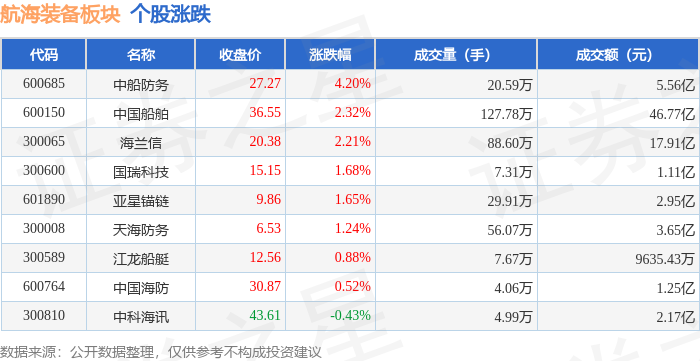
Core Viewpoint - The maritime equipment sector experienced a notable increase of 2.21% on October 27, with China Shipbuilding Defense leading the gains, while the overall market indices also showed positive performance [1] Market Performance - The Shanghai Composite Index closed at 3996.94, up by 1.18% - The Shenzhen Component Index closed at 13489.4, up by 1.51% [1] Individual Stock Performance - China Shipbuilding Defense (600685) closed at 27.27, with a rise of 4.20% and a trading volume of 205,900 shares, totaling a transaction value of 556 million yuan - China Shipbuilding (600150) closed at 36.55, increasing by 2.32% with a trading volume of 1,277,800 shares, amounting to 467.7 million yuan - Hailanxin (300065) closed at 20.38, up by 2.21% with a trading volume of 886,000 shares, totaling 1.791 billion yuan [1] Capital Flow Analysis - The maritime equipment sector saw a net inflow of 289 million yuan from institutional investors, while retail investors experienced a net outflow of 64.14 million yuan - The overall capital flow indicates a mixed sentiment, with institutional buying contrasting with retail selling [1] Detailed Capital Flow for Key Stocks - China Shipbuilding (600150) had a net inflow of 153 million yuan from institutional investors, while retail investors saw a net outflow of 83.85 million yuan - Hailanxin (300065) recorded a net inflow of 95.71 million yuan from institutional investors, with retail investors experiencing a net outflow of 53.16 million yuan - China Shipbuilding Defense (600685) had a net inflow of 46.44 million yuan from institutional investors, while retail investors saw a slight net inflow of 1.02 million yuan [2]



9月快递行业业务量增长12.7%,民航新航季启动:—交通运输行业周报(2025年10月20日-2025年10月26日)-20251027
Hua Yuan Zheng Quan· 2025-10-27 07:00
Investment Rating - The investment rating for the transportation industry is "Positive" (maintained) [4] Core Views - The express delivery industry shows resilient demand, with a year-on-year growth of 12.7% in September, indicating a steady expansion of the market [4][25] - The logistics sector is witnessing technological advancements, with JD Logistics planning to procure 3 million robots and 100,000 unmanned vehicles over the next five years, which may enhance supply chain efficiency [5] - The shipping market is expected to benefit from geopolitical factors and trade negotiations, potentially increasing demand for oil transportation and bulk shipping [6][10] - The aviation sector is experiencing growth, with a 10.8% increase in international flight volumes for the upcoming winter-spring season, reflecting a recovery in air travel [10][12] Summary by Sections Express Delivery - In September 2025, the express delivery business volume reached 16.88 billion pieces, a 12.7% year-on-year increase, with revenue of 127.37 billion yuan, up 7.2% [4][25] - Major players like SF Express and JD Logistics are expected to benefit from cyclical recovery and cost control, with significant growth potential [14] Shipping and Ports - The VLCC market may benefit from U.S. sanctions on Russian oil, potentially increasing long-distance shipping demand [6] - The shipping market is expected to see a recovery driven by environmental regulations and geopolitical stability, with recommendations to focus on companies like China Shipping and COSCO [14][15] Aviation - The aviation industry is projected to maintain steady growth, with a 10.3% increase in total transport turnover and a 5.2% rise in passenger transport volume in the first three quarters of 2025 [10] - Airbus has opened a new A320 assembly line in Tianjin, marking a significant milestone in Sino-European cooperation [9] Road and Rail - National logistics operations are running smoothly, with rail freight increasing by 2.33% and highway freight truck traffic rising by 24.72% [13] - Strategic partnerships in the highway sector are being formed to enhance service offerings and operational efficiency [13] Overall Market Performance - From October 20 to October 24, 2025, the transportation sector index increased by 1.12%, underperforming the Shanghai Composite Index, which rose by 2.88% [20][23]


中船防务股价涨5.08%,国泰海通资管旗下1只基金重仓,持有79.05万股浮盈赚取105.14万元
Xin Lang Cai Jing· 2025-10-27 05:56
Core Viewpoint - China Shipbuilding Defense experienced a 5.08% increase in stock price, reaching 27.50 CNY per share, with a trading volume of 405 million CNY and a market capitalization of 38.871 billion CNY as of October 27 [1] Company Overview - China Shipbuilding Defense, established on October 21, 1994, and listed on October 28, 1993, is located in Nansha District, Guangzhou, Guangdong Province. The company specializes in the research, development, manufacturing, system integration, sales, and service of high-end marine power equipment [1] - The revenue composition of the company includes: 92.37% from ship products, 4.39% from ship repair and modification, 1.37% from other supplementary services, 1.20% from electromechanical products and others, 0.34% from offshore engineering products, and 0.33% from steel structures [1] Fund Holdings - According to data, one fund under Guotai Asset Management has a significant holding in China Shipbuilding Defense. The Guotai Junan CSI 500 Index Enhanced A (014155) held 790,500 shares in the second quarter, accounting for 1.05% of the fund's net value, ranking as the tenth largest holding [2] - The fund has generated an estimated floating profit of approximately 1.0514 million CNY today [2] Fund Performance - The Guotai Junan CSI 500 Index Enhanced A (014155) was established on December 15, 2021, with a current scale of 1.451 billion CNY. Year-to-date, it has achieved a return of 31.11%, ranking 1609 out of 4219 in its category. Over the past year, it has returned 33.45%, ranking 1354 out of 3877, and since inception, it has returned 28.02% [2]
中船防务股价涨5.08%,长信基金旗下1只基金重仓,持有392.36万股浮盈赚取521.84万元
Xin Lang Cai Jing· 2025-10-27 05:56
Core Viewpoint - China Shipbuilding Defense has seen a stock price increase of 5.08%, reaching 27.50 CNY per share, with a trading volume of 403 million CNY and a market capitalization of 38.871 billion CNY as of October 27 [1] Company Overview - China Shipbuilding Defense Equipment Co., Ltd. is located in Nansha District, Guangzhou, Guangdong Province, established on October 21, 1994, and listed on October 28, 1993 [1] - The company's main business involves the research, development, manufacturing, system integration, sales, and service of high-end marine power equipment [1] - Revenue composition includes: 92.37% from ship products, 4.39% from ship repair and modification, 1.37% from other (supplementary), 1.20% from electromechanical products and others, 0.34% from offshore engineering products, and 0.33% from steel structures [1] Shareholder Insights - Longxin Fund's Longxin National Defense Military Industry Quantitative Mixed A Fund (002983) is among the top ten circulating shareholders of China Shipbuilding Defense, having increased its holdings by 1.4537 million shares in the second quarter, totaling 3.9236 million shares, which represents 0.28% of the circulating shares [2] - The fund has achieved a year-to-date return of 31.6%, ranking 2785 out of 8226 in its category, and a one-year return of 30.8%, ranking 2650 out of 8099 [2] Fund Management - The fund manager of Longxin National Defense Military Industry Quantitative Mixed A Fund is Song Haikuan, who has been in the position for 7 years and 260 days [3] - The total asset size of the fund is 3.443 billion CNY, with the best fund return during the tenure being 147.6% and the worst being -26.88% [3] Fund Holdings - Longxin National Defense Military Industry Quantitative Mixed A Fund has increased its holdings in China Shipbuilding Defense, with 3.9236 million shares representing 4.89% of the fund's net value, making it the seventh-largest holding [4]
2025年航运业转型融资研究报告-汇丰&IIGF
Sou Hu Cai Jing· 2025-10-26 09:00
Core Insights - The report highlights the urgent need for diverse financial support in the green shipping sector, estimating that global shipping must invest between $1 trillion to $1.9 trillion to achieve net-zero emissions by 2050 [1][17]. Group 1: Current State of the Green Shipping Industry - Internationally, the IMO's "Net Zero Framework" establishes mandatory emission reduction and carbon pricing mechanisms effective from 2028, while the EU has included the shipping industry in its carbon trading system [2]. - Domestically, China has introduced the "Green Development Action Plan for Shipbuilding Industry (2024-2030)," outlining development goals for 2025 and 2030 [2]. - Technologically, the industry focuses on three main areas: clean energy, energy efficiency improvement, and carbon capture, with LNG and methanol fuel ships already in large-scale use [2]. - The industry chain shows characteristics of "upstream concentration, midstream leadership, and downstream dispersion," with coastal provinces like Shanghai, Jiangsu, and Shandong forming industrial clusters [2]. Group 2: Financial Support Pathways and Comparisons - Domestic financial support encompasses three main areas: debt, equity, and insurance, with a focus on medium to long-term loans and green bonds [3]. - Internationally, a mature financing system has emerged, centered around the "Poseidon Principles," with widespread use of green bonds and sustainable development-linked loans [3]. - Compared to international markets, domestic funding sources are less diverse, relying heavily on policy guidance, with a need for improved environmental benefit quantification and market mechanisms [3]. Group 3: Shanghai's Practices and National Challenges - Shanghai has developed a three-pronged model of technological clusters, market-based emission reductions, and financial innovation, including integrating 31 shipping companies into the local carbon market [4]. - Nationally, challenges include insufficient market incentives, the absence of shipping in the national carbon market, and low participation from social capital in green shipping financing [4]. Group 4: Development Recommendations - The report suggests enhancing policy and market coordination, developing composite financing, enriching financial products, and increasing infrastructure investment to support the green shipping ecosystem [5].

中国首艘自主研发设计双燃料客滚船命名交付
Qi Lu Wan Bao· 2025-10-24 09:11
Core Points - The first domestically developed dual-fuel passenger and vehicle roll-on/roll-off ship, "GNV.VIRGO," was named and delivered in Nansha, Guangzhou on the 23rd [1] - The ship was custom-built by Guangzhou Shipyard International, a subsidiary of China State Shipbuilding Corporation, for Grandi Navi Veloci (GNV), a passenger ferry operator under the Mediterranean Shipping Company (MSC) [1] Company Summary - The ship "GNV.VIRGO" represents a significant achievement in China's shipbuilding industry, showcasing advancements in dual-fuel technology [1] - Grandi Navi Veloci (GNV) is positioned as a leading operator in the passenger ferry sector, enhancing its fleet with the addition of this new vessel [1] - Mediterranean Shipping Company (MSC) continues to expand its logistics and transportation capabilities through strategic investments in innovative vessels like the "GNV.VIRGO" [1]

航海装备板块10月24日涨0.8%,海兰信领涨,主力资金净流入1.58亿元
Zheng Xing Xing Ye Ri Bao· 2025-10-24 08:29
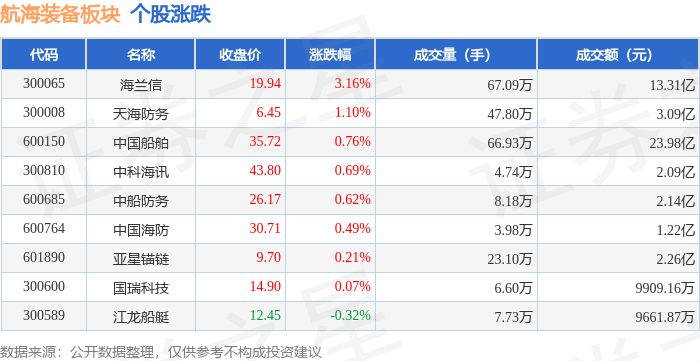
Market Performance - The marine equipment sector increased by 0.8% on October 24, with Hailanxin leading the gains [1] - The Shanghai Composite Index closed at 3950.31, up 0.71%, while the Shenzhen Component Index closed at 13289.18, up 2.02% [1] Individual Stock Performance - Hailanxin (300065) closed at 19.94, up 3.16% with a trading volume of 670,900 shares and a transaction value of 1.33 billion [1] - Tianhai Defense (300008) closed at 6.45, up 1.10%, with a trading volume of 478,000 shares and a transaction value of 309 million [1] - China Shipbuilding (600150) closed at 35.72, up 0.76%, with a trading volume of 669,300 shares and a transaction value of 2.398 billion [1] - Other notable stocks include Zhongke Haixun (300810) at 43.80, up 0.69%, and China Marine Defense (600685) at 26.17, up 0.62% [1] Capital Flow Analysis - The marine equipment sector saw a net inflow of 158 million from main funds, while retail investors experienced a net outflow of 76.1 million [1] - Main funds showed significant net inflows in Hailanxin (859.32 million) and China Shipbuilding (809.78 million) [2] - Retail investors had notable outflows in stocks like Zhongke Haixun (-10.81 million) and China Marine Defense (-1.65 million) [2]



我国自主研发的双燃料客滚船交付海外客户
Xin Hua Wang· 2025-10-23 12:40
Core Viewpoint - The delivery of the green luxury dual-fuel passenger ferry "Virgo" by Guangzhou Shipyard International, a subsidiary of China Shipbuilding Group, to the passenger ferry operator Grandi Navi Veloci (GNV) marks a significant advancement in eco-friendly maritime transportation [1]. Group 1 - The "Virgo" ferry is designed to operate on dual fuel, indicating a shift towards more sustainable shipping solutions [1]. - The vessel was named and delivered on October 23, highlighting the completion of a significant project in the shipbuilding industry [1].
航海装备板块10月23日跌0.66%,中科海讯领跌,主力资金净流出4.95亿元
Zheng Xing Xing Ye Ri Bao· 2025-10-23 08:21
Core Viewpoint - The maritime equipment sector experienced a decline of 0.66% on October 23, with Zhongke Haixun leading the drop, while the Shanghai Composite Index and Shenzhen Component Index both rose by 0.22% [1] Group 1: Market Performance - The closing price of China Shipbuilding was 35.45, down 0.56%, with a trading volume of 528,300 shares and a transaction value of 1.863 billion yuan [1] - Zhongke Haixun saw a significant decline of 4.98%, closing at 43.50, with a trading volume of 53,900 shares and a transaction value of 236 million yuan [1] - The overall maritime equipment sector had a net outflow of 495 million yuan from main funds, while retail investors contributed a net inflow of 410 million yuan [1] Group 2: Fund Flow Analysis - XD Zhongchuan Defense had a main fund net outflow of 4.7343 million yuan, with retail investors contributing a net inflow of 2.0987 million yuan [2] - China Shipbuilding experienced a significant main fund net outflow of 244 million yuan, while retail investors had a net inflow of 205,000 yuan [2] - The overall trend indicates that while main funds are withdrawing, retail investors are actively buying into the sector [2]