WINGTECH(600745)

Search documents
闻泰科技独家回应!安世半导体资产受限新进展
Shang Hai Zheng Quan Bao· 2025-10-16 14:06
Core Viewpoint - The recent asset restriction issue faced by Anshi Semiconductor, a subsidiary of Wentai Technology, has drawn significant market attention, prompting the company to seek legal solutions to the control problem [1][2]. Group 1: Company Response and Actions - At the temporary shareholders' meeting on October 15, Wentai Technology's chairman emphasized the company's commitment to resolving the control issue of Anshi Semiconductor through various legal means [1]. - The company has engaged legal counsel to protect shareholder rights and has communicated with relevant Chinese government departments for guidance and support [3]. - The company is actively maintaining communication with suppliers and customers to stabilize operations and mitigate external impacts [5]. Group 2: Financial Performance and Growth - Anshi Semiconductor has experienced a 60% increase in revenue and significant net profit growth since its acquisition in 2019 [5]. - The company’s CFO highlighted that Anshi's rapid development is attributed to the synergies gained from Wentai's acquisition, which has led to improvements in financial performance, technical asset accumulation, operational resilience, and market position [4]. Group 3: Employee Stock Ownership Plan - The shareholders' meeting approved the 2025 Employee Stock Ownership Plan, which reflects confidence in the company's future development and the achievability of performance targets [7]. - The plan has a total funding limit of 57.158 million yuan and will assess performance metrics over the 2025-2027 fiscal years, with specific profit and revenue growth targets set for each vesting period [7].


荷兰干预安世半导体运营,荷美双方曾有沟通,商务部回应
Nan Fang Du Shi Bao· 2025-10-16 13:10
Core Viewpoint - The Chinese government strongly opposes the Netherlands' intervention in the operations of Nexperia, a subsidiary of Wingtech Technology, citing violations of contractual spirit and market principles, which could harm the business environment in the Netherlands and damage mutual interests [1][2]. Group 1 - The Chinese government emphasizes that the Netherlands should maintain independence and respect objective facts while correcting erroneous practices to protect the legitimate rights of Chinese investors [2]. - On September 30, the Dutch Ministry of Economic Affairs and Climate Policy issued a ministerial order restricting Nexperia from adjusting assets, intellectual property, business, and personnel across its 30 global entities for one year [2]. - Following the ministerial order, three foreign executives of Nexperia filed an urgent request with the Dutch corporate court on October 1 to initiate an investigation and take temporary measures against the company [2].
中国商务部:美“穿透规则”是加害中企始作俑者
Zhong Guo Xin Wen Wang· 2025-10-16 11:59
Core Viewpoint - The Chinese Ministry of Commerce criticizes the Netherlands for intervening in Nexperia's operations, emphasizing that the U.S. "penetration rules" are detrimental to Chinese enterprises and urging the Netherlands to maintain independence and autonomy in its decisions [1][2]. Group 1: China's Position - The Chinese government firmly opposes the Netherlands' broad interpretation of "national security" and its administrative interference in corporate affairs, arguing that such actions violate contractual spirit and market principles [1]. - The Ministry of Commerce highlights that the Netherlands' actions could severely damage its business environment, harming both parties involved [1]. Group 2: U.S. Influence - The Chinese spokesperson notes that the U.S. has communicated demands to the Netherlands regarding changes in Nexperia's management and governance structure to avoid sanctions under the "penetration rules" [1]. - The U.S. "penetration rules" are described as the origin of harm to Chinese companies, significantly impacting international trade order and disrupting global supply chains [1]. Group 3: Call for Fair Practices - The Chinese side urges the Netherlands to respect objective facts, uphold contractual spirit and market principles, and correct its erroneous practices to protect the legitimate rights of Chinese investors [2]. - The Ministry of Commerce indicates that China will take necessary measures to firmly safeguard the legal rights of its enterprises [2].
闻泰之殇:没有“御林军”的出海,是一场高成本裸奔
Guan Cha Zhe Wang· 2025-10-16 11:39
Core Insights - The core issue revolves around the loss of control over the key asset, Nexperia, by Wentai Technology, which has resulted in a significant market value drop and a governance crisis [1][4][7] Group 1: Company Overview - Wentai Technology's stock price has dropped significantly, losing over 10 billion yuan in market value within two days [1] - The company invested 33.2 billion yuan to acquire Nexperia, a Dutch semiconductor firm, which it controlled for five years before losing governance rights [1][4] - The management change was driven by former executives who had previously collaborated with Wentai's founder, Zhang Xuezheng [1][3] Group 2: Acquisition Background - The acquisition of Nexperia was seen as a bold move by Zhang, who aimed to leverage Chinese capital for the growth of the European company [4][5] - Initial integration was successful, with Nexperia achieving record revenues of 2.36 billion euros in 2022 and improving gross margins from 25% in 2020 to 42.4% [4][5] - Tensions began to surface in 2021 due to failed acquisitions and government scrutiny, leading to a deterioration of relations between Wentai and Nexperia's management [5][6] Group 3: Geopolitical Context - The situation escalated in 2024 with a cyberattack on Nexperia and subsequent U.S. sanctions, which placed Wentai on an entity list, complicating its operations [6][7] - The introduction of the "50% rule" by the U.S. further threatened Nexperia's ability to engage with American suppliers, creating panic among its European management [6][10] - The court's rapid decision to suspend Zhang's position and place Wentai's shares in Nexperia under third-party control highlights the geopolitical pressures faced by Chinese firms [6][7] Group 4: Challenges in Cross-Border M&A - The case illustrates the unequal playing field for Chinese companies in cross-border acquisitions, facing stringent political scrutiny and operational restrictions [8][9] - Chinese firms often encounter various limitations, such as mandatory local management retention and technology transfer restrictions, which do not apply to Western firms acquiring Chinese companies [8][9][10] - The reliance on U.S. technology and equipment creates vulnerabilities for Chinese firms, as seen in Nexperia's dependency on American semiconductor supplies [10][23] Group 5: Strategic Missteps - The analysis identifies four strategic failures in Chinese overseas investments, including over-reliance on foreign intermediaries and lack of government backing [15][16][18] - The absence of pre-established dispute resolution mechanisms has left Chinese firms at a disadvantage in foreign legal systems [17][18] - The need for a national-level support system for Chinese firms in international markets is emphasized, particularly in high-stakes industries like semiconductors [18][19] Group 6: Future Directions - The incident signals a need for Chinese companies to pivot from relying on overseas acquisitions for technology to focusing on independent R&D [22][23] - There is a call for a strategic reassessment of investment targets, prioritizing those with lower geopolitical risks [22][23] - The overarching theme is the necessity for enhanced domestic capabilities and a robust risk management framework to navigate the complexities of international business [24][25]

商务部:中方坚决反对荷兰干预安世半导体运营
半导体芯闻· 2025-10-16 10:43
Core Viewpoint - The Chinese semiconductor industry association opposes Dutch authorities' interference in Nexperia's operations, emphasizing that such actions violate market principles and harm the business environment [1][2]. Group 1: Government Response - The Chinese government firmly opposes the Netherlands' broad interpretation of "national security" and administrative intervention in corporate affairs, stating it undermines contractual spirit and market principles [1]. - The Chinese government highlights that the Dutch court's recent documents reveal communications between the U.S. and the Netherlands regarding "penetration rules," which included demands to change Nexperia's CEO and adjust governance structures to avoid sanctions [1]. Group 2: International Trade Relations - The Chinese government urges the Netherlands to maintain independence and respect for objective facts, advocating for the correction of erroneous practices to protect Chinese investors' legitimate rights [2]. - The Chinese government warns that the U.S. "penetration rules" significantly disrupt international trade order and threaten the stability of global supply chains, labeling the Netherlands' actions as a clear example of harm to Chinese enterprises [1].

突发|荷兰冻结闻泰子公司Nexperia 147亿资产:半导体供应链影响与应对策略
Sou Hu Cai Jing· 2025-10-16 09:50
Core Viewpoint - The Dutch Ministry of Economic Affairs and Climate Policy has issued an asset freeze order against Nexperia, a wholly-owned subsidiary of Wingtech Technology, involving semiconductor assets valued at approximately 14.7 billion RMB (about 2 billion USD) to protect national security, which may restrict Nexperia's operations in the Netherlands [1][3]. Group 1: Event Background - The asset freeze was issued in October 2025, targeting Nexperia's key assets in the Netherlands, including the NXP legacy factory and R&D center, due to foreign investment scrutiny and national security concerns, particularly regarding technology transfer risks [3]. - Wingtech Technology has faced regulatory pressures in Europe and the U.S. since acquiring Nexperia in 2021, and this freeze may be a result of the expanded EU foreign investment review framework [3]. - Nexperia plans to appeal the decision and maintains that business operations will continue normally, although the incident has led to a short-term decline in Wingtech's stock price [3]. Group 2: Multi-Dimensional Impact - For Wingtech/Nexperia, the asset freeze may lead to operational halts in the Netherlands, affecting the production of discrete semiconductors (such as diodes and transistors) and increasing financial pressure, resulting in heightened stock price volatility [4]. - The global supply chain may experience a shortage of discrete components, particularly in the automotive and consumer electronics sectors, with prices potentially rising by 5-10% and delivery times extending by 2-4 weeks [5]. - The incident highlights the "decoupling" trend, prompting the EU and U.S. to accelerate localization efforts (e.g., CHIPS Act), leading to increased demand for alternative suppliers like Vishay and Infineon [6]. Group 3: Company Response and Forecast - Nexperia may appeal the asset freeze and consider relocating assets outside the Netherlands while enhancing its EV/5G product lines [7]. - If the appeal fails, Nexperia might sell off some assets, and in the long term, Wingtech is expected to accelerate localization efforts in China, facing more EU scrutiny [7]. - Official updates are anticipated within 1-3 months, and monitoring Wingtech's official website is advised [7]. Group 4: Practical Guidance for Clients - Clients are advised to assess Nexperia inventory and confirm supply through Wingtech's global channels [8]. - Switching to alternative suppliers like Vishay or Infineon is recommended, with free BOM audits offered by Wingtech [9]. - Conducting compliance self-checks to evaluate foreign investment review risks and signing end-user declarations to avoid gray market channels is crucial [10]. - In the medium to long term, building a multi-supplier system and securing long-term contracts with alternative suppliers is suggested [11]. Group 5: Industry Perspective - The incident serves as a reminder that compliance and redundancy in design are more critical than overreacting to asset freezes, emphasizing the importance of supply chain resilience [13]. - The asset freeze is viewed as an opportunity for a healthier industry, with Wingtech committed to supporting clients from component alternatives to PCBA delivery [14].
环环相call:荷兰企图劫掠中企?中方绝不答应!
Huan Qiu Shi Bao· 2025-10-16 09:12
01:27 殖民时代的"海盗劫掠"企图在21世纪重现?荷兰政府12日称,已作"极为特殊"决定,对中国企业闻泰科 技旗下安世半导体进行干预,理由是可能对"荷兰及欧洲的经济安全构成风险"。 英国广播公司称,荷兰政府的声明并未具体说明为何认为该公司运营存在风险,文章还暗示这一举动与 美国商务部9月"进一步收紧对华限制措施"有关。 明眼人都看得出,这是荷兰政府以莫须有的"国家安全"为借口,严重滋扰中企控股芯片公司,试图将中 国企业多年的投入据为己有。这一行为被不少人称为21世纪的"海盗劫掠",令国际舆论哗然。 但21世纪的公然劫掠绝行不通,中国也绝不答应,各方都不应低估中方维护自身权益的坚定决心与充分 能力。希望荷方尊重国际经贸规则,看清历史大势,否则只会搬起石头砸了自己的脚。 此前荷方下达行政指令,限制安世半导体及其关联实体的经营决策,并实际剥夺中方股东的正常控制 权。闻泰科技随即声明,对这种针对中资企业的不公待遇表示强烈抗议。14日,中国半导体行业协会也 发布声明,强调坚定支持闻泰科技捍卫自身合法权益。 ...
解密主力资金出逃股 连续5日净流出708股




Zheng Quan Shi Bao Wang· 2025-10-16 08:53
Core Insights - As of October 16, a total of 708 stocks in the Shanghai and Shenzhen markets have experienced a net outflow of main funds for five consecutive days or more [1] - The stock with the longest continuous net outflow is Dayu Ming, with 23 days, followed by Tianma Technology with 22 days [1] - The largest total net outflow amount is from Dongfang Wealth, with a cumulative outflow of 7 days totaling 7.857 billion yuan [1] Group 1: Stocks with Significant Net Outflows - Dongfang Wealth has seen a net outflow of 7 days amounting to 7.857 billion yuan, with a net outflow ratio of 9.51% and a cumulative decline of 7.83% [1] - Wen Tai Technology follows with a net outflow of 3.135 billion yuan over 7 days, a net outflow ratio of 13.69%, and a cumulative decline of 25.26% [1] - Shanghai Electric has recorded a net outflow of 2.976 billion yuan over 5 days, with a net outflow ratio of 7.24% and a cumulative decline of 7.13% [1] Group 2: Other Notable Stocks - Ganfeng Lithium has a net outflow of 2.716 billion yuan over 5 days, with a net outflow ratio of 6.47% and a cumulative decline of 3.00% [1] - ST Huatuo has experienced a net outflow of 2.609 billion yuan over 9 days, with a net outflow ratio of 9.74% and a cumulative decline of 12.70% [1] - Changying Precision has a net outflow of 2.416 billion yuan over 5 days, with a net outflow ratio of 8.76% and a cumulative decline of 8.25% [1] Group 3: Additional Stocks with Notable Trends - Shanshan Co. has seen a net outflow of 2.280 billion yuan over 6 days, with a net outflow ratio of 19.16% and a cumulative decline of 17.61% [1] - WuXi AppTec has a net outflow of 2.215 billion yuan over 6 days, with a net outflow ratio of 6.49% and a cumulative decline of 9.79% [1] - Inspur Information has recorded a net outflow of 2.030 billion yuan over 6 days, with a net outflow ratio of 4.84% and a cumulative decline of 9.42% [1]
74.03亿元资金今日流出电子股
Zheng Quan Shi Bao Wang· 2025-10-16 08:48
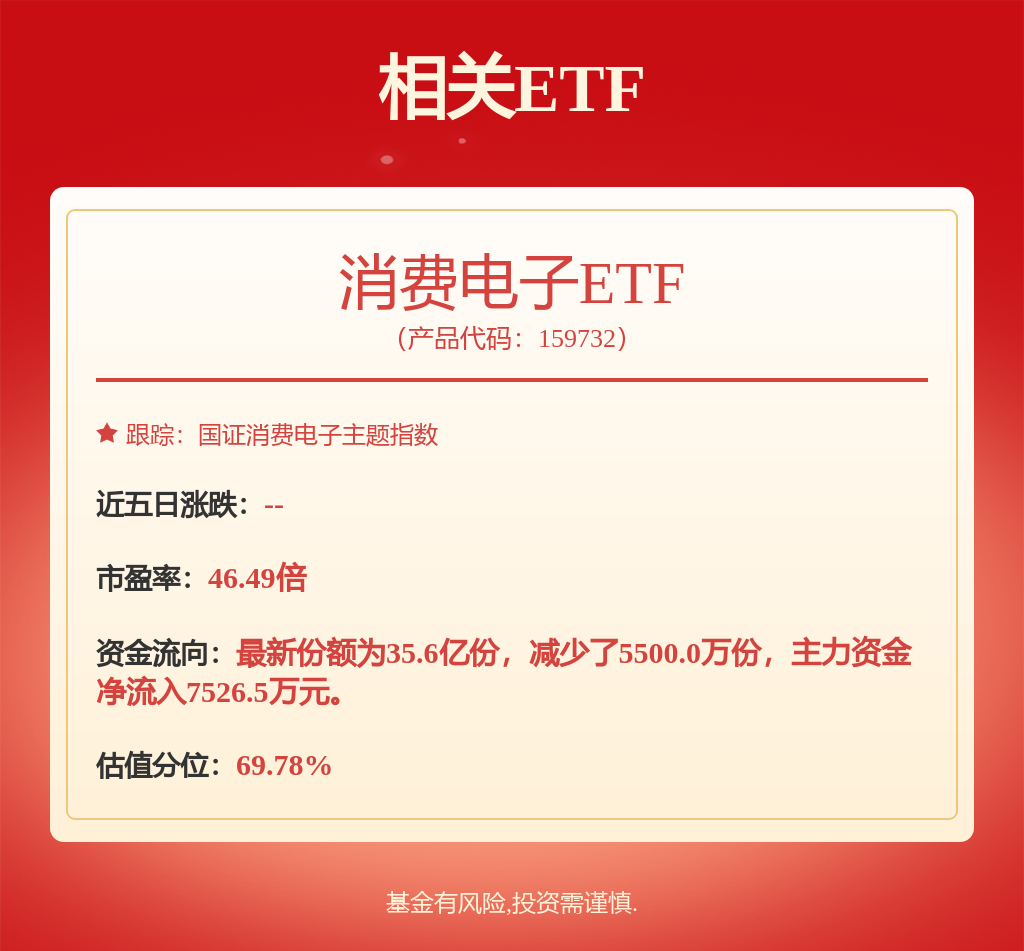
Market Overview - The Shanghai Composite Index rose by 0.10% on October 16, with seven sectors experiencing gains, notably coal and banking, which increased by 2.35% and 1.35% respectively [1] - The steel and non-ferrous metals sectors faced declines, with decreases of 2.14% and 2.06% respectively [1] Electronic Industry Performance - The electronic sector fell by 0.60%, with a net outflow of 7.403 billion yuan in main capital throughout the day [1] - Out of 468 stocks in the electronic sector, 115 stocks rose, with four hitting the daily limit, while 350 stocks declined [1] - Notable stocks with significant net inflows included: - Shannon Chip (香农芯创) with a net inflow of 632.46 million yuan, increasing by 16.70% - Zhaoyi Innovation (兆易创新) with a net inflow of 591.44 million yuan, increasing by 3.03% - Demingli (德明利) with a net inflow of 512.92 million yuan, increasing by 10.00% [1] Capital Outflow in Electronic Sector - Major stocks with significant capital outflows included: - Wenta Technology (闻泰科技) with a net outflow of 753.15 million yuan, decreasing by 3.33% - Haiguang Information (海光信息) with a net outflow of 585.99 million yuan, decreasing by 3.34% - SMIC (中芯国际) with a net outflow of 503.46 million yuan, decreasing by 1.74% [2] ETF Insights - The Consumer Electronics ETF (product code: 159732) tracks the Guozheng Consumer Electronics Theme Index and has a current P/E ratio of 46.49 times [4] - The ETF has seen a reduction in shares, with the latest total at 3.56 billion shares, down by 55 million shares, and a net inflow of 75.265 million yuan [4]



商务部:中方将采取必要措施
第一财经· 2025-10-16 08:45
Core Viewpoint - The Chinese Ministry of Commerce expresses strong opposition to the Netherlands' intervention in the operations of Nexperia, a subsidiary of Wingtech Technology, emphasizing that such actions violate contractual spirit and market principles, and could harm the business environment in the Netherlands [1][2]. Group 1 - The Ministry of Commerce highlights that the Netherlands' actions are influenced by the U.S. "penetration rules," which aim to undermine Chinese enterprises [2]. - The Ministry calls for the Netherlands to maintain independence and respect for objective facts, urging them to correct their actions to protect the legitimate rights of Chinese investors [2]. - The Ministry indicates that necessary measures will be taken to firmly safeguard the legal rights of Chinese enterprises [2].