Shanxi Xinghuacun Fen Wine Factory (600809)

Search documents
A股白酒股午后持续走强,泸州老窖、山西汾酒、今世缘涨超3%,古井贡酒、迎驾贡酒、五粮液跟涨。
news flash· 2025-07-22 05:15
A股白酒股午后持续走强,泸州老窖、山西汾酒、今世缘涨超3%,古井贡酒、迎驾贡酒、五粮液跟 涨。 ...

白酒股午后震荡拉升,泸州老窖、山西汾酒均涨超4%
news flash· 2025-07-22 05:14
Group 1 - The core viewpoint of the article highlights the significant rise in the stock prices of Chinese liquor companies, particularly Luzhou Laojiao and Shanxi Fenjiu, which both increased by over 4% [1] - Other companies in the sector, such as Jinshiyuan and Gujing Gongjiu, also saw gains exceeding 3%, indicating a positive trend across the industry [1] - The article suggests that "smart money" is flowing into these stocks, hinting at a strategic investment interest in the liquor sector [1]




2025年《财富》中国500强净利润率最高的40家公司
财富FORTUNE· 2025-07-22 04:03
Core Insights - The 2025 Fortune China 500 list was released, providing insights into the latest development trends of China's largest companies [1] - The ranking methodology is consistent with the Fortune Global 500, including both listed and unlisted companies [1] Profit Margin Rankings - Among the top ten companies with the highest profit margins, three are from the beverage industry: Kweichow Moutai, Luzhou Laojiao, and Shanxi Fenjiu, with Kweichow Moutai leading at over 49% [1] - Taiwan Semiconductor Manufacturing Company (TSMC) ranks third in profit margin with over 40% [1] - Ctrip is the only internet company in the top ten for profit margins, achieving over 32%, benefiting from the tourism industry's growth and favorable policies [1]




金十图示:2025年07月22日(周二)富时中国A50指数成分股午盘收盘行情一览:银行、保险股延续跌势,酿酒、食品饮料板块集体走高
news flash· 2025-07-22 03:38
Market Overview - The FTSE China A50 Index components showed a mixed performance with banking and insurance stocks continuing to decline, while the liquor and food & beverage sectors experienced gains [1][6]. Banking Sector - Major banks like China Everbright Bank reported a market capitalization of 249.93 billion with a trading volume of 446 million, showing a decline of 0.09 (-1.59%) [3]. - China Pacific Insurance, China Ping An, and China Life Insurance had market capitalizations of 436.27 billion, 347.77 billion, and 1,028.70 billion respectively, with trading volumes of 991 million, 2.11 billion, and 462 million, reflecting declines of 0.51 (-1.39%), 0.70 (-1.22%), and 0.07 (-0.83%) [3]. Insurance Sector - The insurance sector continued to face downward pressure, with significant declines in major companies [3]. Liquor Industry - The liquor sector saw positive movement, with Kweichow Moutai, Shanxi Fenjiu, and Wuliangye reporting market capitalizations of 1,820.06 billion, 225.24 billion, and 482.06 billion respectively, and trading volumes of 2.14 billion, 1.36 billion, and 1.15 billion, with increases of 4.34 (+2.41%), 1.63 (+1.33%), and 5.86 (+0.41%) [3]. Semiconductor Sector - The semiconductor industry showed varied performance, with Northern Huachuang, Cambricon Technologies, and Haiguang Information having market capitalizations of 229.98 billion, 248.67 billion, and 316.92 billion respectively, and trading volumes of 1.33 billion, 2.71 billion, and 1.24 billion, with changes of -1.34 (-0.42%), +12.40 (+2.13%), and -0.32 (-0.23%) [3]. Oil Industry - The oil sector, including companies like Sinopec and PetroChina, reported market capitalizations of 725.05 billion and 1,643.53 billion respectively, with trading volumes of 758 million and 563 million, showing slight increases [3]. Coal Industry - The coal sector, represented by companies like Shenhua Group and Shaanxi Coal and Chemical Industry, had market capitalizations of 750.04 billion and 189.83 billion respectively, with minimal changes in stock prices [3]. Automotive Sector - The automotive sector, led by BYD, reported a market capitalization of 1,849.01 billion with a trading volume of 3.54 billion, showing a slight increase of 2.39 (+0.72%) [3]. Other Sectors - Various other sectors such as chemicals, pharmaceuticals, and logistics showed mixed results, with some companies experiencing gains while others faced declines [4][6].







浙商证券:重点关注当前至中秋国庆白酒配置机会 推荐贵州茅台(600519.SH)等
智通财经网· 2025-07-22 02:44
Group 1 - The core viewpoint of the report emphasizes the short-term impact on consumption scenarios and the long-term focus on the bottoming out of the cycle and strategic choices of liquor companies, particularly highlighting the investment opportunities in leading liquor companies ahead of the Mid-Autumn Festival and National Day [1] - The current adjustment period is deeper than the previous one from 2012-2015, with greater pressures from economic and policy backgrounds, leading to a more severe short-term impact on consumption scenarios compared to the last adjustment period [1] - The report identifies two key points for long-term observation: the way the liquor cycle bottoms out and the strategic choices made by companies during this adjustment period, which will determine which companies can navigate through the cycle [1] Group 2 - The report outlines key signals for the liquor industry to identify the bottoming out, including the performance expectations of liquor companies and the pricing of Moutai, which serve as leading indicators for stock price bottoms [2] - It suggests focusing on the current period leading up to the Mid-Autumn Festival and National Day for potential investment opportunities, as performance expectations are likely to reach a low point during this time [2] - The report indicates that the supply of Moutai during the upcoming festive season may represent the low point of pricing in this adjustment cycle [2] Group 3 - The report discusses how to assess the bottoming out of market capitalization for leading liquor companies, recommending the selection of companies with strong fundamentals and high dividend yields during counter-cyclical periods [3] - Two methods are proposed for estimating the market capitalization bottom: cautious profit assumptions for the next three years combined with required dividend yield calculations, and assessing the asset value of companies with substantial aged liquor inventory [3]
《Brand Finance 2025年全球酒精饮料品牌价值榜》发布
Jing Ji Guan Cha Wang· 2025-07-21 13:29
Core Insights - The report from Brand Finance reveals that Chinese alcoholic beverage brands continue to dominate the global market, with the industry valued at $123.38 billion, reflecting a 5.2% increase from 2024 [1] Beer Segment - Snow Beer is recognized as the most valuable beer brand in China, with a brand value of $4.66 billion, marking an 8.6% year-on-year growth and ranking sixth globally [1] - Tsingtao Beer saw a significant brand value increase of 42.3%, reaching $3.63 billion, and rose three positions to ninth in the global beer brand ranking [2] - Yanjing Beer experienced a 21.5% growth in brand value, reaching $640 million, and improved its ranking by seven places to 38th [2] Spirits Segment - Six Chinese liquor brands made it to the top ten in the global spirits brand value ranking, with Moutai, Wuliangye, Luzhou Laojiao, and Fenjiu maintaining the top four positions [3] Wine Segment - Zhangyu is the only Chinese wine brand listed, with a brand value increase of 16.1% to $820 million, solidifying its position among the top five global wine brands [4] Global Brand Leaders - Corona Extra retained its title as the most valuable beer brand globally, valued at $13.36 billion [5] - Jack Daniel's remains the most valuable whiskey brand with a value of $4.44 billion [5] - Crown Vodka's brand value grew by 33.3% to $2.93 billion, maintaining its leading position in the vodka category [5] Industry Trends - The Chinese alcoholic beverage industry is experiencing four key development trends: accelerated premiumization, deepened internationalization, innovation-driven competition, and cultural empowerment reshaping brand value [5]


食品饮料周报(25年第29周):白酒估值持续修复,关注中报业绩窗口-20250721
Guoxin Securities· 2025-07-21 12:25
Investment Rating - The report maintains an "Outperform" rating for the food and beverage sector [2][6]. Core Views - The liquor sector is experiencing a valuation recovery, with some companies releasing mid-year performance forecasts that are expected to alleviate demand pressure. The overall sentiment in the liquor market is improving due to positive policy expectations, leading to a rebound in stock prices for major players [3][12]. - The beer and beverage segments are entering a peak season, with a focus on mid-year performance. Major beer companies are expected to maintain high profit growth due to cost reduction and efficiency improvements [4][15]. - The report highlights three main investment themes in the liquor sector: resilient leaders like Kweichow Moutai, Shanxi Fenjiu, and Wuliangye; companies like Luzhou Laojiao that are showing signs of valuation recovery; and brands like Jinsiyuan and Yingjiagongjiu that have potential for market share growth [3][14]. Summary by Sections Liquor - The liquor sector's revenue for the first half of the year reached 331.6 billion yuan, a year-on-year increase of 5.5%. However, production has decreased by 5.8% [3][12]. - The report recommends focusing on companies with strong anti-risk capabilities and those that are actively engaging in digital transformation [3][14]. Consumer Goods - The beer segment is expected to see significant profit growth, with Yanjing Beer and Zhujiang Beer forecasting net profits to increase by 40% to 50% year-on-year [15][16]. - The snack food sector is under pressure, with companies like Ganyuan Food and Qiaqia Food predicting substantial declines in net profits due to high raw material costs and increased marketing expenses [17][18]. Seasonality and Market Trends - The report notes that the beverage industry is entering a peak consumption period, with expectations for continued growth in segments like sugar-free tea and energy drinks [21][22]. - The dairy sector is anticipated to recover gradually, with policies stimulating demand and improving supply dynamics [20][21]. Key Data Tracking - The food and beverage sector saw a 1.02% increase in stock prices, outperforming the Shanghai Composite Index by 0.33 percentage points during the week of July 14 to July 18, 2025 [22].


食品饮料周报:白酒情绪边际修复,关注中报确定性个股-20250721
Tai Ping Yang Zheng Quan· 2025-07-21 11:49
Investment Rating - The overall investment rating for the food and beverage industry is positive, with expectations of returns exceeding the CSI 300 index by more than 5% in the next six months [23]. Core Insights - The food and beverage sector has shown signs of stabilization and recovery, with soft drinks, liquor, and dairy products leading in growth. The sector index increased by 0.97%, ranking 14th among 31 sub-industries [4][13]. - The liquor segment is experiencing a rebound, with the SW liquor index rising by 0.88%. The sector is in a bottoming phase, with a focus on the upcoming demand during the Mid-Autumn Festival and National Day [5][17]. - The beverage market is seeing mixed short-term performances due to external events, but there is a long-term positive outlook for companies with upward momentum [6][18]. Summary by Sections Liquor Sector - The liquor sector is recommended for investment, with specific companies like Guizhou Moutai, Luzhou Laojiao, Shanxi Fenjiu, and Jianshiyuan receiving "Buy" ratings. The sector is currently at a historical low valuation, suggesting a potential recovery [3][5][21]. - The price of Moutai (bottle) is reported at 1890 RMB, showing a slight increase, while the price of Wuliangye remains stable at 870 RMB [5][17]. Beverage Sector - The beverage sector is experiencing fluctuations due to public sentiment affecting certain brands. Companies like Nongfu Spring and China Resources Beverage have shown resilience, with Nongfu Spring's market share recovering significantly [6][20]. - Recommendations include Youyou Foods, Dongpeng Beverage, and Dashi Co., with a focus on companies that can capitalize on market share recovery [6][18][21]. Food Sector - The food sector has seen some companies facing challenges due to external events, but there are still opportunities for growth in the long term. The focus remains on companies with strong mid-year performance [6][18].

张坤基金规模跌破600亿元,增持白酒股,卖出腾讯、招行;谢治宇重仓港股创新药
Sou Hu Cai Jing· 2025-07-21 10:12
Group 1 - The core viewpoint of the article highlights the decline in fund sizes managed by prominent fund managers Zhang Kun and Xie Zhiyu during the second quarter, with Zhang's total fund size dropping to 55.047 billion yuan, a decrease of 5.775 billion yuan, and Xie's fund size at 39.266 billion yuan, down by approximately 446 million yuan [2] - Zhang Kun remains heavily invested in the consumer and technology sectors, increasing holdings in liquor stocks such as Wuliangye and Luzhou Laojiao, while reducing positions in Tencent Holdings and China Merchants Bank [2][3] - Xie Zhiyu has made new investments in Hong Kong innovative drug companies, including Innovent Biologics and Nuo Cheng Jianhua, while also increasing positions in his funds [2][12] Group 2 - Zhang Kun expressed that the pessimistic expectations in the market will eventually be broken, indicating that a sign of this would be when long-term government bond yields no longer remain at low levels that do not match economic development prospects [12] - Xie Zhiyu noted that the consumer sector is benefiting from an acceleration in policy subsidies, particularly in new consumption areas represented by tea drinks and trendy toys, although he cautioned that demand growth may face challenges in the second half of the year due to base effect declines [18] - The report indicates that Zhang Kun's flagship fund, E Fund Blue Chip, saw a decrease in size from 38.908 billion yuan to 34.943 billion yuan, with a stable stock position of 93.06% [3][5]



白酒行业“秒变”红利资产?招商中证白酒指数基金二季度净申购藏玄机
Mei Ri Jing Ji Xin Wen· 2025-07-21 08:18
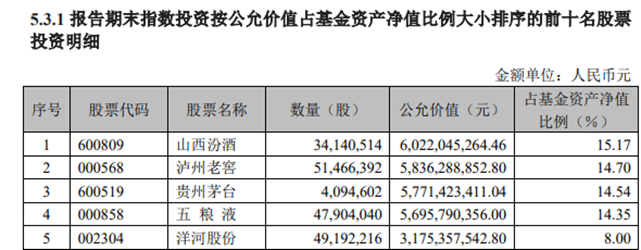
Core Viewpoint - The second quarter of 2025 saw a significant net subscription of 34.64 billion units in the China Securities White Wine Index Fund C, indicating a shift in investor sentiment towards short-term trading opportunities in the white wine sector, despite a 13.47% decline in the index [2][4][6]. Group 1: Fund Performance - The China Securities White Wine Index Fund C maintained a stable position with a 94.5% portfolio allocation, successfully tracking its benchmark [2]. - The net subscription for the China Securities White Wine Index Fund A was 2.34 billion units, significantly lower than that of Fund C, highlighting a preference for the latter among investors [4]. - The top holdings in the fund include Shanxi Fenjiu, Luzhou Laojiao, Kweichow Moutai, and Wuliangye, which together account for approximately 58.76% of the fund's net asset value [2][3]. Group 2: Market Dynamics - The white wine industry is experiencing pressure on demand, prompting companies to lower their annual growth targets while seeking to stabilize prices [2][9]. - Investors are increasingly viewing white wine stocks as high-dividend assets, with current dividend yields exceeding 4%, making them attractive for short-term speculative trading [9]. - Notable stock price rebounds were observed in leading white wine companies since July, with significant monthly increases in share prices for Luzhou Laojiao, Yanghe, and Wuliangye [9]. Group 3: Investment Strategy - The C class fund is more suitable for short-term investments due to its lower subscription fees compared to the A class fund, which is better for long-term holdings [7][8]. - The strategy of increasing dividend payouts by white wine companies has made mid-year reporting periods critical for attracting investor interest [9].