HZBank(600926)

Search documents
杭州银行(600926) - 杭州银行2025年半年度权益分派实施公告
2025-11-11 11:15
证券代码:600926 证券简称:杭州银行 公告编号:2025-082 优先股代码:360027 优先股简称:杭银优 1 杭州银行股份有限公司 2025年半年度权益分派实施公告 本公司董事会及全体董事保证本公告内容不存在任何虚假记 载、误导性陈述或者重大遗漏,并对其内容的真实性、准确性和 完整性承担法律责任。 重要内容提示: 每股分配比例 A 股每股现金红利0.38元(含税) 3.分配方案: 本次利润分配以方案实施前的公司总股本7,249,002,548股为 基数,每股派发现金红利0.38元(含税),共计派发现金红利 2,754,620,968.24元。 相关日期 | 股份类别 | 股权登记日 | 最后交易日 | 除权(息)日 | 现金红利 | | --- | --- | --- | --- | --- | | | | | | 发放日 | | A股 | 2025/11/17 | - | 2025/11/18 | 2025/11/18 | 差异化分红送转: 否 一、 通过分配方案的股东大会届次和日期 2025 年 6 月 25 日,杭州银行股份有限公司(以下简称"公司" "本公司")召开2024年年度股东大会审 ...

杭州银行(600926.SH)2025年半年度权益分派:每股派利0.38元
Ge Long Hui A P P· 2025-11-11 11:12
Core Points - Hangzhou Bank (600926.SH) announced a cash dividend distribution of 0.38 yuan per share (including tax), totaling 2.755 billion yuan based on a total share capital of 7.249 billion shares [1] Group 1 - The dividend distribution is based on the company's total share capital of 7.249 billion shares [1] - The cash dividend per share is set at 0.38 yuan, which includes tax [1] - The total cash dividend to be distributed amounts to 2.755 billion yuan [1] Group 2 - The record date for the dividend distribution is November 17, 2025 [1] - The ex-dividend date is November 18, 2025 [1]
杭州银行2025年半年度权益分派:每股派利0.38元
Ge Long Hui· 2025-11-11 11:02
Core Viewpoint - Hangzhou Bank (600926.SH) announced a cash dividend distribution plan for the first half of 2025, distributing a total of 2.755 billion yuan in cash dividends based on a total share capital of 7.249 billion shares, with a dividend of 0.38 yuan per share (tax included) [1] Summary by Sections - **Dividend Distribution Details** - The total cash dividend to be distributed is 2.755 billion yuan [1] - The dividend per share is set at 0.38 yuan (including tax) [1] - The total share capital used for the distribution is 7.249 billion shares [1] - **Key Dates** - The record date for the dividend distribution is November 17, 2025 [1] - The ex-dividend date is November 18, 2025 [1]
城商行板块11月11日跌0%,上海银行领跌,主力资金净流入2.41亿元
Zheng Xing Xing Ye Ri Bao· 2025-11-11 08:46
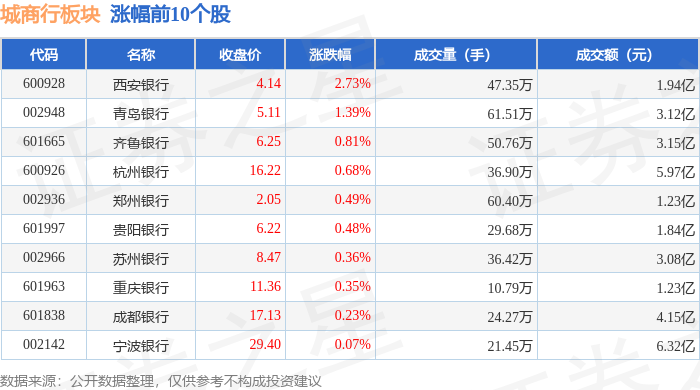
Market Overview - The city commercial bank sector experienced a slight decline of 0.0% on November 11, with Shanghai Bank leading the drop [1] - The Shanghai Composite Index closed at 4002.76, down 0.39%, while the Shenzhen Component Index closed at 13289.0, down 1.03% [1] Individual Bank Performance - Xi'an Bank saw the highest increase in share price, closing at 4.14 with a rise of 2.73% [1] - Qingdao Bank and Qilu Bank also reported positive performance, with increases of 1.39% and 0.81% respectively [1] - Shanghai Bank, on the other hand, closed at 10.13, down 0.98%, indicating a significant decline in its stock price [2] Trading Volume and Capital Flow - The city commercial bank sector recorded a net inflow of 241 million yuan from institutional investors, while retail investors saw a net outflow of 290 million yuan [2] - Jiangsu Bank attracted the highest net inflow from institutional investors at 113 million yuan, representing 11.75% of its trading volume [3] - In contrast, Zhengzhou Bank experienced a net outflow of 421,280 yuan from institutional investors, indicating a negative sentiment towards its stock [3]




杭州银行前三季度业绩保持稳健 中期分红方案兑现发展红利
Zhong Guo Jing Ji Wang· 2025-11-11 03:27
Core Viewpoint - Hangzhou Bank has demonstrated a strong commitment to shareholder returns through its mid-term dividend plan, reflecting its robust operational performance and asset quality in the first three quarters of 2025 [1][2] Dividend Plan - The bank announced a mid-term dividend of 0.38 yuan per share, which is an increase from the previous year's 0.37 yuan per share, despite a 20.83% increase in total ordinary shares due to a 15 billion yuan convertible bond redemption [1][2] - The total cash dividend distribution will amount to 2.755 billion yuan (including tax), representing a 24.10% increase compared to the previous year's mid-term dividend [2] Operational Performance - For the first three quarters of 2025, Hangzhou Bank reported an operating income of 28.88 billion yuan, a year-on-year increase of 1.35%, with net interest income rising by 9.96% to 20.093 billion yuan and net commission income increasing by 12.65% to 3.298 billion yuan [2] - The net profit attributable to shareholders reached 15.885 billion yuan, reflecting a year-on-year growth of 14.53%, indicating strong profitability and operational resilience [2]
真金白银!年内十余家上市银行获股东、高管增持,银行“防御性板块”角色要变?
Xin Lang Cai Jing· 2025-11-10 12:57
Core Viewpoint - The recent surge in share buybacks by various banks, including Qilu Bank and Qingdao Bank, reflects strong confidence in the long-term value of the banking sector, with over 10 listed banks participating in this trend [1][9][10]. Group 1: Share Buybacks - Qilu Bank announced that its directors, supervisors, and senior executives have collectively increased their holdings by 3.15 million yuan, accounting for 90% of the planned buyback amount [1]. - Qingdao Bank's major shareholder, Qingdao Guoxin Financial Holdings, increased its holdings by 957 million yuan, raising its stake to 15.42%, making it the largest shareholder [4]. - Xiamen Bank's executives completed a buyback plan exceeding the minimum target, with total contributions reaching 1.6857 million yuan [5]. Group 2: Market Sentiment - The buyback activities are interpreted as a recognition of the banking sector's valuation, with a current price-to-book ratio of 0.72 and a dividend yield of 3.99%, attracting long-term capital [10][12]. - The banking sector has seen a collective "self-purchase" phenomenon, with various regional banks also engaging in buybacks, indicating a broader trend across the industry [6][8]. Group 3: Performance and Valuation - Despite a slight decline in revenue and net profit for 42 A-share listed banks in the first quarter, 24 banks reported growth in both metrics, particularly city and rural commercial banks [10]. - The net interest margin for listed banks is projected to stabilize, with a simulated net interest margin of 1.32% for Q3 2025, marking a potential turning point after four years of decline [12]. - Long-term capital, particularly from insurance funds, has been increasingly allocated to the banking sector, with a reported increase of 8.36 billion shares held by insurance funds in Q3 2025 [12][13].




银行推出平台化服务 助力中小企业数字化转型
Zhong Guo Jing Ying Bao· 2025-11-10 12:09
Core Viewpoint - Digital finance is increasingly becoming an important engine for promoting high-quality economic development as part of the "Five Major Articles" initiative [1] Group 1: Industry Developments - The banking industry is actively building platform-based service capabilities to assist enterprises in their digital transformation [1] - CITIC Bank launched the "Xiaotianyuan" enterprise ecological service platform, utilizing a "digital + finance + ecology" innovative model to empower the digital transformation of small and medium-sized enterprises (SMEs) [1] - Hangzhou Bank introduced "Xinyibao 1.0" to meet the diverse and intelligent operational needs of SMEs [1] Group 2: Challenges for SMEs - SMEs face challenges in digital transformation due to high costs and prolonged transition periods, leading to a reluctance to transform [1] - Zhejiang Unicom is addressing these challenges by creating a data element circulation platform and an industrial trusted data space, providing standardized and modular digital solutions to lower the transformation threshold for SMEs [1] Group 3: Recognition and Impact - At the recent 2025 "Data Element Empowerment New Industrialization" competition award ceremony, Zhejiang Unicom had eight projects recognized, covering various advantageous industries in Zhejiang such as smart manufacturing, chemicals, and apparel [1] - The focus of these projects is on solving practical pain points, such as improving product quality, reducing operational costs, and optimizing resource allocation [1]

城商行板块11月10日涨0.96%,厦门银行领涨,主力资金净流入7750.91万元
Zheng Xing Xing Ye Ri Bao· 2025-11-10 08:48
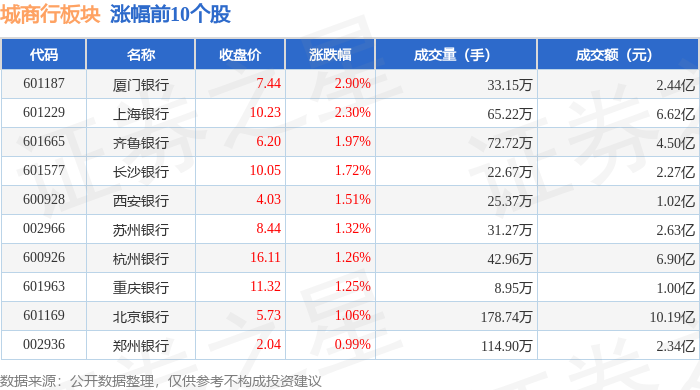
Market Performance - The city commercial bank sector increased by 0.96% on November 10, with Xiamen Bank leading the gains [1] - The Shanghai Composite Index closed at 4018.6, up 0.53%, while the Shenzhen Component Index closed at 13427.61, up 0.18% [1] Individual Bank Performance - Xiamen Bank's closing price was 7.44, with a rise of 2.90% and a trading volume of 331,500 shares, amounting to 2.44 billion yuan [1] - Shanghai Bank closed at 10.23, up 2.30%, with a trading volume of 652,200 shares and a transaction value of 660 million yuan [1] - Qilu Bank saw a closing price of 6.20, increasing by 1.97%, with a trading volume of 727,200 shares and a transaction value of 450 million yuan [1] - Other notable banks include Changsha Bank, Xi'an Bank, and Suzhou Bank, with respective increases of 1.72%, 1.51%, and 1.32% [1] Capital Flow Analysis - The city commercial bank sector experienced a net inflow of 77.51 million yuan from institutional investors, while retail investors saw a net outflow of 10.29 million yuan [1] - Beijing Bank had a significant net inflow of 1.35 billion yuan from institutional investors, but a net outflow of 582.22 million yuan from retail investors [2] - Jiangsu Bank also reported a net inflow of 103 million yuan from institutional investors, with retail investors experiencing a net outflow of 91.58 million yuan [2]
本周在售混合产品近3月年化最高涨超60%
2 1 Shi Ji Jing Ji Bao Dao· 2025-11-10 08:43
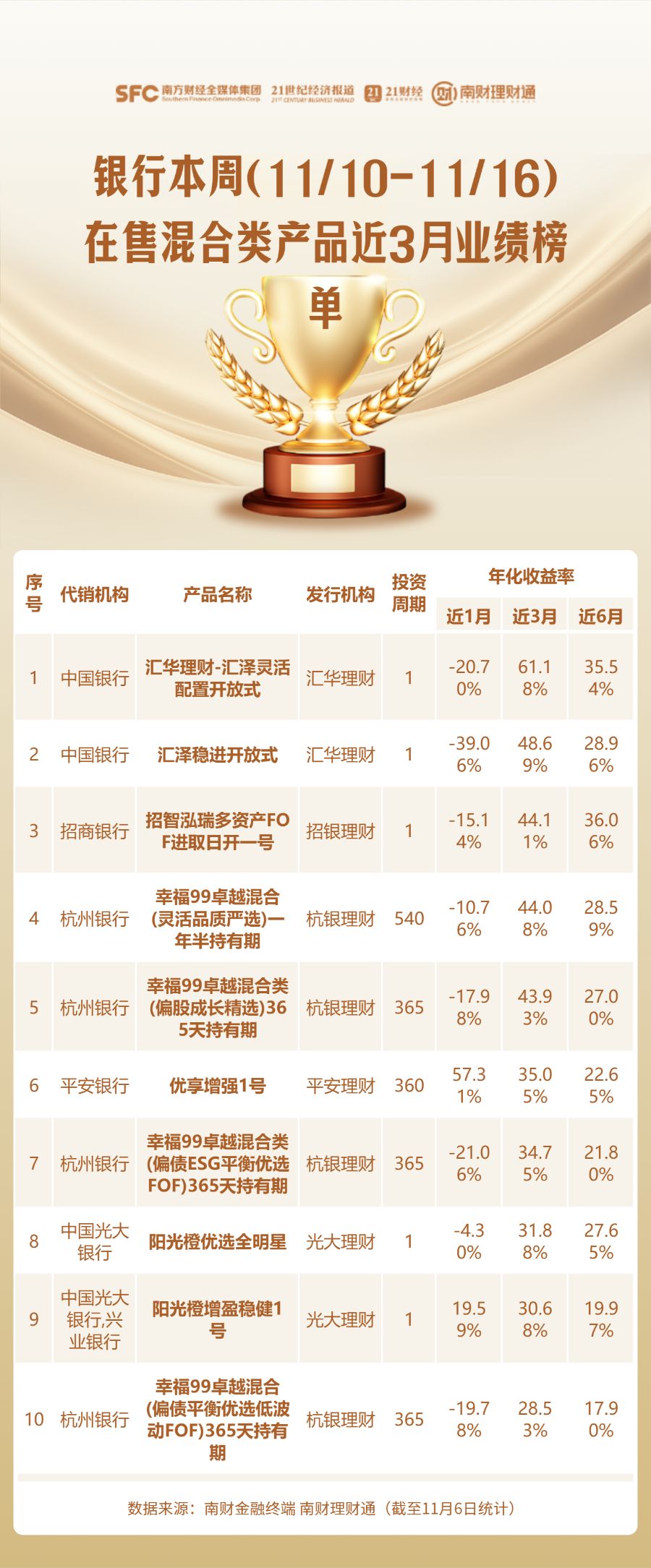
Core Insights - The article emphasizes the abundance of bank wealth management products with similar names and vague characteristics, urging investors to carefully select and differentiate among them [1] - The research team from Nanfang Finance aims to reduce investors' selection costs by focusing on the performance of wealth management products available through various distribution channels [1] Group 1: Performance Evaluation - The report highlights the performance of mixed-asset products issued by wealth management companies, providing a ranking based on annualized returns over the past month, three months, and six months [1] - The ranking is sorted by the annualized return over the past three months to reflect the products' performance amid recent market fluctuations [1] Group 2: Distribution Channels - A total of 28 distribution institutions are involved in the evaluation, including major banks such as Industrial and Commercial Bank of China, Bank of China, Agricultural Bank of China, and others [1] - The report notes that the assessment of the "on-sale" status of wealth management products is based on their investment cycles, but actual availability may vary due to factors like sold-out quotas or differences in product listings for different customers [1]


从增量扩面到提质控险 银行业普惠金融迈向差异化精准服务
2 1 Shi Ji Jing Ji Bao Dao· 2025-11-10 04:21
Core Insights - The report highlights the significant growth and development of inclusive finance in China, particularly focusing on small and micro enterprises and rural areas, with a notable annual growth rate of over 20% in inclusive micro loans during the 14th Five-Year Plan period [1][2] - As of June 2025, the balance of inclusive micro loans reached 36 trillion yuan, which is 2.3 times that of the end of the 13th Five-Year Plan, with a decrease in interest rates by 2 percentage points [1][2] - The average interest rate for newly issued inclusive micro loans was 3.48% as of June 2025, reflecting a decrease of 66 basis points year-on-year [1][2] Group 1: Digital Empowerment - Digital technology has been a key driver for the development of inclusive finance, with banks utilizing big data and AI to enhance loan approval efficiency and reduce financing costs [2][7] - The market structure among banks is changing, with large commercial banks holding a 45.11% share of inclusive micro loans, while rural financial institutions have seen a decline in their market share [2][3] - The average growth rate of inclusive micro loans has been slowing down, with a decrease from 30.9% in 2020 to 12.3% by mid-2025 [2][3] Group 2: Performance of Listed Banks - Among listed banks, Agricultural Bank of China, Industrial and Commercial Bank of China, and Beijing Bank reported the highest growth rates in inclusive micro loans at 18.50%, 17.30%, and 17.27% respectively [3][4] - In contrast, some banks, including Shanghai Bank and Zhengzhou Bank, experienced negative growth rates of -3.97% and -2.06% [3][4] - The performance of different banks varies significantly, with state-owned banks generally showing stronger growth in inclusive micro loans compared to smaller banks [3][4] Group 3: Interest Rates and Risk Management - The interest rates for newly issued inclusive micro loans have decreased across various banks, with the highest rate at 4.20% and the lowest at 2.94% [7][8] - The gap in interest rates between large and small banks is narrowing, with some large banks' rates aligning closely with those of smaller banks [8][9] - The report emphasizes the importance of risk management in the inclusive finance sector, with several banks focusing on improving asset quality and managing non-performing loans [9][10]