
HZBank(600926)

Search documents
多家股份行城商行前三季发力个人房贷
Feng Huang Wang· 2025-11-07 02:27
Core Insights - The latest reports indicate a significant increase in personal housing loans from several listed banks, contrasting with the decline observed in state-owned banks' mortgage lending [1][2][6][7] Group 1: Personal Housing Loan Growth - Nearly ten listed banks, including Minsheng Bank, Ping An Bank, and others, reported a clear increase in personal housing loans by the end of Q3 compared to the beginning of the year [1][2] - Specific banks like Ping An Bank reported a housing loan balance of 3,523.50 billion yuan, growing by 8.1% from the beginning of the year [2] - Minsheng Bank's mortgage loan balance increased by 180.41 billion yuan, marking a growth of 3.24% [2] Group 2: State-Owned Banks' Decline - The six major state-owned banks experienced a reduction of over 1,000 billion yuan in personal housing loans in the first half of the year, continuing a downward trend for three consecutive years [1][6] - By the end of Q3, the total personal housing loan balance for these banks was approximately 25.086 trillion yuan, reflecting a decrease of 1,078 billion yuan since the beginning of the year [6] Group 3: Market Dynamics and Regional Insights - The demand for housing loans remains strong in certain regions, such as Jiangsu, Zhejiang, and Shanghai, prompting banks to increase mortgage lending [4][5] - The new personal housing loans issued in key economic regions accounted for 87.70% of the total new loans issued by Shanghai Pudong Development Bank, indicating a regional focus in lending strategies [3] Group 4: Overall Market Trends - As of the end of Q3 2025, the total personal housing loan balance in the market was 37.44 trillion yuan, showing a year-on-year decline of 0.3% despite the growth from smaller banks [7] - The overall trend suggests that while some smaller banks are increasing their mortgage lending, it is not sufficient to offset the overall decline in the personal housing loan market driven by the larger state-owned banks [7]




银行永续债补位 优先股“性价比”低遭集中赎回
2 1 Shi Ji Jing Ji Bao Dao· 2025-11-06 11:12
Core Viewpoint - Recent announcements from multiple banks indicate a trend of redeeming preferred shares, driven by cost optimization and capital structure adjustments in response to regulatory requirements [4][6]. Group 1: Redemption of Preferred Shares - Ningbo Bank plans to fully redeem 100 million preferred shares issued on November 7, 2018, with a total scale of 10 billion RMB, at a redemption price of 104.5 RMB per share, scheduled for November 7, 2025 [1]. - Hangzhou Bank, Shanghai Bank, and Changsha Bank also announced plans to redeem their preferred shares in December 2025, with similar redemption structures [2]. - The total amount of preferred shares redeemed by banks this year is significant, with a focus on optimizing costs and reducing liabilities [1][2]. Group 2: Issuance of Perpetual Bonds - In conjunction with the redemption of high-cost preferred shares, banks are increasingly issuing perpetual bonds as a replacement, with 51 perpetual bonds issued this year totaling 675.4 billion RMB, surpassing last year's figures [1][6]. - Perpetual bonds are seen as a more flexible and lower-cost capital tool compared to preferred shares, which typically have higher dividend rates [4][6]. Group 3: Market Trends and Regulatory Environment - The trend of redeeming preferred shares and issuing perpetual bonds reflects a broader market shift, where banks are adapting to lower interest rates and tighter regulatory requirements [4][7]. - The issuance of perpetual bonds is particularly crucial for smaller banks facing capital adequacy pressures, as they seek to enhance their capital structure and meet regulatory demands [7].





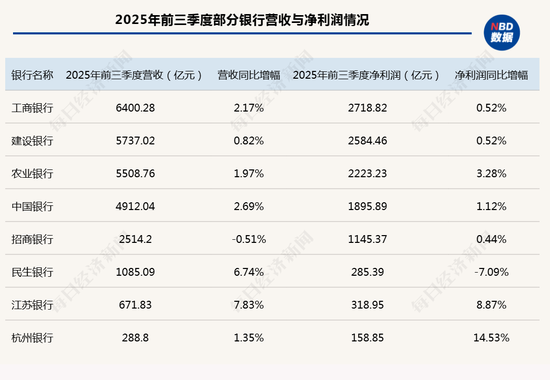
上市银行哪家强?齐鲁银行净利增16.14%,常熟银行净息差2.57%保持领先
Mei Ri Jing Ji Xin Wen· 2025-11-06 10:23
Core Insights - The overall performance of A-share listed banks in the first three quarters of 2025 reflects a stable total, improved structure, and significant differentiation amid a gradually recovering macroeconomic environment [1][10] - Revenue growth remains robust, with over 60% of listed banks reporting year-on-year increases, driven by optimized asset structures and a focus on non-interest income [2][10] - The net interest margin (NIM), a key profitability driver, is under pressure, posing challenges to the banking industry's profit model [1][7] Revenue Growth Resilience - More than 60% of A-share listed banks achieved positive year-on-year revenue growth in the first three quarters of 2025, indicating effective support for the real economy [2][4] - There is a clear structural differentiation in growth dynamics among banks of different sizes, with larger banks showing stable revenue while some smaller banks exhibit stronger growth [4][10] Bank Performance Data - Key performance metrics for selected banks in the first three quarters of 2025 include: - Industrial and Commercial Bank of China: Revenue of 6400.28 billion, 2.17% growth; Net profit of 2718.82 billion, 0.52% growth - Agricultural Bank of China: Revenue of 5508.76 billion, 1.97% growth; Net profit of 2223.23 billion, 3.28% growth - Minsheng Bank: Revenue of 1085.09 billion, 6.74% decline; Net profit of 285.39 billion, 7.09% decline - Jiangsu Bank: Revenue of 671.83 billion, 7.83% growth; Net profit of 318.95 billion, 8.87% growth [3][4] Performance of State-Owned Banks - State-owned banks maintain a leading position in revenue due to their large asset scale and extensive customer base, with revenue growth rates above 1.5% for major banks [4][6] - Despite a stable net profit growth, the overall growth rates are moderate, reflecting the challenges of achieving high growth from a large base [4][6] Performance of Smaller Banks - Some smaller banks and regional banks demonstrate significant growth potential, with Minsheng Bank and Jiangsu Bank showing revenue growth rates of 6.74% and 7.83%, respectively [4][6] - The ability of these banks to achieve rapid profit growth is attributed to precise customer targeting, effective cost management, and supplementary income from non-interest sources [6][10] Net Interest Margin Challenges - The net interest margin for listed banks is generally declining, primarily due to factors such as the decrease in loan market quotation rates and adjustments in existing mortgage rates [7][8] - State-owned banks and some joint-stock banks experience a decline in NIM by approximately 15 basis points, while Postal Savings Bank sees a more significant drop of 21 basis points [8][9] Resilience in NIM - Some banks, like Minsheng Bank, show resilience with a slight increase in NIM, indicating effective business structure management in response to interest rate fluctuations [9][10] - Regional banks like Ningbo Bank exhibit smaller declines in NIM compared to the industry average, showcasing the effectiveness of their localized service models [9][10] Future Outlook - The banking sector's operating environment is expected to gradually improve with the continued effectiveness of macroeconomic policies, although differentiation among institutions is likely to persist [10] - Large banks need to leverage technology to enhance their comprehensive service advantages, while smaller banks must focus on deepening their niche markets to establish competitive strengths [10]





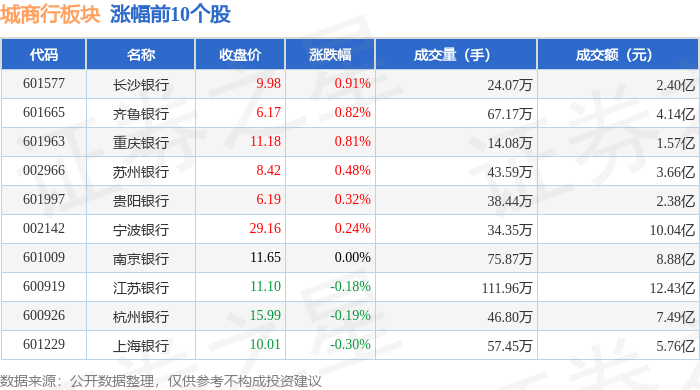
城商行板块11月6日跌0.11%,厦门银行领跌,主力资金净流出6.08亿元
Zheng Xing Xing Ye Ri Bao· 2025-11-06 08:51
Core Viewpoint - The city commercial bank sector experienced a slight decline of 0.11% on November 6, with Xiamen Bank leading the drop, while the overall market indices showed positive movements with the Shanghai Composite Index up by 0.97% and the Shenzhen Component Index up by 1.73% [1][2]. Group 1: Market Performance - The closing price of Xiamen Bank was 7.16, reflecting a decrease of 2.59% with a trading volume of 539,700 shares and a transaction value of 387 million yuan [2]. - Other notable banks included Changsha Bank, which closed at 9.98 with a rise of 0.91%, and Qilu Bank, which closed at 6.17 with an increase of 0.82% [1]. - The city commercial bank sector saw a net outflow of 608 million yuan from major funds, while retail investors contributed a net inflow of 473 million yuan [2][3]. Group 2: Individual Bank Performance - Beijing Bank had a net inflow from major funds of 20.80 million yuan, while it experienced a net outflow from retail investors of 30.79 million yuan [3]. - Chongqing Bank recorded a net inflow of 11.91 million yuan from major funds but faced a net outflow of 12.20 million yuan from retail investors [3]. - Jiangsu Bank had a net inflow of 202.55 million yuan from major funds, while retail investors contributed a net inflow of 3.33 million yuan [3].


杭州银行将在12-26起启用《个人综合积分活动细则(2025年版)》
Jin Tou Wang· 2025-11-06 03:23
Core Points - Hangzhou Bank announced the implementation of the "Personal Comprehensive Points Activity Rules (2025 Edition)" starting from December 26, 2025, replacing the 2019 version [1] - The new rules cancel the cumulative points activity for fund distribution business signing, while existing points will remain valid [1] - Adjustments have been made to the rules regarding credit card consumption points, activity reward points, and points gift exchange activities [1] - The bank continues to provide a variety of points gifts and a convenient redemption experience [1] Summary by Categories - **New Rules Implementation** - Hangzhou Bank will implement the new points activity rules from December 26, 2025, which will replace the previous version from 2019 [1] - **Changes in Points Accumulation** - The new rules eliminate the cumulative points activity for fund distribution business signing, but existing points will still be valid [1] - **Adjustments in Points Activities** - The bank has updated the descriptions of credit card consumption points, activity reward points, and points gift exchange activities [1] - **Customer Engagement** - Hangzhou Bank emphasizes its commitment to providing a rich selection of points gifts and a seamless redemption experience for customers [1]
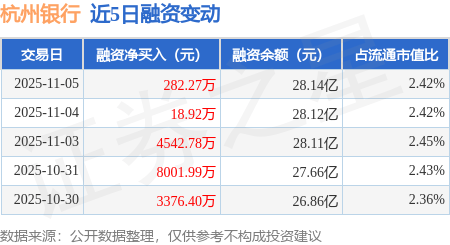
杭州银行:11月5日融资净买入282.27万元,连续3日累计净买入4843.97万元
Sou Hu Cai Jing· 2025-11-06 02:18
Core Viewpoint - Hangzhou Bank (600926) has shown a positive trend in financing activities, with a net financing buy of 2.82 million yuan on November 5, 2025, and a total net buy of 48.44 million yuan over the last three trading days, indicating strong investor interest [1][4]. Financing Activities - On November 5, 2025, the financing buy amounted to 133 million yuan, while financing repayment was 130 million yuan, resulting in a net financing buy of 2.82 million yuan [1]. - The financing balance reached 2.814 billion yuan, with a total of 14 out of the last 20 trading days showing net financing buys [1][4]. - The financing balance increased by 0.1% from the previous day, reflecting a slight upward trend in investor sentiment [4]. Margin Trading - On the same day, 7,000 shares were sold short, while 7,700 shares were repaid, leading to a net short selling of 700 shares [2][3]. - The margin trading balance was reported at 535,870 yuan, with 13 out of the last 20 trading days showing net short selling [2][3]. Market Sentiment - The increase in financing balance suggests a bullish market sentiment, indicating that investors are leaning towards buying [5]. - Conversely, the increase in short selling indicates some bearish sentiment in the market, as reflected in the margin trading activities [5].
债市成拖累?多家银行非息收入承压,央行重启国债买卖有何利好
Xin Lang Cai Jing· 2025-11-06 00:38
Core Viewpoint - The bond market's volatility has significantly impacted the non-interest income and overall revenue growth of listed banks in China during the first three quarters of the year [1][3][7]. Group 1: Non-Interest Income Decline - Among 42 A-share listed banks, 24 reported a year-on-year decline in non-interest income, with 8 banks experiencing a drop in net investment income [1][2]. - For instance, China Merchants Bank reported a 4.23% decrease in non-interest net income, primarily due to reduced bond and fund investment returns [3][4]. - Ping An Bank's revenue fell by 9.8%, influenced by declining loan rates and market volatility affecting non-interest income [3]. Group 2: Fair Value Changes - The significant drop in fair value changes has also been a major factor in revenue growth decline, with China Merchants Bank reporting a cumulative loss of 8.827 billion yuan in fair value changes for the first three quarters [4]. - Other banks like Everbright Bank and Huaxia Bank also reported losses in fair value changes, amounting to 4.982 billion yuan and 4.505 billion yuan, respectively [4]. - Analysts noted that fair value changes are highly influenced by bond market fluctuations, with smaller banks being more affected due to a higher proportion of FVTPL assets [4]. Group 3: Future Outlook and Central Bank Actions - The People's Bank of China announced the resumption of government bond trading operations, which is expected to help lower bond yields and benefit banks' non-interest income [11][12]. - Some bank executives expressed uncertainty about future non-interest income growth due to ongoing market volatility, suggesting that the bond market may remain in a fluctuating state [9][10]. - Analysts believe that the resumption of government bond trading will provide a safety net for the bond market, potentially stabilizing yields and supporting both bond and equity markets in the long term [12][13].



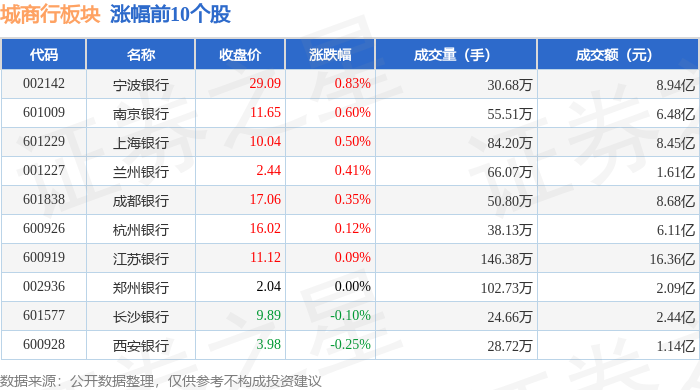
城商行板块11月5日涨0.12%,宁波银行领涨,主力资金净流入5236.36万元
Zheng Xing Xing Ye Ri Bao· 2025-11-05 08:55
Market Performance - The city commercial bank sector increased by 0.12% on November 5, with Ningbo Bank leading the gains [1] - The Shanghai Composite Index closed at 3969.25, up 0.23%, while the Shenzhen Component Index closed at 13223.56, up 0.37% [1] Individual Stock Performance - Ningbo Bank (002142) closed at 29.09, up 0.83% with a trading volume of 306,800 shares and a transaction value of 894 million [1] - Nanjing Bank (6000000) closed at 11.65, up 0.60%, with a trading volume of 555,100 shares and a transaction value of 648 million [1] - Shanghai Bank (601229) closed at 10.04, up 0.50%, with a trading volume of 842,000 shares [1] - Other notable performances include Chengdu Bank (601838) at 17.06, up 0.35%, and Hangzhou Bank (600926) at 16.02, up 0.12% [1] Capital Flow Analysis - The city commercial bank sector saw a net inflow of 52.36 million from institutional investors, while retail investors contributed a net inflow of 89.18 million [2] - The sector experienced a net outflow of 142 million from speculative funds [2] Detailed Capital Flow for Selected Banks - Jiangsu Bank (600919) had a net inflow of 63.74 million from institutional investors, while it faced a net outflow of 46.26 million from speculative funds [3] - Chengdu Bank (601838) reported a net inflow of 63.42 million from institutional investors, with a net outflow of 57.05 million from speculative funds [3] - Ningbo Bank (002142) had a net inflow of 5.72 million from institutional investors but a significant net outflow of 43.57 million from retail investors [3]


一平台打通管理经营 杭州银行“薪易宝”塑造企服新范式
Zhong Guo Jing Ji Wang· 2025-11-04 12:35
Core Insights - Hangzhou Bank has launched its integrated digital platform "Xinyibao 1.0" aimed at addressing the diverse and intelligent operational needs of small and medium-sized enterprises (SMEs) [1] Group 1: Digital Infrastructure - "Xinyibao" aims to create a secure, stable, and scalable digital infrastructure to tackle the complexities and high costs faced by SMEs during digital transformation [2] - The platform utilizes advanced technologies such as financial-grade security systems and cloud computing, covering multiple scenarios including HR, payroll, finance, inventory, and collaborative office [2] - This one-stop digital service system is designed to free enterprises from cumbersome transactional processes, enhancing overall management efficiency and enabling lighter operations [2] Group 2: Data-Driven Decision Making - "Xinyibao" aspires to serve as a "smart compass" for enterprises by optimizing internal processes [3] - The platform features tools like "Enterprise Radar" for real-time monitoring of public sentiment risks, "Industry Map" for insights into industry dynamics and supply chain relationships, and "Park Information Database" to assist in business decision-making [3] - These functionalities aim to help enterprises accurately identify risks and opportunities in a complex market environment, fostering modern operational capabilities that are market-visible, risk-controllable, and data-driven [3] Group 3: Ecosystem and Future Growth - "Xinyibao" is positioned not just as a management tool but as an open ecosystem connecting finance, lifestyle, and professional services [4] - The platform integrates convenient financial calculations and information services while incorporating engaging features to enhance employee experience, making digital services more personable [4] - The launch of "Xinyibao 1.0" is seen as an innovative practice in financial services for the real economy, with plans for continuous improvement and collaboration with partners to build a secure and efficient digital service ecosystem for regional economic development [4]
长三角城商行扩表进行时:对公信贷狂飙,财富业务回暖
2 1 Shi Ji Jing Ji Bao Dao· 2025-11-04 11:57
Core Insights - The banking sector in the Yangtze River Delta is experiencing a different trend compared to the overall slowdown in loan growth, with several city commercial banks showing double-digit asset growth [1][3] Group 1: Loan Growth - As of the end of Q3, several city commercial banks in the Yangtze River Delta reported significant asset growth: Jiangsu Bank at 4.93 trillion yuan (up 24.68%), Ningbo Bank at 3.58 trillion yuan (up 14.50%), and Nanjing Bank at 2.96 trillion yuan (up 14.31%) [1] - The overall loan growth for all A-share listed banks was 7.70% year-on-year, with city commercial banks leading at 12.86% [1][2] - Specific banks like Jiangsu Bank and Ningbo Bank reported loan growth rates exceeding 17% in Q3, driven primarily by corporate loans [3][5] Group 2: Corporate Loans - Corporate loans have significantly increased, with Ningbo Bank's corporate loan growth reaching 32.10% in Q3, the highest among peers [5] - The proportion of corporate loans in total loans has risen for many banks, with Jiangsu Bank's corporate loans making up 67.38% and Nanjing Bank's at 76.03% [4][5] - The focus on corporate loans, particularly in technology sectors, has been emphasized by several banks, with notable increases in technology-related loan disbursements [6][8] Group 3: Revenue and Profitability - The total revenue for six city commercial banks in the Yangtze River Delta reached 243.6 billion yuan in Q3, a year-on-year increase of 6.41%, while net profit grew by 8.36% to 111.2 billion yuan [7] - Jiangsu Bank reported a revenue of 67.18 billion yuan and a net profit of 30.58 billion yuan, both showing positive growth [7] - Wealth management and retail banking segments are showing signs of recovery, contributing to the overall revenue growth [8] Group 4: Investment Income - Investment income has been under pressure due to rising interest rates and market volatility, with the fair value changes of financial assets showing negative results [9][10] - Shanghai Bank reported the highest investment income at 16.77 billion yuan, but also faced significant losses in fair value changes [11]
