
CSC(601066)

Search documents
中信建投:有色金属全面强势上涨 资源定价新范式开启
Zhi Tong Cai Jing· 2025-12-28 23:46
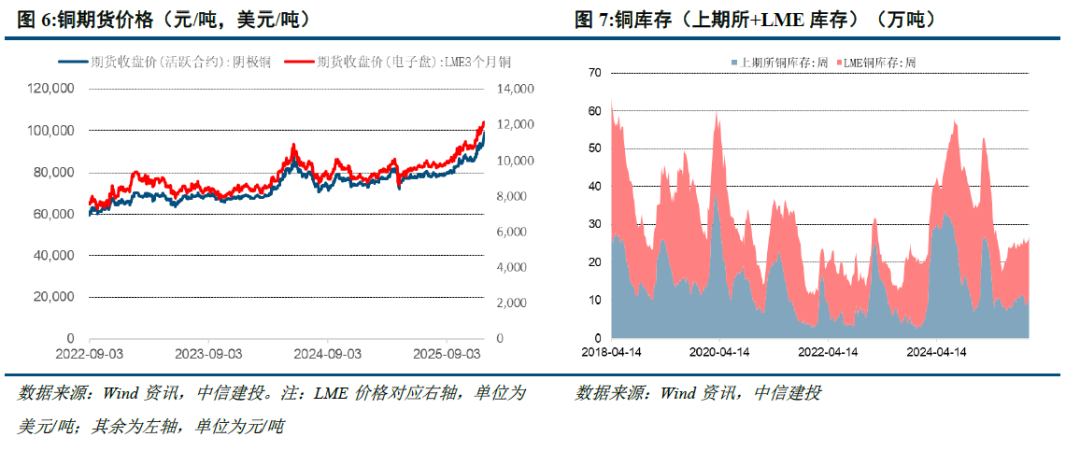
中信建投(601066)证券发布研报称,上周有色金属全面强势上涨,白银、铜空中加速创下历史新高,黄金、锡、铝亦刷新阶段高点记录。资本性开支不 足、资源供应受限、AI需求前景强劲,以及财政赤字扩张、利率处于下行周期等因子重叠,又遭遇美国关税对部分关键矿产的威胁,导致实物在美国与 非美之间分配不均,造成局部货物流动性缺失,资金流入做多。一场用做多有限资源对抗弱化的美元信用的全新表达,正在全球掀起新的资源定价范式, 有色的盛宴正在舞动。 (4)展望:冷静的权益终将向火热的商品靠拢。自11月底我们根据CESCO会议上出现的新变量提示"铜的结构性牛市"以来,一个月时间铜价从8.6万涨破10 万,往美国搬货叠加贵金属情绪高涨是主驱动。相较炙热的铜期货,股票显得相对冷静,一则对搬货造就的结构性牛市持续的时长不确定,二则对铜价重 心定位没共识。铜关税预期未落,2026现货锁定长单未交付,搬货逻辑会持续;其次,权益尚未对8.5万的铜价做充分定价,过于保守,提供了持仓的安 全边际,建议耐心持有,等待商品价格回踩的加仓机会。 中信建投主要观点如下: 工业金属:上周SHFE铜、铝、铅、锌、锡价格变化为5.9%、1.0%、4.0%、0 ...


中信建投:A股跨年行情已经启动
Xin Lang Cai Jing· 2025-12-28 23:40
Core Viewpoint - CITIC Securities indicates that the A-share year-end rally has begun, driven by positive signals from the recent eight consecutive days of gains in the Shanghai Composite Index, following the completion of a mid-term adjustment [1] Market Outlook - The optimistic expectations from institutional investors suggest that the spring market rally may start earlier than usual [1] - Improvements in overseas liquidity and risk, alongside the conclusion of adjustments in AI models in the U.S., contribute to a favorable market environment [1] - The release of numerous policies and events related to the 14th Five-Year Plan has heightened investor expectations [1] Sector Focus - Key sectors to watch include non-ferrous metals and AI computing power, with commercial aerospace remaining the primary market focus [1] - Secondary themes include the Hainan Free Trade Zone, controllable nuclear fusion, and humanoid robots [1] Specific Sector Insights - The upgrade of NVIDIA's Rubin architecture is expected to boost the entire AI computing power industry chain, benefiting sectors such as optical fibers, liquid-cooled servers, CPOs, and storage chips [1] - Non-ferrous metals continue to maintain a rising trend due to price increases in lithium carbonate, gold, silver, copper, and aluminum, indicating a high level of industry prosperity [1] - The market's thematic focus remains on commercial aerospace, with secondary attention on the Hainan Free Trade Zone, controllable nuclear fusion, and humanoid robots [1] Investment Highlights - Key sectors for investment consideration include non-ferrous metals, commercial aerospace, AI, humanoid robots, controllable nuclear fusion, innovative pharmaceuticals, non-bank financials, and the Hainan Free Trade Zone [1]
中信建投:跨年行情已经启动
Xin Lang Cai Jing· 2025-12-28 23:36
Group 1 - The market's year-end rally is driven by three main expectations: optimistic outlook from institutional investors, completion of overseas AI model adjustments, and high policy expectations following the release of the 14th Five-Year Plan [2][3][4] - The A-share market has shown positive signals with the Shanghai Composite Index experiencing an eight-day winning streak, indicating the start of the year-end rally [3][4][35] - Key sectors to focus on include non-ferrous metals and AI computing power, with commercial aerospace remaining the primary market hotspot, followed by secondary themes such as Hainan Free Trade Zone, controllable nuclear fusion, and humanoid robots [3][4][15] Group 2 - The AI computing power industry is expected to benefit from NVIDIA's Rubin architecture upgrade, positively impacting sectors such as optical fibers, liquid-cooled servers, CPO, and storage chips [3][15][17] - Non-ferrous metals continue to maintain a rising trend, driven by price increases in lithium carbonate, silver, copper, and aluminum, with lithium and aluminum prices rising by 69% and 88% respectively over the past four months [20][34] - The 14th Five-Year Plan has led to heightened market policy expectations, with significant developments in sectors like new energy, new materials, quantum technology, mobile communication, and commercial aerospace [13][22][34] Group 3 - The year-end rally is anticipated to coincide with a seasonal "spring surge," which typically occurs between the Spring Festival and the Two Sessions, with historical data showing a high probability of market gains during this period [8][41] - Recent improvements in overseas liquidity and risk appetite are attributed to a shift in the U.S. strategic focus away from China, easing tensions in U.S.-China relations, and ongoing advancements in the AI sector [10][41] - The release of numerous high-quality AI models has bolstered confidence in the AI industry, contributing to a favorable investment environment [11][10]

A股或迎接跨年“小躁动”行情
Mei Ri Jing Ji Xin Wen· 2025-12-28 21:55
Group 1 - The A-share market is experiencing a "small fluctuation" trend as it approaches the end of the year, with the Shanghai Composite Index recording eight consecutive days of gains [1] - Market liquidity is driving the current trend, with total trading volume exceeding 2 trillion yuan on the last Friday, indicating a significant increase in market activity [1] - Key sectors such as non-ferrous metals and lithium mining are benefiting from price increases, while themes like Hainan Free Trade Port and commercial aerospace remain active [1] Group 2 - Institutional buying power is expected to strengthen, with increased allocation of funds as external uncertainties ease, contributing to a positive cross-year market outlook [2] - The rebound of U.S. tech stocks, appreciation of the yuan, and rising prices of non-ferrous metals are identified as catalysts for the upcoming market rally [2] - The cross-year market is anticipated to show a clear characteristic of "growth leading, liquor sector consolidating," with a focus on sectors like snacks and dairy that are showing clear growth potential [3] Group 3 - The liquor sector is currently in a "bottoming out" phase, with demand expected to increase as the Spring Festival approaches, leading to a potential valuation recovery post-holiday [3] - Recent stabilization in prices from leading liquor companies and a decrease in inventory levels are early signs of recovery in the liquor market [3]

【十大券商一周策略】A股跨年行情已经启动,新的主线浮出水面
Xin Lang Cai Jing· 2025-12-28 15:19
Core Viewpoint - The A-share market is expected to experience a spring rally driven by liquidity, policy expectations, and structural opportunities, with a focus on sectors like AI, commercial aerospace, and non-bank financials [5][10][12]. Group 1: Market Trends and Predictions - 39 out of 360 industry/theme ETFs reached new highs in December, with communication and non-ferrous metals being traditional favorites, while new themes like commercial aerospace are gaining traction [3]. - The A-share market is showing signs of a spring rally, supported by liquidity and positive policy expectations, with a focus on sectors such as technology and advanced manufacturing [5][10]. - The market is expected to maintain a high risk appetite due to favorable conditions, including a weak dollar and the upcoming Chinese New Year and Two Sessions [11][16]. Group 2: Sector Focus and Investment Opportunities - Key sectors to watch include AI, commercial aerospace, and non-ferrous metals, which are expected to benefit from structural changes and increased demand [10][12]. - The manufacturing sector, particularly in chemicals and engineering machinery, is showing signs of recovery and is expected to benefit from the shift in global competition [3][4]. - Non-bank financials, including insurance and brokerage firms, are positioned to benefit from the anticipated capital inflows and improved asset returns [9][12]. Group 3: Currency and Economic Factors - The appreciation of the RMB is expected to lower import costs and enhance domestic purchasing power, benefiting sectors reliant on imports and domestic consumption [7][9]. - The potential for significant capital inflows due to RMB appreciation could lead to a revaluation of Chinese assets, creating a favorable environment for investment [7][9]. - The overall economic environment is improving, with expectations of continued liquidity support and a stable policy backdrop, which is conducive to market growth [5][10].




中信建投:跨年行情或呈现“成长先行、白酒蓄力”的鲜明特征
Zheng Quan Shi Bao Wang· 2025-12-28 13:08
转自:证券时报 人民财讯12月28日电,中信建投研报称,从月度数据与市场表现来看,跨年行情或呈现"成长先行、白 酒蓄力"的鲜明特征。当前市场资金更倾向于布局零食、乳业等景气度明确、弹性更高的赛道,这类板 块在政策支持与产业趋势共振下,月度数据持续改善,成为跨年行情的核心驱动力。而白酒板块则处 于"磨底蓄力"阶段,随着春节临近,终端备货需求逐步启动,近期头部酒企批价企稳、库存回落的边际 变化已开始显现,预计春节后随着消费场景修复与需求集中释放,白酒将迎来估值修复行情。 ...
中信建投:跨年行情成长先行 白酒蓄力静待春来
智通财经网· 2025-12-28 12:48
Group 1: Market Trends and Insights - The cross-year market trend is characterized by "growth leading, liquor accumulating," with funds favoring sectors like snacks and dairy that show clear momentum and higher elasticity, driven by policy support and industry trends [1][3] - The liquor sector is in a "bottoming accumulation" phase, with demand for inventory preparation increasing as the Spring Festival approaches, indicating a potential valuation recovery post-holiday [1][3] Group 2: Liquor Industry Developments - Major liquor companies such as Gujing Gongjiu, Xijiu, and Luzhou Laojiao are signaling positive developments, revealing strategic plans and annual results amidst industry adjustments and high inventory levels [1][2] - Gujing Gongjiu aims to optimize product structure and expand growth through new product launches and enhanced market strategies, while Xijiu reported a stable sales figure of approximately 19 billion yuan for the year, with significant inventory reduction [2][6] - Luzhou Laojiao is focusing on digital transformation and strategic upgrades, targeting younger consumers and enhancing brand value while maintaining price stability for its flagship product [2][8] Group 3: Performance Forecasts - As the 2025 annual report forecast period approaches, certain food and beverage sectors are expected to exceed performance expectations due to differentiated advantages, despite short-term revenue growth slowdowns [4] - The liquor sector is anticipated to see improved performance due to inventory control and channel optimization, while segments like prepared dishes and functional snacks are benefiting from consumer recovery and product upgrades [4] Group 4: Catalysts for Future Growth - Multiple catalysts are expected to drive better-than-expected Q1 results starting from late January, including the peak sales season for liquor companies during the Spring Festival and improved data from various consumer goods sectors [5] - The food and beverage sector is currently at historical low valuations, suggesting potential for significant upward movement as market sentiment improves [5] Group 5: Dairy and Processed Food Insights - The dairy processing industry is set to benefit from temporary anti-subsidy measures on EU dairy products, accelerating domestic processing and improving profit margins for upstream dairy producers [10] - The average price of raw milk has shown signs of stabilization, indicating a potential turning point for the dairy market in 2026 [10] Group 6: Snack and Beverage Sector Dynamics - As the Spring Festival approaches, snack companies are preparing for a peak sales season, with expectations for strong performance in Q1 due to extended inventory and sales timelines [12][13] - The beverage industry is currently focused on inventory reduction, with a more favorable competitive environment anticipated as seasonal activities ramp up [13]


中信建投:人民币升值大趋势并未结束
Xin Lang Cai Jing· 2025-12-28 12:37
Core Viewpoint - The rapid appreciation of the RMB is significantly influenced by currency settlement, similar to the situation in July-August this year. The previous three years of bearish sentiment towards the RMB and bullish sentiment towards the USD have led to capital being trapped overseas. This year, as US assets weaken and Chinese assets strengthen, this trapped capital is reversing through currency settlement, driving the RMB's appreciation. The trend of RMB appreciation is expected to continue, with a high probability of breaking the 7 mark, although short-term pressures from currency settlement will ease after the settlement window closes [1][2][3]. Group 1 - The RMB's appreciation this year is a reversal of the depreciation experienced over the past three years, which was largely unexpected by the market. The RMB has approached the 7 mark against the USD [5][30]. - The depreciation of the RMB in previous years was primarily due to the stronger performance of US assets from 2022 to 2024, driven by significant fiscal stimulus and an AI industrial revolution in the US, while other major economies struggled with high inflation [6][31]. - The second reason for the RMB's depreciation was the persistent weakness in China's real estate sector, which suppressed domestic demand and led to a long-term bearish narrative around the economy [7][8][32]. Group 2 - By 2025, the factors that previously led to the RMB's weakness are expected to reverse. The USD is projected to weaken against all major currencies, indicating a decline in global confidence in US assets [10][35]. - The negative impact of the real estate sector on the economy is expected to stabilize by 2025, contributing to a more favorable outlook for the RMB [10][35]. - The strong performance of Chinese exports and the emergence of technological advantages are expected to further enhance the RMB's appreciation momentum [10][35]. Group 3 - The reversal of depreciation expectations is linked to the RMB starting to price in "Chinese advantages," particularly in technology and manufacturing [38][41]. - In 2025, significant changes in asset performance are anticipated, with precious metals and Chinese tech stocks expected to outperform other major assets, reflecting a shift in global economic dynamics [39][40]. - The weakening of the USD is attributed to concerns over US credit and technology, while the RMB's strength is supported by China's robust manufacturing capabilities and the resilience of its supply chains [16][41]. Group 4 - The future outlook for the RMB suggests a systematic re-evaluation of its exchange rate amid the construction of a new global order, driven by China's role in the global manufacturing system and technological leadership [44][46]. - The RMB is expected to undergo a second re-evaluation as it moves away from the negative impacts of the "old economy," with a focus on balancing domestic demand [47]. - In the short term, the RMB should maintain moderate stability, as uncertainties in global conditions and the domestic economy persist [22][27][48].

广东炎墨方案科技股份有限公司启动上市辅导
Jing Ji Guan Cha Wang· 2025-12-28 12:21
经济观察网证监会网站显示,广东炎墨方案科技股份有限公司2025年12月27日向广东证监局办理辅导备 案登记,辅导机构为中信建投(601066)证券股份有限公司。 ...
中信建投:央行购金的已知和未知
Xin Lang Cai Jing· 2025-12-27 14:37
Core Viewpoint - The year 2025 is pivotal for gold, with significant price increases and central bank gold reserves reaching 36,000 tons, valued over $4 trillion, surpassing euro reserves and approaching dollar levels [1][3]. Group 1: Central Bank Gold Purchases - Central banks have become significant players in the gold market, with their purchasing behavior reflecting strategic needs amid global political instability [2][3]. - The World Gold Council's data does not fully capture the extent of central bank gold purchases, indicating a need for more comprehensive research [2][3]. - Central banks primarily acquire gold through four channels: OTC market purchases, local production, transactions with the IMF, and potentially through gold ETFs [7][10][44]. Group 2: Gold Storage and Management - Global gold storage is managed through a diverse system involving central banks, commercial banks, and specialized custodians [12][46]. - Two main operational models for gold storage exist: internal (self-managed by central banks) and external (outsourced to third-party custodians) [47][48]. - The three major pillars of global central bank gold custody are the New York Federal Reserve, the Bank of England, and the Bank for International Settlements (BIS) [52][58]. Group 3: Storage Strategies and Motivations - Central banks employ three primary storage strategies: domestic storage emphasizing sovereignty and security, a mixed domestic and foreign storage approach, and non-disclosure of storage locations [61][62][66]. - Countries like China and the U.S. predominantly store their gold domestically, while others, such as Germany and Belgium, utilize a mixed approach due to historical and logistical reasons [63][65]. - Many nations opt for secrecy regarding their gold storage details to mitigate geopolitical risks and maintain market stability [66].