
Chongqing Rural Commercial Bank(601077)

Search documents
银行研思录25:银行股息率排名与中期分红进度梳理-20251114
CMS· 2025-11-14 03:02
Investment Rating - The report does not explicitly state an investment rating for the banking sector, but it provides detailed insights into dividend yields and distribution processes, which can inform investment decisions. Core Insights - The report outlines the latest dividend yields and mid-term dividend processes for A and H shares of listed banks, emphasizing the importance of accurately calculating dynamic dividend yields to avoid discrepancies across periods [1][2]. - It details the two processes for mid-term dividends following the 2023 revision of the regulatory guidelines, highlighting the conventional and simplified processes for implementing mid-term dividends [2]. - The report provides a comprehensive overview of key dates related to dividend distribution for both A and H shares, including the importance of purchasing shares before the ex-dividend date to qualify for dividends [3][4]. Summary by Sections Dynamic Dividend Yield Calculation - A simplified yet accurate method for calculating dynamic dividend yield is introduced, defined as "rolling 12-month EPS * cash dividend rate / share price," which helps avoid issues related to overlapping or missing annual and mid-term dividends [1]. - The report calculates the cash dividend rate using a standardized approach across different banks, resulting in a clear comparison of dividend yields as of November 13, 2025 [1]. Mid-Term Dividend Processes - The report explains the two processes for mid-term dividends: the conventional process requiring shareholder approval and a simplified process allowing for quicker implementation [2]. - The simplified process is designed to enhance flexibility for companies in distributing mid-term dividends, thereby improving shareholder returns [2]. Dividend Distribution Key Dates - For A shares, investors must purchase shares before the ex-dividend date to receive dividends on the same day, while H shares typically see a delay of about one month for dividend payments [3][4]. - The report outlines the differences in the dividend distribution timeline between A and H shares, emphasizing the need for investors to be aware of these timelines to maximize their returns [3][4]. Mid-Term Dividend Progress - As of November 13, 2025, 31 A-share banks have confirmed mid-term dividends, while 11 H-share banks have also confirmed their dividend distributions [9][11]. - The report categorizes banks based on their dividend status, detailing those that have implemented dividends, those that are pending, and those that have opted not to distribute dividends [9][10][11]. - It highlights that the end of 2025 and early 2026 is expected to be a peak period for mid-term dividend distributions, suggesting potential investment opportunities for dividend-seeking investors [11].





下半年以来23家上市银行共获748家机构调研
Zheng Quan Ri Bao· 2025-11-13 23:12
Core Insights - In the second half of this year, institutions have actively researched and tracked the operational status of listed banks, with 748 institutions conducting 133 investigations into 23 listed banks as of November 13 [1][2] - The focus of these investigations has been primarily on city commercial banks and rural commercial banks, with key areas of interest including net interest margin trends, non-interest income trends, and capital replenishment [1][2] Group 1: Institutional Research - The majority of institutions conducting research on listed banks are fund companies and securities firms, accounting for 53% of the total [2] - Jiangsu Bank emerged as the most popular among institutions, receiving 83 investigations, followed by Chongqing Rural Commercial Bank and Ningbo Bank with 76 and 75 investigations respectively [2] - Ruifeng Bank had the highest number of total investigations at 22 [2] Group 2: Net Interest Margin Trends - Net interest margin has been a focal point for institutions, with some listed banks showing signs of stabilization or slight recovery compared to the previous year [2] - Several banks reported successful measures to reduce funding costs, such as exiting high-cost deposits and enhancing the absorption of low-cost current deposits [3] - Xiamen Bank reported a 4 basis point increase in net interest margin to 1.08% in the first half of the year, with continued stabilization in the third quarter [3] Group 3: Debt Market Analysis - The bond market has shown a volatile trend this year, impacting the investment income of some listed banks, particularly city and rural commercial banks [4] - Banks are focusing on their investment strategies in the bond market, with a cautious approach to market trends and adjustments in trading positions [4] - Shanghai Bank plans to enhance its market analysis capabilities and maintain flexibility in its investment strategies to mitigate risks from market interest rate fluctuations [4] Group 4: Non-Interest Income and Capital Replenishment - Many banks noted changes in non-interest income, particularly in net income from fees and commissions, which have been affected by regulatory requirements on self-managed wealth management [6] - Banks are exploring various methods for capital replenishment, combining internal capital accumulation with external sources to strengthen their capital base [6]



下半年以来23家上市银行共获748家机构调研 净息差走势、非息收入趋势、资本补充等被重点关注
Zheng Quan Ri Bao· 2025-11-13 16:49
Core Insights - Institutions are actively researching the operational status of listed banks in the second half of the year, with 748 institutions conducting 133 investigations into 23 listed banks, primarily focusing on city commercial banks and rural commercial banks [1][2] Group 1: Institutional Research - The majority of institutions conducting research are fund companies and securities firms, accounting for 53% of the total [2] - Jiangsu Bank is the most popular among institutions, receiving 83 investigations, followed by Chongqing Rural Commercial Bank and Ningbo Bank with 76 and 75 investigations respectively [2] - Ruifeng Bank leads in total investigation counts with 22 [2] Group 2: Net Interest Margin Trends - Net interest margin (NIM) has stabilized for some listed banks, with a slight year-on-year recovery noted [2] - Several banks have reported success in reducing funding costs, which alleviates downward pressure on NIM by exiting high-cost deposits and enhancing low-cost deposit absorption [2][3] - Xiamen Bank reported a 4 basis point increase in NIM to 1.08% in the first half of the year, with continued stabilization in the third quarter [3] Group 3: Debt Market Analysis - The bond market has shown volatility this year, impacting investment income for some banks, particularly city and rural commercial banks [4] - Banks are adjusting their investment strategies in response to market conditions, with a focus on defensive strategies and selective trading opportunities [4] - Shanghai Bank aims to enhance market analysis and maintain flexibility in its investment strategies while managing interest rate risks [4] Group 4: Non-Interest Income and Capital Supplementation - Non-interest income, particularly from fees and commissions, has been affected by regulatory requirements on self-managed wealth management products [5] - Banks are exploring ways to supplement capital through internal accumulation and external sources to strengthen their capital base [5] - Qingdao Bank focuses on standardized fixed-income securities and emphasizes duration management to ensure steady growth in bond investment income [5]
渝农商行跌1.13% 涨幅垫底银行板块
Zhong Guo Jing Ji Wang· 2025-11-13 09:07
Core Viewpoint - The stock price of Chongqing Rural Commercial Bank (601077.SH) closed at 6.99 yuan, reflecting a decline of 1.13% on the day, positioning it at the bottom of the banking sector [1] Group 1: Company Performance - Chongqing Rural Commercial Bank's stock price decreased by 1.13% today [1] - The bank's stock price is currently at 6.99 yuan [1] Group 2: Industry Context - The banking sector overall experienced a slight decline, with an average drop of 0.24% [1] - Chongqing Rural Commercial Bank's performance is notably weaker compared to the broader banking sector [1]
农商行板块11月13日跌0.39%,渝农商行领跌,主力资金净流入4475.12万元
Zheng Xing Xing Ye Ri Bao· 2025-11-13 08:45
Group 1 - The agricultural commercial bank sector experienced a decline of 0.39% compared to the previous trading day, with Yunnan Agricultural Commercial Bank leading the decline [1] - The Shanghai Composite Index closed at 4029.5, up 0.73%, while the Shenzhen Component Index closed at 13476.52, up 1.78% [1] - A table detailing the individual stock performance within the agricultural commercial bank sector was provided [1] Group 2 - The net inflow of main funds into the agricultural commercial bank sector was 44.75 million yuan, while speculative funds saw a net outflow of 5.51 million yuan, and retail investors experienced a net outflow of 39.24 million yuan [2] - A table showing the fund flow for individual stocks in the agricultural commercial bank sector was included [2]


戴志锋:3Q25货币政策执行报告点评
Xin Lang Cai Jing· 2025-11-12 11:59
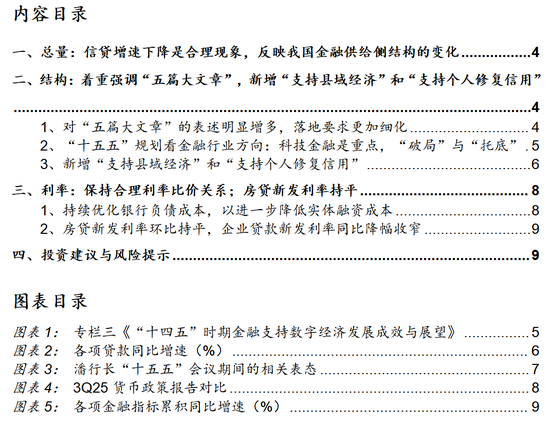
Summary of Key Points Overall Credit Growth - The decline in credit growth is a reasonable phenomenon, reflecting changes in China's financial supply-side structure. The focus should be on social financing scale and money supply as more comprehensive indicators compared to bank loans [1][8]. - Factors contributing to the decline include local special bonds replacing financing platform loans, the reform of small and medium-sized banks, and the trend of long-term economic structural evolution [9][12]. - Since last year, local governments have issued 4 trillion yuan in special refinancing bonds, with approximately 60-70% used to repay bank loans [10]. - In 2024, financial institutions are expected to write off about 1.3 trillion yuan in loans, with over 1 trillion yuan already written off in the first nine months of this year [11]. - The decline in real estate loans and the low credit dependence of light asset industries make it difficult to fill the gap left by real estate [12]. Structural Emphasis - The monetary policy report emphasizes the "Five Major Articles," with increased focus on supporting county economies and personal credit repair [2][18]. - The "14th Five-Year Plan" highlights technology finance as a key area, with policies aimed at breaking through economic growth ceilings and stabilizing macroeconomic environments [16]. - New measures include improving financial support mechanisms for county economic development and implementing policies for personal credit repair, which will not display certain default information in credit systems for individuals who have repaid loans [18][19]. Interest Rates - Maintaining a reasonable interest rate relationship is crucial, with new mortgage rates remaining stable [3][21]. - Continuous optimization of bank liability costs is necessary to lower financing costs for the real economy. The report notes that loan rates are decreasing faster than deposit rates, which compresses banks' net interest margins [21]. - As of September 2025, new loan rates for general loans, personal housing loans, and corporate loans are 3.67%, 3.06%, and 3.14%, respectively, with year-on-year declines of 48 basis points, 25 basis points, and 37 basis points [22]. Investment Recommendations - The banking sector is transitioning from a "pro-cyclical" to a "weak cyclical" phase, with a focus on the stability and sustainability of the sector [4]. - Two main investment lines are suggested: regional banks with strong certainty and high dividend stability, particularly in areas like Jiangsu, Shanghai, and Fujian [4].

农商行板块11月12日涨0.34%,渝农商行领涨,主力资金净流出2619.33万元
Zheng Xing Xing Ye Ri Bao· 2025-11-12 08:49
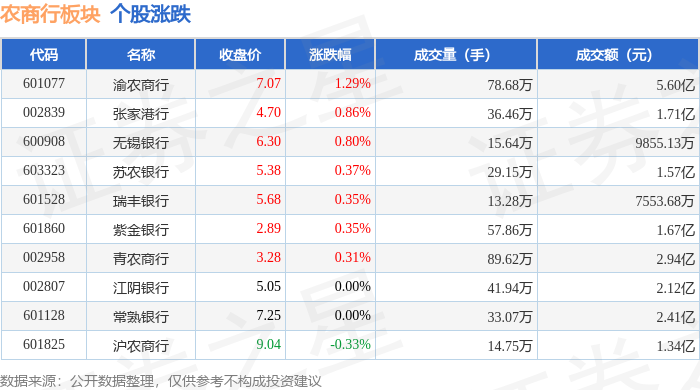
Core Viewpoint - The rural commercial bank sector experienced a slight increase of 0.34% on November 12, with Yunnan Rural Commercial Bank leading the gains, while the Shanghai Composite Index fell by 0.07% and the Shenzhen Component Index decreased by 0.36% [1] Group 1: Market Performance - The closing price of Yunnan Rural Commercial Bank was 7.07, with an increase of 1.29% and a trading volume of 786,800 shares, amounting to a transaction value of 560 million yuan [1] - Zhangjiagang Bank closed at 4.70, up 0.86%, with a trading volume of 364,600 shares and a transaction value of 171 million yuan [1] - Wuxi Bank's closing price was 6.30, reflecting an increase of 0.80%, with a trading volume of 156,400 shares and a transaction value of approximately 98.55 million yuan [1] - Su Nong Bank closed at 5.38, up 0.37%, with a trading volume of 291,500 shares and a transaction value of 157 million yuan [1] - Ruifeng Bank's closing price was 5.68, with a 0.35% increase, trading 132,800 shares for a total value of approximately 7.55 million yuan [1] - Zijin Bank closed at 2.89, up 0.35%, with a trading volume of 578,600 shares and a transaction value of 167 million yuan [1] - Qingnong Bank closed at 3.28, reflecting a 0.31% increase, with a trading volume of 896,200 shares and a transaction value of 294 million yuan [1] - Jiangyin Bank's closing price was 5.05, unchanged, with a trading volume of 419,400 shares and a transaction value of 212 million yuan [1] - Changshu Bank closed at 7.25, unchanged, with a trading volume of 330,700 shares and a transaction value of 241 million yuan [1] - Shanghai Rural Commercial Bank closed at 9.04, down 0.33%, with a trading volume of 147,500 shares and a transaction value of 134 million yuan [1] Group 2: Fund Flow Analysis - The rural commercial bank sector saw a net outflow of 26.19 million yuan from main funds, while speculative funds experienced a net inflow of 34.43 million yuan, and retail investors had a net outflow of 8.24 million yuan [1]
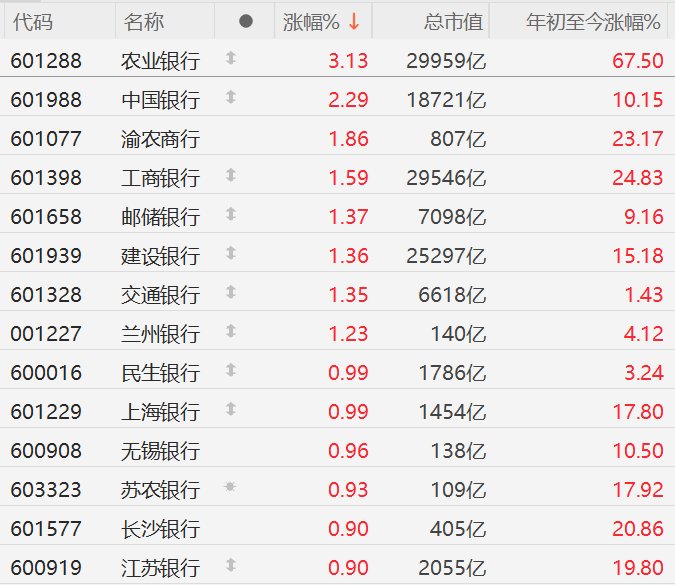
银行股强势!农行、工商均再创历史新高
Ge Long Hui A P P· 2025-11-12 04:13
Core Insights - The A-share market has seen a strong performance in bank stocks, with Agricultural Bank leading the gains, rising over 3% [1] - Major banks such as Industrial and Commercial Bank of China also reached historical highs [1] Summary by Category Stock Performance - Agricultural Bank: Increased by 3.13%, total market value at 299.59 billion, year-to-date increase of 67.50% [2] - Bank of China: Increased by 2.29%, total market value at 187.21 billion, year-to-date increase of 10.15% [2] - Chongqing Rural Commercial Bank: Increased by 1.86%, total market value at 8.07 billion, year-to-date increase of 23.17% [2] - Industrial and Commercial Bank: Increased by 1.59%, total market value at 295.46 billion, year-to-date increase of 24.83% [2] - Postal Savings Bank: Increased by 1.37%, total market value at 70.98 billion, year-to-date increase of 9.16% [2] - Construction Bank: Increased by 1.36%, total market value at 252.97 billion, year-to-date increase of 15.18% [2] - Transportation Bank: Increased by 1.35%, total market value at 66.18 billion, year-to-date increase of 1.43% [2] - Lanzhou Bank: Increased by 1.23%, total market value at 1.40 billion, year-to-date increase of 4.12% [2] - Minsheng Bank: Increased by 0.99%, total market value at 17.86 billion, year-to-date increase of 3.24% [2] - Shanghai Bank: Increased by 0.99%, total market value at 14.54 billion, year-to-date increase of 17.80% [2] - Yuanxi Bank: Increased by 0.96%, total market value at 1.38 billion, year-to-date increase of 10.50% [2] - Sunong Bank: Increased by 0.93%, total market value at 1.09 billion, year-to-date increase of 17.92% [2] - Changsha Bank: Increased by 0.90%, total market value at 4.05 billion, year-to-date increase of 20.86% [2] - Jiangsu Bank: Increased by 0.90%, total market value at 20.55 billion, year-to-date increase of 19.80% [2]

农业银行涨超2%,再创历史新高
Ge Long Hui A P P· 2025-11-12 01:51
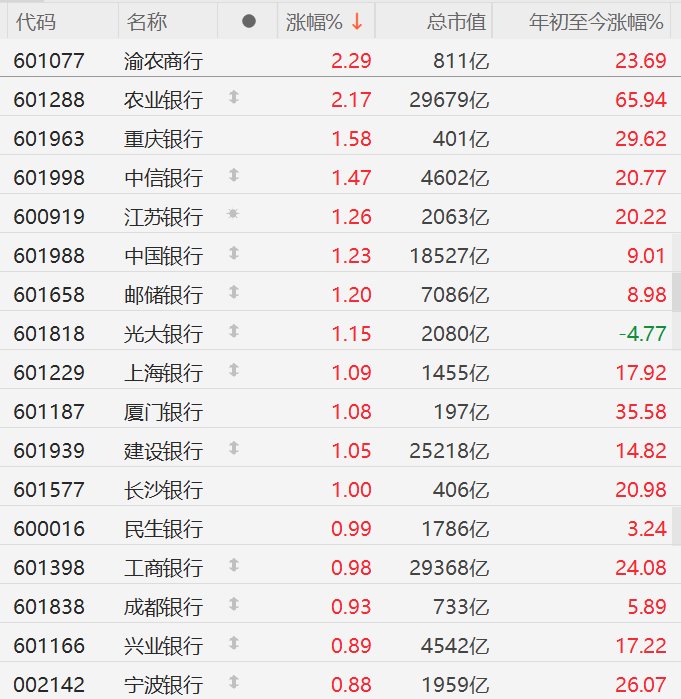
Core Insights - The A-share market has seen a rise in bank stocks, with notable increases in shares of Chongqing Rural Commercial Bank and Agricultural Bank, both rising over 2% [1] - Agricultural Bank has reached a historical high, with its total market capitalization approaching 3 trillion yuan [1] Summary by Category Stock Performance - Chongqing Rural Commercial Bank (601077) increased by 2.29%, with a total market capitalization of 81.1 billion yuan and a year-to-date increase of 23.69% [2] - Agricultural Bank (601288) rose by 2.17%, reaching a market capitalization of 2,967.9 billion yuan and a year-to-date increase of 65.94% [2] - Other banks such as Chongqing Bank (601963), CITIC Bank (601998), and Jiangsu Bank (600919) also saw increases of over 1% [2] Market Capitalization - The total market capitalization of Agricultural Bank is nearing 3 trillion yuan, marking a significant milestone [1] - Other banks like China Bank (601988) and Postal Savings Bank (601658) have market capitalizations of 1,852.7 billion yuan and 708.6 billion yuan, respectively [2] Year-to-Date Performance - The year-to-date performance of various banks shows significant growth, with Agricultural Bank leading at 65.94%, followed by Chongqing Bank at 29.62% and Jiangsu Bank at 20.22% [2]
监管研究系列三:存款非银化对流动性风险指标的影响与测算
KAIYUAN SECURITIES· 2025-11-11 14:12
Investment Rating - The investment rating for the banking industry is "Positive" (maintained) [1] Core Insights - The report highlights the ongoing trend of deposit non-bankization, which is leading to a marginal decline in liquidity indicators for banks. This trend is particularly pronounced among large banks, with a notable increase in the proportion of non-bank deposits [12][16] - The liquidity coverage ratio (LCR) and net stable funding ratio (NSFR) are critical indicators for banks, and the report provides quantitative assessments of how deposit non-bankization impacts these metrics. The effects are manageable for major banks, with LCR expected to remain above 120% even under significant conversion scenarios [4][34] Summary by Sections 1. Deposit Non-Bankization and Liquidity Management - The process of deposit non-bankization is intensifying the demand for banks to manage liquidity indicators more stringently. Since May 2025, the growth rate of personal fixed deposits has been declining, with large banks showing a decrease in monthly increments compared to the same period in 2024 [12][16] - The report quantifies the impact of deposit non-bankization on LCR and NSFR for major banks, indicating that even with a 70% conversion of personal fixed deposits to non-bank deposits, the LCR for most large banks is expected to remain above 120% [4][34] 2. Liquidity Indicator Management - The management of LCR focuses on maintaining liquidity asset reserves, while NSFR management emphasizes improving the liability structure. Issuing long-term interbank certificates of deposit is highlighted as an effective method to optimize these liquidity indicators [5][22] - The report details how the conversion of personal fixed deposits to non-bank deposits affects various liquidity risk indicators, with specific calculations provided for LCR and NSFR under different conversion scenarios [18][23] 3. Investment Recommendations - The report suggests a tiered investment strategy: - Core holdings should focus on large state-owned banks, benefiting from institutions like Agricultural Bank of China and Industrial and Commercial Bank of China - Core allocations should include leading comprehensive banks such as China Merchants Bank and CITIC Bank - Flexible allocations can target regional banks like Jiangsu Bank and Chongqing Bank [6][19]

