Chongqing Rural Commercial Bank(601077)

Search documents
监管研究系列三:存款非银化对流动性风险指标的影响与测算
KAIYUAN SECURITIES· 2025-11-11 14:12
Investment Rating - The investment rating for the banking industry is "Positive" (maintained) [1] Core Insights - The report highlights the ongoing trend of deposit non-bankization, which is leading to a marginal decline in liquidity indicators for banks. This trend is particularly pronounced among large banks, with a notable increase in the proportion of non-bank deposits [12][16] - The liquidity coverage ratio (LCR) and net stable funding ratio (NSFR) are critical indicators for banks, and the report provides quantitative assessments of how deposit non-bankization impacts these metrics. The effects are manageable for major banks, with LCR expected to remain above 120% even under significant conversion scenarios [4][34] Summary by Sections 1. Deposit Non-Bankization and Liquidity Management - The process of deposit non-bankization is intensifying the demand for banks to manage liquidity indicators more stringently. Since May 2025, the growth rate of personal fixed deposits has been declining, with large banks showing a decrease in monthly increments compared to the same period in 2024 [12][16] - The report quantifies the impact of deposit non-bankization on LCR and NSFR for major banks, indicating that even with a 70% conversion of personal fixed deposits to non-bank deposits, the LCR for most large banks is expected to remain above 120% [4][34] 2. Liquidity Indicator Management - The management of LCR focuses on maintaining liquidity asset reserves, while NSFR management emphasizes improving the liability structure. Issuing long-term interbank certificates of deposit is highlighted as an effective method to optimize these liquidity indicators [5][22] - The report details how the conversion of personal fixed deposits to non-bank deposits affects various liquidity risk indicators, with specific calculations provided for LCR and NSFR under different conversion scenarios [18][23] 3. Investment Recommendations - The report suggests a tiered investment strategy: - Core holdings should focus on large state-owned banks, benefiting from institutions like Agricultural Bank of China and Industrial and Commercial Bank of China - Core allocations should include leading comprehensive banks such as China Merchants Bank and CITIC Bank - Flexible allocations can target regional banks like Jiangsu Bank and Chongqing Bank [6][19]



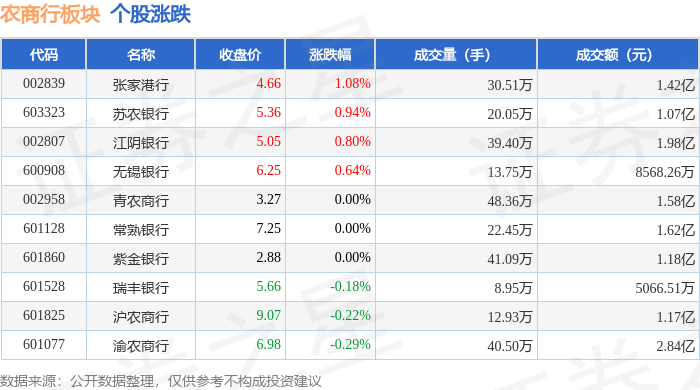
农商行板块11月11日涨0.01%,张家港行领涨,主力资金净流出1.4亿元
Zheng Xing Xing Ye Ri Bao· 2025-11-11 08:46
Core Insights - The rural commercial bank sector experienced a slight increase of 0.01% on November 11, with Zhangjiagang Bank leading the gains [1] - The Shanghai Composite Index closed at 4002.76, down 0.39%, while the Shenzhen Component Index closed at 13289.0, down 1.03% [1] Stock Performance - Zhangjiagang Bank (002839) closed at 4.66, up 1.08% with a trading volume of 305,100 shares and a transaction value of 1.42 billion [1] - Su Nong Bank (603323) closed at 5.36, up 0.94% with a trading volume of 200,500 shares and a transaction value of 107 million [1] - Jiangyin Bank (002807) closed at 5.05, up 0.80% with a trading volume of 394,000 shares and a transaction value of 1.98 billion [1] - Wuxi Bank (600908) closed at 6.25, up 0.64% with a trading volume of 137,500 shares and a transaction value of 85.68 million [1] - Qingnong Commercial Bank (002958) and Changshu Bank (601128) remained unchanged at 3.27 and 7.25 respectively [1] Fund Flow Analysis - The rural commercial bank sector saw a net outflow of 140 million from institutional investors, while retail investors contributed a net inflow of 79.48 million [1] - Zhangjiagang Bank had a net inflow of 6.31 million from institutional investors, but a net outflow of 4.63 million from retail investors [2] - Wuxi Bank experienced a net inflow of 2.46 million from institutional investors, with retail investors contributing a net inflow of 3.07 million [2] - Qingnong Commercial Bank faced a significant net outflow of 23.40 million from institutional investors, while retail investors contributed a net inflow of 20.09 million [2] - Yunnan Agricultural Bank (601077) had the highest net outflow of 87.93 million from institutional investors, with retail investors contributing a net inflow of 47.76 million [2]







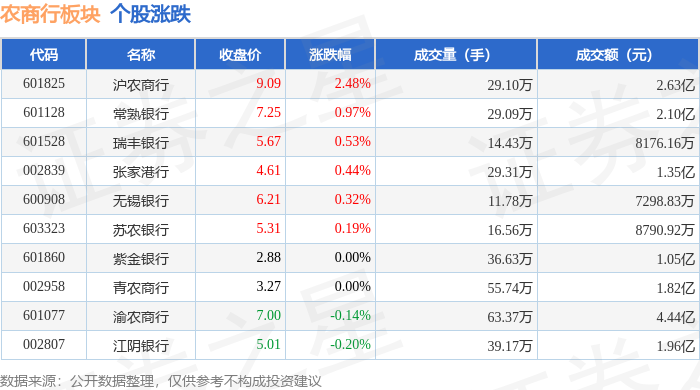
农商行板块11月10日涨0.92%,沪农商行领涨,主力资金净流出2.1亿元
Zheng Xing Xing Ye Ri Bao· 2025-11-10 08:48
Core Insights - The agricultural commercial bank sector experienced a rise of 0.92% on November 10, with Shanghai Agricultural Commercial Bank leading the gains [1] - The Shanghai Composite Index closed at 4018.6, up 0.53%, while the Shenzhen Component Index closed at 13427.61, up 0.18% [1] Sector Performance - Shanghai Agricultural Commercial Bank (601825) closed at 60.6, with a gain of 2.48% and a trading volume of 291,000 shares, amounting to a transaction value of 263 million yuan [1] - Changshu Bank (601128) closed at 7.25, up 0.97%, with a trading volume of 290,900 shares and a transaction value of 210 million yuan [1] - Ruifeng Bank (601528) closed at 5.67, up 0.53%, with a trading volume of 144,300 shares and a transaction value of 81.76 million yuan [1] - Zhangjiagang Bank (002839) closed at 4.61, up 0.44%, with a trading volume of 129,300 shares and a transaction value of 135 million yuan [1] - Yuanxi Bank (600908) closed at 6.21, up 0.32%, with a trading volume of 117,800 shares and a transaction value of 72.99 million yuan [1] - Shinan Bank (603323) closed at 5.31, up 0.19%, with a trading volume of 165,600 shares and a transaction value of 87.91 million yuan [1] - Zijin Bank (601860) closed at 2.88, unchanged, with a trading volume of 366,300 shares and a transaction value of 105 million yuan [1] - Qingnong Commercial Bank (002958) closed at 3.27, unchanged, with a trading volume of 557,400 shares and a transaction value of 182 million yuan [1] - Yunnan Agricultural Commercial Bank (601077) closed at 7.00, down 0.14%, with a trading volume of 633,700 shares and a transaction value of 444 million yuan [1] - Jiangyin Bank (002807) closed at 5.01, down 0.20%, with a trading volume of 391,700 shares and a transaction value of 196 million yuan [1] Fund Flow Analysis - The agricultural commercial bank sector saw a net outflow of 210 million yuan from main funds, while retail funds experienced a net inflow of 118 million yuan [1] - The main fund flow for Shanghai Agricultural Commercial Bank was a net inflow of 9.12 million yuan, while retail funds saw a net outflow of 197,440 yuan [2] - Ruifeng Bank had a main fund net inflow of 4.43 million yuan, but retail funds experienced a net outflow of 763.71 million yuan [2] - Zhangjiagang Bank had a significant main fund net outflow of 16.33 million yuan, while retail funds saw a net inflow of 1.77 million yuan [2] - Changshu Bank experienced a main fund net outflow of 21.87 million yuan, with retail funds seeing a net inflow of 26.42 million yuan [2] - Qingnong Commercial Bank had a main fund net outflow of 32.17 million yuan, while retail funds had a net inflow of 20.39 million yuan [2] - Yunnan Agricultural Commercial Bank faced a substantial main fund net outflow of 143 million yuan, but retail funds had a net inflow of 59.38 million yuan [2]


从增量扩面到提质控险 银行业普惠金融迈向差异化精准服务
2 1 Shi Ji Jing Ji Bao Dao· 2025-11-10 04:21
Core Insights - The report highlights the significant growth and development of inclusive finance in China, particularly focusing on small and micro enterprises and rural areas, with a notable annual growth rate of over 20% in inclusive micro loans during the 14th Five-Year Plan period [1][2] - As of June 2025, the balance of inclusive micro loans reached 36 trillion yuan, which is 2.3 times that of the end of the 13th Five-Year Plan, with a decrease in interest rates by 2 percentage points [1][2] - The average interest rate for newly issued inclusive micro loans was 3.48% as of June 2025, reflecting a decrease of 66 basis points year-on-year [1][2] Group 1: Digital Empowerment - Digital technology has been a key driver for the development of inclusive finance, with banks utilizing big data and AI to enhance loan approval efficiency and reduce financing costs [2][7] - The market structure among banks is changing, with large commercial banks holding a 45.11% share of inclusive micro loans, while rural financial institutions have seen a decline in their market share [2][3] - The average growth rate of inclusive micro loans has been slowing down, with a decrease from 30.9% in 2020 to 12.3% by mid-2025 [2][3] Group 2: Performance of Listed Banks - Among listed banks, Agricultural Bank of China, Industrial and Commercial Bank of China, and Beijing Bank reported the highest growth rates in inclusive micro loans at 18.50%, 17.30%, and 17.27% respectively [3][4] - In contrast, some banks, including Shanghai Bank and Zhengzhou Bank, experienced negative growth rates of -3.97% and -2.06% [3][4] - The performance of different banks varies significantly, with state-owned banks generally showing stronger growth in inclusive micro loans compared to smaller banks [3][4] Group 3: Interest Rates and Risk Management - The interest rates for newly issued inclusive micro loans have decreased across various banks, with the highest rate at 4.20% and the lowest at 2.94% [7][8] - The gap in interest rates between large and small banks is narrowing, with some large banks' rates aligning closely with those of smaller banks [8][9] - The report emphasizes the importance of risk management in the inclusive finance sector, with several banks focusing on improving asset quality and managing non-performing loans [9][10]


中国区域性银行_2025 年第三季度回顾_核心盈利稳步复苏,我们偏好宁波银行和南京银行-China regional banks_ 3Q25 review_ Steady recovery in core earnings, we prefer BoNB and BoNJ
2025-11-10 03:34
Summary of China Regional Banks 3Q25 Review Industry Overview - The report focuses on the performance of China Regional Banks (CRBs) in the third quarter of 2025 (3Q25) - Overall profits for CRBs grew by 6% year-over-year (y/y), a decrease from 9% y/y in 2Q25, primarily due to a decline in non-fee income [1][3] Core Earnings and Profitability - CRBs demonstrated a core earnings recovery of 12% y/y, outperforming large banks which only saw a 1% y/y increase in core earnings [1][3] - Net Interest Income (NII) for CRBs grew by an average of 7% y/y, improving from 5% y/y in 2Q25, while large banks averaged only 0.4% growth [3][7] - Fee income increased by 16% y/y, reversing a contraction trend, supported by agency fee growth as market sentiment improved [3][7] - Non-fee income saw a significant decline of 32% y/y, primarily due to fair value losses in bond investments [3][7] Asset Quality - Asset quality remained stable, with the average Non-Performing Loan (NPL) ratio declining by 1 basis point (bps) q/q to 0.96% in 3Q25 [1][21] - The Special Mention Loan (SML) ratio increased by 3 bps q/q, indicating some pressure on asset quality compared to large banks [21] - The NPL coverage ratio decreased slightly by 1 bps q/q, suggesting a cautious approach to provision releases [21] Capital and Growth Constraints - The Common Equity Tier 1 (CET1) ratio for CRBs decreased by 11 bps q/q, raising concerns about growth constraints due to lower capital levels [3][21] - CRBs reported a 2% q/q loan growth, consistent with industry trends, but with significant variations among banks [20] - Deposit growth was flat on average, with BoNB experiencing the highest contraction at -1.4% q/q [20] Investment Recommendations - Top picks among regional banks include BoNB and BoNJ, both showing double-digit growth in core earnings and stable asset quality [1][3] - BoBJ's performance was the weakest, with a profit contraction of 2% y/y and a low CET1 ratio, although its high dividend yield of 5.8% provides some downside protection [1][3] - Caution is advised regarding CSRCB until clearer signs of improvement in SME asset quality are observed [1][3] Valuation Insights - The report includes a valuation comparison of various regional banks, highlighting differences in price-to-earnings (P/E) ratios, price-to-book (P/B) ratios, and return on equity (ROE) [5] - The average P/E for CRBs is projected at 6.1 for FY25E and 5.7 for FY26E, with an average dividend yield of 5.0% for FY25E [5] Conclusion - The overall performance of China Regional Banks in 3Q25 indicates a steady recovery in core earnings, although challenges remain in non-fee income and capital levels. The investment outlook is cautiously optimistic for select banks, particularly BoNB and BoNJ, while caution is warranted for others like CSRCB and BoBJ.




渝农商行增长下的隐忧:零售贷款不良率升至2.04% 高层或代职超期
Xi Niu Cai Jing· 2025-11-07 10:29
Core Viewpoint - The financial performance of Chongqing Rural Commercial Bank (渝农商行) in the first three quarters of 2025 shows a slowdown in revenue growth compared to local peers, raising concerns about its operational outlook [2][3]. Financial Performance - For Q3 2025, the bank reported operating revenue of 6,916.9 million, a year-on-year increase of 1.10%, and a net profit of 3,078.0 million, up 2.14% [1]. - For the first nine months of 2025, the bank's operating revenue reached 21,657.7 million, reflecting a growth of 0.67%, while the net profit was 10,924.9 million, an increase of 3.32% [1][3]. - Interest income for the first three quarters was 347.59 million, down 6.49%, while interest expenses decreased by 9.62% to 169.09 million, indicating that the growth in net interest income was primarily due to reduced expenses rather than increased income [4]. Comparison with Peers - Chongqing Rural Commercial Bank's revenue growth is significantly lagging behind that of Chongqing Bank, which reported a 10.40% increase in revenue for the same period [2]. Investment Income - The bank's investment income for the first three quarters was 34.95 million, down 8.10%, contrasting with many domestic banks that reported substantial increases in investment income [4]. Cost Management - The bank's business and management expenses for the first three quarters were 58.92 million, a year-on-year increase of 1.84%, with other general and administrative expenses decreasing by 9.17% [5]. Asset Quality - As of Q3 2025, the bank's non-performing loan balance was 87.11 million, an increase of 2.92 million from the end of 2024, with a non-performing loan ratio of 1.12%, down 0.06 percentage points [5]. Leadership Changes - The bank has experienced significant leadership changes, with the chairman resigning in October 2024 and the current acting chairman, Sui Jun, serving in this role for nearly a year, which exceeds the regulatory limit of six months for acting positions [7][9][10].


齐鲁银行渝农商行苏州银行今日涨幅垫底银行板块
Zhong Guo Jing Ji Wang· 2025-11-07 09:11
Core Points - The banking sector experienced a slight decline today, with a drop of 0.16% overall [1] - Qilu Bank's stock closed at 6.08 yuan, reflecting a decrease of 1.46% [1] - Chongqing Rural Commercial Bank's stock closed at 7.01 yuan, down by 1.13% [1] - Suzhou Bank's stock closed at 8.33 yuan, with a decline of 1.07% [1] - Qilu Bank, Chongqing Rural Commercial Bank, and Suzhou Bank were the largest decliners in the banking sector today [1]


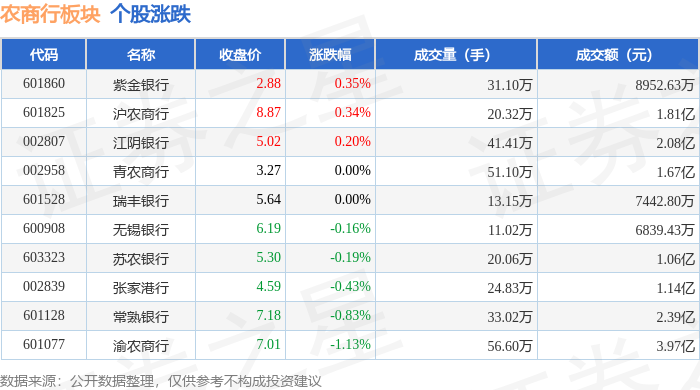
农商行板块11月7日跌0.26%,渝农商行领跌,主力资金净流出5990.34万元
Zheng Xing Xing Ye Ri Bao· 2025-11-07 08:37
Market Overview - On November 7, the rural commercial bank sector declined by 0.26% compared to the previous trading day, with Yunnan Rural Commercial Bank leading the decline [1] - The Shanghai Composite Index closed at 3997.56, down 0.25%, while the Shenzhen Component Index closed at 13404.06, down 0.36% [1] Individual Stock Performance - Key stock performances in the rural commercial bank sector included: - Zijin Bank: Closed at 2.88, up 0.35% with a trading volume of 311,000 shares and a turnover of 89.53 million yuan - Hu'nong Commercial Bank: Closed at 8.87, up 0.34% with a trading volume of 203,200 shares and a turnover of 181 million yuan - Jiangyin Bank: Closed at 5.02, up 0.20% with a trading volume of 414,100 shares and a turnover of 208 million yuan - Yunnan Rural Commercial Bank: Closed at 7.01, down 1.13% with a trading volume of 566,000 shares and a turnover of 397 million yuan [1] Fund Flow Analysis - The rural commercial bank sector experienced a net outflow of 59.90 million yuan from institutional investors and 50.91 million yuan from retail investors, while there was a net inflow of 111 million yuan from individual investors [1] - Detailed fund flow for individual stocks showed: - Yunnan Rural Commercial Bank: Net outflow of 10.11 million yuan from retail investors, with a net inflow of 777.16 thousand yuan from institutional investors [2] - Jiangyin Bank: Net outflow of 560.48 thousand yuan from institutional investors, with a net inflow of 1.24 million yuan from retail investors [2] - Common trends included significant net outflows from institutional and speculative investors across various banks, while retail investors showed some net inflows in several cases [2]
中国银行业(HA 股)_ 2025 年第三季度表现分化,上行空间有限但下行支撑稳固-Banks - China (H_A)_ 3Q25 mixed, upside limited but good for downside support
2025-11-07 01:28
Summary of Key Points from the Conference Call Industry Overview - **Industry**: Chinese Banking Sector (H-share banks) - **Period**: 3Q25 results and 9M25 performance Earnings Review - **Net Profit Growth**: Increased from +0.4% YoY in 1H25 to +0.5% in 9M25, with all big six state banks reporting positive YoY growth [1][11] - **Core Earnings Growth**: Slowed from +1.6% YoY in 1H to +0.8% by 9M25 [1] - **Performance Comparison**: H-share bank sector rose 19.9% YTD, underperforming MSCI China and HSI by 16ppt and 9ppt, respectively [1][11] - **Dividend Yield**: Sector's dividend yield at 5.3% is considered unattractive [1][11] - **Stock Recommendations**: Downgraded CCB-H/ABC-H from Buy to Neutral; upgraded BoComm-H from Underperform to Neutral; ICBC is the top pick among large banks [1][11] Loan Growth and Deposit Trends - **Loan Growth**: Average loan growth decelerated from 6.8%/6.9% YoY in FY24/1H25 to 6.3% in 9M25; big six state banks led with 7.5-10.0% YoY growth [2] - **Small Banks**: Experienced loan size contraction of 0.3-1.4% QoQ, raising concerns [2] - **Deposit Growth**: Seasonally low at 0.2% QoQ in 3Q, but YoY growth at 6.8% exceeded loan growth [2] Net Interest Margin (NIM) - **NIM Trends**: Average NIM edged down 1bp QoQ to 1.42% in 3Q; some banks reported NIM increases due to reduced funding costs [3] - **Future Outlook**: Potential stabilization of margins expected if no further policy rate cuts occur [3] Non-Interest Income - **Fee Income Growth**: Improved from +3.3% YoY in 1H to +4.8% in 9M25, attributed to a lower base and strong capital markets [4] - **Trading Gains**: Weakened from 29% YoY in 1H25 to 16% in 9M25, with some banks experiencing significant QoQ drops [4] Credit Quality and Provisions - **NPL Ratio**: Stable at 1.22% QoQ/YTD; average credit cost fell 5bp YoY to 67bp in 9M25 [5] - **Provisions**: Total provisions rose by +0.5% YoY in 9M, down from +3.5% in 1H [5] - **Coverage Ratios**: NPL and loan reserve coverage edged down QoQ to 232% and 2.75%, respectively [5] Valuation and Market Performance - **Valuation Metrics**: H-share banks currently trade at 0.55x P/B, 3.5x P/PPOP, and 6.0x P/E; dividend yield has declined from nearly 10% in Jan-2024 to 5.3% [11][21][23] - **Market Performance**: H-share banks underperformed the MSCI China index YTD; A-H share premium narrowed from 34% to 21% [31][11] Conclusion - The Chinese banking sector is showing mixed signals with modest profit growth and declining loan growth. While larger banks provide some stability, the overall market performance and valuation metrics suggest caution for investors. The focus remains on key players like ICBC, with recommendations adjusted based on recent performance.

资产规模前十大农商行部分财务指标
Zhong Guo Zheng Quan Bao· 2025-11-06 20:15
Core Insights - The article provides a summary of the financial performance of various rural commercial banks in China as of September 2025, highlighting their total assets, operating income, and net profit compared to the previous year [1] Group 1: Financial Performance - Chongqing Rural Commercial Bank reported total assets of 165.58 billion yuan, a 9.30% increase, with operating income of 21.66 billion yuan and net profit of 10.93 billion yuan [1] - Shanghai Rural Commercial Bank's total assets reached 155.81 billion yuan, up 4.72%, with operating income of 19.83 billion yuan and net profit of 10.81 billion yuan [1] - Guangzhou Rural Commercial Bank had total assets of 141.64 billion yuan, a 3.96% increase, with operating income of 1.10 billion yuan and net profit of 0.17 billion yuan [1] - Beijing Rural Commercial Bank's total assets were 134.98 billion yuan, a 7.29% increase, with operating income of 1.19 billion yuan and net profit of 0.60 billion yuan [1] - Chengdu Rural Commercial Bank reported total assets of 99.92 billion yuan, a 9.29% increase, with operating income of 1.42 billion yuan and net profit of 0.60 billion yuan [1] - Shenzhen Rural Commercial Bank experienced a decline in total assets to 80.25 billion yuan, down 1.78%, with no disclosed operating income or net profit [1] - Dongguan Rural Commercial Bank's total assets were 76.97 billion yuan, a 3.19% increase, with operating income of 0.86 billion yuan and net profit of 0.37 billion yuan [1] - Jiangsu Jiangnan Rural Commercial Bank reported total assets of 61.65 billion yuan, a 5.39% increase, with operating income of 0.99 billion yuan and net profit of 0.40 billion yuan [1] - Hangzhou United Bank had total assets of 59.61 billion yuan, a 6.39% increase, with operating income of 0.87 billion yuan and net profit of 0.42 billion yuan [1] - Qingdao Rural Commercial Bank reported total assets of 50.99 billion yuan, a 3.01% increase, with operating income of 0.80 billion yuan and net profit of 0.33 billion yuan [1]