
INDUSTRIAL BANK(601166)

Search documents
福建:“借绿生金”,绿色金融赋能高质量发展
Xin Hua She· 2025-09-16 12:47
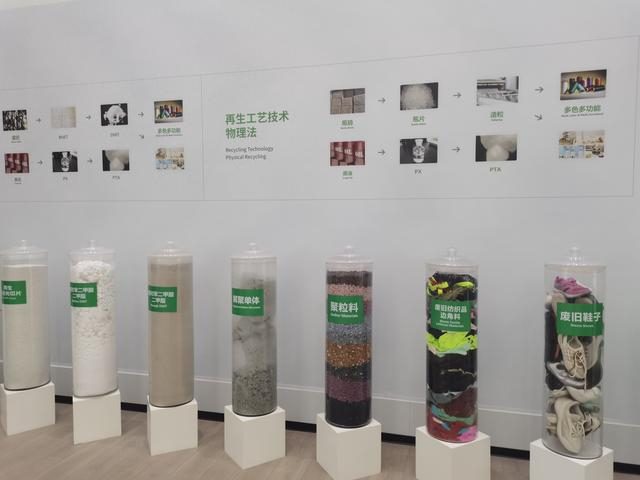
Group 1 - The core viewpoint highlights the significant growth of Huafeng Huajin Group due to the increasing demand for recycled materials driven by the green transformation of industries [1] - Huafeng Huajin Group has received over 6 billion yuan in credit support from Industrial Bank for its recycled fiber projects, production line upgrades, and technology acquisitions since 2021 [1] - The company is actively investing in new industrial projects and technologies to sustain its growth in the green textile industry [1] Group 2 - Green finance has effectively supported the green development of industries and ecological protection in Fujian, exemplified by the Zijinshan Gold-Copper Mine, which has integrated environmental restoration with mining operations [2] - Industrial Bank has provided nearly 3.5 billion yuan in loans specifically for environmental remediation and related expenses for Zijin Mining Group [2] - The financial support has facilitated the successful implementation of environmental projects, ensuring efficient and sustainable mining practices [2] Group 3 - Fujian's banking sector has expanded its green finance services to cover key areas such as renewable energy, green transportation, and ecological protection [5] - As of June, the green loan balance in Fujian reached 1.27 trillion yuan, growing by 12.99% since the beginning of the year, surpassing the growth rate of other loans by 10.18 percentage points [5] - The province has issued 37.2 billion yuan in carbon reduction loans, supporting 750 green projects, thereby contributing to high-quality economic and social development [5]


兴业银行9月16日现1笔大宗交易 总成交金额3119.49万元 溢价率为0.00%
Xin Lang Cai Jing· 2025-09-16 10:20
Group 1 - The core point of the article highlights the recent trading activity of Industrial Bank, which saw a decline of 1.76% on September 16, closing at 20.70 yuan [1] - A significant block trade occurred, with a total volume of 1.507 million shares and a transaction amount of 31.1949 million yuan, indicating a premium rate of 0.00% [1] - The buyer and seller for this transaction were both from Huatai Securities Co., Ltd., Guangzhou Zhujiang West Road Securities Business Department [1] Group 2 - Over the past three months, Industrial Bank has recorded three block trades with a cumulative transaction amount of 67.8402 million yuan [1] - In the last five trading days, the stock has experienced a cumulative decline of 3.81%, with a net outflow of 805 million yuan from major funds [1]
兴业银行长沙分行:多维深耕金融教育 构筑消费者权益立体防护网
Chang Sha Wan Bao· 2025-09-16 10:13
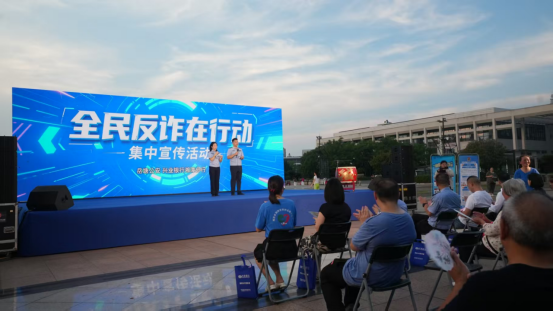
长沙晚报掌上长沙9月16日讯(通讯员 邓凯茜) 兴业银行长沙分行辖内各二级分行以"五进联动"创新模 式全面推进金融知识普及,通过警银协作、场景化宣教、精准化服务等多元举措,切实提升消费者风险 防范能力,筑牢金融消费者权益保护屏障。 警银联动筑防线 破诈防损显担当 在反诈攻坚行动中,株洲分行通过柜面业务监测成功拦截多起大额异常资金转移,联动公安机关阻止群 众损失超百万元。因在警银协作中的突出表现,该行获株洲市公安局与人民银行株洲市分行联合通报表 扬。湘潭分行则联合岳塘区公安分局举办"反诈护民"主题宣传活动,通过情景剧演绎、案例拆解、线上 直播互动等形式,形成"线上+线下"立体宣传矩阵。 普惠金融润乡土 情暖田间千万家 常德分行组建"金融轻骑兵"深入县域乡镇,以"流动课堂+擂台竞赛"形式开展金融知识下乡。通过方言 讲解非法集资,手把手教学移动支付,发放普惠知识手册,创新性开展的"金融知识大富翁"互动游戏让 防诈知识入脑入心,生动诠释金融机构助力乡村振兴的使命担当。 金融启蒙进校园 护航青春零风险 株洲分行、衡阳分行联合各类院校开展"金融安全第一课"系列活动,从小学生的金融安全启蒙到大学生 的防范金融风险,针对校园 ...
兴业银行今日大宗交易平价成交150.7万股,成交额3119.49万元
Xin Lang Cai Jing· 2025-09-16 09:36
9月16日,兴业银行大宗交易成交150.7万股,成交额3119.49万元,占当日总成交额的1.34%,成交价 20.7元,较市场收盘价20.7元持平。 | 交易日期 | 证券商标 | 蓬券代码。 | 成交价(元) 成交金额(万元) 成交量(*) 莫入营业部 | | | 美出营业部 | 是否为专场 | | --- | --- | --- | --- | --- | --- | --- | --- | | 025-09-16 | 兴业银行 | 601166 | 20.7 3119.49 | 150.7 | 华泰证券股份有限 | 华泰证券股份有限 | rea | | | | | | | 公司广州珠江西路 below couple come and the can and | 公司广州珠江西路 were come comes commerce and "career of | | ...

法国兴业银行首席执行官克鲁帕:坚决致力于在处理过剩资本时保持理性。
Xin Lang Cai Jing· 2025-09-16 09:27
Core Viewpoint - The CEO of Société Générale, Frédéric Oudéa, emphasizes a rational approach to managing excess capital [1] Group 1 - The company is committed to maintaining a rational strategy in handling surplus capital [1]

股份制银行板块9月16日跌1.54%,浦发银行领跌,主力资金净流出34.2亿元
Zheng Xing Xing Ye Ri Bao· 2025-09-16 08:46
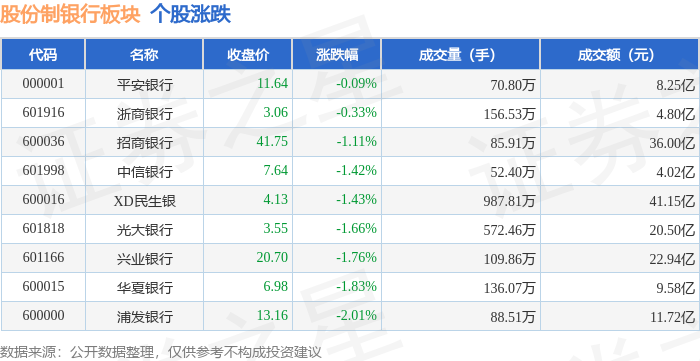
Core Viewpoint - The banking sector, particularly the joint-stock banks, experienced a decline of 1.54% on September 16, with Shanghai Pudong Development Bank leading the drop [1] Group 1: Market Performance - The Shanghai Composite Index closed at 3861.87, up 0.04%, while the Shenzhen Component Index closed at 13063.97, up 0.45% [1] - The individual performance of joint-stock banks showed varied results, with most banks experiencing a decline in share price [1] Group 2: Individual Bank Performance - Ping An Bank closed at 11.64, down 0.09% with a trading volume of 708,000 shares and a transaction value of 82.58 million [1] - Zhejiang Commercial Bank closed at 3.06, down 0.33% with a trading volume of 1,565,300 shares and a transaction value of 4.80 million [1] - China Merchants Bank closed at 41.75, down 1.11% with a trading volume of 859,100 shares and a transaction value of 3.60 billion [1] - CITIC Bank closed at 7.64, down 1.42% with a trading volume of 524,000 shares and a transaction value of 402 million [1] - Minsheng Bank closed at 4.13, down 1.43% with a trading volume of 9,878,100 shares and a transaction value of 4.11 million [1] - Everbright Bank closed at 3.55, down 1.66% with a trading volume of 5,724,600 shares and a transaction value of 2.05 billion [1] - Industrial Bank closed at 20.70, down 1.76% with a trading volume of 1,098,600 shares and a transaction value of 2.29 billion [1] - Huaxia Bank closed at 6.98, down 1.83% with a trading volume of 1,360,700 shares and a transaction value of 958 million [1] - Shanghai Pudong Development Bank closed at 13.16, down 2.01% with a trading volume of 885,100 shares and a transaction value of 1.17 billion [1] Group 3: Capital Flow - The joint-stock banking sector saw a net outflow of 3.42 billion in principal funds, while speculative funds saw a net inflow of 1.45 billion and retail investors saw a net inflow of 1.97 billion [1]






大盘价值的底层支撑:龙头集群与行业比较优势
Xin Lang Cai Jing· 2025-09-16 06:08
Core Viewpoint - The Shanghai Stock Exchange 50 Index (SSE 50) has become a core target in value investing due to its precise selection of quality constituent stocks and scientific industry allocation, providing a robust underlying support for returns amidst market volatility [1][2]. Group 1: Constituent Stock Quality - The top ten constituent stocks of the SSE 50 form a "leader matrix" covering multiple core sectors, representing the pricing power and profit resilience of China's core economic assets [1]. - Key sectors include food and beverage, finance, public utilities, resources, and pharmaceuticals, with leading companies establishing strong competitive moats [1][2]. - For instance, Kweichow Moutai, with a weight of 10.55% and a market capitalization exceeding 1.8 trillion, leverages brand scarcity and rigid consumption scenarios to maintain high profitability across economic cycles [1][4]. Group 2: Industry Allocation Advantages - The SSE 50 exhibits a strategic positioning in core sectors, emphasizing "economic foundation + consumption upgrade," which provides a comparative advantage over the CSI 300 and CSI 500 indices [2][7]. - In the financial sector, the SSE 50's allocation is significant, with a combined weight of 36.4% in banking and non-banking financial sectors, substantially higher than the CSI 300's 26.2% and CSI 500's 9.5% [7][8]. - Leading banks like Industrial and Commercial Bank of China and China Merchants Bank are noted for their superior asset quality management and interest margin control, contributing to a "double boost" effect on performance during economic recovery [7][8]. Group 3: Consumer Sector Focus - The food and beverage sector holds a weight of 13.6% in the SSE 50, significantly surpassing the CSI 300's 8.1% and CSI 500's 1.8%, focusing on high-end consumer leaders like Kweichow Moutai [8][9]. - The current TTM price-to-earnings ratio for the food and beverage index is 21.76, indicating it is at a historically low relative valuation, which, combined with a recovering consumption trend, suggests potential for valuation recovery [8][9]. - The food and beverage sector is positioned as a "stabilizer" for the SSE 50, with expectations for steady earnings growth and reasonable valuation recovery, contributing to ongoing cash flow and valuation elasticity [9].




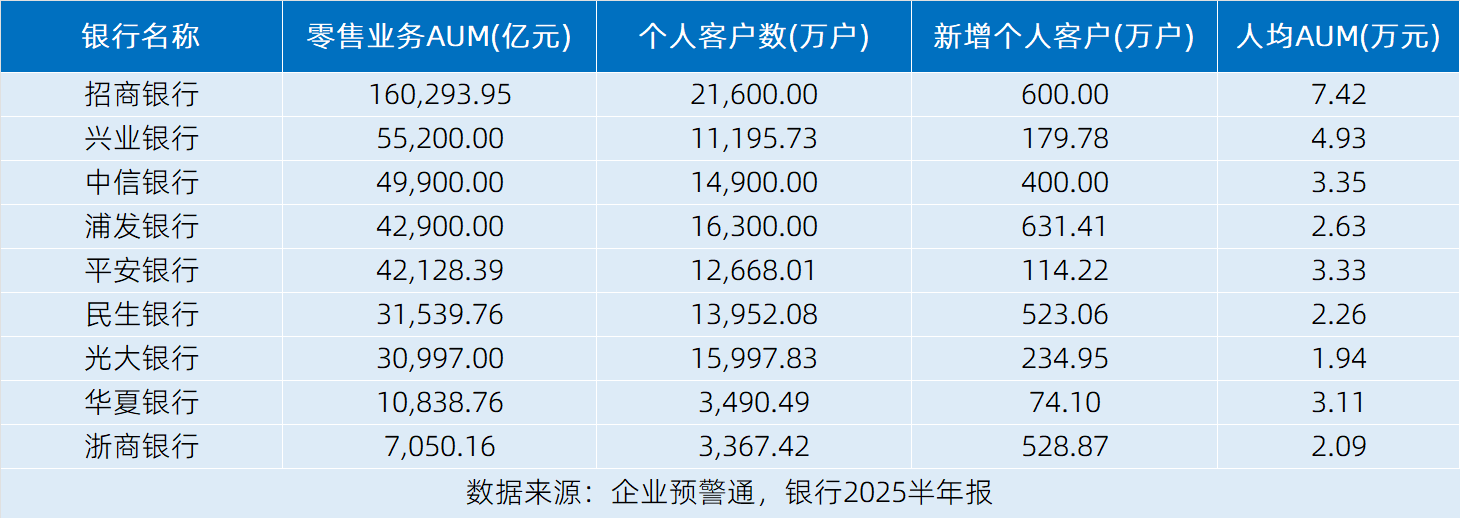
透视9家上市股份行零售金融业务:招商银行、浦发银行、光大银行个人客户数位列前三
Jin Rong Jie· 2025-09-16 03:54
Core Viewpoint - The retail transformation in the financial industry emphasizes personal financial services as a key strategy for banks to adjust their business structure and build differentiated competitive advantages [1] Group 1: Personal Financial Asset (AUM) - China Merchants Bank leads the industry with a retail AUM of 16.03 trillion yuan, significantly ahead of its competitors by over 1 trillion yuan [3] - Industrial Bank ranks second with a retail AUM of 5.52 trillion yuan, showing an 8% increase from the previous year [3] - CITIC Bank, with a retail AUM of 4.99 trillion yuan, has adopted a "retail first strategy" and achieved a 6.52% growth [4] Group 2: Number of Personal Customers - China Merchants Bank has the largest personal customer base with 216 million customers, enhancing its cross-selling opportunities [5] - Shanghai Pudong Development Bank follows with 163 million customers, leveraging online and offline channels for customer acquisition [5] - China Everbright Bank ranks third with 160 million customers, utilizing precise marketing strategies to attract specific customer segments [5] Group 3: New Personal Customer Acquisition - Shanghai Pudong Development Bank leads in new customer acquisition with 6.31 million new customers, continuing its online and offline customer acquisition strategy [6] - China Merchants Bank ranks second with 6 million new customers, indicating a lower growth rate relative to its existing customer base [6] - Zhejiang Commercial Bank reported a growth of 5.29 million new customers, focusing on various targeted customer segments [6] Group 4: Average AUM per Customer - China Merchants Bank has the highest average AUM per customer at 74,200 yuan, reflecting its strong wealth management capabilities [7] - Industrial Bank ranks second with an average AUM of 49,300 yuan, maintaining a strong position in customer asset management [7] - CITIC Bank, Ping An Bank, and Huaxia Bank have average AUMs ranging from 30,000 to 40,000 yuan, indicating a need for improvement in high-net-worth service capabilities [8]
小番茄撬动大产业 兴业银行乌鲁木齐分行精准赋能新疆特色产业发展
Zheng Quan Shi Bao Wang· 2025-09-16 03:14
Group 1 - The core viewpoint of the articles highlights the proactive financial support provided by Industrial Bank's Urumqi branch to tomato processing enterprises in Xinjiang, addressing their seasonal funding needs during the harvest period [1][2] - Xinjiang is identified as a key region for tomato cultivation and processing in China, accounting for over 80% of the national planting area, thus playing a significant role in rural revitalization [1] - The bank has developed a tailored financial service plan specifically for the tomato industry, which includes a rapid loan approval process that enabled the disbursement of 10 million yuan in working capital to a tomato processing company [1] Group 2 - Since the beginning of the year, the Urumqi branch has provided credit support to nearly 10 small and micro enterprises in the tomato industry, with total loans exceeding 50 million yuan, which has stabilized their operations and contributed to high-quality development in the sector [2] - The bank plans to continue deepening industry research and innovating financial products and services under the "one county, one industry, one policy" model to support small and micro enterprises as vital contributors to regional economic development [2]
兴业银行厦门分行落地福建省首笔 融资租赁ESG挂钩贷款
Jin Rong Jie· 2025-09-16 02:26
Core Insights - Xiamen Branch of Industrial Bank cooperated with Xiamen Xiangyu Jinxiang Holding Group to launch the first ESG-linked loan supporting financing leasing in the province, marking a significant step in innovative green financial products and sustainable economic development [1] Group 1: ESG-linked Loan Details - The loan provided by Xiamen Branch is aimed at financing the purchase price of leasing assets for a storage project, linking the loan interest rate to the company's performance in three ESG dimensions: environmental protection, social responsibility, and corporate governance [1] - This innovative model creates a virtuous cycle of "ESG value discovery - financial leasing ecosystem co-construction," contributing to the achievement of the "dual carbon" goals [1] Group 2: Industrial Bank's ESG Leadership - Industrial Bank is recognized as a pioneer in the green finance and ESG field in China, with its MSCI ESG rating upgraded to AAA, making it the only bank to receive the highest rating in the domestic banking sector for six consecutive years [1] - The Xiamen Branch plans to continue innovating green financial products and services in alignment with the national "dual carbon" strategy and regional economic development needs, aiming to contribute to sustainable development and the vision of a beautiful China [1]