
GAC GROUP(601238)

Search documents
广汽集团三款智能机器人集体亮相2025世界机器人大会
Zheng Quan Ri Bao Wang· 2025-08-11 04:48
Core Insights - GAC Group showcased its second-generation humanoid robots, GoMove, GoSide, and the third-generation GoMate, at the 2025 World Robot Conference, highlighting applications in healthcare and security [1] - GAC Group's humanoid robots were included in Morgan Stanley's global top 100 humanoid robots list earlier this year [1] - The company has achieved self-design and manufacturing of key components for its humanoid robots and plans to establish a global demonstration area in Guangzhou by the end of 2023, with large-scale production expected to start in 2027 and projected revenue exceeding 1 billion yuan by 2030 [1] Product Highlights - The third-generation humanoid robot GoMate features an industry-first variable wheel-foot configuration, allowing it to operate in both two-wheel and four-wheel modes, reducing energy consumption by over 80% compared to similar products and achieving a 6-hour battery life [2] - GoMate's self-developed drive unit weighs only 40 grams and is 80% smaller than the industry average, while its dexterous hand integrates visual and tactile sensors for precise object manipulation [2] - The robot is equipped with proprietary visual autonomous driving algorithms and advanced AI perception technologies, enabling rapid response to complex commands and seamless switching between remote and autonomous control [2] Market Outlook - The Chinese humanoid robot market is projected to reach 38 billion yuan by 2030, with a compound annual growth rate exceeding 61% [2] - The year 2025 is anticipated to mark the beginning of mass production for humanoid robots, positioning this sector for high growth, particularly for companies with established automotive supply chains that can leverage component commonality [2]

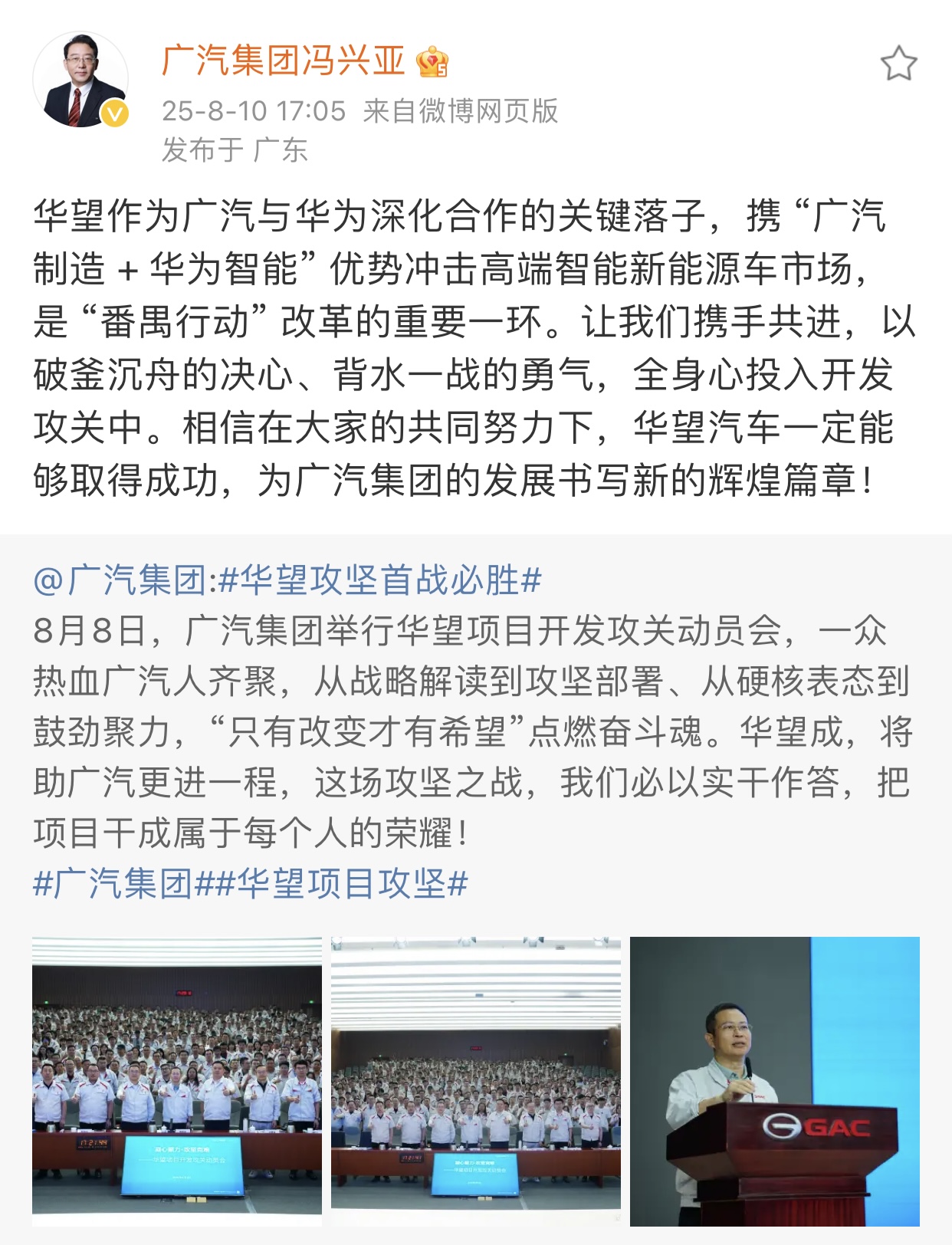
华望项目开发攻关动员会举行,广汽今年底发布全新品牌名称
Bei Ke Cai Jing· 2025-08-11 04:37
Core Viewpoint - GAC Group is investing 1.5 billion yuan to establish a new high-end smart car brand, Huawang Automotive, in collaboration with Huawei, focusing on luxury smart electric vehicles priced around 300,000 yuan. Group 1 - GAC Group announced the investment of 1.5 billion yuan to create Huawang Automotive, aiming to develop an independent high-end smart car brand in partnership with Huawei [5]. - The new brand's vehicles will feature Huawei's intelligent driving software, smart cockpit, and vehicle control solutions, with the first model targeting the luxury smart electric vehicle market [5]. - The brand construction work for Huawang Automotive is fully underway, with plans to officially unveil the brand name by the end of this year and the first model expected to launch by the end of 2026 [6].

广汽集团三款智能机器人亮相2025世界机器人大会计划2027年启动大规模量产
Xin Lang Cai Jing· 2025-08-11 03:04
Group 1 - GAC Group showcased its second-generation embodied intelligent robots, including GoMove, GoSide, and the third-generation humanoid robot GoMate, at the 2025 World Robot Conference [1] - GAC's embodied intelligent robots were recognized in Morgan Stanley's global top 100 humanoid robots list earlier this year [1] Group 2 - GAC has achieved independent design and manufacturing of core components for embodied intelligent robots, including drivers, motors, and dexterous hands, and has initiated demonstration applications in health care and security scenarios [2] - The GoMate robot, set to be released by the end of 2024, features an industry-first variable wheeled-foot configuration, allowing it to operate on both two wheels and four legs [2] - The self-developed driver for GoMate weighs only 40 grams and is 80% smaller than the industry average, while its dexterous hand integrates visual and tactile sensors for precise object handling [2] - The Ministry of Industry and Information Technology reported a 27.8% year-on-year revenue growth in the robotics industry in the first half of the year, with industrial and service robot production increasing by 35.6% and 25.5% respectively, marking 12 consecutive years as the world's largest market [2]

广汽集团三款智能机器人亮相2025世界机器人大会 计划2027年启动大规模量产
Zheng Quan Shi Bao Wang· 2025-08-11 02:05
Core Insights - GAC Group showcased its second-generation embodied intelligent robots at the 2025 World Robot Conference, highlighting applications in healthcare and security [1] - The company aims to establish a global demonstration zone for humanoid robots in Guangzhou by the end of 2023, with plans for commercial validation by 2026 and large-scale production by 2027 [1] - GAC's humanoid robot GoMate features innovative design elements, including a variable wheel-foot configuration that reduces energy consumption by over 80% compared to similar products [1] Company Developments - GAC has achieved self-design and manufacturing of key components for its embodied intelligent robots, including drivers, motors, and dexterous hands [1] - The GoMate robot weighs only 40 grams for its self-developed driver, with an 80% reduction in size compared to industry averages [2] - The robot integrates advanced technologies such as pure visual autonomous driving algorithms and AI perception capabilities, allowing for rapid response to complex commands [2] Industry Trends - The robotics industry experienced a revenue growth of 27.8% in the first half of the year, with industrial and service robot production increasing by 35.6% and 25.5% respectively [2] - China continues to be the largest industrial robot application market globally for 12 consecutive years [2]
广汽集团7月销售汽车11.95万辆,同比下降15.4%
Ju Chao Zi Xun· 2025-08-10 12:08
Core Insights - The automotive sales of GAC Group showed a significant decline in July, with total sales dropping by 15.4% year-on-year to 119,482 units, and cumulative sales for the first seven months down by 12.9% to 874,782 units [4] Group Summaries GAC Honda - GAC Honda's July sales were 28,039 units, a decrease of 34.99% year-on-year, with cumulative sales for the year at 193,301 units, down 15.15% [1] - The decline is attributed to shrinking demand for fuel vehicles and inventory adjustments, with July sales dropping to 16,033 units, a sharp decline of 51.81% [1] GAC Toyota - GAC Toyota reported July sales of 57,903 units, an increase of 12.74% year-on-year, making it the only segment with positive growth [2] - Cumulative sales reached 406,815 units, reflecting a growth of 4.04% compared to the previous year [2] GAC Trumpchi - GAC Trumpchi's sales in July were 23,414 units, down 28.94% year-on-year, with cumulative sales at 176,537 units, a decline of 22.08% [1][2] - The brand's performance continues to struggle, with a year-on-year decrease of 6.66% in July sales [1] GAC Aion - GAC Aion's July sales were 18,849 units, a decrease of 35.51% year-on-year, with cumulative sales for the year at 151,851 units, down 10.40% [1] - The decline is attributed to intensified competition in the A-class electric vehicle market and adjustments in pricing strategies [2] New Energy Vehicles - GAC Group's new energy vehicle sales in July were 31,485 units, a slight decrease of 9.76% year-on-year, with cumulative sales at 218,617 units, nearly flat with a decrease of 0.08% [1][2] - The new energy segment accounted for 28.0% of total passenger vehicle sales, with Aion contributing approximately 70% of new energy sales, although its growth rate lagged behind the industry average [2] Vehicle Categories - In July, sedan sales plummeted by 43.5% to 30,300 units, while MPV sales fell by 26.8% to 17,200 units [3] - Conversely, SUV sales increased by 12.1% to 71,700 units, driven by strong demand for models like the Toyota Highlander and Trumpchi GS8 [3] Overall Production and Sales - GAC Group produced 128,490 vehicles in July, a decrease of 18.06% year-on-year, with total production for the first seven months at 930,155 units, down 8.48% [1][4] - The overall automotive market is facing challenges, with significant declines in various segments impacting total sales figures [4]
乘联会小幅上调全年预期
Dong Zheng Qi Huo· 2025-08-10 07:43
1. Report Industry Investment Rating No relevant content provided. 2. Core Views of the Report - In the 31st week of 2025 (July 28 - August 3), domestic passenger car and new energy passenger car sales increased week - on - week. Passenger car retail sales were 465,000 units, a year - on - year increase of 2.8%; new energy passenger car retail sales were 247,000 units, a year - on - year increase of 10.4%, with a penetration rate of 53.1%. Since the beginning of the year, cumulative passenger car retail sales were 12.563 million units, a year - on - year increase of 7.0%; cumulative new energy passenger car retail sales were 6.407 million units, a year - on - year increase of 26.9%, with a cumulative penetration rate of 51.0% [2][110][118]. - The China Passenger Car Association slightly raised the full - year forecast for 2025. It is expected that passenger car retail sales will reach 24.35 million units, a 6% increase, with the forecast volume 300,000 units more than the June forecast; passenger car exports will be 5.46 million units, a 14% increase, with the forecast volume 160,000 units higher than the initial forecast; new energy passenger car wholesale will be 15.48 million units, a 27% increase, with the forecast volume slightly down from the June forecast, and the new energy wholesale penetration rate will reach 56%; automobile wholesale will be 34.04 million units, an 8% increase, with the forecast volume 5 percentage points higher than the initial forecast [2][108][118]. 3. Summary According to the Directory 3.1. Key Target Tracking - The report presents the weekly price changes of relevant sectors and listed companies. For example, among listed companies, Great Wall Motor (601633.SH) had a weekly increase of 3.00%, while BYD (002594.SZ) had a weekly decrease of 1.77% [16]. 3.2. Industrial Chain Data Tracking 3.2.1. China New Energy Vehicle Market Tracking - **Sales and Exports**: Charts show the sales (seasonal), penetration rate, domestic sales (seasonal), exports (seasonal), and sales of EV and PHV in the Chinese new energy vehicle market [17][22][24]. - **Inventory Changes**: Charts display the monthly new inventory of new energy passenger vehicle channels and manufacturers [26]. - **Delivery Volume of New Energy Vehicle Manufacturers**: Charts present the monthly delivery volumes of several new energy vehicle manufacturers such as Leapmotor, Li Auto, XPeng, etc. [29][33][35]. 3.2.2. Global and Overseas New Energy Vehicle Market Tracking - **Global Market**: Charts show the sales (by region), penetration rate, and sales of EV and PHV in the global new energy vehicle market [41][44]. - **European Market**: Charts present the sales, penetration rate, and sales of EV and PHV in the European new energy vehicle market, as well as the sales of EV and PHV in the UK, Germany, and France [46][49][50]. - **North American Market**: Charts show the sales, penetration rate, and sales of EV and PHV in the North American new energy vehicle market [59][60]. - **Other Regions**: Charts display the sales, penetration rate, and sales of EV and PHV in other regions, including Japan, South Korea, and Thailand [62][63][67]. 3.2.3. Power Battery Industry Chain - Charts show the power battery loading volume (by material), export volume (by material), weekly average price of battery cells, cell material cost, and the operating rates and prices of various battery materials such as ternary materials, precursors, lithium iron phosphate, etc. [78][82][83]. 3.2.4. Other Upstream Raw Materials - Charts present the daily prices of rubber, glass, steel, and aluminum [102][104]. 3.3. Hot News Summary 3.3.1. China: Policy Dynamics - The State Administration for Market Regulation plans to build a number of national carbon measurement centers by 2030, with priority given to the carbon measurement needs of key industries such as power batteries [108]. 3.3.2. China: Industry Dynamics - The China Passenger Car Association slightly raised the full - year forecast for 2025, including the increase in passenger car retail, exports, and automobile wholesale, and a slight decrease in new energy passenger car wholesale forecast [108]. - In July, the new energy wholesale sales were 1.18 million units, a year - on - year increase of 25%, and the cumulative wholesale from January to July was 7.63 million units, a year - on - year increase of 35% [109]. - From July 1 - 31, new energy retail sales increased by 14% year - on - year, and the cumulative retail sales since the beginning of the year increased by 30% year - on - year [110]. - From January to June, the domestic charging infrastructure increment was 3.282 million units, a year - on - year increase of 99.2%, and the vehicle - to - charging - pile increment ratio was 1.8:1 [111]. 3.3.3. China: Enterprise Dynamics - Sunwoda plans to list in Hong Kong and build a new production base in Vietnam with a total investment of no more than RMB 2 billion [113]. - Leapmotor's first batch of electric SUVs arrived in Brazil [114]. 3.3.4. Overseas: Policy Dynamics - Russia will allocate 5.7 billion rubles from 2025 - 2027 to develop electric vehicle charging infrastructure, aiming to have 28,000 DC charging stations with an output power over 149kW in operation by 2030 [114]. 3.3.5. Overseas: Industry Dynamics - In the UK, July passenger car sales decreased by 5.0% to 140,000 units, while pure - electric and plug - in hybrid vehicles increased by 9.1% and 33.0% respectively [115]. - In Germany, July passenger car sales increased by 11.1% to 265,000 units, with pure - electric and plug - in hybrid vehicles increasing by 58.0% and 83.6% respectively [116]. - In Brazil, July new car sales increased by 0.8% to 243,000 units, with pure - electric and plug - in hybrid vehicles increasing by 48.2% and 22.3% respectively [116]. 3.4. Industry Views - Similar to the core views, it emphasizes the sales situation in the 31st week of 2025 and the adjustment of the full - year forecast by the China Passenger Car Association [118]. 3.5. Investment Suggestions - The penetration rate of the Chinese new energy vehicle market exceeded 30% in 2023 and 50% since 2024. In 2025, high - competitiveness new car products continue to be launched, and price wars are gradually halted. Overseas, due to strong trade protectionism in Europe and the US, there are risks in exports. Attention should be paid to new growth points such as countries along the Belt and Road and the Middle East. In terms of the competitive landscape, domestic independent brands' market share continues to expand, and attention should be paid to companies with strong product capabilities, smooth overseas expansion, and stable supply [3][119].





广汽集团获融资买入0.16亿元,近三日累计买入0.56亿元
Jin Rong Jie· 2025-08-09 00:42
Group 1 - The core point of the article highlights the financing activities of GAC Group, indicating a net sell-off in recent trading days [1] - On August 8, GAC Group had a financing buy-in amount of 0.16 billion, ranking 956th in the two markets, with a financing repayment amount of 0.26 billion, resulting in a net sell of 10.23 million [1] - Over the last three trading days (August 6-8), GAC Group experienced financing buy-ins of 0.09 billion, 0.31 billion, and 0.16 billion respectively [1] Group 2 - In terms of securities lending, on August 8, there were no shares sold short, but there was a net buy of 0.07 thousand shares [1]
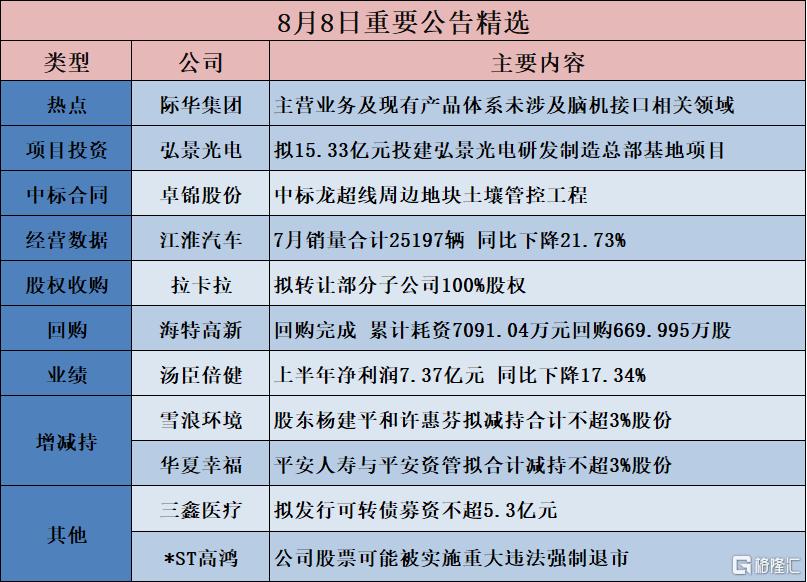
公告精选︱弘景光电:拟15.33亿元投建弘景光电研发制造总部基地项目;吉视传媒:不涉及“国资云”相关业务


Ge Long Hui· 2025-08-09 00:42
Company Announcements - Jihua Group's main business and existing product system do not involve brain-computer interface related fields [1] - Hongjing Optoelectronics plans to invest 1.533 billion yuan to build a research and manufacturing headquarters project [1] - Zhuojin Co., Ltd. won the bid for soil control project around Longchao Line [1] - Jianghuai Automobile's July sales totaled 25,197 units, a year-on-year decrease of 21.73% [1][2] - Lakala intends to transfer 100% equity of certain subsidiaries [1] - Haitai High-tech completed a buyback, spending a total of 70.91 million yuan to repurchase 6.69995 million shares [1] - Tongchen Beijian reported a net profit of 737 million yuan for the first half of the year, a year-on-year decrease of 17.34% [1][3] - Xuelang Environment's shareholders plan to reduce their holdings by a total of no more than 3% [1] - Huaxia Happiness's shareholders plan to reduce their holdings by a total of no more than 3% [1] - Sanxin Medical plans to issue convertible bonds to raise no more than 530 million yuan [1] - *ST Gaohong's stock may face mandatory delisting due to major legal violations [1] Investment and Financial Data - GAC Group's July automobile sales were 119,482 units, a year-on-year decrease of 15.38% [2] - Minghe Co., Ltd. reported July sales revenue of 41.36 million yuan [2] - Tangrenshen's July pig sales revenue totaled 589.6 million yuan [3] - Tiankang Biological's July pig sales revenue was 335 million yuan [3] - Chongqing Construction's new contract amount for the first half of the year was 24.271 billion yuan, a year-on-year decrease of approximately 19.20% [3] Shareholder Actions - Guangdong Hongda's subsidiary plans to acquire 60% equity of Changzhilin [3] - Ningbo Energy intends to acquire a total of 41% equity of Yongneng Comprehensive Energy [3] - Tianyang Technology plans to invest to acquire 51% equity of Moshuzhiqing [3] - ST Lutong's specific shareholders plan to reduce their holdings by a total of no more than 3.27% [3] - Jiuliang Co., Ltd.'s shareholders plan to reduce their holdings by a total of no more than 3% [3] - Ailis's employee stock ownership platform plans to reduce a total of no more than 13.5 million shares [3] - Huaxia Happiness's shareholders plan to reduce their holdings by a total of no more than 3% [3] Other Developments - Sanxin Medical plans to use the raised funds for the expansion project of producing 10 million blood dialysis membranes and 10 million blood dialysis devices [3]
广州汽车集团股份有限公司2025年7月份产销快报
Zheng Quan Ri Bao· 2025-08-08 22:41
Core Points - Guangzhou Automobile Group Co., Ltd. reported a significant decline in both production and sales for July 2025, with production down 18.06% year-on-year and sales down 15.38% year-on-year [1] - Cumulative production for the year reached 930,155 vehicles, reflecting an 8.48% decrease compared to the previous year, while cumulative sales totaled 874,782 vehicles, marking a 12.89% decline [1] Production and Sales Data - July 2025 production was recorded at 128,490 vehicles [1] - July 2025 sales amounted to 119,482 vehicles [1] - The data includes contributions from major investment enterprises, such as GAC Aion New Energy Commercial Vehicle Co., Ltd. and Hozon Auto Technology Co., Ltd. [1]
广汽集团7月汽车销量同比下降15.38%
Bei Jing Shang Bao· 2025-08-08 12:54
Group 1 - GAC Group reported a decline in July 2025 automobile sales, totaling 119,500 units, a year-on-year decrease of 15.38% [1] - Cumulative sales for the current year reached 874,800 units, reflecting a year-on-year decline of 12.89% [1] - The automobile production in July 2025 was 128,500 units, down 18.06% compared to the previous year [1] Group 2 - Cumulative production for the current year was 930,200 units, showing a year-on-year decrease of 8.48% [1]