AGRICULTURAL BANK OF CHINA(601288)

Search documents
银行股逆势走强成避风港
第一财经· 2025-11-13 01:07
Core Viewpoint - The banking sector has emerged as a "safe haven" amid market downturns, with significant gains driven by rising risk aversion, institutional fund inflows, and expectations of loose monetary policy [3][8]. Group 1: Banking Sector Performance - On November 12, the banking index rose by 0.46%, outperforming the Shanghai Composite Index, which fell by 0.07%, and the Shenzhen Component Index, which declined by 0.36% [3]. - Agricultural Bank of China led the sector with a 3.49% increase, reaching a market capitalization of over 3 trillion yuan, while other major state-owned banks also saw gains [5]. - The banking sector has accumulated an 8.73% increase in the fourth quarter up to November 12 [3]. Group 2: Fund Flows and Market Dynamics - The banking sector experienced a net inflow of 1.076 billion yuan, with Agricultural Bank, Ping An Bank, and Construction Bank attracting the most capital [6]. - The E Fund Bank ETF has seen a capital inflow of 567 million yuan over the past 22 trading days, indicating strong investor interest [6]. Group 3: Factors Driving Bank Stock Performance - Analysts attribute the banking sector's resilience to a combination of heightened risk aversion, long-term capital allocation, and expectations of monetary policy easing [8]. - The average dividend yield for the banking sector is approximately 6.5%, significantly higher than the 1.80% yield on 10-year government bonds, making it an attractive option for low-risk investors [8]. Group 4: Future Outlook for the Banking Sector - Institutions are optimistic about the banking sector's investment prospects, with expectations that high dividend strategies will continue to dominate the market [12]. - Analysts predict that the banking sector will remain a "ballast" in the market due to its stable dividends and low valuation characteristics, especially as economic conditions evolve [12]. - The ongoing structural adjustments in banking services towards technology, green finance, and pension finance are expected to enhance long-term growth potential and support valuation recovery [12].



数说“十四五”成绩单,看金融之笔如何绘出三农好“丰”景
2 1 Shi Ji Jing Ji Bao Dao· 2025-11-13 01:05
Core Insights - The article highlights the significant progress in China's agricultural sector during the "14th Five-Year Plan" period, emphasizing the role of financial support in enhancing agricultural productivity and rural development [4][5][32]. Group 1: Agricultural Production and Financial Support - China's grain production is expected to exceed 1.4 trillion jin (approximately 700 million tons) in 2024, marking a new milestone in agricultural output [4]. - The coverage rate of high-quality crop varieties has surpassed 96% during the "14th Five-Year Plan" period, indicating advancements in agricultural technology [5]. - Agricultural Bank of China has optimized its agricultural technology financial services, with a loan balance for grain and important agricultural products reaching 1.25 trillion yuan, growing at a rate of 25.1%, which is higher than the bank's average loan growth of 16.7% [5]. Group 2: Rural Development and Tourism - New business models such as rural tourism and e-commerce have emerged, with the national leisure agriculture revenue projected to approach 900 billion yuan in 2024 [7]. - The loan balance for rural construction reached 2.47 trillion yuan, with a growth rate of 9.7%, exceeding the bank's average loan growth by 1.3 percentage points [7]. Group 3: Technological Advancements in Agriculture - The contribution rate of technological progress in rural areas has reached 63.2%, with the comprehensive mechanization rate for crop farming exceeding 75% [11]. - The use of drones for agricultural tasks has modernized farming practices, enhancing efficiency in crop management [8][9]. Group 4: Income Growth and Financial Inclusion - Rural residents' per capita disposable income is projected to reach 17,522 yuan in 2024, reflecting a nearly 40% increase during the "14th Five-Year Plan" period [24]. - The Agricultural Bank's "惠农e贷" (Huinong e-loan) product has a balance of 1.83 trillion yuan, growing at 22.4%, indicating strong demand for financial products tailored to farmers [14]. Group 5: Financial Services Expansion - The coverage rate of township bank outlets has exceeded 98%, ensuring financial services are accessible in rural areas [17]. - The Agricultural Bank has established a comprehensive service system that includes physical outlets, self-service devices, mobile banking, and remote banking, extending financial services to remote regions [18]. Group 6: Poverty Alleviation and Support for Farmers - The bank has issued loans totaling 31.5 trillion yuan to support poverty alleviation efforts, with a loan balance of 2.52 trillion yuan in 832 poverty-stricken counties, growing at 10.66% [20]. - The financial support has significantly contributed to the development of local industries, such as the apple industry in Yan'an, which has seen substantial growth due to e-commerce [22][23].

数说“十四五”成绩单,看金融之笔如何绘出三农好“丰”景
21世纪经济报道· 2025-11-13 00:51
Core Viewpoint - The article emphasizes the significant progress in rural revitalization and agricultural development during the "14th Five-Year Plan" period, highlighting the role of financial support, particularly from Agricultural Bank of China, in enhancing agricultural productivity and rural living standards [4][5][18]. Group 1: Agricultural Production and Financial Support - During the "14th Five-Year Plan" period, China's grain production is expected to exceed 1.4 trillion jin (approximately 700 million tons) in 2024 [4]. - The coverage rate of quality crop varieties in China surpassed 96% during this period, supported by improved financial services from Agricultural Bank of China [5]. - As of September 2025, the balance of loans for food security and important agricultural products reached 1.25 trillion yuan, with a growth rate of 25.1%, significantly higher than the average loan growth rate of the bank [5][6]. Group 2: Rural Tourism and New Business Models - New business models such as rural tourism and e-commerce have emerged, with the national income from leisure agriculture expected to approach 900 million yuan in 2024 [7]. - The balance of loans for rural construction reached 2.47 trillion yuan as of September 2025, with a growth rate of 9.7%, also exceeding the bank's average loan growth rate [7]. Group 3: Technological Advancements in Agriculture - The contribution rate of technological progress in rural areas reached 63.2% during the "14th Five-Year Plan" period, with the comprehensive mechanization rate of crop farming exceeding 70% [10]. - Agricultural Bank's "Flying Hand Loan" product has facilitated the purchase of drones for agricultural applications, enhancing efficiency in crop management [9]. Group 4: Income Growth and Financial Inclusion - Rural residents' per capita disposable income is projected to reach 17,522 yuan in 2024, reflecting a nearly 40% increase during the "14th Five-Year Plan" period [23]. - The balance of loans for rural industries reached 2.74 trillion yuan as of September 2025, with a growth rate of 22.8%, surpassing the bank's average loan growth rate [23]. Group 5: Financial Services Expansion - Financial services coverage in rural areas has expanded significantly, with over 98% of town banks having service points [14][15]. - Agricultural Bank has established a comprehensive service system that includes physical branches, self-service devices, mobile banking, and rural financial service points, ensuring accessibility for farmers [16]. Group 6: Poverty Alleviation and Support for Farmers - The bank has issued loans totaling 3.15 trillion yuan to poverty-stricken areas, with nearly 400 billion yuan in small loans to impoverished populations [18]. - As of September 2025, the loan balance for 832 poverty-stricken counties reached 2.52 trillion yuan, with a growth rate of 10.66%, indicating effective support for poverty alleviation and rural revitalization [18].

农行A股总市值突破3万亿元; 中国支付清算协会:杜绝默认开通“免密支付” | 金融早参
Mei Ri Jing Ji Xin Wen· 2025-11-13 00:30
Group 1 - The People's Bank of China emphasizes the need for continuous deepening of financial supply-side structural reforms and steady advancement of high-level financial openness to maintain national financial security and contribute to the goals set for the 14th Five-Year Plan [1] Group 2 - The China Payment and Clearing Association calls for the elimination of default activation of "no-password payment" services, urging payment service providers to enhance security management and ensure user consent [2] Group 3 - Agricultural Bank of China's A-shares have surged over 3%, with a total market capitalization exceeding 3 trillion yuan, marking a 68% increase year-to-date and establishing it as the new market leader [3] Group 4 - The implementation of unified reporting and pricing for non-auto insurance has begun, with several insurance companies forming specialized teams to assess and upgrade their non-auto insurance products and systems to comply with regulatory requirements [4]
多家银行上调积存金起点
2 1 Shi Ji Jing Ji Bao Dao· 2025-11-13 00:24
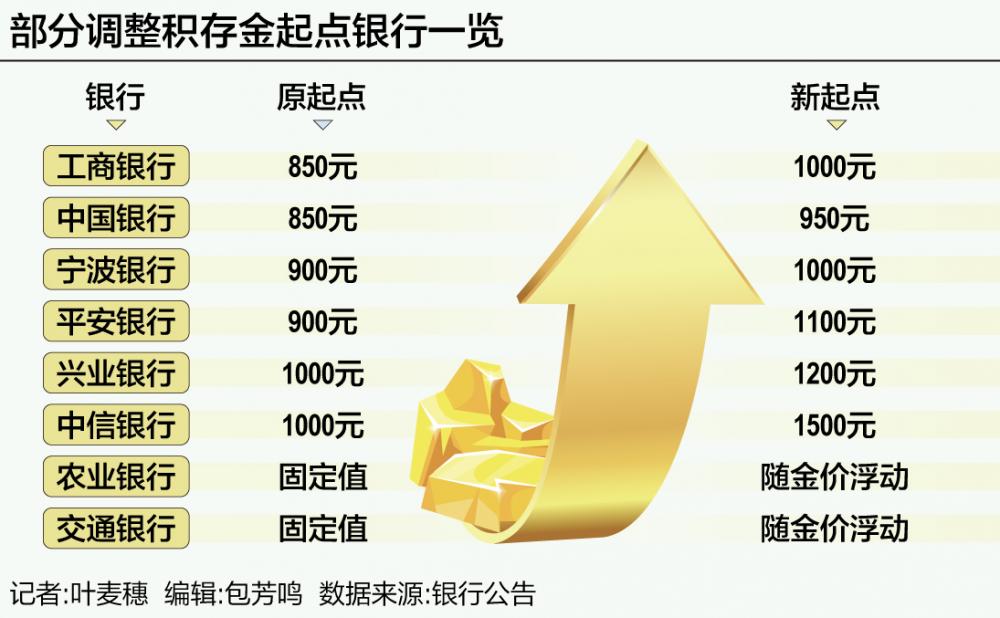
Core Viewpoint - The international gold price has returned to $4100 per ounce, prompting banks to raise the minimum investment threshold for gold accumulation, with some banks adjusting the starting point to a historical high of 1500 yuan [1][3]. Summary by Sections Bank Adjustments - Several banks have raised their gold accumulation thresholds, with notable changes including: - ICBC from 850 yuan to 1000 yuan - Bank of China from 850 yuan to 950 yuan - Ningbo Bank from 900 yuan to 1000 yuan - Ping An Bank from 900 yuan to 1100 yuan - Industrial Bank from 1000 yuan to 1200 yuan - CITIC Bank from 1000 yuan to 1500 yuan - Agricultural Bank and Bank of Communications have switched to a "floating with gold price" mechanism [2][3]. Investment Mechanism Changes - Some banks, like Agricultural Bank and Bank of Communications, have implemented a "floating with gold price" mechanism to avoid frequent adjustments, allowing the minimum investment amount to vary with market prices [4][5]. - This approach aims to provide flexibility for investors and better align with market dynamics [4]. Market Analysis - The gold price has seen significant volatility, with a rise of over 60% this year, peaking above $4300 per ounce before experiencing a sharp decline [6][7]. - Analysts have differing views on future gold prices, with predictions ranging from $3650 to $5000 per ounce by the end of 2026, influenced by various economic factors [7][8]. - The outlook remains optimistic for gold due to factors such as a weakening dollar and inflation risks, which could sustain investment demand [7][8]. Risk Awareness - In response to the volatile gold market, banks and regulatory bodies have increased risk awareness efforts, advising investors to recognize the inherent risks in precious metal investments [5].



财经早报:AI泡沫担忧从美股蔓延至美国债市 银行ETF吸金60亿丨2025年11月13日
Xin Lang Zheng Quan· 2025-11-13 00:14
Group 1 - The photovoltaic industry faced significant market turbulence due to rumors about a high-level executive from JA Solar stating that a storage platform had failed, which led to a sharp decline in stock prices within the sector [2][15] - The China Photovoltaic Industry Association issued a statement refuting these rumors, emphasizing that the industry is making steady progress and warning against misinformation that could harm the sector's reputation [2][15] Group 2 - The banking sector has shown a remarkable recovery in the fourth quarter, with the Shenwan Banking Index rising nearly 9%, significantly outperforming the broader market [4] - Agricultural Bank of China and Industrial and Commercial Bank of China reached historical highs in their stock prices, with Agricultural Bank's market capitalization surpassing 3 trillion yuan [4] - Over 60 billion yuan flowed into bank-related ETFs in the fourth quarter, indicating a shift in market sentiment towards the banking sector [4][5] Group 3 - AMD's CEO expressed optimism about the AI market, predicting that the total addressable market for AI data centers will exceed 1 trillion dollars by 2030, with a compound annual growth rate of over 40% [6] - AMD aims to capture a double-digit market share in the AI data center chip market, with expected annual revenue from this segment reaching 100 billion dollars within five years [6] Group 4 - Concerns about an AI investment bubble have spread from the stock market to the bond market, with corporate bonds facing sell-offs and widening yield spreads compared to U.S. Treasuries [7] - The market is increasingly wary of the financial implications of large tech companies seeking funding through public debt markets amid fears of an AI bubble [7] Group 5 - The third-quarter monetary policy report from the central bank highlighted the need for balanced macroeconomic policies to support growth while managing risks, with an emphasis on maintaining a stable economic environment [9] - Experts believe that the central bank will implement moderately accommodative monetary policies to achieve the annual growth target of around 5% [9] Group 6 - The Chinese M&A market has seen a significant increase in technology-related mergers, with a 287% year-on-year growth in tech acquisitions since the introduction of new regulations [10] - Traditional industries are also pursuing mergers to adapt and seek new growth avenues, indicating a trend towards consolidation in various sectors [10] Group 7 - OPEC's latest report suggests a potential oversupply in the oil market by 2026, a significant shift from previous forecasts that anticipated prolonged supply shortages [11] - This change in outlook has led to a sharp decline in oil prices, with Brent crude futures dropping nearly 4% following the report [11]



农行总市值近3万亿坐稳A股一哥 股价迭创新高418亿分红将落地
Chang Jiang Shang Bao· 2025-11-12 23:36
Core Viewpoint - Agricultural Bank of China has seen a significant increase in its stock price, reaching historical highs in both A-shares and H-shares, driven by strong fundamentals and leading performance among state-owned banks [2][3][5]. Stock Performance - As of November 12, 2025, Agricultural Bank's A-share price reached 8.64 CNY, marking a 68% increase year-to-date, while H-shares peaked at 6.4 HKD, reflecting a 48% increase [3][4]. - The A-share closed at 8.59 CNY with a trading volume of 512.59 million shares and a total turnover of 4.368 billion CNY on the same day [3]. Market Capitalization - Agricultural Bank's total market capitalization stands at 2.92 trillion CNY, making it the highest among A-share listed companies [4]. - The bank's A-share market capitalization is 2.74 trillion CNY, while its H-share market capitalization is approximately 194.58 billion HKD [4]. Financial Performance - For the first three quarters of 2025, Agricultural Bank reported operating income of 550.88 billion CNY, a year-on-year increase of 1.97%, and a net profit attributable to shareholders of 220.86 billion CNY, up 3.03% [6][7]. - The bank's total assets reached 48.14 trillion CNY, with a year-on-year growth of 11.33% [7]. Loan and Deposit Growth - As of September 30, 2025, the total amount of loans and advances was 26.99 trillion CNY, increasing by 8.36% from the previous year, while total deposits reached 32.07 trillion CNY, up 5.82% [7]. - In the rural finance sector, loans and advances amounted to 10.9 trillion CNY, reflecting a growth of 10.57% [7]. Asset Quality - The non-performing loan (NPL) ratio improved to 1.27%, a decrease of 0.03 percentage points from the end of the previous year [7]. - The bank's provision coverage ratio stands at 295.08%, down 4.53 percentage points from the previous year [7]. Dividend Distribution - Agricultural Bank plans to distribute a cash dividend of 0.1195 CNY per share, totaling approximately 41.82 billion CNY, which represents 29.98% of the net profit for the first half of 2025 [8].
资金涌向银行股 “大象”再起舞
Zhong Guo Zheng Quan Bao· 2025-11-12 22:00
Core Viewpoint - The banking sector is experiencing a significant rally, with major banks like Agricultural Bank of China and Industrial and Commercial Bank of China reaching historical highs, driven by a shift in market sentiment and increased capital inflow into the sector [1][2][3] Group 1: Market Performance - On November 12, 42 bank stocks in A-shares mostly rose, with Agricultural Bank leading the gains at 3.49%, boosting its price-to-book ratio to 1.1, the highest among A-share listed banks [2] - The banking sector has seen a net inflow of over 300 million yuan in the last five trading days, ranking first among 36 secondary industry sectors [2] Group 2: Fundamental Factors - Agricultural Bank's strong performance is attributed to its solid fundamentals, including deep penetration in county-level finance, good asset quality, and strong risk compensation and profit reinvestment capabilities [2][3] - The low volatility and stable dividend characteristics of bank stocks have made them attractive to long-term investors in a low-interest-rate environment [3] Group 3: Institutional Activity - Recent reports indicate that several bank executives and major shareholders are actively increasing their stakes, signaling confidence in long-term investment value [4] - Institutional investors are intensively researching the banking sector, with a focus on high-quality regional banks that exhibit strong asset quality and regional economic resilience [4]
资金涌向银行股“大象”再起舞
Zhong Guo Zheng Quan Bao· 2025-11-12 20:18
Core Viewpoint - The banking sector is experiencing a significant rally, with Agricultural Bank of China and Industrial and Commercial Bank of China reaching historical highs, driven by a shift in market style and increased capital inflow into the banking sector [1][2]. Group 1: Market Performance - On November 12, 42 banking stocks in A-shares mostly rose, with Agricultural Bank leading the sector with a 3.49% increase, boosting its price-to-book ratio to 1.1, the highest among A-share listed banks [1]. - The banking sector has seen a net inflow of over 300 million yuan in the past five trading days, ranking first among 36 Wind secondary industry sectors [2]. Group 2: Fundamental and Technical Factors - The strong performance of Agricultural Bank is attributed to its solid fundamentals, including deep penetration in county-level finance, strong asset quality, and robust risk absorption and profit reinvestment capabilities [2][3]. - The low volatility and stable dividends of bank stocks have made them attractive to long-term funds in a low-interest-rate environment, contributing to the recent capital shift towards the banking sector [2]. Group 3: Institutional Activity - Recent reports indicate a decrease in public fund holdings in bank stocks, creating a replenishment opportunity for underweight sectors, with banks expected to benefit from this trend [3]. - Several bank executives and major shareholders have disclosed plans to increase their holdings, signaling confidence in the long-term investment value of bank stocks [3].
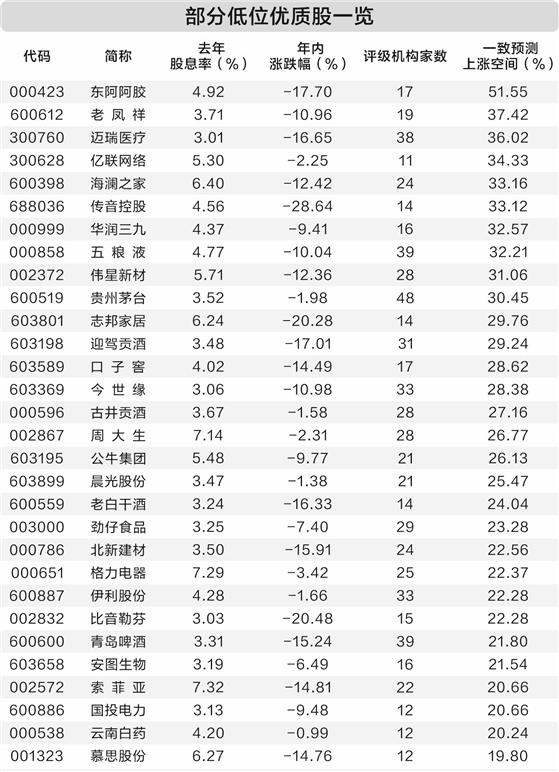
红利板块持续走强 机构关注46只低位优质股
Zheng Quan Shi Bao· 2025-11-12 18:40
Core Viewpoint - The A-share market is showing a clear preference for dividend stocks, with significant price increases in major companies like China Petroleum and Agricultural Bank, indicating a strong trend towards dividend-paying stocks [2][3][4]. Group 1: Dividend Stock Performance - The dividend sector, including oil, banking, and coal, has outperformed other sectors since November, with notable gains in the index [2][4]. - Agricultural Bank's A-shares reached a historical high of 8.65 yuan per share, while its H-shares also saw a significant increase, reflecting strong investor interest [3]. - Major weight stocks like China Petroleum have shown significant price movements, contributing to the overall rise in the dividend sector [4]. Group 2: Institutional Interest in Low-Valued Dividend Stocks - Analysts suggest focusing on low-valued dividend stocks with stable dividend expectations, with 46 stocks meeting criteria such as a dividend yield over 3% and a decline in stock price this year [5]. - Stocks with the highest dividend yields include Fuanna at over 8%, and others like Sophia, Gree Electric, and Zhou Dasheng with yields exceeding 7% [5]. - Guizhou Moutai has the highest institutional ratings, with 48 institutions covering it, followed by Wuliangye and Qingdao Beer, each with over 30 ratings [5]. Group 3: Future Dividend Expectations - Guizhou Moutai plans to distribute cash dividends amounting to at least 75% of its net profit annually from 2024 to 2026, with distributions occurring twice a year [6]. - Ganyuan Food has announced a similar plan, committing to distribute at least 70% of its distributable profits annually, contingent on certain conditions [6]. Group 4: Heavy Holdings by Social Security and Insurance Funds - Among the 46 stocks, 10 have a projected price increase potential exceeding 30%, including Dong'e Ejiao and Maijie Medical [7]. - Eleven stocks have received significant attention from social security and insurance funds, with Wei Xing's holdings exceeding 8% and others like Anji Food and Chuanxin Beer over 3% [7].