
AGRICULTURAL BANK OF CHINA(601288)

Search documents
农行股价再创新高
第一财经· 2025-10-28 02:17
Core Viewpoint - Agricultural Bank of China has reached a new historical high with a stock price of 8.29 CNY per share, pushing its total market capitalization close to 3 trillion CNY [1]. Group 1: Stock Performance - Agricultural Bank of China saw an increase of over 1% in its stock price, marking a significant milestone [1]. - Other banks such as Xiamen Bank, Chongqing Bank, Postal Savings Bank, and Industrial and Commercial Bank also experienced upward movement in their stock prices [2]. - The following are the current prices and percentage changes for selected banks: - Xiamen Bank: 6.91 CNY, up 1.92% - Chongqing Bank: 10.63 CNY, up 1.72% - Agricultural Bank: 8.28 CNY, up 1.22% - Qilu Bank: 6.10 CNY, up 0.66% - Qingdao Bank: 5.24 CNY, up 0.38% - Zijin Bank: 2.93 CNY, up 0.34% - Postal Savings Bank: 6.03 CNY, up 0.33% - Industrial and Commercial Bank: 7.92 CNY, up 0.13% - Changsha Bank: 9.54 CNY, up 0.10% [3].


金融作笔 逐“绿”不辍
Jin Rong Shi Bao· 2025-10-28 02:08
Group 1: Green Finance Development - The People's Bank of China (PBOC) in Heyuan has been actively promoting green finance to support the local economy, with green loan balances expected to grow by 21.77% and 21.99% year-on-year by the end of 2023 and 2024 respectively [1] - As of mid-2023, the green loan balance in Heyuan reached 11.581 billion yuan, marking a year-on-year increase of 42.65%, significantly outpacing the overall loan growth rate by 40.99 percentage points [1] - The PBOC has established a comprehensive monitoring mechanism for green credit, implementing monthly monitoring, quarterly reporting, and annual evaluations to ensure banks fulfill their responsibilities in green development [3] Group 2: Renewable Energy Projects - A blueberry farm in Dongyuan County has integrated photovoltaic panels to generate over 100 million kilowatt-hours of clean energy annually, showcasing a successful model of combining agriculture with renewable energy [2] - The project has effectively reduced coal consumption and emissions of pollutants, while also alleviating local electricity shortages, supported by a loan of 138 million yuan from the PBOC [2] Group 3: Support for Traditional Industries - The PBOC is exploring financial solutions tailored to the needs of traditional industries undergoing low-carbon transitions, with several innovative green credit products being introduced [6] - A smart rice farm in Heyuan has benefited from the "Win-Win Plan + Transformation Finance" initiative, receiving a 5 million yuan credit line and a 1 million yuan low-carbon transformation loan to support sustainable agricultural practices [7] Group 4: Geographic Indication and Intellectual Property - The PBOC is focusing on geographic indications as a key area for enhancing financial support, establishing mechanisms for seamless project and funding connections with various government departments [5] - The establishment of "green branches" in local banks aims to support industries related to geographic indications, with loans of 167 million yuan and 4.469 million yuan allocated to specific agricultural products [4]


银行股走势分化,农业银行涨超1%再创历史新高
Mei Ri Jing Ji Xin Wen· 2025-10-28 02:07
Core Insights - The performance of bank stocks is showing divergence, with Agricultural Bank of China rising over 1% to reach a new historical high, approaching a total market value of 3 trillion yuan [1] - Postal Savings Bank and Industrial and Commercial Bank also saw gains, while Shanghai Pudong Development Bank experienced a significant drop of over 4% [1] Group 1 - Agricultural Bank of China has achieved a new historical high, with its market value nearing 3 trillion yuan [1] - Postal Savings Bank and Industrial and Commercial Bank are following the upward trend in bank stocks [1] - Shanghai Pudong Development Bank's stock has declined sharply, falling over 4% [1]
A股震荡走高,农业银行总市值逼近3万亿大关,中际旭创续创新高,国债大涨,人民币中间价创近一年高位
Hua Er Jie Jian Wen· 2025-10-28 02:04
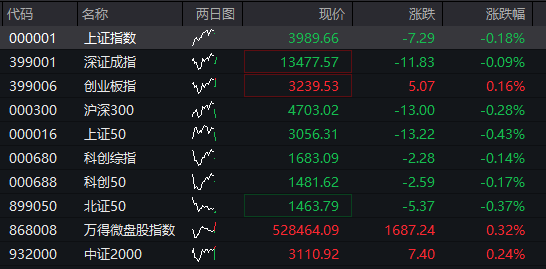
Market Overview - A-shares opened lower with the three major indices experiencing fluctuations and declines, particularly in technology stocks, storage chips, and copper-clad laminate concepts [1][12] - The Hang Seng Index opened higher but turned negative, with mixed performance in tech stocks and declines in Apple-related stocks [2][3] - The bond market saw a collective rebound in government bond futures, with the 30-year main contract rising by 0.56% [3][4] A-shares Performance - As of the report, the Shanghai Composite Index fell by 0.18% to 3989.66, while the Shenzhen Component Index decreased by 0.09% to 13477.57, and the ChiNext Index rose by 0.16% to 3239.53 [1][12] - The technology sector faced a general pullback, with significant declines in storage chips and copper-clad laminate concepts, and a notable drop of nearly 6% in Shenghong Technology post-earnings [12][13] Hong Kong Market Performance - The Hang Seng Index decreased by 0.30% to 26353.17, and the Hang Seng Tech Index fell by 0.42% to 6145.14 [2][3] - The performance of Chinese tech stocks was mixed, with some stocks like Xiaopeng Motors rising over 4% [16] Commodity Market - Domestic commodity futures mostly rose, with polysilicon and lithium carbonate increasing by over 2%, while other commodities like rapeseed, glass, and iron ore also saw gains [4][5] - Precious metals experienced declines, with gold and silver dropping over 2% [5][16] CPO Concept Stocks - CPO concept stocks showed a rebound, with Zhongji Xuchuang rising nearly 4% to reach a historical high, and Lian Te Technology increasing by over 10% [6][7] Banking Sector - The banking sector exhibited mixed trends, with Agricultural Bank of China rising over 1% to approach a market capitalization of 3 trillion, while other banks like Shanghai Pudong Development Bank fell over 4% [8][9] Robotics and Software Concepts - Robotics stocks surged, with Nanjing Julong increasing over 12%, while the domestic software sector saw stocks like Rongji Software hitting the daily limit [10][12]

百余家收粮大户获贷1.4亿元
Jin Rong Shi Bao· 2025-10-28 02:03
Core Insights - Agricultural Bank of China (ABC) has introduced a specialized loan product, "Grain Purchase Large Household Loan," to support grain purchase during the autumn harvest season, with a maximum credit limit of 5 million yuan, significantly higher than similar products from previous years [1][2] - The bank has implemented an efficient mechanism for loan approval, allowing for rapid response and processing, completing the loan approval and disbursement for a client in less than three days [1] - ABC has already disbursed over 140 million yuan in loans to more than 100 grain purchasing households in the Handan region, ensuring timely financial support for the autumn grain collection [2] Group 1 - The loan product "Grain Purchase Large Household Loan" has a maximum credit limit of 5 million yuan, which is a significant increase compared to previous years [1] - The bank has established a "frontline investigation + backend approval" mechanism to enhance efficiency in loan processing [1] - The rapid response mechanism allows for same-day investigation and approval, facilitating quick access to funds for farmers [1] Group 2 - The timely financial support has enabled farmers to invest in necessary equipment, such as drying machines, improving their operational efficiency [2] - The bank's financial services are crucial for mitigating risks associated with adverse weather conditions affecting the autumn harvest [1][2] - The successful disbursement of loans reflects the bank's commitment to supporting local agricultural development and ensuring food security [2]
守护千家万户“米袋子”
Jin Rong Shi Bao· 2025-10-28 02:03
Core Insights - Agricultural Bank of China (ABC) in Liaoning Province is actively supporting the autumn harvest through comprehensive financial services, enhancing food security in the country [1][2] - The bank has conducted over 320 "Three Rural Financial Lectures," providing detailed explanations of products like "Huinong e-loan" and "Agricultural Machinery Installment," resulting in a loan issuance of 2.38 billion yuan benefiting 13,000 farmers [1] - The bank's timely financial assistance has significantly improved operational efficiency for farmers and grain companies, with loans addressing urgent funding needs during critical periods [1] Group 1 - ABC has organized over 2,000 "Three Rural Financial Lectures," issuing loans totaling 1.92 billion yuan, benefiting 22,700 farmers [2] - The loan balance for key grain sectors has exceeded 7 billion yuan, with a net increase of nearly 3 billion yuan since the beginning of the year, including over 3.5 billion yuan for autumn grain purchasing [2] Group 2 - Specific case studies highlight the impact of ABC's financial products, such as a 300,000 yuan "Huinong (Agricultural Machinery) Installment" loan that improved harvesting efficiency for a major grain grower [1] - The bank's quick response to urgent funding requests, such as a one-day approval for an irrigation machine loan, demonstrates its commitment to supporting farmers in crisis situations [1]
未来五年怎么走?政策性银行、国有大行集体发声,擘画“十五五”工作重点
Xin Lang Cai Jing· 2025-10-28 01:21
Core Viewpoint - The financial regulatory bodies in China are focusing on risk prevention and enhancing financial services to support the real economy, as outlined in the spirit of the 20th National Congress of the Communist Party of China [1][2][4]. Financial Regulatory Focus - The central bank and financial regulatory authorities emphasize the importance of risk prevention and the establishment of a comprehensive financial risk management system [2][4]. - The next phase of work will prioritize enhancing financial services for the real economy, particularly in areas such as technology innovation, consumption stimulation, and support for small and micro enterprises [1][2][4]. Key Work Areas - The People's Bank of China (PBOC) has identified five key areas for future work: maintaining centralized leadership in financial work, developing a robust monetary policy framework, enhancing macro-prudential management, deepening supply-side structural reforms, and promoting high-level financial openness [2][3][4]. - Financial institutions are encouraged to align their strategies with national goals, focusing on the "Five Major Articles" to improve financial service quality and adaptability [4][5]. Progress in Financial Services - As of Q3 2025, the balance of inclusive small and micro loans reached 36.09 trillion yuan, with a year-on-year growth of 12.2%, outpacing overall loan growth by 5.6 percentage points [8]. - Green loans also saw significant growth, with a balance of 43.51 trillion yuan, reflecting a 17.5% increase since the beginning of the year [8][9]. Institutional Responses - Major state-owned banks and policy banks are actively implementing strategies to support national priorities, including food security, rural development, and ecological sustainability [5][6][7]. - Insurance companies are also aligning their strategies with the national agenda, focusing on enhancing support for technology innovation and green development [6][7]. Digital Transformation and Innovation - Banks are increasingly adopting digital transformation and AI applications to improve service efficiency across various functions, including credit assessment and customer service [10]. - The banking sector is also focusing on developing pension financial products to cater to the aging population, with initiatives aimed at enhancing the pension service system [10].




数字化转型核心载体:存量时代手机银行APP的经营之策
艾瑞咨询· 2025-10-28 00:04
Core Insights - The article emphasizes the critical role of mobile banking apps in the digital transformation of commercial banks, highlighting their function as the main platform for financial services and user engagement in the digital economy [1][6] Group 1: Market Trends - The mobile banking app market in China has transitioned from a high-growth phase to a more refined operational stage, with active users stabilizing around 700 million, leading to a focus on user retention and value extraction rather than mere user acquisition [1][6] - The competition among banks has shifted from "land grabbing" to "fine-tuning" user engagement and operational efficiency, making the ability to leverage existing user bases for deeper engagement a key differentiator [1][6] Group 2: Agricultural Bank's Strategy - Agricultural Bank of China (ABC) has positioned its mobile banking app as a core component of its online operational framework, achieving the highest average monthly unique device count of 252.4 million in Q3 2025, reflecting its strong market presence [2][3] - ABC's stock performance has been positively impacted by its digital transformation efforts, with its share price reaching a peak in October 2025, indicating investor confidence in its operational capabilities and growth potential [2] Group 3: Operational Strategies - ABC employs a "one app strategy" to create a unified platform that integrates financial services, user needs, and technological capabilities, avoiding the pitfalls of fragmented service delivery [4] - The bank focuses on a user-centric approach, offering tailored services for diverse customer segments, including elderly users and minority groups, through a comprehensive service lifecycle management system [4][5] - ABC has developed a "one-stop" smart scene ecosystem that combines financial services with everyday life scenarios, enhancing user experience and engagement [5] Group 4: Technological Investment - ABC invests heavily in financial technology, utilizing AI, big data, and cloud computing to enhance service efficiency and security, thereby improving customer engagement and operational performance [5][6] - The bank's data-driven approach allows for personalized service offerings, significantly improving service conversion rates and customer satisfaction [5][6] Group 5: Future Outlook - The mobile banking app is expected to continue leading innovation in financial services, driven by accelerated ecosystem integration, deepened technological empowerment, and refined user management strategies [6][7]

下阶段金融工作“路线图”,明确六大工作重点
2 1 Shi Ji Jing Ji Bao Dao· 2025-10-27 23:15
Group 1: Monetary Policy - The report emphasizes the implementation of a moderately loose monetary policy to create a suitable financial environment for economic recovery [2][3] - The People's Bank of China (PBOC) has injected liquidity into the banking system, with a recent announcement of 900 billion yuan in medium-term lending facility (MLF) operations [2][3] - The PBOC aims to maintain ample liquidity and support government bond issuance and bank credit [2][3] Group 2: Financial Regulation - The report highlights the need to strengthen and improve financial regulation to enhance regulatory quality and effectiveness [4][5] - Major banks have adopted a common principle of "preventing risks, strengthening regulation, and promoting high-quality development" [5] - A multi-layered risk control network is being established within the banking system to ensure compliance and risk management [4][5] Group 3: Support for the Real Economy - The report stresses the importance of providing high-quality financial services to support the real economy and continuing structural reforms in financial supply [6][7] - From November 2024 to September 2025, A-shares saw 98 companies go public, raising 91.8 billion yuan, with 86% being private enterprises [6] - Major banks are committed to enhancing financial services for the real economy, focusing on sectors like advanced manufacturing and rural finance [6][7] Group 4: Risk Prevention - The report emphasizes the need to prevent and mitigate financial risks in key areas while maintaining systemic financial stability [8][9] - Banks are focusing on balancing development and safety, with a commitment to comprehensive risk management [9] - The banking sector has seen a reduction in the number of institutions and an improvement in asset quality, with non-performing loan ratios decreasing to 1.49% [9] Group 5: Financial Opening - Banks are actively pursuing international competitiveness and enhancing global service capabilities [10] - The China Bank aims to support the internationalization of the yuan and contribute to the Belt and Road Initiative [10] - Major banks are emphasizing the importance of both "going out" and "bringing in" in their strategies for high-level financial openness [10]
中国农业银行股份有限公司优先股一期2024-2025年度股息发放实施公告
Shang Hai Zheng Quan Bao· 2025-10-27 23:15
Core Viewpoint - The announcement details the dividend distribution plan for the first phase of Agricultural Bank of China’s preferred shares for the fiscal year 2024-2025, which has been approved by the board of directors [2][7]. Dividend Distribution Plan - The dividend amount is calculated at a coupon rate of 4.12%, resulting in a cash dividend of RMB 4.12 per share (including tax), totaling RMB 1.648 billion (including tax) [2][3]. - The eligible recipients for the dividend are all holders of the preferred shares registered with the China Securities Depository and Clearing Corporation Limited Shanghai Branch as of the close of trading on November 4, 2025 [2]. Taxation Details - For resident corporate shareholders, the cash dividend is RMB 4.12 per share before tax, with the tax to be paid by the shareholders themselves [3]. - For Qualified Foreign Institutional Investors (QFII), a withholding tax of 10% will be applied, resulting in a net cash dividend of RMB 3.708 per share [3]. - Other shareholders will follow relevant regulations for tax payment on cash dividends [4]. Key Dates for Dividend Distribution - Last trading day: November 3, 2025 - Equity registration date: November 4, 2025 - Ex-dividend date: November 4, 2025 - Dividend payment date: November 5, 2025 [6]. Dividend Payment Method - The dividends will be distributed directly by the Agricultural Bank of China to all holders of the preferred shares [7].