AGRICULTURAL BANK OF CHINA(601288)

Search documents
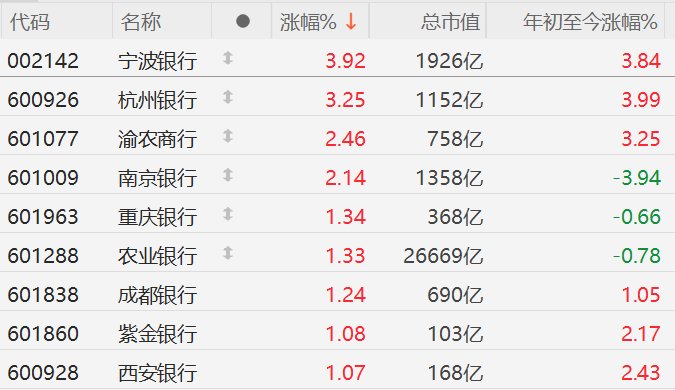
A股银行股普涨,宁波银行、杭州银行涨超3%
Ge Long Hui A P P· 2026-01-13 03:43
Group 1 - The A-share market saw a general rise in bank stocks, with notable increases in Ningbo Bank and Hangzhou Bank, both rising over 3% [1] - Other banks such as Chongqing Bank, Agricultural Bank, and Xian Bank also experienced gains of over 1% [1] Group 2 - Ningbo Bank's stock increased by 3.92%, with a total market capitalization of 192.6 billion [2] - Hangzhou Bank's stock rose by 3.25%, with a market cap of 115.2 billion [2] - Chongqing Bank and Agricultural Bank saw increases of 1.34% and 1.33% respectively, with market caps of 36.8 billion and 26,669 billion [2] - The year-to-date performance shows that Ningbo Bank and Hangzhou Bank have increased by 3.84% and 3.99% respectively, while Nanjing Bank has decreased by 3.94% [2]






银行股普涨,宁波银行、杭州银行涨超3%
Ge Long Hui· 2026-01-13 03:41
Core Viewpoint - The A-share market saw a significant increase in bank stocks on January 13, with notable gains from several banks, indicating a positive trend in the banking sector [1]. Group 1: Stock Performance - Ningbo Bank (002142) experienced a rise of 3.92%, with a total market capitalization of 192.6 billion [2]. - Hangzhou Bank (600926) increased by 3.25%, with a market cap of 115.2 billion [2]. - Chongqing Rural Commercial Bank (601077) saw a gain of 2.46%, with a market value of 75.8 billion [2]. - Nanjing Bank (601009) rose by 2.14%, but has a year-to-date decline of 3.94%, with a market cap of 135.8 billion [2]. - Agricultural Bank of China (601288) increased by 1.33%, with a substantial market capitalization of 2,666.9 billion [2]. - Other banks such as Chengdu Bank (601838), Zijin Bank (601860), and Xi'an Bank (600928) also reported gains of 1.24%, 1.08%, and 1.07% respectively [2].
创新抵押破困局 金融赋能龙头兴——农行锡林郭勒分行助力农牧业龙头企业领跑产业升级
Xin Lang Cai Jing· 2026-01-13 02:14
Core Viewpoint - The development of Xilin Gol League Weiyuan Livestock Products Co., Ltd. is significantly supported by Agricultural Bank of China Xilin Gol Branch through innovative financial products, particularly a frozen meat mortgage loan of 10 million yuan, which addresses the company's financing challenges and promotes regional agricultural industrialization [1][2]. Group 1: Company Overview - Xilin Gol League Weiyuan Livestock Products Co., Ltd. was established in 2004 and operates as a joint-stock enterprise involved in live livestock acquisition, meat processing, and sales [1]. - The company has advanced facilities, including a 4,500-ton storage warehouse and a quick-freezing capacity of 120 tons per day, with a production line capable of processing 1.08 million sheep annually [1]. - The company adheres to international food quality standards and has received recognition as a key agricultural industrialization leading enterprise in Inner Mongolia [1]. Group 2: Financial Support and Innovation - The Agricultural Bank of China Xilin Gol Branch introduced a frozen meat mortgage loan to overcome the traditional collateral limitations faced by the company, providing 10 million yuan in credit [2]. - This financial support alleviates the company's cash flow pressure and enables it to enhance its industrial chain, increase processing capacity, and expand market reach [2]. - The bank's initiative reflects its commitment to innovate financial products tailored to the needs of leading agricultural enterprises and to support the development of local specialty industries [2].
从丰收在望到供给无忧 我国粮食安全不断迈向更高水平
Jin Rong Shi Bao· 2026-01-13 01:30
Group 1 - The article emphasizes the importance of enhancing investment in food security and the role of financial support in achieving this goal, particularly through technological advancements in agriculture [1] - A new round of actions aims to increase grain production capacity by 1 billion jin, focusing on improving crop yields and soil quality as key areas for agricultural technology contributions [1] - The construction of high-standard farmland in Hunan Province has been highlighted, showcasing a successful transformation from uneven plots to high-yield demonstration areas, with financial support from Agricultural Bank of China amounting to nearly 200 million yuan [1][2] Group 2 - The article discusses the necessity of a comprehensive food security strategy that spans the entire supply chain, from production to consumption, and the financial services provided by various banks to support this [3] - Construction Bank is actively offering full-chain financial services and innovative "insurance + futures" models, with project guarantees exceeding 10 billion yuan [3] - Postal Savings Bank is implementing specialized financial services to ensure support for grain producers, cooperatives, and related agricultural entities, streamlining credit approval processes to enhance efficiency [3] Group 3 - The concept of a "big food" perspective is introduced, advocating for a diversified food supply system and the exploration of food sources beyond traditional agriculture [4] - Agricultural Development Bank is expanding its services to support food sources from forests, grasslands, rivers, lakes, and marine environments, emphasizing the importance of marine development alongside traditional grain production [5] - Xiamen International Bank is promoting local特色产业 through financial products tailored to marine economies, exemplified by their support for sea cucumber farming with a personal operating loan of 2 million yuan [5]


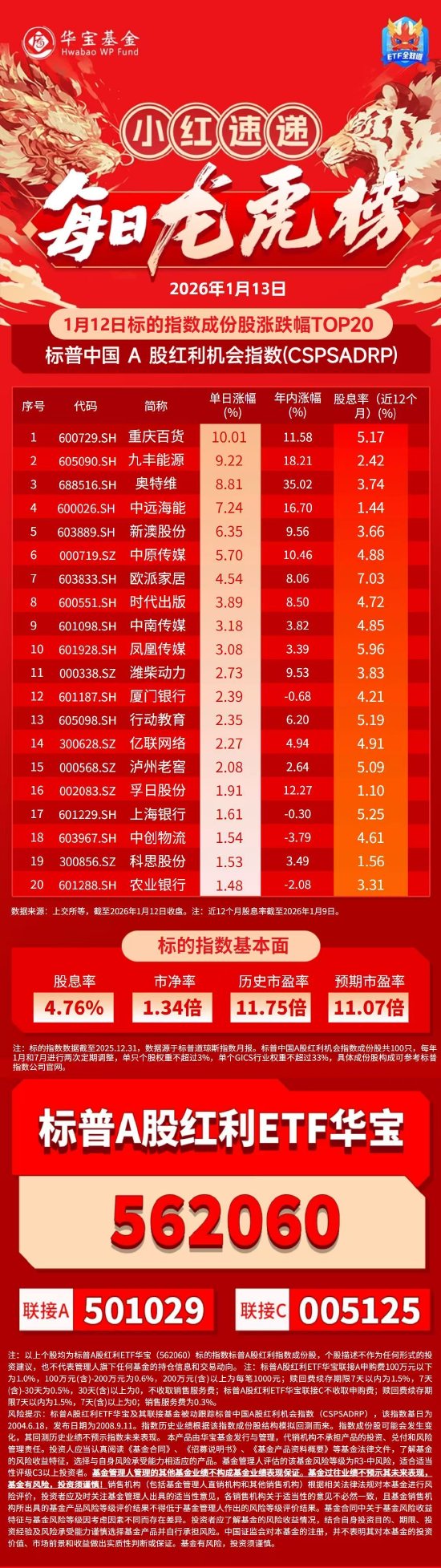
小红日报|重庆百货涨停,标普A股红利ETF华宝(562060)标的指数收涨0.61%
Xin Lang Cai Jing· 2026-01-13 01:09
Core Viewpoint - The article highlights the top-performing stocks in the S&P China A-Share Dividend Opportunity Index as of January 12, 2026, showcasing significant daily and year-to-date gains along with their respective dividend yields. Group 1: Stock Performance - The top stock, Chongqing Department Store (600729.SH), experienced a daily increase of 10.01% and a year-to-date increase of 11.58%, with a dividend yield of 5.17% [1] - Jiufeng Energy (605090.SH) saw a daily rise of 9.22% and a year-to-date rise of 18.21%, with a dividend yield of 2.42% [1] - Aotewei (688516.SH) reported a daily increase of 8.81% and a year-to-date increase of 35.02%, with a dividend yield of 3.74% [1] - Other notable performers include China Merchants Energy (600026.SH) with a daily increase of 7.24% and year-to-date increase of 16.70%, and Xin'ao Co. (603888.SH) with a daily increase of 6.35% and year-to-date increase of 9.56% [1] Group 2: Dividend Yields and Valuation Metrics - The average dividend yield for the index is reported at 4.76%, with a historical price-to-earnings (P/E) ratio of 11.75 times [2] - The expected P/E ratio is noted to be 11.07 times, indicating a stable valuation outlook for the index constituents [2]




马年贺岁纪念币钞,明晚开始预约
Zhong Guo Zheng Quan Bao· 2026-01-12 14:43
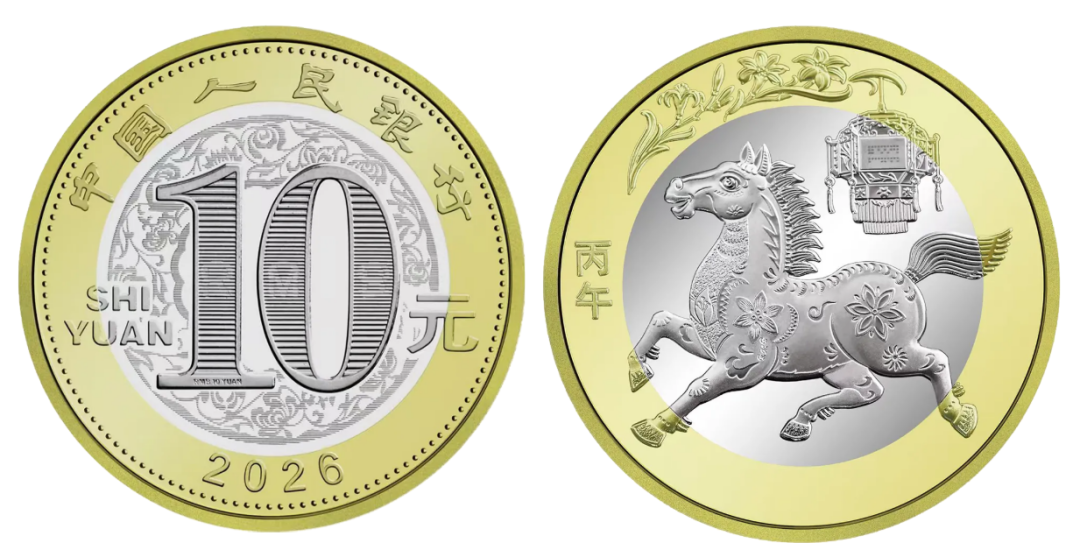
1月13日晚10点和10点半,马年贺岁纪念币、纪念钞开始预约啦! 1月12日,工商银行(601398)、农业银行(601288)、交通银行(601328)等多家银行发布关于2026年贺岁普通纪念币和2026年贺岁纪念钞预约兑换的 公告。公告显示,2026年贺岁纪念币发行量1亿枚,面额为10元;2026年贺岁纪念钞发行量1亿张,面额为20元。2026年贺岁纪念币每人预约、兑换限额为 20枚。2026年贺岁纪念钞每人预约、兑换限额为20张。 "每年我都会抢贺岁纪念币、纪念钞,已经成习惯了。也有抢不到的时候,有的纪念币、纪念钞上线'秒没'。我的经验是不要卡点进抢购页面,要提前几 分钟进去,然后不停刷新。今年是马年,寓意好,抢的人估计很多,得定好闹钟,希望能抢到。"北京居民小李告诉记者。 想了解马年贺岁纪念币、纪念钞何时开始预约兑换,哪些渠道可买到,又有哪些注意事项,请跟记者一起来看! 2026年贺岁纪念币正反面 图源:"交通银行"微信公众号 2026年贺岁纪念钞正反面 图源:"交通银行"微信公众号 马年贺岁纪念币、纪念钞 发售时间安排 01 |预约期 多家银行公告称,本次预约采取线上方式,预约期内先到先得,约满为止 ...


国有大行再度出手,开年有60多家村镇银行“消失”
Di Yi Cai Jing· 2026-01-12 14:14
Group 1 - The core viewpoint of the news is that the Bank of Communications has been approved to acquire a rural bank and convert it into a branch, marking the first case of a state-owned bank's "village to branch" transformation in the new year and the tenth case since last year [1][2] - The approval from the Zhejiang Regulatory Bureau allows the Bank of Communications to acquire the Anji Jiaoyin Rural Bank and establish multiple branches, taking over its assets, liabilities, and employees [2][3] - The Bank of Communications currently controls four rural banks, with recent acquisitions including the Dayi Jiaoyin Xingmin Rural Bank and the Qingdao Laoshan Jiaoyin Rural Bank, indicating a trend of consolidation among state-owned banks [3] Group 2 - The reform of small and medium-sized financial institutions is accelerating, with over 450 small banks expected to exit the market by 2025, including more than 280 rural banks, particularly in regions like Inner Mongolia, Shandong, and Hubei [1][4][5] - In the first half of 2025, there has been a significant increase in the number of rural banks approved for mergers, dissolutions, or cancellations, with 65 cases reported in just half a month, nearing ten times the number from the same period in 2024 [4][5] - The restructuring of rural banks is part of a broader strategy to optimize the financial institution system, focusing on quality improvement rather than just reduction, as emphasized by industry experts [5]
开年有60多家村镇银行消失
第一财经· 2026-01-12 14:00
2026.01. 12 本文字数:2022,阅读时长大约4分钟 作者 | 第一财经 亓宁 日前,交通银行获批收购旗下一家村镇银行并改建,成为新年国有大行"村改支"第一例,也是去年 以来国有大行推进旗下村镇银行"村改支"的第十例。2025年以来,除交通银行外,工商银行、农业 银行也已开始对旗下村镇银行推进"村改支"。 多位业内受访人士认为,随着中央经济工作会议定调中小金融机构"减量提质",年内中小银行改革 化险还会加速推进,重组合并仍是主流模式。数据显示,2025年有450多家中小银行退场,其中 280多家是村镇银行,内蒙古、山东、湖北等地减量最多。 按照2025年上半年持股情况来看,安吉交银村镇银行只是交通银行控股的4家村镇银行之一。此前 2025年8月,交通银行获批受让8家企业法人持有的大邑交银兴民村镇银行2.71%股权,由此实现了 对大邑交银兴民村镇银行的100%控股;2025年9月,交通银行获批收购青岛崂山交银村镇银行,并 设立交通银行青岛国金中心支行、王哥庄支行、北宅支行、沙子口支行、金家岭支行。 相比之下,工商银行是更早推进旗下村镇银行"村改支"的国有大行。2025年6月,金融监管总局江 津监管分局 ...

国有大行再度出手“村改支”,开年有60多家村镇银行消失
Di Yi Cai Jing· 2026-01-12 12:56
Group 1 - The core viewpoint of the articles is the ongoing restructuring of rural banks into branch banks by state-owned banks, with the recent acquisition by Bank of Communications marking the tenth instance of this initiative since last year [1][2][3] - Bank of Communications has received approval to acquire Anji Jiaoyin Rural Bank and establish multiple branches, indicating a strategic shift towards consolidating rural banking operations [2][3] - The trend of restructuring is part of a broader effort to enhance the quality of small financial institutions, with over 450 small banks expected to exit the market by 2025, predominantly rural banks [1][4] Group 2 - In 2025, 454 small banks were approved for mergers, dissolutions, or business cancellations, with rural banks accounting for over 60% of this figure [5] - The regions with the highest number of rural bank exits include Inner Mongolia, Shandong, and Hubei, highlighting significant regional disparities in the banking landscape [5] - Experts emphasize that while reducing the number of small financial institutions is necessary, improving their quality is the ultimate goal, necessitating effective measures to prevent the emergence of high-risk institutions [5]
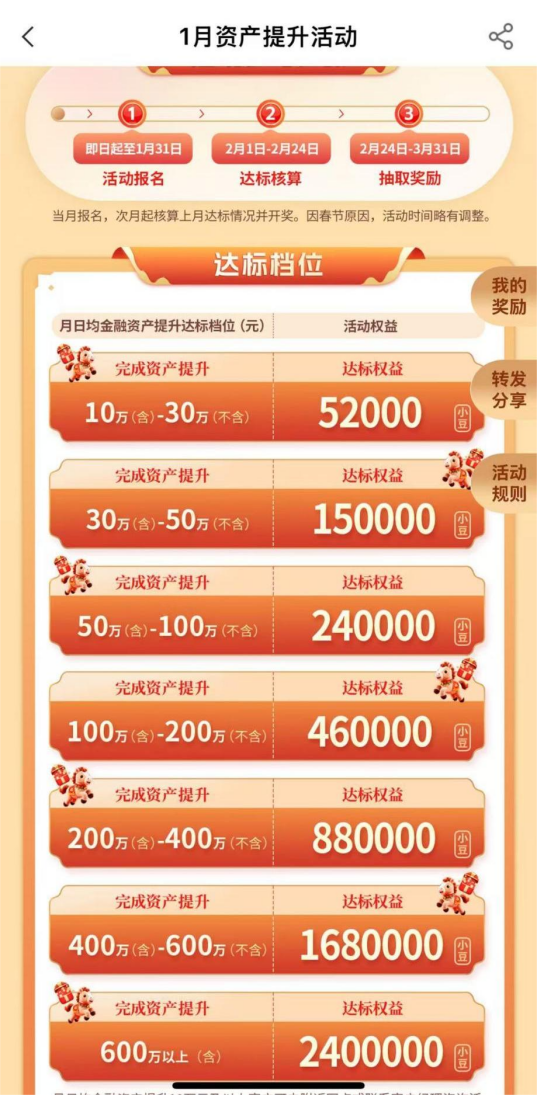
资产提升战”打响!工行、农行、中行、建行等齐下场,已有人薅到上万元“羊毛
Zhong Guo Ji Jin Bao· 2026-01-12 12:09
【导读】"资产提升战"打响,银行发力提升零售AUM 新年伊始,银行业掀起新一轮零售领域的"资产提升战",部分银行的最高奖励超过3000元。同时,微信、小红书等平台也出现了不少"薅羊毛"相关帖子, 甚至有网友透露去年薅到的"羊毛"价值2万多元。 业内人士认为,零售AUM已成为衡量银行零售业务竞争力与未来盈利潜力的关键指标。用户"薅完一家换一家"的现象频发,说明短期激励难以转化为长 期黏性。为了有效提升零售AUM,银行需摒弃短期活动思维,多举措构建以专业服务和长期信任为核心的综合能力。 部分奖励超3000元 银行"资产提升战"打响 开年以来,多家银行密集推出新一期"资产提升活动",用户参与活动达标后可获得相应的积分、微信立减金等权益,涉及国有大行、城商行等。 国有大行中,工行、农行、中行、建行等目前均发布了"资产提升活动"介绍,其中农业银行(601288)表示,即日起至1月31日,月日均金融资产(包 括:存款、理财、基金、保险、国债、存金通)提升至相应档位的客户,最高可获得240万小豆的奖励。据悉该行633小豆可兑换1元京东E卡,按此计 算,客户最高可获得价值超3790元的京东E卡。 中国银行(601988)表示 ...