AGRICULTURAL BANK OF CHINA(601288)

Search documents
国有大行再度出手“村改支”,开年有60多家村镇银行消失
Di Yi Cai Jing· 2026-01-12 12:56
Group 1 - The core viewpoint of the articles is the ongoing restructuring of rural banks into branch banks by state-owned banks, with the recent acquisition by Bank of Communications marking the tenth instance of this initiative since last year [1][2][3] - Bank of Communications has received approval to acquire Anji Jiaoyin Rural Bank and establish multiple branches, indicating a strategic shift towards consolidating rural banking operations [2][3] - The trend of restructuring is part of a broader effort to enhance the quality of small financial institutions, with over 450 small banks expected to exit the market by 2025, predominantly rural banks [1][4] Group 2 - In 2025, 454 small banks were approved for mergers, dissolutions, or business cancellations, with rural banks accounting for over 60% of this figure [5] - The regions with the highest number of rural bank exits include Inner Mongolia, Shandong, and Hubei, highlighting significant regional disparities in the banking landscape [5] - Experts emphasize that while reducing the number of small financial institutions is necessary, improving their quality is the ultimate goal, necessitating effective measures to prevent the emergence of high-risk institutions [5]



资产提升战”打响!工行、农行、中行、建行等齐下场,已有人薅到上万元“羊毛
Zhong Guo Ji Jin Bao· 2026-01-12 12:09
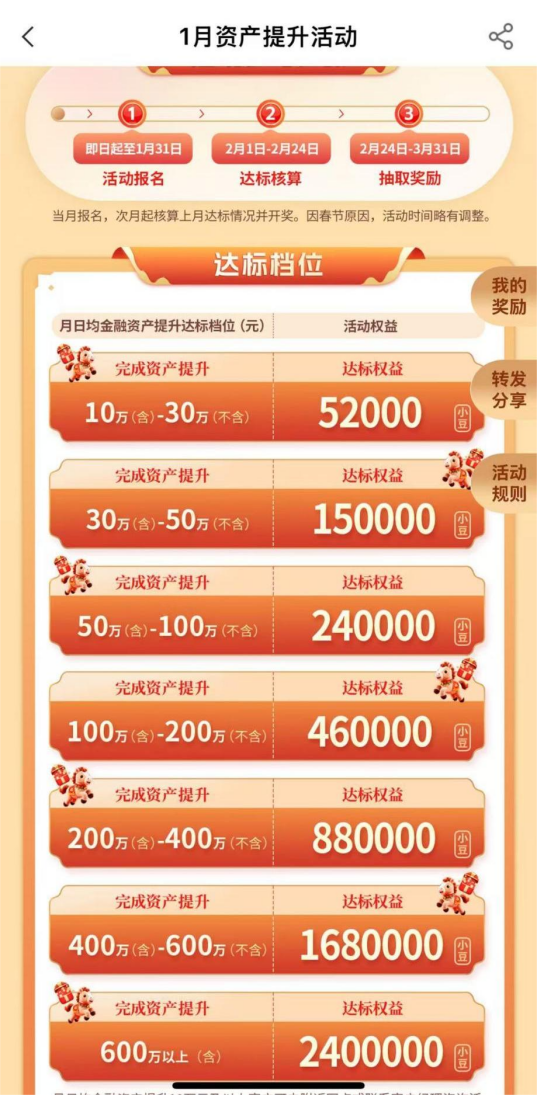
【导读】"资产提升战"打响,银行发力提升零售AUM 新年伊始,银行业掀起新一轮零售领域的"资产提升战",部分银行的最高奖励超过3000元。同时,微信、小红书等平台也出现了不少"薅羊毛"相关帖子, 甚至有网友透露去年薅到的"羊毛"价值2万多元。 业内人士认为,零售AUM已成为衡量银行零售业务竞争力与未来盈利潜力的关键指标。用户"薅完一家换一家"的现象频发,说明短期激励难以转化为长 期黏性。为了有效提升零售AUM,银行需摒弃短期活动思维,多举措构建以专业服务和长期信任为核心的综合能力。 部分奖励超3000元 银行"资产提升战"打响 开年以来,多家银行密集推出新一期"资产提升活动",用户参与活动达标后可获得相应的积分、微信立减金等权益,涉及国有大行、城商行等。 国有大行中,工行、农行、中行、建行等目前均发布了"资产提升活动"介绍,其中农业银行(601288)表示,即日起至1月31日,月日均金融资产(包 括:存款、理财、基金、保险、国债、存金通)提升至相应档位的客户,最高可获得240万小豆的奖励。据悉该行633小豆可兑换1元京东E卡,按此计 算,客户最高可获得价值超3790元的京东E卡。 中国银行(601988)表示 ...


“资产提升战”打响!工行、农行、中行、建行等齐下场,已有人薅到上万元“羊毛”
Xin Lang Cai Jing· 2026-01-12 12:05
Core Viewpoint - The banking industry has initiated a new round of "asset enhancement battles" in the retail sector, with some banks offering rewards exceeding 3,000 yuan. Retail AUM (Assets Under Management) is now seen as a key indicator of a bank's competitive strength and future profitability. The phenomenon of customers frequently switching banks for short-term incentives indicates that short-term activities fail to create long-term customer loyalty. To effectively enhance retail AUM, banks need to abandon short-term thinking and focus on building comprehensive capabilities centered around professional services and long-term trust [1][23][41]. Group 1: Asset Enhancement Activities - Multiple banks have launched new "asset enhancement activities" at the beginning of the year, allowing customers to earn points and benefits by meeting certain criteria. This includes major state-owned banks like ICBC, ABC, BOC, and CCB, with rewards such as 240,000 "small beans" convertible to over 3,790 yuan in JD E-cards for qualifying customers [2][24]. - Agricultural Bank of China has announced that from January 1 to January 31, customers can earn up to 600 million exclusive points if their average financial assets increase by 10,000 yuan or more [5][27]. - Nanjing Bank and other city commercial banks have also introduced similar activities, with Nanjing Bank offering 1,000 comprehensive points for every 10,000 yuan increase in average financial assets, with a maximum of 80,000 points per month [6][28]. Group 2: Market Dynamics and Challenges - The current "asset enhancement battle" reflects a tactical "New Year rush" and a strategic shift in the banking sector, driven by the need to adapt to changing interest rate environments. Retail AUM has become a critical measure of a bank's competitive edge and future profitability [9][31]. - The phenomenon of customers switching banks for incentives highlights two major challenges: the superficial nature of customer relationships ("high flow, low retention") and the lack of differentiation in service offerings, which makes it difficult to establish long-term trust [17][39]. - The "sheep shearing" phenomenon, where customers exploit short-term incentives, indicates a lack of customer loyalty and reveals weaknesses in banks' customer relationship management strategies [11][40]. Group 3: Recommendations for Improvement - To effectively enhance retail AUM, banks should shift from short-term activity thinking to a focus on professional services and long-term trust. This includes transitioning from product sales to asset allocation, integrating financial services with everyday life, and implementing refined customer segmentation and operations [19][41]. - Banks should strengthen their investment advisory capabilities to transition from merely selling products to providing comprehensive asset management solutions, thereby building a "moat" around their services [20][42]. - Digital transformation should evolve from being a mere outreach tool to empowering an ecosystem that enhances customer engagement and retention, creating a complete service loop that turns short-term activity flows into long-term customer relationships [21][43].

农业银行入选“2025中国企业ESG百强”榜单
Xin Lang Cai Jing· 2026-01-12 10:04
新浪财经ESG评级中心提供包括资讯、报告、培训、咨询等在内的14项ESG服务,助力上市公司传播ESG理念,提升ESG可持续发展表现。点 击查看【 ESG评级中心服务手册】 附:"2025中国企业ESG百强"榜 | 排名 | 公司名称 | 公司标识 | 得分星级 行业分类 | | | --- | --- | --- | --- | --- | | | 建设银行 (HK0939) | ▲ 山国建设城门 | ★★★★★ | 金融 | | | 中国移动 (HK0941) | STAN FILL COLL | ★★★★★ | 电信服务 | | | 农业银行 (HK1288) | 1 / 中国 花 机 银 / | ★★★★★ | 金融 | | 4 | 腾讯容投 HK0700 | Tencent 腾讯 | ★★★★★ | 信息技术 | | 5 | SH601988 中国银行 (HK3988) | 中国银行 | ★★★★★ | 金融 | | 6 | 阳光电源 SZ300274 | SUNGROW | 文文文文文文 | T W | | --- | --- | --- | --- | --- | | 7 | 理想汽车 HK201 ...

国有大型银行板块1月12日涨0.76%,农业银行领涨,主力资金净流入5.44亿元
Zheng Xing Xing Ye Ri Bao· 2026-01-12 09:04
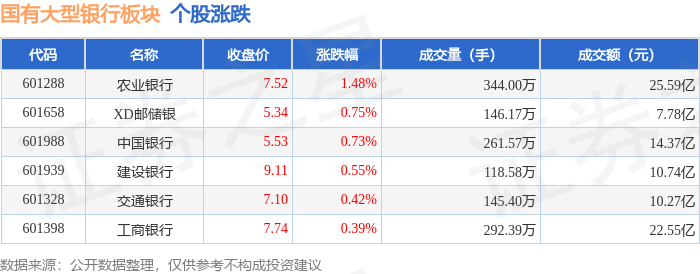
从资金流向上来看,当日国有大型银行板块主力资金净流入5.44亿元,游资资金净流出4.09亿元,散户资 金净流出1.34亿元。国有大型银行板块个股资金流向见下表: 证券之星消息,1月12日国有大型银行板块较上一交易日上涨0.76%,农业银行领涨。当日上证指数报收 于4165.29,上涨1.09%。深证成指报收于14366.91,上涨1.75%。国有大型银行板块个股涨跌见下表: | 代码 | 名称 | 收盘价 | 涨跌幅 | 成交量(手) | 成交额(元) | | --- | --- | --- | --- | --- | --- | | 601288 | 农业银行 | 7.52 | 1.48% | 344.00万 | 25.59亿 | | 601658 | XD邮储银 | 5.34 | 0.75% | 146.17万 | 7.78亿 | | 601988 | 中国银行 | 5.53 | 0.73% | 261.57万 | 14.37亿 | | 666109 | 建设银行 | 9.11 | 0.55% | 118.58万 | 10.74亿 | | 601328 | 交通银行 | 7.10 | 0.42% | 14 ...


农行安阳中原支行 暖心服务无国界农行温情暖客心
Sou Hu Cai Jing· 2026-01-12 08:59
编审:孙喜增 12月30日,寒风裹着凉意笼罩安阳,农业银行安阳中原支行的大厅里却暖意融融,网点主任王爽正统筹 当日厅堂服务工作,内勤行长赵瑞林在柜台区域核查业务台账,全力保障年末业务高效有序办理。临近 中午,两位俄罗斯客户推门走进网点,神色略显茫然,手里攥着人民币现金和手机,用不太流利的中文 夹杂着手势沟通,却始终没能说清需求。王爽见状立刻主动上前接待,赵瑞林也随即赶来配合,两人一 边安抚客户情绪,一边借助翻译软件耐心沟通,很快弄清了原委。这两位客户是来安阳洽谈合作的,刚 收到合作方支付的人民币款项,想将现金兑换后充值到支付宝里,方便后续在当地的餐饮、出行消费, 可因语言不通、不熟悉国内支付规则,一直没能办成。知晓需求后,王爽和赵瑞林分工协作,严守外汇 业务及现金管理规范,先仔细核对两位客户的身份信息、确认兑换金额,赵瑞林负责现金清点、业务资 料录入,全程精准高效,确保每一步流程合规无误;王爽则全程陪同客户,同步用翻译软件细致沟通, 避免信息偏差。待人民币兑换流程办结,两人又手把手教客户操作支付宝,一步步演示充值步骤,反复 核对到账信息,生怕客户后续操作遇到难题。不多时,两位客户的支付宝便显示充值到账,悬在心 ...
2025年全球最赚钱银行,被中国包场了!
Jin Tou Wang· 2026-01-12 08:22
Group 1 - The ranking of the world's most profitable banks in 2025 shows that the top four positions are held by Chinese banks, with Industrial and Commercial Bank of China (ICBC) at the first place, followed by China Construction Bank (CCB), Agricultural Bank of China (ABC), and Bank of China (BOC) [1] - Among the top 10 banks globally, six are from China, and in the top 20, there are ten Chinese banks, indicating a significant presence in the global banking sector [3] - Chinese banks accounted for 25% of the total profits of over 11 trillion yuan generated by the world's top 1000 banks, amounting to approximately 2.6 trillion yuan [3] Group 2 - China's total bank savings have surpassed 80 trillion yuan, which is higher than the combined savings of the United States, Germany, and Japan, showcasing a leading savings rate [4] - The trend of high savings has led to challenges for banks, as the lack of loan demand affects profitability, prompting a continuous decline in interest rates [4] - The one-year fixed deposit rate has fallen below 1%, and the five-year rate has dropped to 1.3%, indicating a shift in the banking landscape [4] Group 3 - Since 2010, China has experienced two significant rounds of deposit "migration" and one round of deposit return, influenced by the growth of the asset management industry and regulatory changes [5] - From 2018 to 2023, the introduction of new regulations and market conditions led to a rebound in resident deposit growth, reaching 20% by 2023 [7] - As of 2024, with declining deposit rates and a recovering capital market, a new wave of deposit migration is expected, with a projected 30 trillion yuan in fixed deposits maturing [8] Group 4 - Many depositors are shifting their funds into bank wealth management products, with the scale of these products exceeding 32 trillion yuan by the third quarter of 2025 [8] - The average annualized return of alternative products, such as "Stable Profit Treasure," is reported at 2.32%, attracting younger investors [8] - The ongoing trend of wealth diversification in a low-interest-rate environment emphasizes the need for individuals to enhance their financial literacy and adapt their investment strategies [10]
这家国有大行“村改支”再添一例!
券商中国· 2026-01-12 07:56
近日,国家金融监督管理总局湖州监管分局作出批复,同意交通银行收购浙江安吉交银村镇银行,并设立交通银行湖州安 吉支行、交通银行湖州安吉梅溪支行和交通银行湖州安吉天荒坪支行,承接浙江安吉交银村镇银行清产核资后的资产、负 债、业务和员工。 批复称,交行应严格按照有关法律法规要求办理收购事宜,并督促浙江安吉交银村镇银行股份有限公司按规定办理法人机构 解散等相关事宜。 此外,该行应在上述支行筹建工作结束后向国家金融监督管理总局湖州监管分局申请核准开业。 交行"村改支"又一例 公开信息显示,2010年4月9日,由交通银行发起设立的安吉交银村镇银行正式开业。该行由交行控股,当地17家企业法人共 同出资。这是交通银行继2008年9月在四川省大邑县设立交银兴民村镇银行后,设立的第二家村镇银行。 根据交通银行2025年半年度报告,截至报告期末,交通银行控股多家村镇银行。例如,其控股的浙江安吉交银村镇银行注册 资本为1.8亿元,交通银行持股比例为51%。 实际上,2025年8月、9月,交通银行已分别获批收购大邑交银兴民村镇银行、青岛崂山交银村镇银行,并将其改建为分支机 构。 连同此次获批的安吉交银村镇银行,交通银行旗下已完成或获批 ...

资本市场丨跻身市值榜上市企业 须从规模优势转向质量优势
Sou Hu Cai Jing· 2026-01-12 05:45
Core Insights - The latest "Top 500 Listed Companies in China" list for 2025 showcases leading enterprises in finance, energy, technology, consumption, and intelligent manufacturing, with major players like Tencent and ICBC demonstrating their industry leadership through trillion-level market capitalizations [1][10] - The presence of companies like Industrial Fulian, SMIC, and Cambricon in the rankings reflects the deep structural transformation of China's economy, indicating these firms are both stabilizers and pioneers in industrial upgrades [1][10] Group 1: Market Capitalization Rankings - The companies ranked from 21 to 30 include Sinopec (700.7 billion), Zhongji Xuchuang (677.8 billion), Yangtze Power (665.3 billion), Postal Savings Bank (641.7 billion), SMIC (632.9 billion), NetEase (614.0 billion), Midea Group (592.9 billion), Bank of Communications (590.8 billion), Cambricon (571.6 billion), and Meituan (570.2 billion) [3][10] Group 2: Economic Structural Transformation - The success of these companies is attributed to multiple factors, including industry scarcity, technological barriers, and stable business models, which create competitive advantages [4][11] - Companies like Zhongji Xuchuang and SMIC exemplify the dual drivers of technological innovation and market opportunities, with Zhongji Xuchuang capitalizing on the AI infrastructure wave [4][11] Group 3: Challenges and Opportunities - Companies face the challenge of transitioning from scale advantages to quality advantages, with risks related to technological iteration and high valuation sustainability [6][12] - The need for technological independence and improved profitability models is highlighted, particularly for firms like Zhongji Xuchuang and Cambricon, which must navigate rapid technological changes [6][12] Group 4: Future Trends - Future market leaders are expected to emerge from sectors such as high-end manufacturing, green energy, and innovative pharmaceuticals, with a focus on hard technology like semiconductors and AI [8][9] - The anticipated market structure will feature a three-tier system, with traditional giants at the base, tech newcomers leading, and niche champions filling in [8][9] Group 5: Investment Opportunities - The average market capitalization of the top 500 companies reached 185.6 billion, reflecting a significant increase, particularly in information technology, finance, and consumer discretionary sectors [23] - Companies are expected to enhance their value and market capitalization through innovation, digital transformation, and sustainable practices, aligning with national policies and market demands [21][24]


【Fintech 周报】去年理财产品平均收益率2.28%;银行短期大额存单利率进入“0字头”
Sou Hu Cai Jing· 2026-01-12 04:27
Regulatory Dynamics - The Financial Regulatory Bureau has issued a notice to unify the execution standards for non-auto insurance "reporting and issuing" practices, addressing issues of irrational competition and high costs in the non-auto insurance market [1] - Guangzhou Huilibao Payment Technology Co., Ltd. has been fined over 74 million yuan for multiple violations, including breaches of clearing management regulations and merchant management rules [1] Industry Dynamics - Major state-owned banks are raising the threshold for gold accumulation business, requiring personal clients to have a risk tolerance level of C3- or above to purchase gold accumulation products starting January 12, 2026 [2] - The interest rates for short-term large-denomination time deposits have dropped to "0" for several major state-owned banks, with rates for 1-month and 3-month deposits at 0.9% [2] - The average annualized yield of wealth management products has decreased to 2.2809% as of the end of 2025, with a total market size of 31.63 trillion yuan [3] - A significant wave of deposits maturing, estimated at 50 trillion yuan, is expected this year, with the majority concentrated in 2-year and 3-year deposits [5] - Several joint-stock banks' financial asset investment companies have begun investing in emerging industries, focusing on high-growth sectors such as new energy and materials [5] Corporate Dynamics - Everbright Bank's "Lehui Jin" credit card has been reported to show ghost debts, affecting users' credit scores and loan applications despite no actual defaults [6] - Yunnan's first trillion-yuan bank is set to be established through the merger of local rural credit cooperatives, creating the largest financial institution in the province [7] - Ping An Life has increased its holdings in Agricultural Bank of China and China Merchants Bank, triggering regulatory filings for both [8] - China Dadi Insurance and Sunshine Property Insurance have ceased new financing insurance business applications as of the end of 2025 [8] - Beijing's North Silver Consumer Finance has received approval to increase its registered capital by 150 million yuan, raising it to 1 billion yuan [9] - Jinshan Consumer Finance has become an executed party in a court case, with a claim amount of 20,000 yuan [9] - Zhonggang Yintong's payment license has been revoked by the central bank, marking the 12th payment license cancellation in 2025 [10] - ELong has fully acquired Firefly Microloan, enhancing its position in the financial services sector [11] Overseas Dynamics - JPMorgan Chase is set to take over Goldman Sachs' Apple credit card business, acquiring over $20 billion in credit card loans as Goldman Sachs shifts away from consumer finance [12] - Global fintech venture capital funding has rebounded significantly in 2025, reaching $55.94 billion, a 25% increase from 2024 [13]