AGRICULTURAL BANK OF CHINA(601288)

Search documents
4张表看信用债涨跌:4张表看信用债涨跌(12/15-12/19)
SINOLINK SECURITIES· 2025-12-21 09:23
Report Summary 1. Core Viewpoint Among the top 50 AA urban investment bonds (subject rating) with the highest discount margins, "20 Tiantai Bond" has the largest valuation price deviation. Among the top 50 individual bonds with the largest net price declines, "20 Tiantai Bond" also has the largest valuation price deviation. Among the top 50 individual bonds with the largest net price increases, "22 Vanke 02" has the largest valuation price deviation. Among the top 50 secondary perpetual bonds with the largest net price increases, "25 Agricultural Bank of China Secondary Capital Bond 04B(BC)" has the largest valuation price deviation [2]. 2. Summary by Directory 2.1 Top 50 AA Urban Investment Bonds with the Highest Discount Margins - "20 Tiantai Bond" has a remaining term of 2.00 years, a valuation price deviation of -33.42%, a valuation net price of 39.95 yuan, a valuation yield deviation of 34.99 bp, a valuation yield of 1.98%, and a coupon rate of 4.80%. It has an implied rating of AA(2) and a subject rating of AA, with a transaction date of 2025/12/15 [4]. 2.2 Top 50 Individual Bonds with the Largest Net Price Declines - "20 Tiantai Bond" has a remaining term of 2.00 years, a valuation price deviation of -33.42%, a valuation net price of 39.95 yuan, a valuation yield deviation of 34.99 bp, a valuation yield of 1.98%, and a coupon rate of 4.80%. It has an implied rating of AA(2) and a subject rating of AA, with a transaction date of 2025/12/15 [5]. 2.3 Top 50 Individual Bonds with the Largest Net Price Increases - "22 Vanke 02" has a remaining term of 1.21 years, a valuation price deviation of 15.70%, a valuation net price of 22.82 yuan, a valuation yield deviation of -4185.72 bp, a valuation yield of 247.05%, and a coupon rate of 3.64%. It has an implied rating of CC and a subject rating of AAA, with a transaction date of 2025/12/16 [9]. 2.4 Top 50 Secondary Perpetual Bonds with the Largest Net Price Increases - "25 Agricultural Bank of China Secondary Capital Bond 04B(BC)" has a remaining term of 9.93 years, a valuation price deviation of 0.19%, a valuation net price of 98.85 yuan, a valuation yield deviation of -2.17 bp, a valuation yield of 2.53%, and a coupon rate of 2.40%. It has an implied rating of AAA - and a subject rating of AAA, with a transaction date of 2025/12/18 [12].


金融赋能幸福养老:从产品提供者到生态构建者
Bei Jing Ri Bao Ke Hu Duan· 2025-12-20 23:12
Core Insights - The aging population and increased health awareness are driving demand for health management, medical care, and elderly services, making the development of the elderly finance sector a strategic priority [1] - Financial institutions are transitioning from being "single product providers" to "resource integrators" and "elderly ecosystem builders," utilizing emotional empowerment, technological assistance, and ecological layout to enhance elderly care [1][8] Emotional Empowerment - Shanghai Rural Commercial Bank's "Heart Home" project extends its services beyond financial offerings to include cultural and community activities, establishing over 1,000 service stations across Shanghai [2] - The project aims to address social connectivity issues among the elderly and enhance service warmth through community engagement and social activities [2] Health Management and Social Needs - Postal Savings Bank of China's Shanghai branch is creating a new paradigm in elderly finance by integrating health management and social needs through initiatives like "Postal Savings - Ctrip Friendship Club" [3] - The bank's activities encourage social interaction among the elderly, fostering community bonds and trust [3] Technological Empowerment in Care Services - Financial institutions are addressing challenges in elderly care services through credit support and technological empowerment, as highlighted by the implementation of a long-term care insurance management system by Shanghai's Love Nursing Station [4] - The system enhances service quality by providing real-time monitoring of elderly care and streamlining administrative processes [4] Information Technology in Elderly Care - Shanghai Hongri Puhua Nursing Home is implementing a smart elderly care system to improve management efficiency and enhance the quality of life for residents [6] - The system allows for comprehensive electronic management of resident information and care records, facilitating better service delivery [6] National Elderly Service Network - China Pacific Insurance has established a national elderly service network with the opening of new community projects in Beijing and Sanya, enhancing operational capabilities across 15 community projects [6][7] - The insurance sector is increasingly involved in the elderly care ecosystem, with various companies adopting different asset strategies to support the silver economy [7] Future of Elderly Finance - The elderly finance sector is expected to become a mainstream business for financial institutions in the next 10 to 20 years, necessitating a shift towards resource integration and the creation of a "financial + elderly care + medical" closed loop [8]

这些国有大行干部被查!
券商中国· 2025-12-20 15:44
Core Viewpoint - The article highlights the ongoing anti-corruption efforts within China's state-owned banks, detailing recent investigations into several high-ranking officials for serious violations of discipline and law [1][2][4]. Summary by Sections Investigation of Officials - Jiang Wenjun, deputy inspector of the Agricultural Bank of China in Inner Mongolia, is under investigation for serious violations and has a long history with the bank, holding various significant positions [1][2]. - Other officials from major state-owned banks have also been investigated, including Chen Dong from China Construction Bank and Lü Hongxiao from Industrial and Commercial Bank of China, indicating a broader crackdown on corruption [1][4][5]. Anti-Corruption Measures - The Agricultural Bank of China has emphasized the need for enhanced supervision of key personnel, particularly focusing on the "first responsible person" in various branches, to ensure compliance and prevent misconduct [3]. - The bank is implementing measures such as internal inspections and audits to monitor the performance and mindset of its leaders, aiming to strengthen the management of credit risks and ethical standards [3]. Recent Developments - The article notes that multiple officials from local branches of state-owned banks have been investigated recently, reflecting a sustained effort to address corruption within the financial sector [4][5]. - Specific cases include the investigation of Wu Biao, former director of the policy research office of the Agricultural Development Bank of China, further illustrating the extensive nature of the anti-corruption campaign [5].




中国农业银行董事长谷澍拜会辽宁省委书记许昆林、省长王新伟
Zheng Quan Shi Bao Wang· 2025-12-20 10:00
人民财讯12月20日电,12月19日,中国农业银行(601288)董事长、党委书记谷澍在辽宁沈阳拜会辽宁 省委书记许昆林、省长王新伟,围绕贯彻落实中央经济工作会议精神,进一步深化银政合作,推动金融 更好服务辽宁振兴发展等进行深入交流。 谷澍表示,农业银行高度重视服务辽宁振兴发展,下一步将持续加强乡村全面振兴、现代化产业体系建 设、科技创新等重点领域的金融服务和金融创新,加大融资供给,为辽宁的高质量发展贡献农行力量。 许昆林表示,希望农业银行继续将辽宁作为战略布局的重点区域,加大对重点产业、重大项目、提振消 费、县域"三农"等领域的金融支持力度。辽宁将为包括农业银行在内的各类金融机构创造良好条件。 ...
金融知识宣传 守护群众“钱袋子”
Xin Lang Cai Jing· 2025-12-19 22:31
Core Viewpoint - Agricultural Bank of China (ABC) Guizhou Branch has been actively promoting financial education and safety awareness among the public since 2025, focusing on deposit insurance and fraud prevention [1] Group 1: Financial Education Initiatives - The bank has established a multi-level mechanism for financial education, integrating it into daily services through a model of "branch coordination + outlet implementation + full staff participation" [1] - Various departments, including consumer protection and fraud prevention, lead the educational efforts, covering topics such as personal information protection and account security management [1] Group 2: Targeted Services for Key Groups - The bank focuses on elderly customers by conducting "Deposit Insurance Small Classes" to explain the "500,000 yuan compensation limit" and "coverage scope," ensuring that the public understands the security of their deposits [1] - Anti-fraud reminders are prominently displayed in service areas like ticket machines and counters to enhance risk awareness [1] Group 3: Community Engagement - Bank staff engage with local communities by organizing "Financial Knowledge Markets" in towns like Luxi in Xifeng County, integrating financial education with local market activities [1]
12 月 19 日信用债异常成交跟踪
SINOLINK SECURITIES· 2025-12-19 15:38
1. Report Industry Investment Rating - No relevant content provided 2. Core Viewpoints of the Report - Among the bonds with discounted transactions, "24 Guoyuan 01" had a relatively large deviation in bond valuation price. Among the bonds with rising net prices, "22 Vanke 02" ranked high in terms of valuation price deviation. Among the Tier 2 and perpetual bonds with rising net prices, "25 Agricultural Bank of China Tier 2 Capital Bond 01A(BC)" had a relatively large deviation in valuation price. Among the commercial financial bonds with rising net prices, "25 China Everbright Bank Bond 02" ranked high in terms of valuation price deviation. Among the individual bonds with a transaction yield higher than 5%, real estate bonds ranked high [2]. - The changes in credit bond valuation yields were mainly distributed in the [-5,0) interval. The transaction terms of non - financial credit bonds were mainly distributed between 2 and 3 years, with the 1 - 1.5 - year - term varieties having the highest proportion of discounted transactions. The transaction terms of Tier 2 and perpetual bonds were mainly distributed between 4 and 5 years, with the varieties within 1 year having the highest proportion of discounted transactions. By industry, real estate industry bonds had the largest average deviation in valuation prices [2]. 3. Summaries Based on Relevant Catalogs 3.1 Discounted Transaction Tracking - Bonds such as "24 Guoyuan 01", "Jian Guan VY02", and "24 China Construction MTN002" had significant valuation price deviations in discounted transactions. The industries involved included urban investment, transportation, and building decoration. The transaction scales ranged from several million yuan to tens of millions of yuan [4]. 3.2 Tracking of Bonds with Rising Net Prices - Bonds like "22 Vanke 02", "22 Vanke 04", and "22 Vanke 06" had large positive deviations in valuation prices. The industries mainly included real estate, non - bank finance, and urban investment. The transaction scales varied from tens of thousands of yuan to hundreds of millions of yuan [5]. 3.3 Tracking of Tier 2 and Perpetual Bond Transactions - Bonds such as "25 Agricultural Bank of China Tier 2 Capital Bond 01A(BC)", "25 Industrial and Commercial Bank of China Tier 2 Capital Bond 03BC", and "25 Agricultural Bank of China Tier 2 Capital Bond 02A(BC)" had certain valuation price deviations. Banks involved included state - owned banks, joint - stock banks, and city commercial banks. The transaction scales were relatively large, reaching tens of millions of yuan to billions of yuan [6]. 3.4 Tracking of Commercial Financial Bond Transactions - Bonds like "25 China Everbright Bank Bond 02", "24 China Construction Bank Bond 01B", and "25 Jiangsu Bank Bond 02BC" had valuation price deviations. Banks included joint - stock banks, state - owned banks, and city commercial banks. The transaction scales ranged from several million yuan to hundreds of millions of yuan [7]. 3.5 Tracking of Bonds with a Transaction Yield Higher than 5% - Bonds such as "22 Vanke 02", "22 Vanke 04", and "24 Chanrong 06" had a transaction yield higher than 5%. The industries mainly included real estate and non - bank finance. The transaction scales were relatively small, mostly in the range of tens of thousands to hundreds of thousands of yuan [8]. 3.6 Distribution of Credit Bond Transaction Valuation Deviations on the Day - The changes in credit bond valuation yields were mainly distributed in the [-5,0) interval [2]. 3.7 Distribution of Non - Financial Credit Bond Transaction Terms on the Day - The transaction terms of non - financial credit bonds were mainly distributed between 2 and 3 years, with the 1 - 1.5 - year - term varieties having the highest proportion of discounted transactions [2]. 3.8 Distribution of Tier 2 and Perpetual Bond Transaction Terms on the Day - The transaction terms of Tier 2 and perpetual bonds were mainly distributed between 4 and 5 years, with the varieties within 1 year having the highest proportion of discounted transactions [2]. 3.9 Discounted Transaction Proportions and Transaction Scales of Non - Financial Credit Bonds in Each Industry - The real estate industry had the largest average deviation in non - financial credit bond valuation prices [2].
2026年贺岁纪念币和纪念钞来了,先睹为快!
Xin Hua Wang· 2025-12-19 15:07
Core Viewpoint - The People's Bank of China will issue the 2026 New Year commemorative coins and banknotes starting from December 22, 2025, including a copper alloy coin, a banknote, a gold coin, and a silver coin, all of which are legal tender in the People's Republic of China [1][3]. Group 1: Commemorative Coins - The copper alloy commemorative coin features the inscription "People's Bank of China," "10 Yuan," the pinyin "SHIYUAN," and the year "2026" on the front, with a design combining traditional paper-cut art and decorative elements on the back [1]. - The gold commemorative coin has a design featuring the character "福" (Fortune) and a pouch, with a maximum issuance of 150,000 pieces [5][8]. - The silver commemorative coin features the character "福" and a scene of dancing fish lanterns, with a maximum issuance of 1,000,000 pieces [8]. Group 2: Commemorative Banknotes - The front of the commemorative banknote showcases a horse design, the national emblem, and the denomination "20 Yuan," along with various security features [3]. - The back of the banknote depicts children celebrating with drums, accompanied by Mongolian decorative patterns, and includes multiple languages for the denomination [3]. Group 3: Distribution and Exchange - The commemorative coins and banknotes will be available through a reservation system, managed by several major banks including ICBC, ABC, and BOC, among others [5]. - The reservation period is set for January 13-14, 2026, with the exchange period from January 20-26, 2026, and limits of 20 pieces for coins and 20 notes per person [5].




2025年,村镇银行加速“减量”
Jing Ji Guan Cha Wang· 2025-12-19 14:56
Group 1 - The core viewpoint of the articles highlights the acceleration of mergers and acquisitions among rural banks, with over 200 banks involved since 2025, marking a significant increase compared to 2024 [1] - As of the end of 2024, the total number of rural banks in China was 1,538, a decrease of 98 banks from the end of 2023 [1] - Various reform and restructuring methods have emerged, including "village to branch" and "village to division" models, primarily initiated by local rural commercial banks and supported by state-owned banks [2][3] Group 2 - The first state-owned bank to engage in the "village to branch" model was the Industrial and Commercial Bank of China, which completed its acquisition of Chongqing Bishi Rural Bank in June 2025 [2] - Other state-owned banks, such as Agricultural Bank of China and Bank of Communications, have also been involved in acquiring rural banks throughout 2025 [2] - Analysts suggest that the participation of state-owned banks in rural bank reforms is crucial for risk management and reflects their responsiveness to regulatory requirements [3] Group 3 - The financial indicators of state-owned banks are currently stable, and their involvement in rural bank reforms is expected to have minimal impact on their operations [3] - The bankruptcy of rural banks is rare, with only two instances reported by 2025, indicating ongoing challenges in risk management within this sector [4][5] - The Dalian Jinzhou Lianfeng Rural Bank was approved for bankruptcy proceedings in July 2025, becoming the second rural bank to do so, with its deposits being taken over by Dalian Rural Commercial Bank [5] Group 4 - The ongoing reform of rural banks aims to address issues such as deteriorating asset quality and increasing credit risks, particularly in economically weaker regions [7] - The China Banking Association's report indicates that rural banks are facing multiple challenges, including intensified regulatory compliance and competition, necessitating urgent reforms [7] - The restructuring of rural banks is being pursued through mergers, acquisitions, and dissolutions, with a notable reduction of 99 banks in 2024, accounting for nearly 50% of the total reduction in banking institutions that year [7] Group 5 - Employees of merged rural banks have reported changes in job roles but generally view the transitions positively, indicating a degree of stability post-merger [8] - For initiating banks, the restructuring can present opportunities for growth, as seen with Changshu Bank, which has actively pursued mergers to enhance its market presence [8] - The central economic work conference emphasized the importance of reducing and improving the quality of small financial institutions to mitigate financial risks in the coming year [8]
农业银行内蒙古自治区分行副巡视员姜文俊被查
Bei Jing Shang Bao· 2025-12-19 09:26
北京商报讯(记者 宋亦桐)12月19日,来自中央纪委国家监委网站发布的消息,据中央纪委国家监委 驻中国农业银行纪检监察组、内蒙古自治区纪委监委消息:中国农业银行内蒙古自治区分行副巡视员姜 文俊涉嫌严重违纪违法,目前正接受中央纪委国家监委驻中国农业银行纪检监察组纪律审查和内蒙古自 治区呼和浩特市监委监察调查。 ...
浙江社保科创基金、农业银行等新设股权投资企业,出资额80亿
Qi Cha Cha· 2025-12-19 08:17
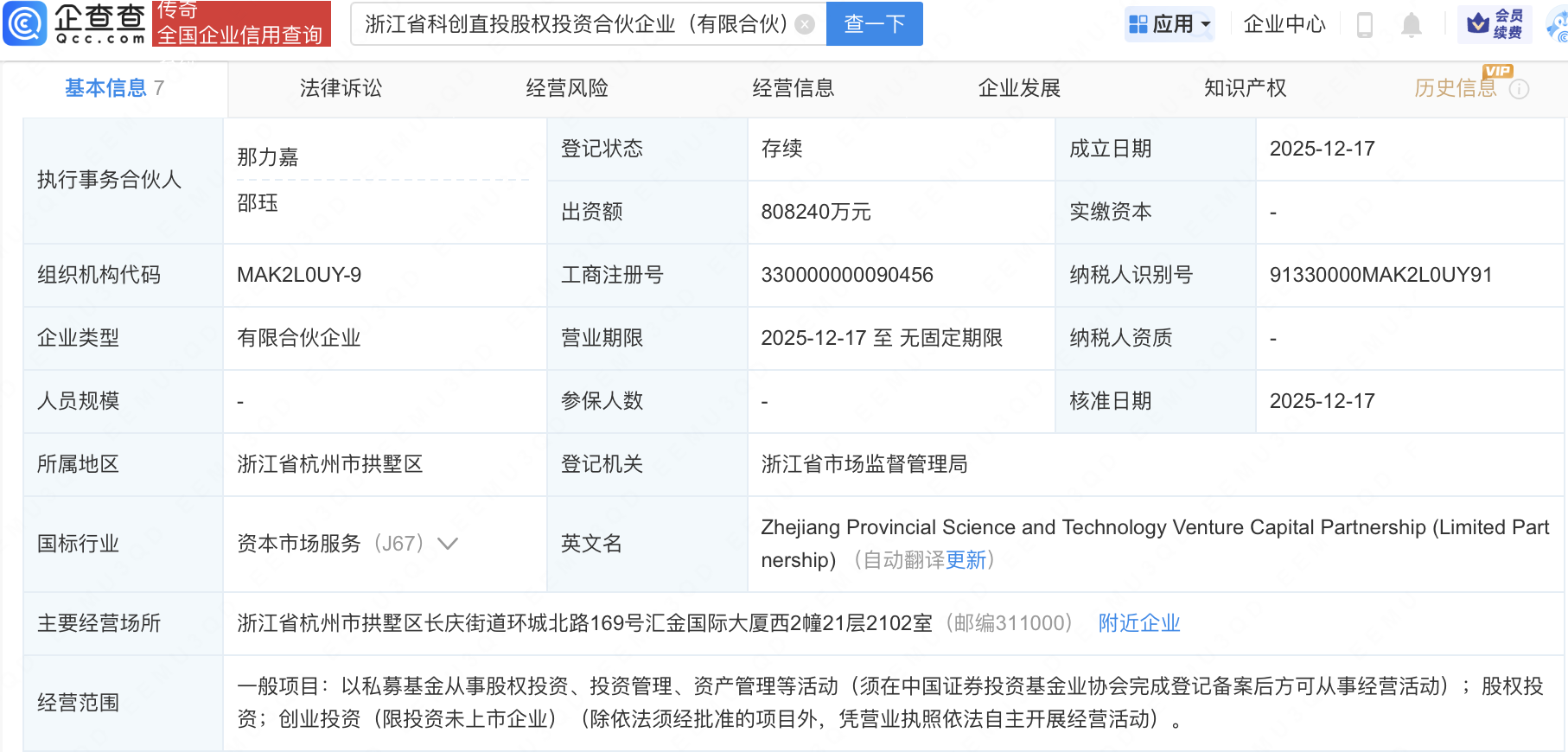
Group 1 - The Zhejiang Provincial Science and Technology Innovation Direct Investment Partnership (Limited Partnership) has been established with a capital contribution of approximately 80.82 billion yuan, focusing on private equity investment, investment management, and asset management activities [1][3]. - The partnership is co-funded by the Zhejiang Provincial Social Security Science and Technology Innovation Equity Investment Fund Partnership (Limited Partnership) and the wholly-owned subsidiary of Agricultural Bank of China, Nongyin Capital Management Co., Ltd. [1][3]. - The registered status of the partnership is active, with a business term extending until December 17, 2025, and it operates in the capital market services sector [3]. Group 2 - The executive partner of the partnership is Na Lijia, and it is located in Hangzhou, Zhejiang Province [3]. - The partnership's business scope includes private equity investment, investment management, and asset management, specifically targeting investments in unlisted companies [3]. - The partnership is classified under the national standard industry of capital market services [3].