
PICC(601319)

Search documents
时报观察 加快权益资产配置 险资“长钱长投”效应显现
Zheng Quan Shi Bao· 2025-08-28 17:58
上市险企的投资动向历来是市场关注焦点。截至6月30日,五家A股上市险企持有的股票资产金额超1.8 万亿元,较上年末增超4000亿元,增幅达28.7%,远超投资资产增幅,入市明显提速。 去年9月中央政治局会议提出"大力引导中长期资金入市"要求,《关于推动中长期资金入市的指导意 见》等政策相继落地,打通保险资金入市堵点成效显著,稳步入市成为险企投资布局时的共同选择。 险资积极入市,得以更大程度发挥市场稳定器和压舱石作用,并引导市场逐步形成长期投资、价值投资 之风,助推资本市场平稳健康发展。反过来,资本市场稳步向好,也让保险公司受益,两者呈现出良性 互动的局面。长期来看,在低利率环境和政策鼓励保险等中长期资金入市的背景下,保险公司对权益资 产的配置有望持续提升。 (文章来源:证券时报) 上市险企持有的股票和基金合计金额亦呈现较快增长。截至6月30日,中国人寿、中国平安、中国太 保、中国人保的股票和基金配置比例分别达13.6%、12.6%、11.8%和10.7%,上升区间为0.9个至2.7个百 分点。新华保险股票和基金配置比例虽较上年末减少0.2个百分点,但仍处历史和行业高位,达到 18.6%。 险资积极入市主要有两 ...



五大上市险企日赚十亿的当下与未来
Bei Jing Shang Bao· 2025-08-28 17:24
Core Viewpoint - The performance of major listed insurance companies in China showed a slight increase in net profit for the first half of 2025, driven by improved investment returns and strong growth in new business value in the life insurance sector [1][2]. Group 1: Overall Performance - The five major listed insurance companies in A-shares achieved a total net profit of 178.19 billion yuan in the first half of 2025, averaging a daily profit of 984 million yuan, reflecting a slight year-on-year increase [1]. - China Ping An led the group with a net profit of 68.05 billion yuan, while New China Life Insurance recorded the highest growth rate at 33.53% [1]. Group 2: Investment Income - The recovery of the capital market significantly boosted investment income, with many companies reporting improved total investment returns compared to the first half of 2024 [2]. - China Ping An reported a non-annualized comprehensive investment return rate of 3.1%, up 0.3 percentage points year-on-year, while China People's Insurance achieved a 5.1% annualized total investment return rate, an increase of 1 percentage point [2]. Group 3: New Business Value in Life Insurance - The life insurance sector experienced notable growth in new business value, with China People's Life Insurance achieving a new business value of 4.978 billion yuan, a growth rate of 71.7% [3]. - New China Life Insurance's new business value grew by 58% to 6.182 billion yuan, while Ping An Life and China Life reported new business values of 22.335 billion yuan and 28.546 billion yuan, respectively, both with over 20% year-on-year growth [3]. Group 4: Future Outlook - The insurance industry is optimistic about future growth, driven by the aging economy and increasing demand for diversified financial services and risk protection [4]. - Executives from major companies expressed confidence in the life insurance sector's potential, citing significant development space, strong demand for protection, and supportive policies as key factors [4]. Group 5: Property Insurance Cost Optimization - The comprehensive cost ratios of major property insurance companies continued to improve, with China People's Insurance and Ping An Insurance reporting ratios of 95.3% and 95.2%, respectively, both showing declines from previous periods [5]. - The competition in the traditional auto insurance market is intensifying, with a focus on the emerging new energy vehicle insurance market, which has seen a 36.8% increase in the number of insured new energy vehicles [5][6].


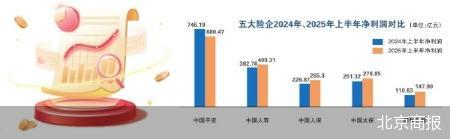
上半年A股五大上市险企共赚近1782亿元
Zheng Quan Ri Bao· 2025-08-28 16:08
Core Viewpoint - The five major A-share listed insurance companies reported a net profit of 178.19 billion yuan for the first half of 2025, reflecting a year-on-year growth of 3.7% [1] Group 1: Financial Performance - The overall net profit of A-share listed insurance companies showed a "four increases and one decrease" trend, with China Ping An leading at 68.05 billion yuan, followed by China Life at 40.93 billion yuan, China Pacific Insurance at 27.88 billion yuan, China Property & Casualty Insurance at 26.53 billion yuan, and New China Life at 14.8 billion yuan, which had the highest growth rate of 33.5% [2] - The new business value of life insurance for major listed insurers saw significant growth, with China Life's new business value increasing by 20.3% year-on-year to 28.55 billion yuan, and China Ping An's new business value growing by 39.8% [2][3] Group 2: Underwriting Business - The comprehensive cost ratio for property insurance businesses among China Property & Casualty, China Ping An, and China Pacific Insurance all decreased year-on-year, indicating improved underwriting profits [3][4] - China Property & Casualty's comprehensive cost ratio was 95.3%, the best level for the same period in nearly a decade, while China Ping An's was 95.2%, down by 2.6 percentage points [4] Group 3: Investment Activities - The insurance companies increased their equity market investments, achieving better investment returns, with China Life's net investment yield at 2.78% and total investment yield at 3.29% [5][6] - China Property & Casualty reported a 26.1% increase in A-share investment assets compared to the beginning of the year, with a 1.2 percentage point rise in the proportion of total investment assets [6][7]
中国人保20250828
2025-08-28 15:15
Summary of China People's Insurance Group Conference Call Company Overview - **Company**: China People's Insurance Group (中国人保) - **Period**: First half of 2025 Key Financial Metrics - **Premium Income**: CNY 454.6 billion, up 6.4% year-on-year [2][5] - **Investment Scale**: Exceeded CNY 1.7 trillion, up 7.2% [2] - **Net Profit**: CNY 26.5 billion, up 16.9% [3] - **Total Investment Income**: CNY 41.5 billion, a historical high [3] - **Consolidated Net Assets**: CNY 389.5 billion, up 6.1% [3][6] - **Core Solvency Ratio**: 219% [6] - **Comprehensive Solvency Ratio**: 276% [6] Business Performance Property and Casualty Insurance - **Service Revenue**: Increased by 5.6% year-on-year [2] - **Net Profit**: Increased by 34% [2] - **Comprehensive Cost Ratio**: 95.3%, down 1.5 percentage points [2] - **Auto Insurance Premiums**: Increased by 3.4% [2] - **Non-auto Insurance Premiums**: Increased by 16.6% [2] Life and Health Insurance - **Service Revenue**: Increased by 13.2% year-on-year [2] - **Net Profit**: Increased by 49.6% [2] - **Contract Service Margin**: Increased by 14.6% [2] - **Return on Equity**: Increased by 3.2 percentage points [2] Strategic Initiatives - **New Business Value**: CNY 8.8 billion, a historical high [3] - **Focus on High-Quality Development**: Emphasis on enhancing insurance functions and risk management [11][12] - **Digital Transformation**: Implementation of AI in underwriting and claims management [35] Industry Trends and Challenges - **Non-auto Insurance Regulation**: New regulations expected to improve profitability in the non-auto sector [14] - **Natural Disaster Impact**: Significant losses from natural disasters, but overall losses decreased by 39.9% year-on-year [23][24] - **Investment Strategy**: Focus on long-term investments and high-dividend stocks to mitigate market volatility [25][38] Future Outlook - **Growth in New Energy Vehicle Insurance**: Projected export volume to exceed 1 million units, a growth of over 70% [15][16] - **Continued Focus on High-Quality Development**: Plans to enhance service capabilities and expand into new markets [12][45] - **Sustainability Initiatives**: Commitment to green finance and technology-driven insurance solutions [8][9] Additional Insights - **Risk Management**: Enhanced risk assessment and compliance culture [7] - **Customer Base**: Service to 317 million individual clients and 7.94 million institutional clients [7] - **Community Support**: Active involvement in disaster relief and insurance coverage for major disasters [7] This summary encapsulates the key points from the conference call, highlighting the financial performance, strategic initiatives, industry trends, and future outlook of China People's Insurance Group.
业绩、股价均创新高,中国人保接下来如何布局|直击业绩会
Guo Ji Jin Rong Bao· 2025-08-28 14:59
Core Insights - China Pacific Insurance (CPIC) reported strong financial results for the first half of 2025, with insurance service revenue reaching 280.25 billion yuan, a year-on-year increase of 7.1% [1] - The company achieved a net profit attributable to shareholders of 26.53 billion yuan, reflecting a 16.9% growth compared to the previous year [1] - Investment assets grew to over 1.7 trillion yuan, marking a 7.2% increase since the beginning of the year [1] Financial Performance - The comprehensive cost ratio for property insurance was 95.3%, the best level for the same period in nearly a decade [3] - New business value in life insurance reached 8.8 billion yuan, setting a historical high for the same period [3] - Total investment income was 41.5 billion yuan, also a record for the same period [3] - The combined net profit for the group was 35.9 billion yuan, achieving a historical peak [3] Stock Performance - CPIC's A-shares reached their highest price in nearly six years, while H-shares hit a record high since their listing 13 years ago [3] - The stock price increase is attributed to several factors, including China's high-quality economic development and improved operating environment [3] Strategic Focus - The company aims to build a world-class insurance financial group, focusing on enhancing protection functions, improving development quality, and deepening six key reforms [3] Regulatory Developments - The non-auto insurance "reporting and operation in one" policy is expected to be implemented in the fourth quarter, which will significantly improve the comprehensive cost ratio [5] - This policy aims to standardize non-auto insurance business and control premium collection risks [5] International Expansion - CPIC is actively pursuing internationalization, with a focus on the overseas market for new energy vehicle insurance [6] - The company has already insured over 1,000 Chinese brand new energy vehicles in Hong Kong, with a current claims ratio of 50% [5] Investment Strategy - Total investment income for the first half of 2025 was 41.478 billion yuan, a 42.7% increase year-on-year, with an annualized total investment return rate of 5.1% [8] - The company plans to enhance its investment strategy by focusing on high-dividend stocks and exploring opportunities for collaboration with invested companies [8][9]
直击中国人保业绩会:业绩股价为何双创新高?财险老大如何“反内卷”?
Bei Jing Shang Bao· 2025-08-28 14:47
"人身险新业务价值88亿元,创历史同期最高;集团总投资收益415亿元,创历史同期新高;集团合并净利润359亿元,创历史同期新高。"8月28日,在中国 人保举行的中期业绩发布会上,中国人保总裁赵鹏以多个"最高"描述公司业绩开场。 此外,中国人保管理层还对经营目标、非车险"报行合一"、寿险新业务价值等问题进行了重点回应。 业绩股价创历史新高 今年上半年,中国人保实现净利润265.3亿元,同比增长16.9%。该集团拟向股东派发2025年中期现金股息每10股0.75元(含税),同比提升19%。 今年险资在资本市场举牌频频,中国人保是否会有类似动作?才智伟透露,公司会不断丰富权益投资方式,加大对于优质标的的研究储备,对于符合国家战 略、长期经营业绩稳健、具有发展潜力的优质标的,会适时通过举牌、战投等方式来加大投资力度。 财险老大喊话"反内卷" 财险业务是中国人保最重要的业务板块。上半年"财险一哥"人保财险综合成本率为95.3%,同比下降1.5个百分点,综合成本率水平在业内处于较低水平。 在业绩会上,赵鹏用多个"新高"介绍公司业绩,高质量发展取得显著成效,财产险综合成本率95.3%,创近十年同期最好水平;人身险新业务价值 ...
日赚十亿!五大上市险企高光背后的近喜与远虑
Bei Jing Shang Bao· 2025-08-28 14:47
Core Viewpoint - The performance of China's five major listed insurance companies in the first half of 2025 shows a slight increase in net profit, driven by a recovery in the capital market and strong growth in new business value for life insurance [1][3]. Group 1: Overall Performance - The five major listed insurance companies in A-shares achieved a total net profit of 178.19 billion yuan in the first half of 2025, averaging a daily profit of 984 million yuan, reflecting a slight year-on-year increase [1][3]. - China Ping An led the net profit among the five companies with 68.05 billion yuan, while New China Life Insurance recorded the highest growth rate at 33.53% [3][5]. - Other companies reported net profits of 40.93 billion yuan for China Life, 26.53 billion yuan for China Property & Casualty, and 27.88 billion yuan for China Taiping, with year-on-year growth rates of 6.93%, 16.94%, and 10.95% respectively [3][5]. Group 2: Investment Performance - The recovery of the capital market has significantly boosted investment income, with many insurance companies reporting a noticeable increase in total investment returns compared to the first half of 2024 [3][4]. - China Ping An achieved a non-annualized comprehensive investment return rate of 3.1%, up 0.3 percentage points year-on-year, while China Property & Casualty reported an annualized total investment return rate of 5.1%, an increase of 1 percentage point [4]. Group 3: Life Insurance New Business Value - The life insurance sector experienced significant growth in new business value, with China Property & Casualty achieving a new business value of 4.978 billion yuan, a growth rate of 71.7% [5][6]. - New China Life's new business value grew by 58% to 6.182 billion yuan, while Ping An Life and China Life reported new business values of 22.335 billion yuan and 28.546 billion yuan, both with over 20% year-on-year growth [5][6]. Group 4: Cost Optimization in Property Insurance - The comprehensive cost ratios of major property insurance companies continued to improve, with China Property & Casualty, Ping An Property & Casualty, and China Taiping reporting ratios of 95.3%, 95.2%, and 96.3% respectively, reflecting decreases of 1.5, 2.6, and 0.8 percentage points [7][8]. - The optimization of cost ratios is attributed to the application of technology to control expenses and improve business quality [7]. Group 5: Focus on New Energy Vehicle Insurance - The competition in the traditional auto insurance market is intensifying, leading companies to focus on the new energy vehicle insurance market, with China Property & Casualty reporting a 36.8% year-on-year increase in the number of new energy vehicles insured [8]. - Ping An Property & Casualty reported a 46.2% year-on-year increase in original insurance premium income from new energy vehicle insurance, amounting to 21.7 billion yuan, while also achieving underwriting profitability in this segment [8].

中国人保集团上半年承担风险保障金额1780万亿元
Xin Hua She· 2025-08-28 14:41
Core Insights - China Pacific Insurance Group reported a risk-bearing amount of 178 trillion yuan and compensation expenses of 233.5 billion yuan in the first half of the year, representing year-on-year growth of 6.9% and 14% respectively [1][2] - The company achieved premium income of 454.6 billion yuan, a year-on-year increase of 6.4%, with property insurance premiums at 323.3 billion yuan (up 3.6%) and life insurance premiums at 131.2 billion yuan (up 13.8%) [1][2] - The new business value for life insurance reached 8.8 billion yuan, marking a historical high for the same period [1] Financial Performance - The total investment income for the first half of the year was 41.5 billion yuan, setting a historical record for the same period [2] - The consolidated net profit for the first half of the year was 35.9 billion yuan, also a historical high [2] - As of June 30, the company’s total investment assets exceeded 1.7 trillion yuan, reflecting a growth of 7.2% since the beginning of the year [2] Operational Highlights - The comprehensive cost ratio for property insurance was 95.3%, the best level for the same period in nearly a decade [1] - The company provided risk protection for 127,000 high-tech enterprises and insured 6.16 million new energy vehicles, a year-on-year increase of 36.8% [1] - The scale of green investments reached 140.4 billion yuan, with a year-on-year growth of 13.6% [1] Capital Adequacy - As of June 30, the consolidated net assets were 389.5 billion yuan, a 6.1% increase from the beginning of the year [2] - The core solvency adequacy ratio was 219%, while the comprehensive solvency adequacy ratio was 276% [2]
中国人保业绩会:非车险“报行合一”有望四季度落地,“反内卷”已取得初步成效
Sou Hu Cai Jing· 2025-08-28 14:13
出品|搜狐财经 作者|汪梦婷 8月28日,中国人保召开2025年中期业绩发布会。 业绩会上,中国人保管理层对上半年经营业绩进行了解读,同时回应了"报行合一"、股价新高、巨灾损失等诸多热点问题。 今年上半年,中国人保实现归母净利润265.30亿元,同比增长16.9%。原保险保费收入4546.25亿元,同比增长6.4%;其中,财产险保费收入3233亿元,同比 增长3.6%。人身险保费收入1312亿元,同比增长13.8%。 对于行业而言,"报行合一"有助于避免行业"内卷式"竞争,于泽在发布会上对于"反内卷"也进行了回应。 | | | | - | | --- | --- | --- | --- | | 主要会计数据 | 2025年1-6月 | 2024年1-6月 | 增减(%) | | 营业总收入 | 324,014 | 292,307 | 10.8 | | 保险服务收入 | 280,250 | 261,629 | 7.1 | | 营业总支出 | 281,521 | 257,328 | 9.4 | | 保险服务费用 | 246,201 | 227,518 | 8.2 | | 营业利润 | 42,493 | 34,97 ...
关于股价上涨原因?央企回应
Jin Rong Shi Bao· 2025-08-28 13:37
Core Viewpoint - The stock prices of China Pacific Insurance (601319) have reached record highs due to strong performance and favorable market conditions, significantly outperforming peers and the broader market since the start of the 14th Five-Year Plan [1][2]. Group 1: Stock Performance - In the first half of the year, China Pacific Insurance's A-shares hit their highest price in nearly six years, while H-shares reached their highest price in 13 years, and the H-shares of China Pacific Property Insurance hit their highest price in 22 years [1]. - The cumulative increase in stock prices for A-shares, H-shares, and China Pacific Property Insurance H-shares has significantly outperformed both industry peers and the overall market during the past four complete years [1]. Group 2: Factors Driving Stock Price Increase - The rise in stock prices is attributed to multiple factors, including China's high-quality economic development, which has created historic opportunities for the insurance industry [2]. - New demands for insurance services have emerged from sectors such as technological innovation, green development, digital economy, and elderly care, enhancing the insurance industry's role in supporting China's modernization [2]. - Regulatory improvements and policies aimed at enhancing the insurance sector's core functions have further supported the industry's stable growth and risk management [2]. Group 3: Company Fundamentals - China Pacific Insurance has shown continuous improvement in its fundamentals, with a significant enhancement in value creation capabilities [3]. - The comprehensive cost ratio for property insurance reached 95.3%, marking the best level for the same period in nearly a decade, while new business value in life insurance and total investment income also hit historical highs [3]. - The group reported a total investment income of 41.5 billion yuan and a consolidated net profit of 35.9 billion yuan, both achieving historical records for the same period [3].