PICC(601319)

Search documents
非银金融周报:融资保证金比例上调,金监总局部署2026年监管工作-20260118
HUAXI Securities· 2026-01-18 14:52
Investment Rating - The industry rating is "Recommended" [5] Core Insights - The adjustment of the financing margin ratio from 80% to 100% aims to cool down excessive leverage and maintain market stability. This change will take effect on January 19, 2026, and applies only to new financing contracts [3][4][15][7] - As of January 14, 2026, the total market financing balance reached a historical high of 2.68 trillion yuan, with the margin balance accounting for 2.59% of the A-share market capitalization, indicating an increase from the average level of 2.40% in 2025 [4][15] - The non-bank financial sector index fell by 2.63%, underperforming the CSI 300 index by 2.06 percentage points, ranking 26th among all primary industries. The securities sector decreased by 2.21%, while the financial technology sector increased by 1.34% [2][13] Summary by Sections Market and Sector Performance - The average daily trading volume of A-shares for the week of January 11-17, 2026, was 34.651 billion yuan, a 21.5% increase week-on-week and a 189.4% increase year-on-year. The average trading volume for the first quarter of 2026 is 31.585 billion yuan, up 107.7% from the same period in 2025 [19] - In the same week, three new stocks were issued, raising 2.025 billion yuan, while two new stocks were listed, raising 1.484 billion yuan. Year-to-date, three A-share IPOs have raised 3.039 billion yuan [19] Financing Margin Ratio Adjustment - The financing margin ratio adjustment is a regulatory measure to prevent systemic risks and protect investors' rights. The increase in the minimum margin requirement is intended to curb market overheating and ensure a smooth market transition [4][7][15] Regulatory Developments - The National Financial Supervision Administration held a regulatory work meeting on January 15, 2026, outlining five key tasks for the year, including risk resolution for small and medium-sized financial institutions and enhancing regulatory quality. The focus for 2026 is on preventing systemic risks and ensuring high-quality industry development [8][16][17]





应对降雪低温天气,人保财险北京分公司已接车险报案363件
Bei Jing Shang Bao· 2026-01-18 08:52
Group 1 - The core viewpoint of the article highlights the proactive measures taken by the company to ensure customer safety and efficient claims processing during the snowfall in Beijing starting January 17 [1] Group 2 - The company has initiated a self-service rapid reporting channel that operates 24 hours to receive customer claims [1] - A quick rescue service has been activated to provide timely assistance to affected vehicles [1] - The company has collaborated with a thousand repair institutions to ensure the promptness of vehicle rescue services [1] - An online quick compensation service for minor personal injuries has been launched to provide direct support to customers [1] Group 3 - The company has prepared 200 rescue vehicles to ensure adequate rescue capabilities during the snowfall [1] - In case of concentrated orders in specific areas, the company will activate a cross-regional service scheduling mechanism to enhance service capacity [1] - As of January 18 at 11 AM, there were 363 car insurance claims reported, with 39 rescue operations dispatched, representing an approximate 20% increase in claims compared to normal days [1] - The claims were primarily concentrated in the Chaoyang, Haidian, and Daxing districts [1]
机器人租赁风口下,保险能否筑牢安全防线?
Cai Jing Wang· 2026-01-18 05:14
Core Insights - The article emphasizes that robot insurance is not only a risk transfer tool but also a "connector" and "stabilizer" for the robot industry ecosystem, supporting China's ambition to become a global leader in robotics through financial and technological innovation [1] Group 1: Market Dynamics - The rapid growth of the robot leasing market is driven by technological advancements and market demand, with the domestic robot leasing market expected to exceed 1 billion yuan by 2025 [2] - Shanghai has launched the first national robot leasing open platform, aiming to have over 10 manufacturers and 200 service providers by 2026, serving over 400,000 leasing customers [2] - The rental prices for robots have decreased significantly, making them more accessible to small and medium-sized enterprises [2] Group 2: Insurance Demand - The risks associated with robot operations, such as damage and third-party injuries, have led to a strong demand for insurance, with platforms requiring every robot to be insured [3][5] - Major insurance companies are actively developing robot insurance products, including comprehensive coverage for damage and third-party liability [4][5] Group 3: Industry Challenges - The robot insurance market faces challenges such as data barriers, difficulty in risk assessment, and complex liability definitions [7] - The unpredictable nature of robot behavior complicates traditional actuarial models, necessitating the development of dynamic pricing models using real-time data [7][8] Group 4: Future Outlook - The insurance industry is expected to evolve from simple risk compensation to comprehensive risk management, becoming a key infrastructure for connecting technological innovation with commercial applications [8] - Policy guidance and industry collaboration are crucial for addressing existing challenges, with suggestions for modular insurance policies and collaborative data collection to enhance risk assessment [8]


铁岭监管分局核准人保财险西丰支公司平岗营销服务部营业场所地址变更
Jin Tou Wang· 2026-01-16 13:56
2026年1月12日,国家金融监督管理总局铁岭监管分局发布批复称,《中国人民财产保险股份有限公司 辽宁省分公司关于中国人民财产保险股份有限公司西丰支公司平岗营销服务部营业场所变更的请示》 (辽人保财险发〔2025〕422号)收悉。经审核,现批复如下: 二、中国人民财产保险股份有限公司辽宁省分公司应按照有关规定及时办理变更及许可证换领事宜。 一、核准中国人民财产保险股份有限公司西丰支公司平岗营销服务部营业场所地址变更为平岗镇中心 委。 ...
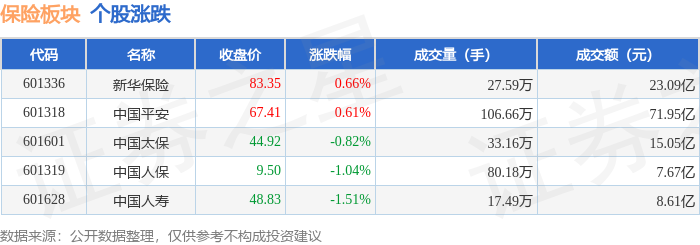
保险板块1月16日跌2.1%,中国人寿领跌,主力资金净流出5.47亿元
Zheng Xing Xing Ye Ri Bao· 2026-01-16 08:55
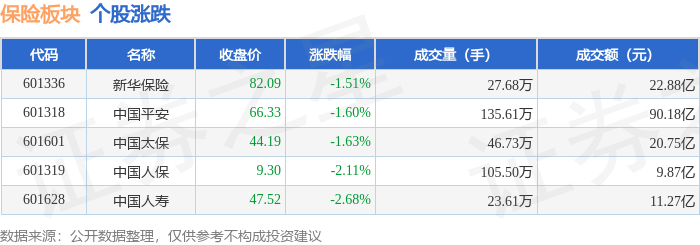
证券之星消息,1月16日保险板块较上一交易日下跌2.1%,中国人寿领跌。当日上证指数报收于 4101.91,下跌0.26%。深证成指报收于14281.08,下跌0.18%。保险板块个股涨跌见下表: | 代码 | 名称 | 收盘价 | 涨跌幅 | 成交量(手) | 成交额(元) | | --- | --- | --- | --- | --- | --- | | 601336 | 新华保险 | 82.09 | -1.51% | 27.68万 | 22.88亿 | | 601318 | 中国平安 | 66.33 | -1.60% | 135.61万 | 90.18亿 | | 601601 | 中国太保 | 44.19 | -1.63% | 46.73万 | 20.75亿 | | 616109 | 中国人保 | 9.30 | -2.11% | 105.50万 | 9.8717 | | 601628 | 中国人寿 | 47.52 | -2.68% | 23.61万 | 11.27 Z | 从资金流向上来看,当日保险板块主力资金净流出5.47亿元,游资资金净流出3.97亿元,散户资金净流入 9.44亿元。保险板块个股资金 ...



张掖监管分局同意中国人保财险临泽支公司板桥营销服务部变更营业场所
Jin Tou Wang· 2026-01-15 12:53
Group 1 - The China People's Property Insurance Company Limited has received approval to change the business location of its Linze branch's Banqiao marketing service department to a new address in Gansu Province, Zhangye City, Linze County [2] - The company is required to present the approval document and related materials to the Zhangye Regulatory Bureau of the National Financial Supervision Administration within 10 days to obtain a new insurance license and comply with relevant announcement regulations [2][3]
保险板块1月15日跌0.63%,中国人寿领跌,主力资金净流出1.65亿元
Zheng Xing Xing Ye Ri Bao· 2026-01-15 08:58
证券之星消息,1月15日保险板块较上一交易日下跌0.63%,中国人寿领跌。当日上证指数报收于 4112.6,下跌0.33%。深证成指报收于14306.73,上涨0.41%。保险板块个股涨跌见下表: 从资金流向上来看,当日保险板块主力资金净流出1.65亿元,游资资金净流出3.33亿元,散户资金净流入 4.98亿元。保险板块个股资金流向见下表: | 代码 | 名称 | 主力净流入 (元) | 主力净占比 游资净流入 (元) | | 游资净占比 散户净流入 (元) | | 散户净占比 | | --- | --- | --- | --- | --- | --- | --- | --- | | 601601 中国太保 | | 1.08亿 | 7.15% | -1.19/Z | -7.93% | 1172.46万 | 0.78% | | 601628 中国人寿 | | 1513.53万 | 1.76% | 515.82万 | 0.60% | -2029.36万 | -2.36% | | 601336 新华保险 | | 606.86万 | 0.26% | -4536.59万 | -1.96% | 3929.73万 | 1. ...
中国人保荣获2025“金责奖”责任投资最佳保险公司奖
Xin Lang Cai Jing· 2026-01-15 08:12
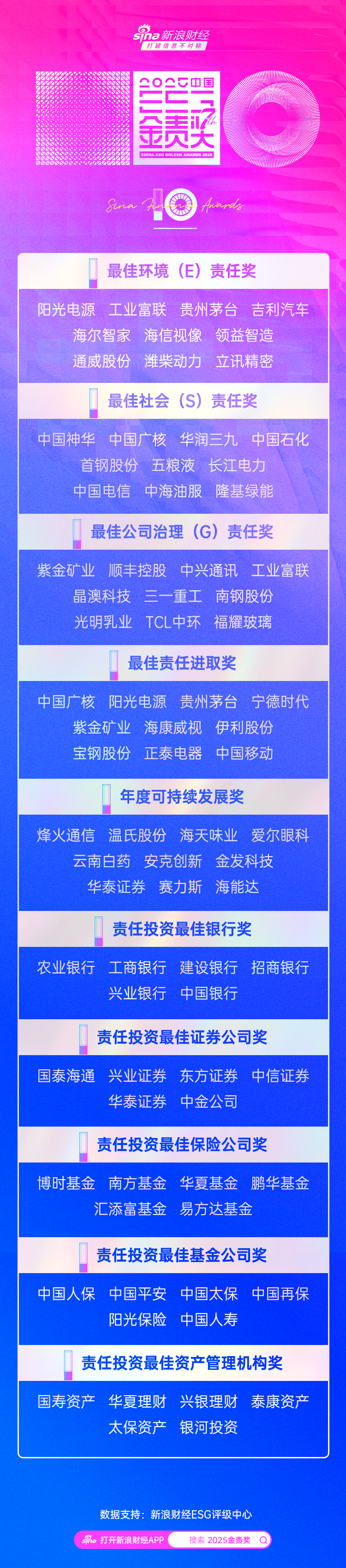
新浪财经ESG评级中心提供包括资讯、报告、培训、咨询等在内的14项ESG服务,助力上市公司传播 ESG理念,提升ESG可持续发展表现。点击查看【 ESG评级中心服务手册】 2025年,ESG已深度嵌入高质量发展内核,成为衡量企业长期竞争力的关键维度。中国大批优质企业将ESG理念 融入战略核心,以绿色转型、责任担当与治理升级践行多元使命;国内金融机构则深化ESG责任投资布局,将相 关理念嵌入融资授信、资产管理等全流程,以金融活水赋能实体企业可持续发展。 秉持"公平、公正、公开"的核心原则,依托权威ESG评级数据库,新浪财经于2025年11月启动了2025中国企业 ESG"金责奖"评选,旨在嘉奖那些对中国ESG事业做出卓越贡献的企业和机构。"金责"二字,取意"责任像金子一 样宝贵与厚重",不仅意在表达业界对负责任企业的认可,更致力于激发全行业ESG创新活力,推动构建更加完善 的ESG生态体系。 本次评选共吸引了超5000家企业参与,历经三个多月的激烈角逐,结合ESG综合绩效、专业评审打分及网络投票 结果,2025中国企业ESG"金责奖"评选获奖名单现正式出炉。 经综合评定,中国人保荣获2025中国企业ESG"金责 ...
2025中国企业ESG“金责奖”责任投资最佳保险公司奖揭晓
Xin Lang Cai Jing· 2026-01-15 07:43
Core Viewpoint - The 2025 China Enterprise ESG "Golden Responsibility Award" aims to recognize companies that excel in environmental, social, and governance (ESG) practices, promoting sustainable development in China [1][4]. Group 1: ESG Award Overview - The award selection process began in November 2025, attracting over 5,000 companies to participate [5]. - The evaluation criteria included comprehensive ESG performance, professional scoring, and online voting results [5]. - The award is intended to encourage more companies to enhance their ESG capabilities and contribute to high-quality development in China [2][5]. Group 2: Award Recipients - The "Best Responsible Investment Insurance Company" award was given to China Life Insurance, China Pacific Insurance, China Reinsurance, Sunshine Insurance, China People's Insurance, and China Ping An [2][5]. - The award committee congratulated the winning companies and expressed hope for them to lead by example in improving ESG performance [2][5]. Group 3: ESG Rating Center Introduction - The Sina Finance ESG Rating Center is the first Chinese platform dedicated to ESG information and ratings, promoting sustainable development and responsible investment [3][6]. - The center aims to establish ESG evaluation standards suitable for China's characteristics and enhance corporate ratings [3][6]. - It also publishes multiple ESG innovation indices to provide investors with more options regarding corporate ESG performance [3][6].
2025中国企业ESG“金责奖”评选结果揭晓 共筑可持续发展新生态
Xin Lang Cai Jing· 2026-01-15 02:38
Core Viewpoint - The 2025 China Enterprise ESG "Golden Responsibility Award" aims to recognize companies and institutions that have made significant contributions to ESG initiatives in China, reflecting a shift from voluntary practices to compliance requirements in ESG performance [1][18]. Group 1: Award Categories and Winners - The award includes ten categories: Best Environmental Responsibility Award, Best Social Responsibility Award, Best Corporate Governance Responsibility Award, Best Responsibility Initiative Award, Annual Sustainable Development Award, Best Responsible Investment Bank Award, Best Responsible Investment Securities Company Award, Best Responsible Investment Insurance Company Award, Best Responsible Investment Fund Company Award, and Best Responsible Investment Asset Management Institution Award [1][18]. - The Best Environmental Responsibility Award winners include: Sungrow Power Supply, Industrial Fulian, Kweichow Moutai, Geely Automobile, Haier Smart Home, Hisense Visual Technology, Linyang Electronics, Tongwei Co., Weichai Power, and Luxshare Precision [10][28]. - The Best Social Responsibility Award winners include: China Shenhua, China General Nuclear Power, China Resources Sanjiu, Sinopec, Shougang, Wuliangye, Yangtze Power, China Telecom, China Oilfield Services, and LONGi Green Energy [10][28]. - The Best Corporate Governance Responsibility Award winners include: Zijin Mining, SF Holding, ZTE Corporation, Industrial Fulian, JA Solar, Sany Heavy Industry, Nanjing Steel, Bright Dairy, TCL Zhonghuan, and Fuyao Glass [10][28]. - The Best Responsibility Initiative Award winners include: FiberHome Technologies, Wens Foodstuff Group, Haitian Flavoring and Food, Aier Eye Hospital, Yunnan Baiyao, Anker Innovations, Kingfa Sci. & Tech., Huatai Securities, Silex, and Hainengda [11][28]. - The Annual Sustainable Development Award winners include: China General Nuclear Power, Sungrow Power Supply, Kweichow Moutai, Contemporary Amperex Technology, Zijin Mining, Hikvision, Yili, Baosteel, Chint Electric, and China Mobile [11][28]. Group 2: Responsible Investment Awards - The Best Responsible Investment Bank Award winners include: Agricultural Bank of China, Industrial and Commercial Bank of China, China Construction Bank, China Merchants Bank, Industrial Bank, and Bank of China [11][28]. - The Best Responsible Investment Securities Company Award winners include: Guotai Junan, Everbright Securities, CITIC Securities, Huatai Securities, and CICC [12][28]. - The Best Responsible Investment Insurance Company Award winners include: China Life Insurance, China Ping An, China Pacific Insurance, China Re, Sunshine Insurance, and China Life [13][28]. - The Best Responsible Investment Fund Company Award winners include: Bosera Funds, Southern Fund, China Asset Management, Penghua Fund, Huitianfu Fund, and E Fund [14][28]. - The Best Responsible Investment Asset Management Institution Award winners include: China Life Asset Management, Huaxia Wealth Management, Xingyin Wealth Management, Taikang Asset, Taikang Asset, and Galaxy Investment [15][28]. Group 3: ESG Development Context - By 2025, China's ESG development has transitioned from "setting standards" to "strengthening regulations," with a comprehensive disclosure standard system being established [1][18]. - The ESG performance of enterprises is now a compliance requirement, linking commercial value with social value [1][18]. - The ESG rating center aims to promote sustainable development and responsible investment, enhancing the ESG performance of listed companies [17][34].