
PICC(601319)

Search documents
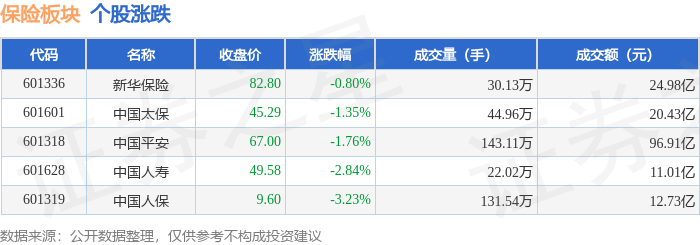
保险板块1月14日跌2.28%,中国人保领跌,主力资金净流出9.6亿元
Zheng Xing Xing Ye Ri Bao· 2026-01-14 08:58
证券之星消息,1月14日保险板块较上一交易日下跌2.28%,中国人保领跌。当日上证指数报收于 4126.09,下跌0.31%。深证成指报收于14248.6,上涨0.56%。保险板块个股涨跌见下表: 以上内容为证券之星据公开信息整理,由AI算法生成(网信算备310104345710301240019号),不构成投资建议。 从资金流向上来看,当日保险板块主力资金净流出9.6亿元,游资资金净流入7.4亿元,散户资金净流入 2.2亿元。保险板块个股资金流向见下表: | 代码 | 名称 | 主力净流入(元) | 主力净占比 游资净流入 (元) | | 游资净占比 散户净流入(元) | | 散户净占比 | | --- | --- | --- | --- | --- | --- | --- | --- | | 601336 新华保险 | | 1.75亿 | 7.01% | 5562.73万 | 2.23% | -2.31 Z | -9.23% | | 601628 中国人寿 | | -1319.10万 | -1.20% | 236.32万 | 0.21% | 1082.78万 | 0.98% | | 601319 中国人保 ...






A股收评:调整融资保证金比例三大指数冲高回落,沪指跌0.31%创指涨0.82%,AI应用走高!超2700股上涨,成交3.99万亿创新高放量2880亿
Ge Long Hui· 2026-01-14 07:33
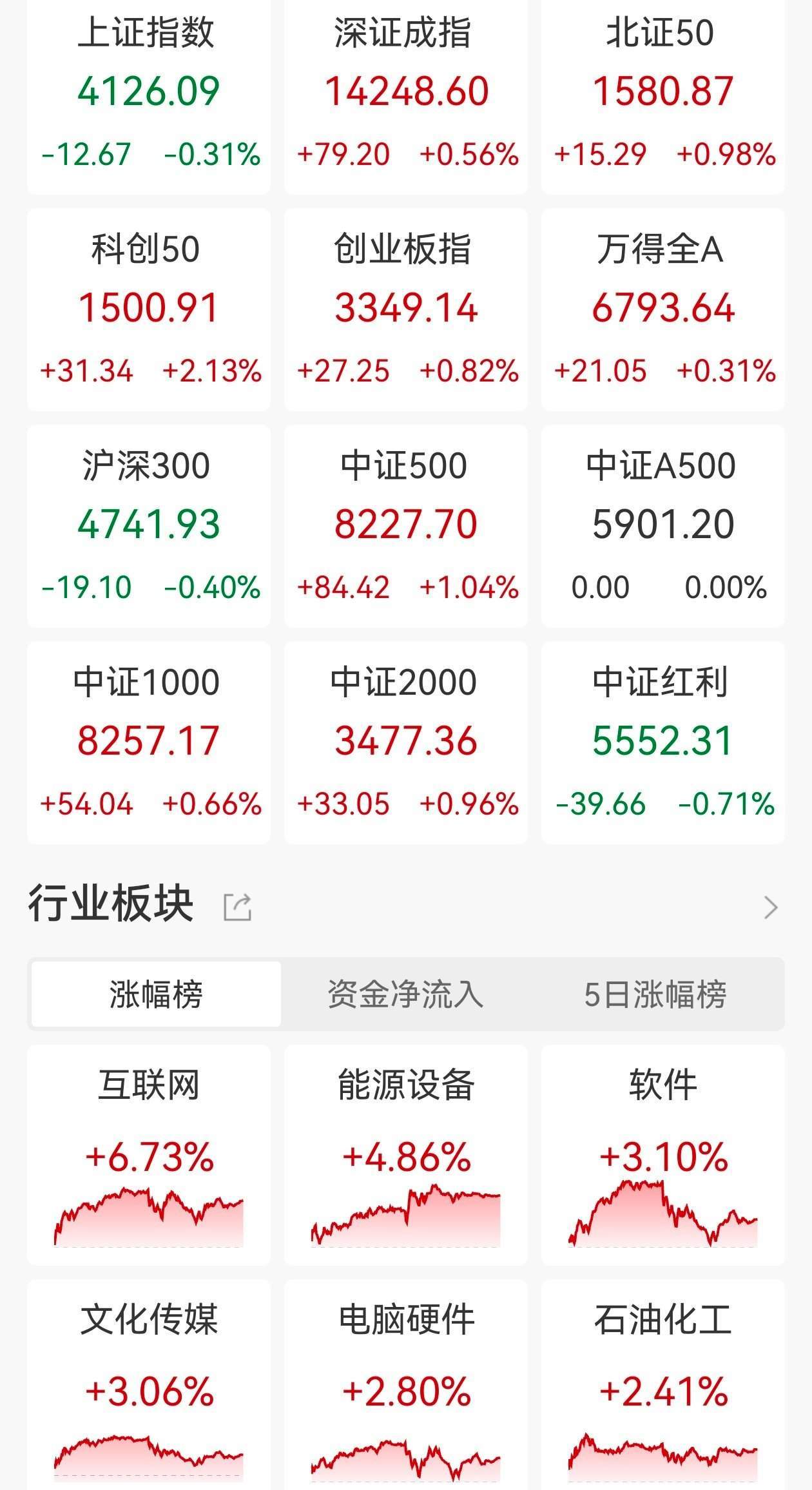
Market Overview - The Shanghai and Shenzhen stock exchanges announced adjustments to the financing margin ratio, leading to a mixed performance in the A-share market, with the Shanghai Composite Index down by 0.31% to 4126 points, while the Shenzhen Component Index rose by 0.56% and the ChiNext Index increased by 0.82% [1] - The total market turnover reached a record high of 3.99 trillion yuan, an increase of 288 billion yuan compared to the previous trading day, with over 2700 stocks rising and nearly 2600 stocks falling [1] Index Performance - Shanghai Composite Index: 4126.09, down 12.67 points (-0.31%) [2] - Shenzhen Component Index: 14248.60, up 79.20 points (+0.56%) [2] - ChiNext Index: 3349.14, up 27.25 points (+0.82%) [2] - Total A-shares Index: 6793.64, up 21.05 points (+0.31%) [2] Sector Performance - The internet sector saw significant gains, with notable stocks like Pinduoduo testing a "100 billion supermarket" concept, leading to a rise in related stocks such as Zhidao and Xinhua [3] - AI application stocks continued to surge, with Kimi concept, AI corpus, and other AI-related stocks leading the gains, resulting in multiple stocks hitting the daily limit [3] - The insurance sector declined, with China Pacific Insurance leading the losses [3] - Lithium mining stocks fell sharply, with Zhongmin Resources dropping over 7% [3] - Other sectors such as banks, robotics actuators, and aviation airports also experienced notable declines [3]




A股保险股午后跳水,中国人保跌3%
Ge Long Hui· 2026-01-14 05:18
格隆汇1月14日|A股市场保险股午后跳水,其中,中国人保跌3%,中国人寿跌超2%,中国太保跌超 1%。 ...
一份写满民生温度的长护答卷
Jin Rong Shi Bao· 2026-01-14 03:02
在浙江嘉兴嘉善县一家医院的病房里,80多岁的章大伯刚从急性胃炎、肺炎的病情中稳定下来,可 行动不便的他,让家人犯了难:怎么安全出院回家?正当一筹莫展之时,他们想起了人保财险浙江嘉兴 嘉善支公司长护险业管中心提醒过,长护险参保人员可预约"善诚护送"服务。"以前出院转运要自己花 钱,现在两次转运下来,160元费用直接减免,体贴入微的政策真是帮到了心坎上!"章大伯的儿子告诉 记者。 据人保财险相关人士介绍,党中央作出"健全基本公共服务体系,提高公共服务水平"决策部署,推 动非急救转运服务纳入长护险保障范围。当地人保财险工作人员深入社区、医院、养老机构,与失能家 庭、医护人员面对面座谈,全面梳理群众在出院转运环节的急难愁盼问题。2024年10月,嘉善县成为浙 江省首个非急救转运惠民机制试点城市。一年下来,这项服务已使用106次,为不少失能患者解决了出 院回家的实际困难。 "多亏了黄医生,她精神好多了,孩子们终于能喘口气奔事业了!"在河北邢台清河县葛仙庄,张阿 姨的老伴摩挲着护理日志上的"红勾",向人保财险的长护险专员道谢。此前,张阿姨突发脑出血后僵卧 在床,儿女们分身乏术无法及时照料,直到村医黄医生定期上门服务,为张 ...
开年“瘦身”步履不停 险企渠道转型聚焦精细化服务
Jin Rong Shi Bao· 2026-01-14 02:37
Core Viewpoint - The insurance industry is undergoing a significant transformation characterized by the continuous withdrawal of branch offices, reflecting a shift from extensive expansion to a focus on value and efficiency [5][6]. Group 1: Branch Withdrawals - In early 2026, multiple insurance companies, including China Life and Sunshine Insurance, have received approval to withdraw branch offices, continuing a trend observed in recent years [1]. - Over the past six years, more than 13,000 branch offices have been closed, with the number of withdrawals increasing from 971 in 2020 to over 3,100 in 2025, marking a new high [2]. - The majority of the withdrawn branches are located in third and fourth-tier cities, with over 70% of the closures in 2025 being marketing service departments [2][3]. Group 2: Factors Driving Closures - The closures are driven by three main factors: regulatory policies, changing market conditions, and technological advancements [4]. - Regulatory bodies have pushed for the elimination of "empty" and "inefficient" branches, particularly following the implementation of the "reporting and operation integration" policy [4]. - The competitive insurance market and rising operational costs have made it essential for companies to optimize branch structures and eliminate low-efficiency outlets [4]. Group 3: Industry Transformation - The ongoing withdrawal of branch offices is seen as a necessary process for the industry to abandon extensive expansion and reconstruct channel value [5]. - The industry is at a critical juncture, focusing on high-quality transformation while addressing challenges such as customer service continuity and talent retention [7]. - Companies are shifting from a traditional sales model to a service-oriented approach, integrating insurance products with health management and other value-added services to enhance customer loyalty [8]. Group 4: Future Outlook - The future of insurance branch offices will not be a complete replacement by online channels but rather a transformation of their functions to enhance customer experience and provide specialized services [8]. - The new channel structure will consist of comprehensive service points in major cities, grid-based service units in lower-tier markets, and a blend of online and offline services [8].


保险板块持续下探
Jin Rong Jie· 2026-01-14 01:58
Group 1 - The insurance sector continues to decline, with China Pacific Insurance and China Life Insurance both dropping over 2%, while New China Life Insurance fell by more than 1% [1]
保险板块持续下探,中国人保、中国人寿跌超2%
Xin Lang Cai Jing· 2026-01-14 01:53
Group 1 - The insurance sector is experiencing a downward trend, with major companies such as China Life Insurance and China Pacific Insurance seeing declines of over 2% [1] - New China Life Insurance has also reported a decrease, falling by more than 1% [1]
南京人保财险成功中标长期护理保险省内异地试点承办项目
Jiang Nan Shi Bao· 2026-01-13 09:32
与本地项目不同,异地承办工作对跨区域协调、资源整合与精细化管理能力提出了更高要求。这不仅是 对过往承办大病保险、本地长护险等项目优异表现的延续,更是对未来服务能力的全新考验。南京市分 公司将以高度的责任感,投入最优资源,确保每一位异地参保人都能享受到和在南京本地同样标准、同 样暖心的服务。 江南时报讯 新年伊始,长期护理保险项目传来捷报。在南京市医疗保障局组织的长期护理保险省内异 地待遇享受试点项目招标中,人保财险南京市分公司凭借专业的方案与丰富的经验成功中标。这一成果 标志着我司在深度参与政府社保项目、服务民生保障方面迈上了新台阶,再次彰显了主管部门对我司综 合服务能力的高度信赖。 根据通知,项目于2026年1月1日起正式执行。南京市分公司将与医保部门紧密沟通,精心规划,确保项 目准时、高质量落地,为完善南京市多层次医疗保障体系贡献人保的专业力量。 此次试点工作的全面推开,正是南京公司前期扎实探索与成功实践的延伸。在项目筹备阶段,南京公司 率先在苏州开展的先行试点,其创新的服务模式已成功入选全国系统十大长护险模式之一,为本次更大 范围的推广积累了宝贵经验。根据市医疗保障局与财政局的联合部署,项目遵循参保地政 ...
保险板块1月13日涨2.14%,新华保险领涨,主力资金净流出4.67亿元
Zheng Xing Xing Ye Ri Bao· 2026-01-13 09:06
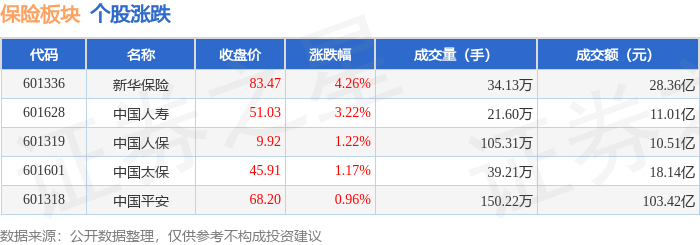
Core Viewpoint - The insurance sector experienced a rise of 2.14% on January 13, with New China Life leading the gains, while the overall market indices saw declines [1] Group 1: Market Performance - The Shanghai Composite Index closed at 4138.76, down 0.64% [1] - The Shenzhen Component Index closed at 14169.4, down 1.37% [1] Group 2: Individual Stock Performance - New China Life (601336) closed at 83.47, up 4.26% with a trading volume of 341,300 shares and a turnover of 2.836 billion [1] - China Life (601628) closed at 51.03, up 3.22% with a trading volume of 216,000 shares and a turnover of 1.101 billion [1] - China Pacific Insurance (601601) closed at 45.91, up 1.17% with a trading volume of 392,100 shares and a turnover of 1.814 billion [1] - China Ping An (601318) closed at 68.20, up 0.96% with a trading volume of 1,502,200 shares and a turnover of 10.342 billion [1] - China Re (601319) closed at 9.92, up 1.22% with a trading volume of 1,053,100 shares and a turnover of 1.051 billion [1] Group 3: Fund Flow Analysis - The insurance sector saw a net outflow of 467 million from institutional investors, while retail investors contributed a net inflow of 418 million [1] - New China Life had a net inflow of 212 million from institutional investors, while retail investors had a net outflow of 171 million [2] - China Life experienced a net inflow of 104 million from institutional investors, with retail investors seeing a net outflow of 8.424 million [2] - China Pacific Insurance had a net outflow of 23.39 million from institutional investors, while retail investors had a net inflow of 61.86 million [2] - China Ping An faced a significant net outflow of 718 million from institutional investors, while retail investors had a net inflow of 597 million [2]
中国人保入选“2025中国企业ESG百强”榜单
Xin Lang Cai Jing· 2026-01-13 05:36
附:"2025中国企业ESG百强"榜单 | 排名 | 公司名称 | 公司标识 | 得分星级 行业分类 | | | --- | --- | --- | --- | --- | | | 建设银行 SH601939 | ▲ 山国建设报订 | ★★★★★ | 美部 | | | 中国移动 (HK0941) | > China Mobile | ★★★★★ | 电信服务 | | | 农业银行 SH601288 | 1 中国农业银行 | ★★★★★ | 金融 | | 4 | 腾讯控股 HK0700 | Tencent 腾讯 | ★★★★★ | 信息技术 | | 5 | 中国银行 SH601988 | 中国银行 | ★★★★★ | 金融 | | 6 | 阳光电源 SZ300274 | SUNGROW | 文文文文文文 | T W | | --- | --- | --- | --- | --- | | 7 | 理想汽车 HK2015 | 一理想 | ★★★★★ | 可选消费 | | 8 | 工商银行 (HK1398) | 中国工商银行 | 文文文文文文 | 金融 | | 9 | 宁德时代 (HK3750) | | 文文文文文 ...
