
PICC(601319)

Search documents
内险股集体走低 中国人保(01339.HK)跌4.59%
Mei Ri Jing Ji Xin Wen· 2025-11-18 06:24
Group 1 - The insurance sector in China experienced a collective decline, with major companies seeing significant drops in their stock prices [1] - China Pacific Insurance (01339.HK) fell by 4.59%, trading at HKD 7.07 [1] - New China Life Insurance (01336.HK) decreased by 4.48%, with a price of HKD 48.62 [1] - China Life Insurance (02628.HK) saw a decline of 3.48%, priced at HKD 26.04 [1] - China Property & Casualty Insurance (02328.HK) dropped by 3.05%, trading at HKD 18.42 [1]


内险股集体走低 多股跌幅超3% 险企净投资收益率仍呈现趋势性下滑
Zhi Tong Cai Jing· 2025-11-18 06:18
Core Viewpoint - The insurance stocks in China have collectively declined, with significant drops observed in major companies such as China Life and New China Life, amidst a backdrop of changing investment strategies and market conditions [1] Group 1: Stock Performance - China Pacific Insurance (601319) fell by 4.59%, trading at 7.07 HKD [1] - New China Life (601336) decreased by 4.48%, trading at 48.62 HKD [1] - China Life (601628) dropped by 3.48%, trading at 26.04 HKD [1] - China Property & Casualty Insurance (02328) declined by 3.05%, trading at 18.42 HKD [1] Group 2: Investment Data - As of the end of Q3, the total stock investment balance for life and property insurance companies reached 3.62 trillion CNY, showing an increase in both scale and proportion compared to the end of Q2 [1] - The bond allocation ratio for life insurance companies has decreased quarter-on-quarter, while both life and property insurance companies have seen a decline in bank deposit allocation scale and proportion [1] Group 3: Analyst Insights - Liu Xinqi, Chief Analyst of Non-Bank Financials at Guotai Junan Securities, noted that the net investment yield for insurance companies is on a downward trend due to a low interest rate environment and narrowing credit spreads [1] - There is a pressing need for insurance companies to shift their asset allocation strategies from passive to active management, aiming to optimize asset allocation structures and achieve stable investment returns [1]


25Q3险资提升核心权益资产配置:保险行业周报(20251110-20251114)-20251118
Huachuang Securities· 2025-11-18 04:03
Investment Rating - The industry investment rating is "Recommended," indicating an expected increase in the industry index exceeding the benchmark index by more than 5% in the next 3-6 months [22]. Core Insights - The insurance index rose by 2.62%, outperforming the market by 3.71 percentage points, with significant individual stock performance variations [1]. - As of Q3 2025, the total balance of insurance funds reached 37.5 trillion, with life insurance companies holding 33.73 trillion and property insurance companies holding 2.39 trillion [2]. - The solvency adequacy ratio for insurance companies was reported at 186.3% for comprehensive and 134.3% for core solvency, with property insurance companies showing a strong solvency position [2]. - The report highlights a shift in asset allocation, with a decrease in bond allocation and an increase in equity and fund holdings, suggesting a more aggressive investment strategy in the current market environment [5]. Summary by Sections Market Performance - The insurance sector showed a positive performance with a 2.62% increase in the index, outperforming the broader market [1]. - Individual stock performances varied, with notable increases in stocks like Taiping (+10.96%) and PICC (+3.16%) [1]. Fund Allocation - As of Q3 2025, the allocation of insurance funds was as follows: bonds 50.3%, stocks 10%, and funds 5.5%, with a slight increase in stock and fund allocations [4]. - Life insurance companies had a bond allocation of 51% and a stock allocation of 10.1%, while property insurance companies had a bond allocation of 40.6% and a stock allocation of 8.7% [4]. Company Performance - New China Life reported a cumulative premium income of 181.973 billion, a 17% year-on-year increase [2]. - China Pacific Life's cumulative premium income was 241.322 billion, reflecting a 9.9% increase, while its property insurance segment saw a modest 0.4% growth [2][3]. - ZhongAn Online reported a cumulative premium income of 29.822 billion [3]. Investment Recommendations - The report suggests a strong beta attribute for the sector in the short term, with a focus on asset performance as a key driver [5]. - Long-term recommendations include companies like China Pacific, China Life, and New China Life based on fundamental performance and valuation [10].


保险板块11月17日跌1.69%,中国人保领跌,主力资金净流出4.49亿元
Zheng Xing Xing Ye Ri Bao· 2025-11-17 08:49
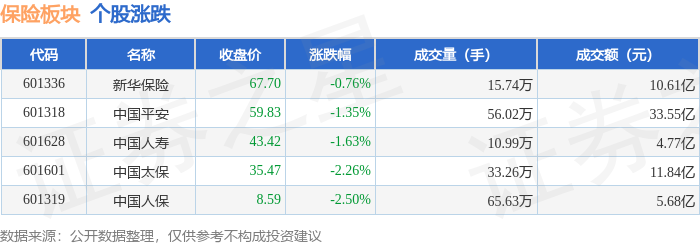
Core Insights - The insurance sector experienced a decline of 1.69% on November 17, with China Pacific Insurance leading the drop [1] - The Shanghai Composite Index closed at 3972.03, down 0.46%, while the Shenzhen Component Index closed at 13202.0, down 0.11% [1] Insurance Sector Performance - Major insurance stocks and their performance on November 17: - New China Life Insurance: Closed at 67.70, down 0.76%, with a trading volume of 157,400 shares and a turnover of 1.061 billion [1] - Ping An Insurance: Closed at 59.83, down 1.35%, with a trading volume of 560,200 shares and a turnover of 3.355 billion [1] - China Life Insurance: Closed at 43.42, down 1.63%, with a trading volume of 109,900 shares and a turnover of 477.1 million [1] - China Pacific Insurance: Closed at 35.47, down 2.26%, with a trading volume of 332,600 shares and a turnover of 1.184 billion [1] - China Reinsurance: Closed at 65.8, down 2.50%, with a trading volume of 656,300 shares and a turnover of 568.17 million [1] Capital Flow Analysis - On the same day, the insurance sector saw a net outflow of 449 million from institutional investors, while retail investors contributed a net inflow of 381 million [1] - Detailed capital flow for major insurance stocks: - New China Life Insurance: Institutional net outflow of 48.11 million, retail net inflow of 80.23 million [2] - China Reinsurance: Institutional net outflow of 59.35 million, retail net inflow of 36.53 million [2] - China Pacific Insurance: Institutional net outflow of 60.37 million, retail net inflow of 73.01 million [2] - China Life Insurance: Institutional net outflow of 66.36 million, retail net inflow of 48.20 million [2] - Ping An Insurance: Institutional net outflow of 215 million, retail net inflow of 143 million [2]

2025年三季度保险公司资金运用点评:资产配置股升债降,主动管理将更为重要
GUOTAI HAITONG SECURITIES· 2025-11-17 06:22
Investment Rating - The report maintains an "Overweight" rating for the insurance industry [3][5]. Core Insights - As of Q3 2025, the balance of insurance funds has steadily increased, with stock assets' proportion rising while bond assets' proportion has decreased. The importance of active management in investments is expected to grow [3][5]. - The insurance industry fund utilization balance reached CNY 37.5 trillion, up 12.6% year-to-date, driven by stable growth in new and renewal premiums, with an overall premium growth of 8.8% year-on-year [5][6]. - The allocation to stock assets increased to CNY 3.62 trillion, representing 10.0% of total assets, up 2.5 percentage points year-to-date [5][6]. - The report emphasizes the need for insurance companies to shift from passive to active asset management strategies to enhance investment returns [5][6]. Summary by Sections Fund Utilization - The insurance industry's fund utilization balance as of Q3 2025 is CNY 37.5 trillion, a 12.6% increase from the beginning of the year. Life insurance accounts for CNY 33.7 trillion (up 12.6%), while property insurance accounts for CNY 2.4 trillion (up 7.5%) [5][6]. - Premium growth for the insurance industry was 8.8% year-on-year, with life insurance growing by 10.2% and property insurance by 4.9% [5][6]. Asset Allocation - Stock asset allocation reached CNY 3.62 trillion, a 1.19 trillion increase year-to-date, with a 10.0% share of total assets, up 2.5 percentage points from the start of the year [5][6]. - The proportion of bond assets is 50.3%, a slight decrease of 0.8 percentage points from the previous quarter, while bank deposits decreased to 7.9% [5][6]. - Other assets, primarily non-standard assets, decreased to 18.4% [5][6]. Investment Strategy - The report highlights the need for improved active management capabilities in the investment sector, as net investment yields are declining in a low-interest-rate environment [5][6]. - It is suggested that insurance companies should adopt more flexible asset allocation strategies to optimize returns [5][6]. Stock Recommendations - The report recommends specific stocks including New China Life, Ping An Insurance, China Pacific Insurance, China Life, and China People's Insurance Group [5][6].
楚雄金融监管分局同意中国人保财险元谋支公司老城营销服务部营业场所变更
Jin Tou Wang· 2025-11-17 05:29
二、中国人民财产保险股份有限公司应按照有关规定及时办理变更及许可证换领事宜。 2025年11月11日,楚雄金融监管分局发布批复称,《关于中国人民财产保险股份有限公司元谋支公司老 城营销服务部变更营业场所的请示》(楚人保财险发〔2025〕124号)收悉。经审核,现批复如下: 一、同意中国人民财产保险股份有限公司元谋支公司老城营销服务部营业场所变更为:云南省楚雄彝族 自治州元谋县老城乡老城村委会河坝街村文兴玉、普文学私宅102室。 ...
保险机构投资前三季度最高收益率8.6% 三大调仓路径浮现:稳固收、加权益、拓另类
Zhong Guo Jing Ji Wang· 2025-11-17 02:09
Core Viewpoint - The insurance sector has shown impressive investment performance in the first three quarters of 2025, driven by a favorable stock market and increased bond yield volatility, leading to higher investment returns for insurance companies [1][2]. Investment Performance - Five listed insurance companies reported significant investment returns, with New China Life achieving an annualized return of 8.6%, while China Pacific Insurance and China Life reported non-annualized returns of 5.2% and 6.42%, respectively [1][2]. - China Life's total investment income reached RMB 368.55 billion, marking a 41.0% year-on-year increase [3]. - China Reinsurance's total investment income was RMB 862.50 billion, reflecting a 35.3% year-on-year growth [3]. Investment Strategies - Insurance companies are actively responding to the demand for long-term capital entry into the market, leveraging their patient capital advantage to steadily increase equity holdings [1][2]. - China Reinsurance has increased its long-duration bond allocation and focused on long-term growth potential in equity investments [3]. - China Pacific Insurance has maintained a disciplined asset allocation strategy, actively managing equity investments with a focus on undervalued and high-dividend stocks [3]. Alternative Investments - Alternative investments are becoming a key focus for insurance companies as part of their diversification strategies and business transformation efforts [4]. - China Reinsurance is actively promoting business transformation by investing in asset-backed plans and public/private REITs [5]. - China Ping An is also increasing its allocation to quality alternative assets to diversify and enhance its revenue sources [6]. Product Performance - A total of 1,483 insurance asset management products achieved positive returns this year, with a 93.8% success rate, and four products exceeded 100% returns [8].
杭州“六小龙”强势崛起 谁在耐心陪跑?
Zheng Quan Ri Bao· 2025-11-16 16:44
Core Viewpoint - The article highlights the significant role of insurance capital in supporting technological innovation and the development of the "Six Little Dragons" in Hangzhou, showcasing a shift from traditional investment to a more integrated approach that combines capital with services [1][5][9]. Group 1: Investment Landscape - The "Six Little Dragons" of Hangzhou include several innovative tech companies that have attracted attention from capital markets, with plans for some to go public [2][3]. - Major insurance companies like China Life and Pacific Insurance are using indirect investment methods, becoming financial backers through a multi-layered investment structure involving private equity funds [2][3]. - Insurance capital has invested over 600 billion yuan in technology enterprises, reflecting a growing commitment to supporting the entire lifecycle of tech companies [5][6]. Group 2: Investment Models - Insurance funds primarily participate as limited partners in private equity funds, often collaborating with government or state-owned funds to invest in technology firms [4][5]. - The investment approach of insurance capital has evolved to include a mix of indirect equity investments and direct funding, aiming to balance safety and strategic value [4][8]. - The establishment of funds like the National SME Development Fund illustrates how insurance capital is leveraging government-led initiatives to invest in technology [3][4]. Group 3: Challenges and Solutions - Insurance capital faces challenges in aligning its traditional investment strategies with the high-risk, high-reward nature of technology innovation [7][8]. - To address these challenges, insurance asset management companies are innovating their investment models, such as using S-funds to better match long-term insurance capital with the needs of tech innovation [7][8]. - The shift towards a more proactive role as "active capital" reflects a broader trend of insurance funds becoming integral partners in the technology sector, moving beyond mere financial investors [9].
险企App迎“花式升级” 场景突围正当时
Bei Jing Shang Bao· 2025-11-16 15:40
Core Insights - Insurance companies are transforming their apps from mere claims processing tools into comprehensive "health partners" and "lifestyle managers" that provide continuous service interactions beyond just insurance transactions [1][2][6] Group 1: Service Innovations - Insurance apps are increasingly offering diverse services, such as mental health assessments through the "Emotional Support Station" on the China People's Insurance app, allowing users to evaluate their psychological state [2][4] - China Life's app has introduced a "Pension Zone," providing users with easy access to information about various pension facilities and enabling online appointment scheduling [3][4] - The integration of medical services is exemplified by Ping An Life's app, which offers "domestic second opinions" from top hospital experts, addressing the shortage of medical resources in lower-tier facilities [4][6] Group 2: Strategic Shift - The evolution of insurance apps reflects a strategic shift from "post-incident compensation" to "full-cycle health management," enhancing user engagement and trust through regular service interactions [4][6] - The focus has shifted from merely selling policies to managing user relationships throughout their life cycles, incorporating health, retirement, and wealth management services [6][7] - Regulatory guidance is pushing insurance companies to integrate health management with insurance services, emphasizing risk reduction as a key business logic [6][7] Group 3: Market Dynamics - The user engagement metrics indicate a successful transition, with China People's Insurance app's monthly active users increasing from 3.35 million to nearly 4 million within a year [5][6] - The competitive landscape is evolving, with large insurers leveraging their resources to create comprehensive service platforms, while smaller firms focus on niche markets and partnerships to enhance their offerings [7][8]
中国医疗领域_花旗 2025 中国会议新动态_商业健康保险小组讨论要点
花旗· 2025-11-16 15:36
Investment Rating - The report assigns a rating of "Buy" for PICC Group with a target price of HK$7.5, implying a 0.72x 2026E P/EV [11] - For PICC Group A-shares, the target price is set at Rmb8.1, implying a 2026E Price/EV multiple of 0.86x [13] - PICC P&C is rated "Buy" with a target price of HK$21.2, based on a three-stage model [15] Core Insights - The consensus from the Citi China Conference 2025 indicates that commercial health insurance in China is transitioning from a supplementary role to an essential component of the healthcare system, potentially creating a market size of Rmb2-3 trillion [2][3] - The implementation of Diagnosis-Related Groups (DRG) reforms is identified as a primary catalyst for the demand for commercial insurance, leading to a dual-track system where commercial insurance covers innovative medical services not accommodated by the public system [3][4] - The new commercial insurance innovative drug catalog is expected to facilitate market access for pharmaceutical companies, allowing for reimbursement and sales of innovative drugs without the constraints of DRG payment limits [4] Market Dynamics - The healthcare market is projected to shift from individual-focused policies to group insurance, indicating the emergence of a more sophisticated corporate payer class [5] - The non-critical illness health segment is expected to grow at a double-digit CAGR, providing a significant funding source for high-cost innovative therapies and premium medical services [8] - The demand for integrated health management services is anticipated to create new B2B opportunities for service providers [7]