BANK COMM(601328)

Search documents
金融活水润百县 交通银行信用卡激活县域消费新动能
Ren Min Wang· 2025-12-22 02:58
Core Viewpoint - Consumption is identified as the main engine driving economic growth and is crucial for facilitating domestic circulation. The Bank of Communications is actively implementing measures to boost consumption through various promotional activities [1] Group 1: Financial Support for Consumption - The People's Bank of China and six other departments have issued guidelines to enhance financial support for key consumption areas, encouraging innovation in financial products tailored to consumption scenarios [2] - The Bank of Communications has launched the "Hundred Counties and Ten Thousand Stores" initiative, targeting county markets to improve financial service accessibility [2] Group 2: Three-Tiered Consumption Activation - The Bank of Communications has established a three-tier upgrade system focusing on basic, improved, and new consumption to stimulate county-level consumer activity [3] - For basic consumption, the bank is creating a network of inclusive services that integrates high-frequency consumption scenarios like dining and home services [3] - To enhance improved consumption, the bank is leveraging government subsidies and credit card advantages to meet the demand for quality upgrades in appliances, home decor, and automobiles [3] - The bank is fostering new consumption through a dual empowerment system combining digital and scenario-based approaches, utilizing the "Buy Now" app and various promotional events [3] Group 3: Local Economic Revitalization - In regions like Yiwu, local businesses embodying cultural heritage are becoming key consumer attractions, supported by the bank's initiatives [4] - The "Cultural Tourism + Consumption" strategy is revitalizing local merchants, allowing residents to enjoy affordable local cuisine while accessing financial services [4] - The bank aims to continue stimulating consumption through events like "Most Popular Friday" and "Year-End Celebration," while enhancing its network of inclusive services [4]

三家银行收千万级罚单,合计被罚超亿元
Jing Ji Wang· 2025-12-22 02:51
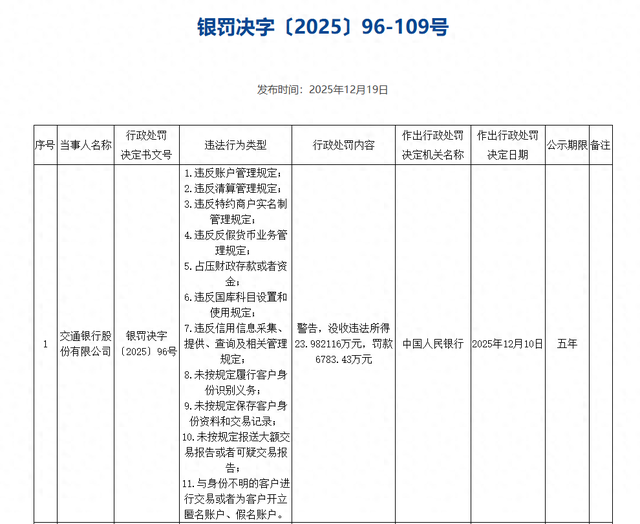
Group 1: Core Insights - The People's Bank of China imposed penalties on three banks for various regulatory violations, including account management and financial statistics [1][2][4][6] - China Merchants Bank was fined 67.8343 million yuan for 11 violations, including failure to comply with customer identity verification and transaction reporting [2] - Industrial and Commercial Bank of China was fined 39.615 million yuan for 10 violations, with penalties imposed on 17 responsible individuals [4][5] - Shanghai Pudong Development Bank was fined 15.6 million yuan for imprudent management of wealth management and sales activities, with multiple individuals facing industry bans [6] Group 2: Specific Violations - Traffic Bank's violations included failure to manage accounts properly, non-compliance with currency management regulations, and not reporting large or suspicious transactions [2] - Industrial and Commercial Bank of China's violations included breaches in financial statistics, account management, and customer identity verification [4][5] - Shanghai Pudong Development Bank's issues stemmed from inadequate management of wealth management and sales operations, leading to penalties for several employees [6] Group 3: Responses from Banks - Traffic Bank acknowledged the penalties and stated that it has completed rectification work and is committed to enhancing compliance and internal controls [3] - Industrial and Commercial Bank of China expressed its commitment to addressing the root causes of the violations and improving risk management and compliance practices [5] - Shanghai Pudong Development Bank's penalties included significant bans on several employees, indicating serious management failures [6]


2026年贺岁纪念币、纪念钞今起陆续发行 预约方式→
Xin Lang Cai Jing· 2025-12-21 21:43
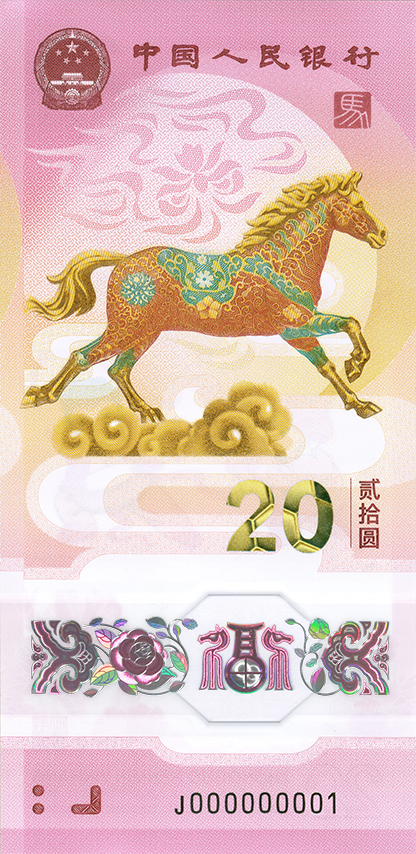
Core Points - The People's Bank of China is issuing the 2026 New Year commemorative banknotes and coins starting from December 22, 2023, which includes one banknote and three types of coins, all recognized as legal tender in the People's Republic of China [1][7]. Commemorative Banknote - The commemorative banknote features a horse design on the front, along with the national emblem, the name of the bank, and various security features such as a holographic pattern and a transparent window. The denomination is 20 yuan [1][3]. - The back of the banknote showcases a festive scene with children celebrating, accompanied by Mongolian decorative patterns, and includes the denomination in multiple languages [3]. - The banknote has a face value of 20 yuan, dimensions of 145mm by 70mm, is made of plastic, and has a total issuance of 100 million pieces, including 20,000 for historical archives [5]. Commemorative Coins - The commemorative coins include a 10 yuan dual-color copper alloy coin, which features traditional Chinese paper-cut art and a horse image on the back, with a total issuance of 100 million pieces, including 10,000 for historical archives [6]. - The dual-color copper alloy coin has a diameter of 27mm and will be available for reservation from January 13 to 14, 2026, through designated banks [6]. - Additionally, a set of gold and silver commemorative coins is being issued, which includes a 1-gram round gold coin and an 8-gram diamond-shaped silver coin, both featuring traditional auspicious designs [7][9]. - The 1-gram gold coin has a face value of 10 yuan, a diameter of 10mm, and a maximum issuance of 150,000 pieces, while the 8-gram silver coin has a face value of 3 yuan, a side length of 23mm, and a maximum issuance of 1 million pieces [8][9]. Sales Channels - The sales channels for these commemorative coins and banknotes will be detailed on the China Gold Coin website and the "China Gold Coin" WeChat official account [10].



银行理财年末蓄势待发
Bei Jing Ri Bao Ke Hu Duan· 2025-12-21 16:34
Core Viewpoint - The year-end bonus has become a focal point for banks' marketing strategies, with various banks launching specialized financial products to attract customers looking to invest their bonuses [1][6]. Group 1: Bank Marketing Strategies - Multiple banks have initiated year-end bonus exclusive financial activities through online channels, offering a range of products including wealth management, funds, and precious metals [1][3]. - Postal Savings Bank has launched a campaign featuring low-risk financial products with attractive yields, such as "天天盈" with a maximum annualized yield of 1.52% and "优盛·鸿锦" with a yield of 4.76% [3]. - Traffic Bank's promotional activities cover a wide array of products, emphasizing low-risk financial products with annualized yields above 4.9% for certain offerings [4]. Group 2: Product Characteristics - The core focus of the promoted financial products is on low to medium risk, aligning with the general market trend towards stable investment options [6][7]. - The financial products are primarily invested in fixed-income assets such as government bonds, financial bonds, and corporate bonds, with some higher-risk products including stocks and funds for enhanced returns [6][7]. - Banks are encouraging a tiered asset allocation strategy, suggesting a mix of conservative, stable, and aggressive investments based on individual risk tolerance [5][6]. Group 3: Investor Guidance - Investors are advised to assess their risk tolerance and investment goals before selecting financial products, with recommendations for low-risk options if the bonus is needed for short-term expenses [7]. - The importance of understanding the performance benchmarks of financial products is emphasized, as actual returns may vary due to market conditions [7].


银行发力年终奖专属理财
Bei Jing Shang Bao· 2025-12-21 15:55
Core Insights - Year-end bonuses are a key focus for banks, leading to the launch of specialized financial products aimed at maximizing returns for employees expecting these bonuses [1][4] - Banks are promoting low to medium-risk financial products, aligning with the conservative investment preferences of the general public [1][4] Product Offerings - Several banks, including Postal Savings Bank, have introduced specific financial products for year-end bonuses, such as "天天盈" with a maximum annualized yield of 1.52% and "优盛·鸿锦最短持有" with a yield of 4.76% [2] - The products are designed to cater to different investment timelines and risk appetites, with options ranging from low-risk daily redeemable products to those with longer holding periods [3] Marketing Strategies - Banks are intensifying their marketing efforts around year-end bonuses to boost their wealth management, fund, and insurance services, enhancing customer loyalty and overall contribution [4] - The marketing strategies include a variety of products such as deposits, wealth management, funds, and insurance, with a focus on low-risk options [3][4] Investment Recommendations - Analysts suggest that investors should assess their risk tolerance and investment needs before selecting financial products, recommending low-risk options for short-term needs and higher-yield products for long-term investments [5] - The importance of understanding the performance benchmarks of financial products is emphasized, as actual returns may vary due to market conditions [5]
盯上年终奖,银行理财蓄势待发,这类产品成“香饽饽”
Bei Jing Shang Bao· 2025-12-21 12:51
Core Insights - The year-end bonus has become a focal point for banks' marketing strategies, with various institutions launching dedicated financial products to attract customers [1][5] - Banks are primarily promoting low to medium-risk financial products, aligning with the conservative investment preferences of the general public [1][5] Group 1: Bank Marketing Strategies - Multiple banks have initiated year-end bonus exclusive financial activities through online channels, offering a one-stop investment solution that includes wealth management, funds, and precious metals [1][3] - Postal Savings Bank has introduced products like "天天盈" with a maximum annualized yield of 1.52% and "优盛·鸿锦最短持有7天15号薪享C" with a yield of 4.76%, targeting different investor needs [3] - The marketing campaigns by banks not only aim to increase sales of financial products but also enhance customer loyalty and overall contribution [5] Group 2: Product Offerings and Risk Assessment - The financial products being marketed are primarily low to medium-risk, focusing on fixed-income assets such as government bonds and corporate bonds, which are consistent with the broader market trends [5] - Traffic Bank's offerings include products with annualized yields above 4.9%, catering to various investment horizons from short-term to annual investments [4] - Investors are advised to assess their risk tolerance and investment goals, with recommendations for low-risk products for those with lower risk capacity and higher-risk options for more aggressive investors [6]

三家银行收千万元级别罚单,合计罚款超亿元,交通银行回应
Sou Hu Cai Jing· 2025-12-21 02:53
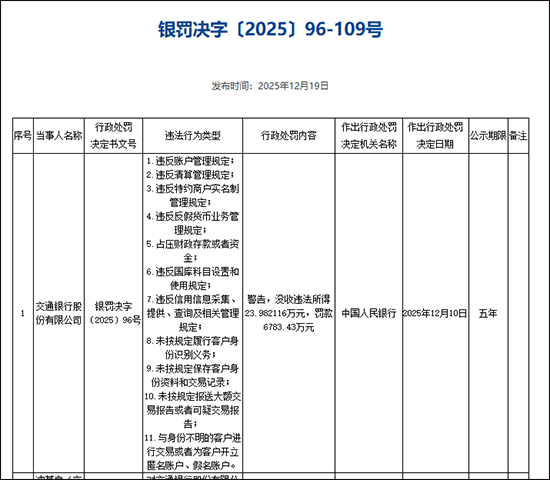
12月19日,央行发布行政处罚信息,工行因10项违法行为类型被警告、没收违法所得434.57万元并罚款 3961.5万元;交行因11项违法行为类型被警告、没收23.98万元并罚款6783.43万元,交行回应称问题发 生在2023年前且已整改。同日,金融监管总局披露浦发银行因业务管理不审慎等被罚1560万元。 其中,工商银行因违反金融统计相关规定、违反账户管理规定等10项违法行为类型被警告,被没收违法 所得434.57万元,罚款3961.5万元。 此外,上述三家银行多名涉事相关责任人一并遭罚。 来源:每日经济新闻、九派新闻 交通银行因违反账户管理规定、违反清算管理规定等11项违法行为类型被处以警告,被没收违法所得 23.98万元,罚款6783.43万元。 交行就此向《每日经济新闻》记者回应称:"2022年11月至2023年4月,中国人民银行对交通银行开展综 合执法检查。本次处罚是基于上述执法检查发现的问题作出的,处罚所涉问题均发生在2023年以前。交 行对此诚恳接受、高度重视,已完成整改工作,并以问题整改为契机,认真举一反三,不断优化长效机 制。本行将持续强化内控合规管理,厚植稳健审慎经营文化,不断提升经营管理 ...
新浪财经资讯AI速递:昨夜今晨财经热点一览 丨2025年12月21日
Xin Lang Cai Jing· 2025-12-21 00:03
Group 1: Economic Performance and Challenges - Nanjing aims for a GDP exceeding 2 trillion yuan by 2025, but its 2024 GDP is projected at 1.85 trillion yuan, with growth rates below national and provincial levels [1][6] - The growth rate for the first three quarters of 2025 is 5.2%, significantly lower than the required 8.1% to meet the target, indicating substantial challenges ahead [1][6] Group 2: Consumer Behavior Trends - The "zero-debt population" has gained popularity on social media, characterized by living without loans and avoiding overspending, leading to discussions on consumer attitudes and quality of life [1][6] Group 3: Gold Market Dynamics - Domestic gold prices have been rising, with brands like Chow Tai Fook increasing prices by over 30% for some products, having raised prices three times this year [1][7] - In response to high gold prices, the consumption of gold jewelry has significantly declined, prompting brands to shift from traditional weight-based pricing to a higher-margin fixed-price model [1][7] Group 4: Regulatory Developments in Banking - Three major banks, including China Communications Bank, Industrial and Commercial Bank of China, and Shanghai Pudong Development Bank, were fined over 120 million yuan for various regulatory violations [2][8] - The fines were issued for issues such as account management and anti-money laundering, with all banks stating that the problems occurred before 2023 and have since been rectified [2][8] Group 5: Stablecoin Regulation - A global regulatory framework for stablecoins is taking shape, with the U.S. and EU introducing relevant legislation [2][9] - China is encouraged to pilot a unique stablecoin scheme in free trade zones, leveraging stablecoins for cross-border payments while ensuring financial security and currency sovereignty [2][9] Group 6: Quality Control Issues in Traditional Brands - Tong Ren Tang, a century-old brand, faces a quality crisis due to a product with zero phospholipid content being sold at a significant markup, raising concerns about profit-driven practices and consumer trust [3][10] - The company has previously encountered quality issues with its branded products, leading to a decline in its reputation and sales performance [3][10] Group 7: Cash Payment Regulations - New regulations from the People's Bank of China will take effect on February 1, 2026, mandating cash acceptance in various payment scenarios to uphold the legal status of the yuan [4][11] - The regulations aim to address cash refusal practices and ensure that cash payment options are available in both online and offline settings [4][11] Group 8: Market Adjustments in Gold Investment - Following new tax policies, the Shenzhen Shui Bei gold market has seen a tightening of regulations, with reports indicating that "investment gold" has been quietly removed from listings [1][13]

交行、工行、浦发三家银行收千万级罚单,累计过亿
Sou Hu Cai Jing· 2025-12-20 15:43
12月19日,中国人民银行与国家金融监督管理总局同日披露多张巨额罚单,涉及交通银行、工商银行及 浦发银行三家大型银行,累计罚款金额超1.2亿元人民币。 交通银行被罚6783.43万元 中国人民银行网站12月19日消息,央行发布行政处罚信息显示,交通银行因违反账户管理规定、违反清 算管理规定等11项违法行为被处以警告,并被没收违法所得23.982116万元,累计罚款约6783.43万元。 | | | | 银行快享 [2025] 96-109号 | | | | | --- | --- | --- | --- | --- | --- | --- | | | | | 发布时间:2025年12月19日 | | | | | 房号 当事人名称 | 行政处罚 | | | 作出行政处罚 | 作出行政处罚 | | | 决定书文号 | | 書法行为类型 | 行政处罚内容 | 决定机关名称 决定日期 | | 公元期限 备注 | | | | 1. 违反账户管理提完; | | | | | | | | 2. 违反清算管理规定; | | | | | | | | 3. 违反特约商户买名制 | | | | | | | | 管理规定; | | | ...
交通银行、工商银行、浦发银行,被处罚
Bei Jing Ri Bao Ke Hu Duan· 2025-12-20 09:03
转自:北京日报客户端 12月19日,中国人民银行发布行政处罚信息显示,交通银行因违反账户管理规定、违反清算管理规定等 11项违法行为被处以警告,并被没收违法所得23.982116万元,罚款6783.43万元; 工商银行因违反金融统计相关规定、违反账户管理规定等10项违法行为被警告,被没收违法所得 434.570857万元,罚款3961.5万元。 同日,金融监管总局披露的罚单显示,浦发银行因相关理财、代销等业务管理不审慎,员工管理不到位 等被罚款1560万元。 上述三家银行所涉多名相关责任人一并遭罚,其中有多人遭受禁业处罚。 交通银行被罚6783.43万元 处罚信息显示,交通银行违法行为包括: 1.违反账户管理规定; 2.违反清算管理规定; 7.违反信用信息采集、提供、查询及相关管理规定; 8.未按规定履行客户身份识别义务; 9.未按规定保存客户身份资料和交易记录; 10.未按规定报送大额交易报告或者可疑交易报告; 11.与身份不明的客户进行交易或者为客户开立匿名账户、假名账户。 3.违反特约商户实名制管理规定; 4.违反反假货币业务管理规定; 5.占压财政存款或者资金; 6.违反国库科目设置和使用规定; 作出 ...