BANK COMM(601328)

Search documents
交通银行“沃德财富万里行”江苏站活动举办
Shang Hai Zheng Quan Bao· 2025-12-23 19:06
Core Insights - The event "沃德财富万里行" organized by Bank of Communications Jiangsu Branch and交银施罗德基金 aims to enhance wealth management services and investor education [1][2] - The "沃德财富" brand has evolved over nearly two decades to provide comprehensive wealth management solutions, including asset allocation, family trusts, cross-border finance, and tax planning [1] - The bank emphasizes the importance of professional wealth management in increasing residents' property income and promoting common prosperity [1] Group 1: Wealth Management Development - The "沃德财富" brand was launched in 2006 and has since become a trusted partner for individual clients, managing over 400 billion yuan in financial assets for more than 11 million customers [1] - The wealth management team consists of experts from various fields, utilizing professional research and quantitative models to create the "沃德优选" product series [1] Group 2: Economic Insights and Asset Allocation - The event featured insights from Zhao Wei, Chief Economist at Shenwan Hongyuan, who discussed the current economic trends and investment opportunities, focusing on policy understanding and market outlook for 2026 [3] - Liu Jiawei from交银施罗德基金 provided practical advice on fund asset allocation and the underlying logic of asset management [3] Group 3: Social Responsibility in Wealth Management - The "瑞善" charitable trust service was launched to enhance the professionalism and efficiency of charitable activities, reflecting the social responsibility aspect of wealth management [4][5] - The "瑞善" program includes upgrades in service models, focus areas, user experience, technology integration, and collaboration with nearly 50 trust and charity organizations to create a transparent charitable network [5]

【金融服务】以数智驱动“五个中心”能级跃升 交通银行上海市分行扎根上海主场,赋能上海发展
Xin Lang Cai Jing· 2025-12-23 12:09
Group 1: Digital Transformation in Shipping Finance - The launch of the "Shipping Butler" service by Bank of Communications Shanghai Branch enables a fully digital settlement system for shipping fees, reducing processing time from over 3 days to just a few minutes [1][14] - The service integrates multi-currency payments and eliminates the need for manual document submission, showcasing the bank's digital innovation in supporting the shipping industry [1][14] Group 2: Support for Key Industries - The "2+3+6+6" modern industrial system in Shanghai focuses on transforming traditional industries and developing three leading sectors: integrated circuits, biomedicine, and artificial intelligence [2][15] - Bank of Communications Shanghai Branch has provided over 170 billion yuan in credit support to more than 1,000 enterprises in these key industries as of September 2025 [17] Group 3: Financing for High-End Manufacturing - The bank plays a crucial role in supporting the domestic aircraft manufacturing supply chain, including financing for the C919 aircraft project [2][15] - It has successfully executed the first business on the China Commercial Aircraft Corporation's "de-nuclearization" supply chain platform, enhancing supply chain resilience [2][15] Group 4: International Trade and Cross-Border Financing - The bank is optimizing cross-border trade settlements to facilitate smoother capital flows, aiming to elevate Shanghai's status in the global trade landscape [6][19] - The introduction of the mBridge digital currency platform allows for innovative cross-border payment solutions, significantly reducing operational costs and risks for enterprises [20][21] Group 5: Aviation Financing Innovations - The bank has developed flexible financing solutions for airlines, including a combination of working capital loans and long-term leasing options for aircraft [9][23] - As of November 2025, the bank has facilitated financing for 30 aircraft, amounting to nearly 16.5 billion yuan [23] Group 6: Support for Technology and Innovation - The establishment of the first technology finance center by Bank of Communications aims to bridge the gap between banks and tech startups, addressing the unique financing challenges faced by these companies [10][24] - The bank has introduced innovative products like the "Smart List Loan," which evaluates companies based on their potential rather than fixed assets, providing significant support to over 1,600 tech enterprises [26][27]
中国银行、建设银行、工商银行、农业银行、交通银行、邮储银行,集体调整中长期存款产品!
Mei Ri Jing Ji Xin Wen· 2025-12-23 03:53
Core Viewpoint - Major Chinese banks, including Bank of China, China Construction Bank, Industrial and Commercial Bank of China, Agricultural Bank of China, Bank of Communications, and Postal Savings Bank, have collectively adjusted their deposit products, particularly reducing the availability of medium to long-term deposit offerings as year-end savings demand increases [1][3]. Group 1: Changes in Deposit Products - Many customers, such as a resident in Beijing, have reported difficulties in finding suitable 5-year large-denomination certificates of deposit (CDs) as these products are no longer displayed by major banks [3]. - The interest rates for 3-year related products have dropped to between 1.5% and 1.75% across various banks [3]. - Smaller banks are also following suit, with institutions like Meizhou Commercial Bank and Yilian Bank removing 5-year fixed deposit products from their offerings [5]. Group 2: Reasons for Adjustments - The withdrawal of long-term deposit products is a response to the ongoing decline in banks' net interest margins, driven by falling loan rates that have significantly reduced asset yields [5]. - Analysts suggest that banks are compelled to eliminate high-interest long-term products to avoid severe interest margin losses or potential deficits, which could threaten their long-term stability and pose systemic risks [5]. Group 3: Implications for the Banking Sector - The adjustments in deposit products are expected to enhance the certainty of banks' profit forecasts, providing fundamental support for valuation recovery, particularly for large banks with low-cost liabilities and high dividend yields [6]. - The reduction in deposit rates may lead to a "deposit migration" effect, where funds seeking higher returns move from the banking system to capital markets, potentially benefiting direct financing markets [6].



中国银行、建设银行、工商银行、农业银行、交通银行、邮储银行,集体调整!
Mei Ri Jing Ji Xin Wen· 2025-12-23 03:45
Core Viewpoint - The recent decrease in medium to long-term deposit products in the market is attributed to banks' responses to the ongoing decline in net interest margins, leading to a reduction in the availability of five-year large certificates of deposit (CDs) and lower interest rates on three-year products [3][5][6]. Group 1: Market Trends - There is a noticeable reduction in the availability of five-year large CDs among major banks, with interest rates for three-year products dropping to between 1.5% and 1.75% [3]. - Smaller banks are also adjusting their deposit offerings, with some, like Meizhou Commercial Bank, announcing the removal of five-year fixed deposit products [5]. - The trend of withdrawing long-term deposit products is not limited to national banks but is also seen in local and private banks [5]. Group 2: Banking Sector Implications - The withdrawal of long-term deposit products is a necessary response to the challenges posed by declining bank net interest margins, as banks face significant risks of interest margin losses if they do not eliminate high-interest long-term products [5]. - Analysts suggest that this shift will enhance the certainty of banks' profit expectations, particularly benefiting large banks with low-cost liabilities and high dividend yields, making them more attractive to long-term investors [6]. - The reduction in deposit rates may lead to a "deposit migration" effect, where funds move from the banking system to capital markets, potentially increasing liquidity in stocks, bonds, and funds, which could positively impact direct financing markets [6].



锚定2026年重点任务:银行业积极稳投资扩内需惠民生
Jin Rong Shi Bao· 2025-12-23 03:21
内需是拉动经济增长主动力与稳定锚。今年以来,针对经济运行中面临的风险挑战,各地区、各部 门按照党中央决策部署,加紧实施更加积极有为的宏观政策,及时出台和有效落实一系列扩大国内需 求、促进产业升级、畅通经济循环的政策措施,对于支持经济平稳运行发挥了重要作用。 近期召开的中央经济工作会议提出,我国经济发展中老问题、新挑战仍然不少,外部环境变化影响 加深,国内供强需弱矛盾突出,重点领域风险隐患较多。 在部署2026年经济工作时,会议将"坚持内需主导,建设强大国内市场"放在了首位。"大国经济的 重要特征是回旋余地大,内部可循环,能够独立自主、自立自强。"中央财办分管日常工作的副主任、 中央农办主任韩文秀表示,要进一步开拓视野、创新思路,努力在扩大消费和投资、发展科技和产业、 促进城乡融合和区域协调发展等方面,培育形成更多新的增长点,开辟发展新空间。 投资是扩大内需的重要抓手。根据中央经济工作会议部署,2026年要推动投资止跌回稳,适当增加 中央预算内投资规模,优化实施"两重"项目,优化地方政府专项债券用途管理,继续发挥新型政策性金 融工具作用,有效激发民间投资活力。高质量推进城市更新。 在国家政策和金融管理部门的指引 ...
半两财经|六大国有银行下架五年期大额存单 居民投资理财方式在变
Sou Hu Cai Jing· 2025-12-23 03:06
Core Viewpoint - The six major state-owned banks in China have collectively withdrawn high-interest five-year large-denomination certificates of deposit (CDs), marking a significant shift in the savings market as they adjust to ongoing pressure on net interest margins [2][3]. Group 1: Changes in Deposit Products - The five-year large-denomination CDs have been completely removed from sale, with searches on banking apps returning results indicating "no products available" or "sold out" [2]. - The minimum investment for three-year large-denomination CDs has increased significantly, with thresholds rising from the traditional 200,000 yuan to between 1 million and 5 million yuan, while the interest rate for a 1 million yuan three-year product is only 1.55%, narrowing the gap with regular savings accounts [3]. Group 2: Impact on Banking Sector - Data from the National Financial Regulatory Administration shows that the net interest margin for commercial banks was only 1.42% in Q3 2025, with predictions indicating a slight narrowing of the decline to around 4 basis points in 2026, marking the first time since 2022 that the annual decline will be in single digits [4]. - The continuous narrowing of net interest margins has been a significant factor affecting bank profitability, prompting banks to withdraw high-interest long-term deposit products to stabilize their margins [5]. Group 3: Shifts in Savings Behavior - The withdrawal of high-interest CDs has led to a migration of funds estimated to be in the hundreds of billions, as the market loses "risk-free high-yield" products [6]. - Despite 62.3% of residents still preferring to save more, this figure has been declining for two consecutive quarters, with a noticeable increase in the willingness to invest [6]. - Different types of savers are adjusting their strategies: conservative savers are sticking to deposit products, while moderate investors are moving towards bank wealth management and "fixed income plus" products, and aggressive investors are beginning to allocate funds to high-dividend stocks and gold ETFs [6].


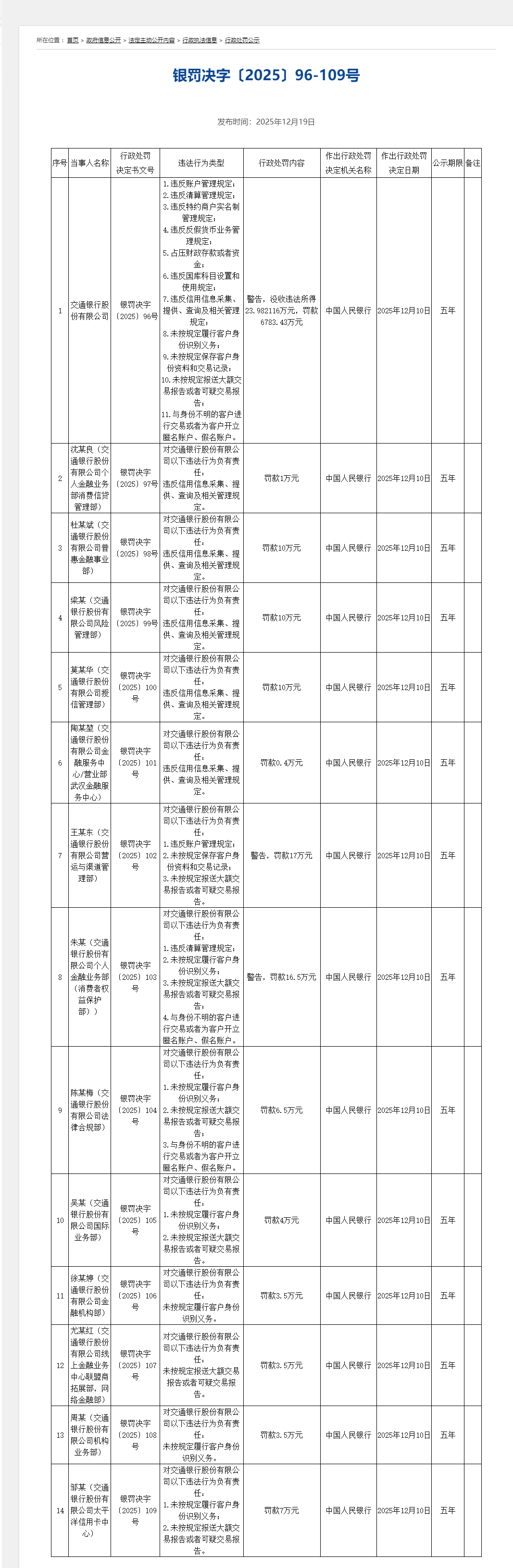
交通银行11宗违规被罚6783.43万元 违反账户管理规定等
Zhong Guo Jing Ji Wang· 2025-12-23 02:41
Core Viewpoint - The People's Bank of China has imposed significant penalties on China Communications Bank for various regulatory violations, highlighting the importance of compliance in the banking sector [1][3]. Regulatory Violations - China Communications Bank was found to have committed multiple violations, including: 1. Violating account management regulations 2. Violating clearing management regulations 3. Violating special merchant real-name system management regulations 4. Violating counterfeit currency business management regulations 5. Misappropriating fiscal deposits or funds 6. Violating treasury account setup and usage regulations 7. Violating credit information collection, provision, inquiry, and related management regulations 8. Failing to fulfill customer identity verification obligations 9. Failing to retain customer identity information and transaction records as required 10. Failing to report large transactions or suspicious transactions as required 11. Conducting transactions with unidentified customers or opening anonymous or pseudonymous accounts for customers [1][4]. Penalties Imposed - The total penalties imposed on China Communications Bank include: - Confiscation of illegal gains amounting to 239,821.16 yuan - A fine of 67,834,300 yuan [1][3]. - Individual employees of the bank also faced penalties, with fines ranging from 4,000 yuan to 100,000 yuan for various infractions [2][5]. Bank's Response - China Communications Bank acknowledged the penalties and stated that the issues were identified during a comprehensive enforcement inspection conducted by the People's Bank of China from November 2022 to April 2023. The bank has completed rectification work and is committed to enhancing internal control and compliance management [3][6].
浙江华正新材料股份有限公司关于为全资子公司提供担保的公告
Shang Hai Zheng Quan Bao· 2025-12-22 19:57
Group 1 - The company Zhejiang Huazheng New Materials Co., Ltd. has provided guarantees for its wholly-owned subsidiaries Zhuhai Huazheng New Materials Co., Ltd. and Zhejiang Huaju Composite Materials Co., Ltd. to support their operational development and funding needs [2][9] - The company signed a guarantee contract with Zhuhai Branch of Bank of Communications for a maximum credit amount of 150 million RMB for Zhuhai Huazheng, with a guarantee period extending three years after the main debt's maturity [2][10] - A maximum guarantee amount of 25 million RMB was also provided for Zhejiang Huaju through a contract with Hangzhou Zhong'an Branch of Industrial and Commercial Bank of China, with a similar three-year guarantee period [2][11] Group 2 - The company's board of directors approved the provision of guarantees for subsidiaries at meetings held on March 17, 2025, and April 10, 2025, with a total maximum guarantee amount of 4.5 billion RMB [3][4] - The approved guarantee limits include 1.8 billion RMB for Zhuhai Huazheng and 455 million RMB for Zhejiang Huaju, with the authorization period lasting until the next annual shareholders' meeting [3][4] - The company has a total external guarantee amount of 3.798 billion RMB, which is 260.98% of the audited net assets for 2024, with no overdue guarantees reported [13]

持续强化金融机构合规意识和风险意识 三家银行累计被罚超1.2亿元
Zhong Zheng Wang· 2025-12-22 09:32
Core Viewpoint - The article highlights the increasing trend of strict financial regulation in China, with multiple banks facing significant penalties for various violations of financial management regulations [1][2][3]. Group 1: Regulatory Actions - The Agricultural Development Bank of China, Hebei Branch, was fined 1.46 million yuan for violating financial statistical management regulations [1]. - Industrial and Commercial Bank of China (ICBC) was penalized with a total fine of approximately 40.6 million yuan for 10 violations, including breaches of financial statistics and account management regulations [2]. - Bank of Communications was fined around 67.83 million yuan for 11 violations, including account management and customer identity verification failures [3]. - Shanghai Pudong Development Bank was fined 15.6 million yuan for mismanagement in wealth management and sales activities [3]. Group 2: Specific Violations - ICBC's violations included failing to comply with financial statistics, account management, and customer identity verification regulations, among others [2]. - Bank of Communications faced penalties for similar issues, including improper account management and failure to report large or suspicious transactions [3]. - The regulatory actions against these banks reflect a broader trend of tightening financial oversight in China, aimed at enhancing compliance and risk awareness within financial institutions [1][3]. Group 3: Individual Accountability - A total of 17 individuals from ICBC were penalized, with fines ranging from 7.1 thousand to 130 thousand yuan for their respective roles in the violations [2]. - 13 individuals from Bank of Communications were also penalized, with fines of 10 thousand yuan each for various infractions [3]. - The regulatory body has taken steps to hold individual employees accountable, indicating a shift towards personal responsibility in compliance failures [4].

交行海南省分行深耕全球布局 为自贸港迈向高水平开放搭建“金融桥梁”
Zhong Guo Jin Rong Xin Xi Wang· 2025-12-22 08:39
Core Viewpoint - Hainan is positioned as a key experimental zone for reform and opening up in the new era, with financial services playing a crucial role in its development, as demonstrated by the achievements of the Bank of Communications Hainan Branch [1]. Group 1: Supporting the Real Economy - The Bank of Communications has implemented a special service plan for supporting Hainan's free trade port development for five consecutive years, translating it into tangible results [4]. - The bank has directed credit resources towards key areas of the real economy, including opening green approval channels for projects like Boao Airport and Sanya Phoenix Airport, ensuring construction progress [4]. - In the direct financing market, the bank plans to increase its investment in local bonds to 6.5 billion yuan in 2024 and has cumulatively underwritten credit bonds exceeding 3.4 billion yuan, providing stable funding for local development [4]. Group 2: Leading Cross-Border Financial Services - As one of the first banks to pilot multi-functional free trade accounts (EF accounts), the Bank of Communications Hainan Branch has achieved a business volume exceeding 46 billion yuan by the end of October 2025, leading among state-owned banks in the province [5]. - The bank has supported the Hainan provincial government in issuing offshore RMB local bonds in Hong Kong for four consecutive years and facilitated the first investment in local government bonds through EF accounts in September 2025 [5]. Group 3: Comprehensive Empowerment Across Industries - The bank focuses on key industries, providing "park guarantee loans" to small and micro enterprises in the Sanya Yazhou Bay Science and Technology City and supporting the cultural tourism industry by underwriting 1.4 billion yuan in medium-term notes for Hainan Tourism Investment Development Co., Ltd [6]. - The proportion of online inclusive loans has reached 75%, with the balance of inclusive loans for small and micro enterprises exceeding 8.8 billion yuan [6]. - The bank has innovated in public welfare finance, launching the first digital RMB tax refund business in the country and collaborating with local authorities to protect workers' wages through a payment supervision system [6]. Group 4: Global Collaboration for Future Development - The bank is enhancing its forward-looking layout to embrace a higher level of openness, deepening the application of EF accounts in offshore bond issuance and new types of offshore international trade settlements [7]. - It aims to strengthen domestic and international linkages to facilitate Hainan enterprises in cross-border mergers and acquisitions, overseas listings, and global financing [7]. - The bank plans to attract more foreign asset management institutions to Hainan and improve payment convenience for foreign individuals through expanded merchant coverage and optimized foreign currency exchange services [7].