
BANK COMM(601328)

Search documents
交通银行(601328) - 交通银行H股公告
2025-12-01 10:45
截至月份: 2025年11月30日 狀態: 新提交 致:香港交易及結算所有限公司 FF301 股份發行人及根據《上市規則》第十九B章上市的香港預託證券發行人的證券變動月報表 公司名稱: 交通銀行股份有限公司 呈交日期: 2025年12月1日 I. 法定/註冊股本變動 | 1. 股份分類 | 普通股 | 股份類別 | H | | 於香港聯交所上市 (註1) | | 是 | | | --- | --- | --- | --- | --- | --- | --- | --- | --- | | 證券代號 (如上市) | 03328 | 說明 | H股 | | | | | | | | | 法定/註冊股份數目 | | | 面值 | | 法定/註冊股本 | | | 上月底結存 | | | 35,011,862,630 | RMB | | 1 RMB | | 35,011,862,630 | | 增加 / 減少 (-) | | | | | | RMB | | | | 本月底結存 | | | 35,011,862,630 | RMB | | 1 RMB | | 35,011,862,630 | | 2. 股份分類 | 普通股 ...
交通银行(601328) - 交通银行第十一届董事会第三次会议决议公告
2025-12-01 09:45
交通银行股份有限公司(以下简称"交通银行"或"本行")董事会及全体董事保证本 公告内容不存在任何虚假记载、误导性陈述或者重大遗漏,并对其内容的真实性、准确性和 完整性承担法律责任。 股票代码:601328 股票简称:交通银行 编号:临 2025-074 交通银行股份有限公司 第十一届董事会第三次会议决议公告 表决情况:同意 15 票,反对 0 票,弃权 0 票 张薇女士简历请见附件。 1 (二)关于修订《交通银行股份有限公司市场风险管理办法》的决议 会议审议批准《关于修订<交通银行股份有限公司市场风险管理办法>的议 案》。 一、董事会会议召开情况 根据《交通银行股份有限公司章程》第 158 条和第 161 条的规定,经任德奇 董事长提议,本行第十一届董事会第三次会议(临时会议)以书面传签方式召开。 本行于 2025 年 11 月 24 日以专人送达或电子邮件的方式,向全体董事发出本次 会议通知和文件。本次会议应参加表决董事 15 名,截至 2025 年 12 月 1 日,共 收回有效表决票 15 份。根据表决结果,参加表决人数符合《中华人民共和国公 司法》和《交通银行股份有限公司章程》的规定。 二、董事会会议 ...
交通银行:捐赠港币1000万元用于香港救灾
Xin Lang Cai Jing· 2025-12-01 09:39
交通银行(601328.SH)公告称,董事会批准向香港捐赠港币1000万元用于救灾和善后。 ...
交通银行(03328) - 月报表 - 截至二零二五年十一月三十日止股份发行人的证券变动月报表
2025-12-01 09:34
FF301 股份發行人及根據《上市規則》第十九B章上市的香港預託證券發行人的證券變動月報表 截至月份: 2025年11月30日 狀態: 新提交 致:香港交易及結算所有限公司 公司名稱: 交通銀行股份有限公司 呈交日期: 2025年12月1日 I. 法定/註冊股本變動 | 1. 股份分類 | 普通股 | 股份類別 | H | | 於香港聯交所上市 (註1) | | 是 | | | --- | --- | --- | --- | --- | --- | --- | --- | --- | | 證券代號 (如上市) | 03328 | 說明 | H股 | | | | | | | | | 法定/註冊股份數目 | | | 面值 | | 法定/註冊股本 | | | 上月底結存 | | | 35,011,862,630 | RMB | | 1 RMB | | 35,011,862,630 | | 增加 / 減少 (-) | | | | | | RMB | | | | 本月底結存 | | | 35,011,862,630 | RMB | | 1 RMB | | 35,011,862,630 | | 2. 股份分類 | 普通股 ...
我国5家银行入选2025年G-SIB名单 分析称未来继续看好银行板块
Zhong Guo Jing Ying Bao· 2025-12-01 09:21
Group 1 - The Financial Stability Board (FSB) announced the 2025 list of Global Systemically Important Banks (G-SIBs), with five Chinese banks included, maintaining the same number as the previous year [1] - Industrial and Commercial Bank of China (ICBC) has been upgraded to the third group with an additional capital requirement of 2.0%, while Bank of China, Agricultural Bank of China, and China Construction Bank remain in the second group with a requirement of 1.5%, and Bank of Communications stays in the first group with a requirement of 1% [1] - Following the upgrade, ICBC's core Tier 1 capital adequacy ratio regulatory requirement increases from 9% to 9.5%, with a current ratio of 13.6%, providing a buffer of 4.6 percentage points [1] Group 2 - Fitch Ratings noted that the scoring changes for Chinese G-SIBs in 2025 show that scale is no longer the primary driver for score increases, and exchange rate effects have positively influenced scores [2] - The Basel Committee plans to adjust the framework for identifying G-SIBs from year-end static data to annual average calculations, which may reduce data volatility and limit the impact on most banks, although institutions near threshold levels may experience changes [2] - The increase in global systemic importance reflects the fundamental strength of large banks, with scores for the five major banks rising between 9 to 33 points, and Bank of China is likely to be upgraded soon [2] Group 3 - The banking sector is viewed positively for long-term investment, with a high dividend strategy still having room for growth amid an "asset shortage" environment, suggesting a continuation of structural market trends [3]



多因素催化银行股涨幅居前,地产风险可控:华创金融红利资产月报(2025年11月)-20251201
Huachuang Securities· 2025-12-01 09:13
Investment Rating - The report maintains a "Buy" rating for the banking sector, highlighting that multiple factors are driving the rise in bank stocks, while real estate risks are deemed manageable [2]. Core Insights - The report emphasizes that the balance between supply and demand is crucial for economic recovery, with recent policies aimed at boosting consumer demand expected to enhance this balance [2]. - The M1 growth rate peaked and has started to decline, indicating a shift in deposit flows towards non-bank deposits due to a buoyant capital market [2]. - The exposure to real estate risks is decreasing, with a notable reduction in the balance of real estate development loans, suggesting that banks are adopting a more cautious approach [2][7]. - The report notes that the non-performing loan ratio for real estate has decreased, indicating improved risk management within the banking sector [7]. Monthly Market Performance - In November 2025, the banking sector saw a cumulative increase of 2.99%, outperforming the CSI 300 index by 5.4 percentage points, ranking second among 31 sectors [11]. - The report indicates that institutional investors have increased their holdings in bank stocks, driven by a stable fundamental outlook and expectations of valuation recovery [11]. - The valuation of state-owned banks has shown significant improvement, with the price-to-book (PB) ratio rising from approximately 0.76X at the beginning of the month to 0.78X by the end [13]. Banking Sector Fundamentals - The report tracks monthly data indicating that the banking sector's core revenue-generating capacity has strengthened, with asset quality remaining stable [8]. - The report highlights that the banking sector's current valuation is at a historically low level, with a price-to-earnings (PE) ratio of 6.53 and a PB ratio of 0.56 [11]. Investment Recommendations - The report suggests a diversified investment strategy focusing on banks with high dividend yields and strong asset quality, particularly smaller banks with solid provisioning coverage [7]. - It also recommends attention to low-valuation joint-stock banks with potential for return on equity (ROE) improvement, such as CITIC Bank and Industrial Bank [7]. - The report indicates that banks with robust customer bases and excellent risk control are likely to have greater valuation elasticity in the context of economic structural transformation [7].


国有大型银行板块12月1日跌0.26%,农业银行领跌,主力资金净流出3.48亿元
Zheng Xing Xing Ye Ri Bao· 2025-12-01 09:09
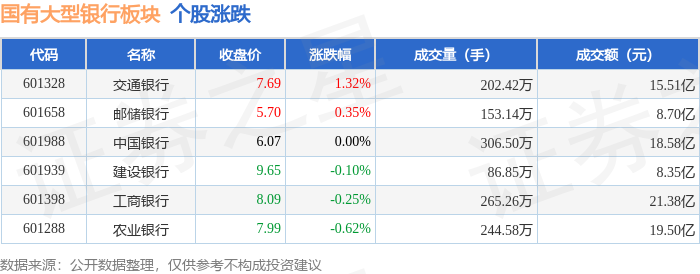
证券之星消息,12月1日国有大型银行板块较上一交易日下跌0.26%,农业银行领跌。当日上证指数报收 于3914.01,上涨0.65%。深证成指报收于13146.72,上涨1.25%。国有大型银行板块个股涨跌见下表: | 代码 | 名称 | 收盘价 | 涨跌幅 | 成交量(手) | 成交额(元) | | | --- | --- | --- | --- | --- | --- | --- | | 601328 | 交通银行 | 7.69 | 1.32% | 202.42万 | | 15.51 Z | | 601658 | 邮储银行 | 5.70 | 0.35% | 153.14万 | | 8.70 Z | | 601988 | 中国银行 | 6.07 | 0.00% | 306.50万 | | 18.58 Z | | 666109 | 建设银行 | 9.65 | -0.10% | 86.85万 | | 8.35 Z | | 601398 | 工商银行 | 8.09 | -0.25% | 265.26万 | | 21.38 Z | | 601288 | 农业银行 | 7.99 | -0.62% | 244.58万 ...


交银展业通“码上扫”全国推广活动在湘启动,政银携手破融资难题
2 1 Shi Ji Jing Ji Bao Dao· 2025-12-01 09:08
Group 1 - The event "Integration of Industry and Finance, Serving Enterprises Together" was held in Changsha, Hunan, aimed at promoting collaboration among government, banks, and enterprises to address financing challenges for SMEs [1] - The "Jiao Xiang Gong Xin Yi Dai" product, developed in collaboration between the Hunan Provincial Department of Industry and Information Technology and Bank of Communications, is designed to alleviate financing difficulties for SMEs [1][3] - The product offers up to 20 million yuan in credit loans, with a fully online application process that can result in funds being disbursed in as little as 2 days [3][4] Group 2 - The Bank of Communications plans to deepen strategic cooperation with the Hunan Provincial Department of Industry and Information Technology, implementing a monthly financing promotion initiative and enhancing risk-sharing mechanisms [2] - The "Jiao Yin Zhan Ye Tong" brand encompasses all inclusive financial products for micro and small enterprises, providing a comprehensive financial service solution [2] - The product has received positive market feedback, with 2,115 applications and a pre-approval amount of 1.8 billion yuan within the first month of launch [4]
交通银行安徽省分行:益农快贷 金融益农
Ren Min Wang· 2025-12-01 08:21
Group 1 - The article highlights the blooming season of oil tea trees in Shucheng County, Anhui Province, emphasizing the local significance of the industry and the efforts of local enterprises in oil tea seedling technology and product development [1] - Anhui Dechang Seedling Company, managed by Zhan Wenyong and his father, operates over 1200 acres of oil tea forest and employs a significant number of workers during peak seasons, showcasing the labor-intensive nature of agricultural production [1] - The company faces financial pressures due to the need for labor, equipment upgrades, and research investments, particularly during production expansion and seasonal procurement [1] Group 2 - In early November, the Agricultural Bank of China provided a loan of 1.3 million yuan through the "Yinong Quick Loan" program, which was crucial for Dechang Seedling Company to procure quality seedlings [2] - The successful approval of the loan marks the first implementation of the "Yinong Quick Loan" product in Anhui, aimed at addressing the financing challenges faced by agricultural enterprises [3] - The Agricultural Bank of China is actively promoting financial services tailored to various agricultural scenarios, utilizing a data-driven risk control model to facilitate efficient online loan approvals for urgent funding needs [3]
金融行业周报:全球重要性银行名单公布,资本市场投融资改革持续推进-20251201
Ping An Securities· 2025-12-01 05:35
Investment Rating - The industry investment rating is "Outperform the Market," indicating an expected performance that exceeds the CSI 300 index by more than 5% within the next six months [34]. Core Insights - The Financial Stability Board (FSB) has released the 2025 list of Global Systemically Important Banks (G-SIBs), with five Chinese state-owned banks included. Notably, the Industrial and Commercial Bank of China (ICBC) has moved to the third group, requiring an additional capital requirement increase from 1.5% to 2.0% [4][12]. - The China Securities Regulatory Commission (CSRC) has issued a draft announcement for the pilot of Commercial Real Estate Investment Trusts (REITs), aimed at revitalizing the commercial real estate market and filling the gap for quality investment targets [5][13]. - A joint announcement from six departments outlines a plan to enhance the adaptability of supply and demand for consumer goods, targeting significant improvements in the supply structure by 2027 and fostering a high-quality development pattern by 2030 [6][19]. Summary by Sections Global Systemically Important Banks - The FSB has categorized Chinese banks into different groups, with ICBC in the third group, Agricultural Bank of China, Bank of China, and China Construction Bank in the second group, and China Communications Bank in the first group. This classification reflects the banks' systemic importance and associated capital requirements [4][12]. Commercial Real Estate Investment Trusts - The CSRC's draft announcement outlines the framework for establishing Commercial REITs, which will allow investment in commercial real estate assets to generate stable cash flows. This initiative is expected to address challenges in the commercial real estate sector and enhance financing channels [5][13]. Consumer Goods Supply and Demand - The joint plan from six government departments aims to optimize the supply structure of consumer goods, with specific targets for 2027 and 2030. The focus is on creating significant consumer sectors and enhancing the quality of products available in the market [6][19]. Industry Data - The banking sector saw a net injection of 15,118 billion yuan through open market operations, while the SHIBOR rates showed mixed performance. The average daily trading volume in the stock market was 21,585 billion yuan, reflecting a decrease of 7.4% from the previous week [21][27][29]. - The insurance sector's ten-year government bond yield increased by 2.46 basis points, indicating a slight upward trend in interest rates [32].