
NCI(601336)

Search documents
非银金融行业跟踪周报:险资规模超36万亿,持续增配股票,市场交投活跃,8月日均超2万亿-20250817
Soochow Securities· 2025-08-17 11:02
Investment Rating - The report maintains an "Increase" rating for the non-bank financial industry [1] Core Insights - The non-bank financial sector has shown strong performance, with all sub-sectors outperforming the CSI 300 index in recent trading days [9][10] - The insurance sector's asset management balance has surpassed 36 trillion yuan, with a continued increase in stock allocation [21][27] - The securities industry has experienced a significant increase in trading volume, with a year-on-year rise of 212.23% in August [15][19] - The multi-financial sector is transitioning into a stable growth phase, with trust assets growing but profits declining [29][32] Summary by Sections Non-Bank Financial Sub-Sector Performance - In the recent five trading days (August 11-15, 2025), the non-bank financial sector outperformed the CSI 300 index, with the securities sector rising by 8.18%, multi-financial by 4.73%, and insurance by 3.28% [9][10] Non-Bank Financial Sub-Sector Insights Securities - Trading volume has significantly increased, with an average daily trading amount of 21,549 billion yuan in August, up 212.23% year-on-year [15][19] - The first unprofitable company under the "Science and Technology Innovation Board" has been approved for IPO, indicating a more inclusive policy for tech firms [19][20] Insurance - The insurance sector's asset management balance reached 36.23 trillion yuan, with a year-to-date increase of 8.9% [21][27] - The allocation to stocks has increased to 8.8%, while the bond allocation is at 51.9% [21][27] Multi-Financial - The trust industry saw its asset scale reach 29.56 trillion yuan, with a year-on-year profit decline of 45.5% [29][32] - The futures market experienced a trading volume of 10.59 billion contracts in July, with a year-on-year increase of 48.89% [33][40] Industry Ranking and Key Company Recommendations - The industry ranking is as follows: Insurance > Securities > Other Multi-Financial [45] - Recommended companies include China Ping An, New China Life, China Pacific Insurance, CITIC Securities, Tonghuashun, and Jiufang Zhitu Holdings [45]





非银行金融行业周报:市场交投延续活跃,持续推荐非银板块-20250817
SINOLINK SECURITIES· 2025-08-17 10:58
Investment Rating - The report suggests a positive outlook for the securities sector, indicating that brokerage firms are entering an accelerated growth phase due to improved market sentiment and trading activity [2][3]. Core Insights - The report highlights a significant increase in daily stock trading volume, with an average daily turnover of 2.1 trillion yuan, representing a 24% increase week-on-week [2]. - The financing balance of margin trading has risen to 2.06 trillion yuan, providing strong support for future market performance [2]. - The introduction of fiscal subsidy policies for personal consumption loans is expected to lower financing costs and stimulate consumer spending, enhancing market vitality [2][50][51]. Summary by Sections Securities Sector - The brokerage sector's performance is improving, with a clear trend of year-on-year earnings growth in the first half of the year, highlighting a mismatch between high profitability and low valuations [3]. - The report recommends focusing on brokerage firms with significantly low valuations and those expected to benefit from potential mergers and acquisitions [3]. - The report notes that the Hong Kong Stock Exchange is likely to benefit from the deepening of cross-border trading and the listing of A-share companies in Hong Kong, with a notable increase in average daily trading volume [3]. Insurance Sector - As of the first half of 2025, the total scale of funds utilized by the insurance industry reached 36.23 trillion yuan, marking an 8.9% increase from the previous year [2]. - The allocation of insurance funds to stocks has increased to 8.8%, with a notable rise in stock investments driven by favorable market conditions [2]. - The report emphasizes the improvement in the insurance operating trend, as evidenced by significant share purchases by major insurance companies, indicating growing confidence in the sector [4]. Market Dynamics - The report indicates that the insurance sector is experiencing a positive shift, with major players increasing their stakes in key insurance stocks, reflecting a recovery in the operating environment [4]. - The report also mentions that the insurance industry is seeing a rise in original premium income, with China Pacific Insurance reporting a 5.48% year-on-year increase [41]. - The report highlights the approval of several insurance asset management companies, indicating a trend towards long-term investment reforms within the insurance sector [43].


2025Q2保险业资金运用数据点评:保险资金加速入市,上半年股票投资净增量超6400亿
CMS· 2025-08-17 04:34
Investment Rating - The report maintains a "Recommended" rating for the insurance industry, indicating a positive outlook for the sector's fundamentals and expected performance relative to market benchmarks [2][6][7]. Core Insights - The insurance industry's fund utilization scale surpassed 36 trillion yuan in Q2 2025, with a net increase of over 1.3 trillion yuan in the quarter, reflecting strong growth driven by premium income and asset value appreciation [5][7]. - The allocation structure of insurance funds has become more pronounced, with bond and stock proportions reaching new highs, indicating a shift towards a "barbell" investment strategy [5][7]. - Regulatory measures have accelerated the entry of insurance funds into the stock market, with the stock allocation reaching a record high of 8.8% by the end of Q2 2025, supported by policy adjustments aimed at promoting long-term investments [5][7]. Summary by Sections Industry Scale - As of Q2 2025, the total market capitalization of stocks held by insurance companies is approximately 670.62 billion yuan, with a circulating market value of about 641.38 billion yuan [2]. Fund Utilization - The total fund utilization balance for insurance companies reached 36.23 trillion yuan by the end of Q2 2025, marking an 8.9% increase year-to-date and a 3.7% increase from Q1 2025 [5][7]. - The bond allocation exceeded 51%, the highest level in recent years, while bank deposits and non-standard investments were reduced [5][7]. Equity Investment - The stock balance for life and property insurance companies reached 3.07 trillion yuan, with a net increase of 640.6 billion yuan in the first half of 2025, indicating a strong commitment to equity investments [5][7]. - The report highlights a resurgence in insurance companies' stake acquisitions in peer firms, with 27 instances recorded in 2025, reflecting confidence in the sector's recovery and long-term value [5][7]. Investment Recommendations - The report suggests individual stock recommendations including China Pacific Insurance, New China Life Insurance, and Ping An Insurance, while also advising attention to China Life Insurance, China Taiping Insurance, and China Property & Casualty Insurance for their long-term investment value [7].

入市加速,险资系私募证券基金增至7家
Zheng Quan Shi Bao· 2025-08-16 11:50
Group 1 - The core viewpoint of the news is the approval of China Pacific Insurance Asset Management Co., Ltd. to establish a private fund management company, marking progress in the long-term investment pilot program for insurance funds [1][2] - The pilot program allows insurance companies to invest in private securities funds primarily targeting the secondary market for stocks, with a focus on long-term holdings [2][3] - The establishment of the new private fund management company increases the total number of insurance-related private fund management companies to seven [4] Group 2 - The newly approved private fund management company, Renbao Qiyuan Huizhong, will issue funds to China Pacific Life Insurance to raise insurance capital for investment in the capital market [3][4] - The pilot program has seen a total of 6 insurance-related private securities investment funds enter the operational phase, with specific funds like the Honghu Fund series and Taikang Stable Fund already established [5][7] - The total amount approved for the long-term investment pilot program has reached 222 billion yuan, with various insurance companies participating, including China Life, Xinhua Insurance, and others [7]

入市加速!险资系私募证券基金增至7家
券商中国· 2025-08-16 10:29
Core Viewpoint - The recent approval of the establishment of the "Renbao Qiyuan Huizhong" private fund management company marks significant progress in the pilot program for long-term investment of insurance funds, increasing the total number of insurance-related private fund companies to seven [1][4]. Summary by Sections Progress of Long-term Investment Pilot - The pilot program allows insurance companies to establish private securities funds primarily investing in the stock market for long-term holding [3]. - The first batch of approvals in October 2023 included China Life and Xinhua Insurance, jointly investing 50 billion yuan to establish a company fund, which has been fully invested [2][3]. - The second batch includes several companies with varying investment amounts, such as 100 billion yuan from Renbao Insurance and its asset management [2][3]. Establishment of Private Fund Companies - The total number of insurance-related private fund management companies has reached seven, with the latest addition being "Renbao Qiyuan Huizhong" [4][5]. - Other companies include "Guofeng Xinghua," "Taikang Stable," "Taibao Zhiyuan," "Hengyi Chiying," and "Yangguang Hengyi" [4][5]. Operational Status of Funds - Six insurance-related private securities investment funds are currently operational, including various funds managed by Guofeng Xinghua and Taikang Stable [6][8]. - The first pilot fund, "Honghu Zhi Yuan," has a total scale of 500 billion yuan, which has been fully invested as of March 2024 [6][7]. Benefits of Long-term Investment Pilot - The pilot program is expected to enhance the efficiency of insurance fund utilization and improve asset-liability matching under new accounting standards, with a total pilot amount of 222 billion yuan across three batches [9].


互联网保险概念上涨3.33%,7股主力资金净流入超3000万元
Zheng Quan Shi Bao Wang· 2025-08-15 10:19
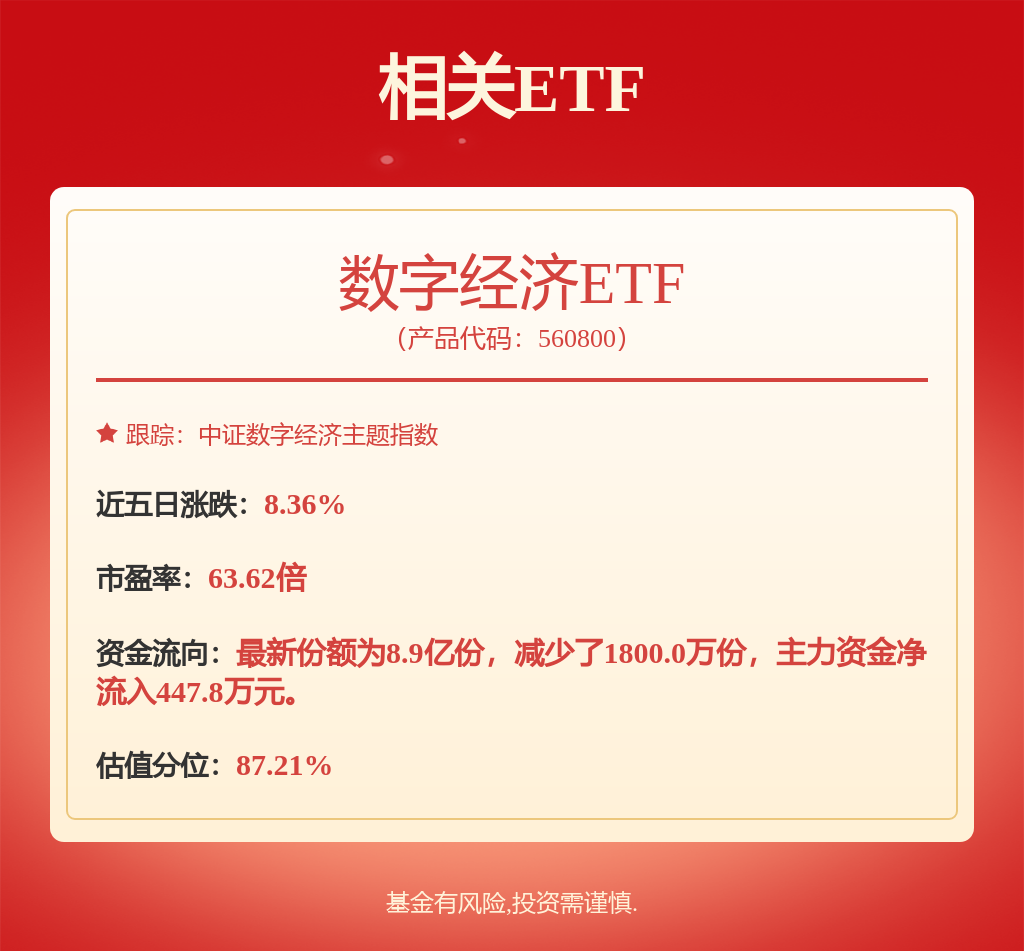
Group 1 - The internet insurance concept index rose by 3.33%, ranking 10th among concept sectors, with 20 stocks increasing in value, led by Guoyuan Technology, Dongfang Wealth, and Zhisheng Information, which rose by 22.29%, 9.85%, and 6.86% respectively [1] - The internet insurance sector saw a net inflow of 6.563 billion yuan, with 13 stocks receiving net inflows, and 7 stocks attracting over 30 million yuan in net inflows. Dongfang Wealth topped the list with a net inflow of 5.713 billion yuan, followed by China Ping An, New China Life, and China Life Insurance with net inflows of 387 million yuan, 268 million yuan, and 6.285 million yuan respectively [2][3] - In terms of net inflow ratios, New China Life, Dongfang Wealth, and Shenzhen Energy had the highest ratios at 13.16%, 12.92%, and 9.45% respectively [3] Group 2 - The digital economy ETF, tracking the CSI Digital Economy Theme Index, experienced a 5-day increase of 8.36% and has a price-to-earnings ratio of 63.62 times, with the latest share count at 890 million, down by 18 million shares, and a net inflow of 4.478 million yuan [6]

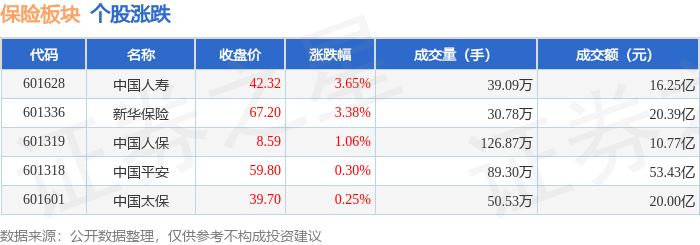
保险板块8月15日涨1.88%,中国人寿领涨,主力资金净流入8.93亿元
Zheng Xing Xing Ye Ri Bao· 2025-08-15 08:44
证券之星消息,8月15日保险板块较上一交易日上涨1.88%,中国人寿领涨。当日上证指数报收于 3696.77,上涨0.83%。深证成指报收于11634.67,上涨1.6%。保险板块个股涨跌见下表: 从资金流向上来看,当日保险板块主力资金净流入8.93亿元,游资资金净流出3.43亿元,散户资金净流出 5.49亿元。保险板块个股资金流向见下表: | 代码 | 名称 | 主力净流入(元) | | 主力净占比 游资净流入 (元) | | 游资净占比 散户净流入(元) | | 散户净占比 | | --- | --- | --- | --- | --- | --- | --- | --- | --- | | 601336 新华保险 | | | 2.88亿 | 14.11% | -3099.64万 | -1.52% | -2.57 Z | -12.59% | | 601318 中国平安 | | | 2.81亿 | 5.26% | -2.13亿 | -3.99% | -6803.03万 | -1.27% | | 601601 中国太保 | | | 2.20亿 | 11.01% | -1.13亿 | -5.63% | -1.0 ...
中证香港200动量指数报4085.10点,前十大权重包含新华保险等
Jin Rong Jie· 2025-08-15 08:23
Core Points - The China Securities Hong Kong 200 Momentum Index has shown significant growth, with a 9.16% increase over the past month, 27.36% over the past three months, and 43.18% year-to-date [1][2] - The index reflects the overall performance of securities listed on the Hong Kong Stock Exchange, utilizing various investment strategies for its composition [1][2] Index Composition - The top ten holdings of the China Securities Hong Kong 200 Momentum Index include: - Kangfang Biotech (5.96%) - Sihuan Pharmaceutical (3.1%) - Kingdee International (2.82%) - China Tower (2.77%) - CITIC Securities (2.71%) - New China Life Insurance (2.66%) - WuXi AppTec (2.5%) - People's Insurance Group of China (2.49%) - Sea Group (2.23%) - Leapmotor (2.2%) [1][2] Sector Allocation - The sector distribution of the index holdings is as follows: - Healthcare: 21.71% - Financials: 19.35% - Information Technology: 12.79% - Communication Services: 9.97% - Consumer Discretionary: 8.87% - Industrials: 8.60% - Materials: 6.74% - Consumer Staples: 5.15% - Utilities: 3.46% - Real Estate: 3.37% [2] Index Adjustment - The index samples are adjusted biannually, with changes implemented on the next trading day following the second Friday of June and December [2]
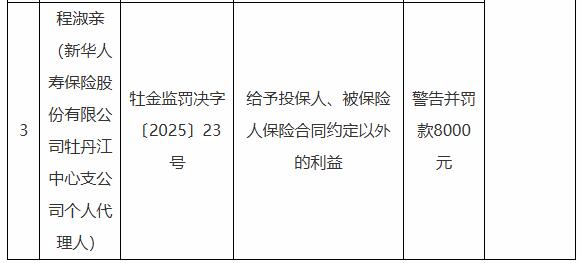
新华保险牡丹江中支代理人被罚 给予投保人合同外利益
Zhong Guo Jing Ji Wang· 2025-08-15 05:57
Group 1 - The National Financial Supervision Administration of China issued a penalty decision against Cheng Shuqin, an individual agent of Xinhua Life Insurance Co., Ltd., for providing benefits outside the insurance contract terms to policyholders and insured individuals [1] - Cheng Shuqin received a warning and was fined 8,000 yuan by the Mudanjiang Financial Supervision Bureau [1]
国家医保局首设商业健康保险创新药目录 保险板块强势拉升
Shen Zhen Shang Bao· 2025-08-14 16:39
Group 1 - The insurance sector experienced a strong rally, with China Pacific Insurance rising by 4.87%, China Life Insurance and China Ping An both increasing by over 1%, and others like China People’s Insurance and New China Life also showing gains [1] - The National Medical Insurance Drug List adjustment for 2025 has commenced, introducing a commercial health insurance innovative drug list for the first time, with 121 drug names passing preliminary review, including 5 high-value innovative cell therapies [1] - In 2024, basic medical insurance covered 1.326 billion people with a participation rate of 95%, and total fund expenditure reached 2.97 trillion yuan. The commercial health insurance premium income is projected to be 977.3 billion yuan, reflecting an 8.2% year-on-year growth [1] Group 2 - Year-to-date stock performance shows New China Life Insurance up by 36.24%, China Pacific Insurance over 20%, and both China Ping An and China People’s Insurance up by over 10% [1] - Market analysts believe that the dual drivers of policy support and market demand may lead to valuation recovery and performance growth opportunities for the insurance sector [1]