NCI(601336)

Search documents
港股异动 | 保险股延续涨势 新华保险(01336)盘中涨近5%破顶 中国人寿(02628)涨近2%
智通财经网· 2025-07-30 03:23
消息面上,近日,保险行业协会公布,当前普通型人身保险产品预定利率研究值为1.99%。根据当前主 要公司已发布的公告来看,普通型人身险产品预定利率将从2.5%下调至2.0%;分红险的保证利率上限 将从2%调整为1.75%,万能险从1.5%调整至1.0%;平安、国寿、太保等公告8月31日之后将全面切换在 售产品至新定价利率要求。 智通财经APP获悉,保险股延续近期涨势,截至发稿,新华保险(01336)涨4.57%,报51.5港元;中国人 寿(02628)涨1.97%,报23.35港元;中国太保(02601)涨1.36%,报33.45港元;中国平安(02318)涨0.89%, 报56.9港元。 大摩近期研报指,自2023年下半年以来,监管机构和保险公司已采取一系列措施减轻利差损失风险,预 计这一趋势将持续。8月后,保险公司新资金流入的保证负债成本预计将降至约1.7%,可提高盈利能 力,相对目前长期利率高于1.7%。该行指,保险公司表现强劲的关键驱动因素包括近期利率上调、稳 健的2025年上半年业绩预告,以及有利的市场情绪和资金流向。 ...



中国7家险企入围2025年世界500强
2 1 Shi Ji Jing Ji Bao Dao· 2025-07-30 02:00
Group 1 - The core viewpoint of the article is that 130 Chinese companies made it to the 2025 Fortune Global 500 list, with 7 insurance companies included, and most of them improved their rankings compared to the previous year [1][2][3] Group 2 - The 7 Chinese insurance companies on the list are China Life Insurance Group (ranked 45), Ping An Insurance Group (ranked 47), People's Insurance Group of China (ranked 141), China Pacific Insurance (ranked 251), Taikang Insurance Group (ranked 334), AIA Group (ranked 417), and New China Life Insurance (ranked 498) [2][3] - China Life's revenue for 2024 is approximately $160.28 billion, while Ping An's is about $158.63 billion, People's Insurance's is around $86.48 billion, China Pacific's is about $56.16 billion, Taikang's is approximately $45.46 billion, AIA's is around $37.61 billion, and New China's is about $32.29 billion [2][3] Group 3 - China Life improved its ranking from 59 to 45, Ping An from 53 to 47, People's Insurance rose 17 places to 141, and China Pacific saw the largest increase of 80 places to 251 [3] - Taikang Insurance has been on the list for eight consecutive years, moving up 47 places to 334, AIA improved by 29 places to 417, and New China returned to the list at 498 after being absent the previous year [3] Group 4 - The total revenue of the companies on the Fortune Global 500 list is approximately $41.7 trillion, which is more than one-third of the global GDP, showing a growth of about 1.8% from the previous year [3] - The threshold for inclusion in the list increased from $32.1 billion to $32.2 billion, and the total net profit of the listed companies grew by approximately 0.4% to around $2.98 trillion [3]



33个内地城市世界500强全览 :北京上榜世界500强企业最多
Di Yi Cai Jing· 2025-07-30 00:32
Group 1 - The 2025 Fortune Global 500 list includes 130 Chinese companies, with 120 from mainland China, 4 from Hong Kong, and 6 from Taiwan [1] - The total revenue of Chinese companies on the list for 2024 is approximately $10.7 trillion, with State Grid Corporation of China leading at $548.4 billion and China General Technology Group at the bottom with $32.3 billion [1] - JD.com ranks highest among private enterprises with a revenue of $161.055 billion for 2024 [1] Group 2 - Among the 33 cities with Fortune Global 500 companies, Beijing, Shanghai, and Shenzhen are the top three, with Beijing having 46 companies [2] - Shanghai has a total of 12 companies, while Shenzhen has 9, with Ping An Insurance ranking highest in Shenzhen at 47th place with a revenue of $158.627 billion [2] - BYD's ranking improved significantly by 52 places due to its leading position in global electric vehicle sales, marking its first entry into the top 100 [2]


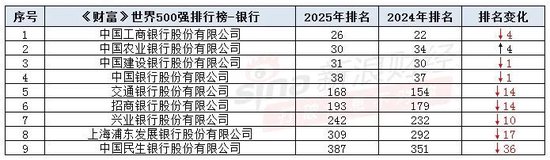
16家银保机构登上《财富》世界500强!民生银行跌36个名次,国寿排名超越平安
Xin Lang Cai Jing· 2025-07-29 12:37
Group 1: Overview of Rankings - In 2025, a total of 9 Chinese banks and 7 insurance companies made it to the Fortune Global 500 list, with 6 institutions entering the top 100 [1][6] - Among banks, Agricultural Bank of China rose in rank, surpassing China Construction Bank to become the second-ranked domestic bank, while Minsheng Bank fell 36 places [1][4] - In the insurance sector, China Life Insurance surpassed Ping An Insurance to become the top-ranked domestic insurer, with Xinhua Life Insurance making a comeback to the list [5][7] Group 2: Bank Rankings and Changes - The rankings of major Chinese banks in the 2025 Fortune Global 500 are as follows: ICBC (26), Agricultural Bank (30), China Construction Bank (31), and Bank of China (38) [2][3] - Minsheng Bank experienced the largest drop, falling 36 places to rank 207, while Agricultural Bank was the only bank to rise, gaining 4 places [3][4] Group 3: Insurance Rankings and Changes - The 7 Chinese insurance companies on the list include China Life, Ping An, People's Insurance, Pacific Insurance, Taikang Insurance, AIA, and Xinhua Life [6][7] - Pacific Insurance saw the largest increase in rank, rising 80 places, while Taikang Insurance improved by 47 places [7] Group 4: Profitability Insights - ICBC is the only Chinese company in the top ten of the Fortune Global 500's most profitable companies, with profits exceeding $50.8 billion [8][10] - China Merchants Bank ranked tenth in profit margin at 29.3%, while several other banks and insurance companies also made it to the list of the most profitable companies [10][12]




保险股沸腾!新华保险创新高,太保、平安涨逾3%,是何原因
Guo Ji Jin Rong Bao· 2025-07-29 10:54
Core Viewpoint - The insurance sector in China has experienced significant stock price increases, driven by adjustments in the predetermined interest rates for insurance products, which are expected to enhance the competitiveness of participating insurance products and improve the overall financial health of insurance companies [2][3][5]. Group 1: Stock Performance - As of July 28, the A-share insurance sector led the market with a 3.50% increase, with companies like New China Life Insurance rising over 4% and hitting historical highs [2]. - In the Hong Kong market, insurance stocks also showed strong performance, with AIA Group increasing over 4% and New China Life Insurance seeing a rise of more than 7% [2]. Group 2: Regulatory Changes - On July 25, the China Insurance Industry Association held a meeting where experts suggested a new predetermined interest rate of 1.99% for ordinary life insurance products, leading to adjustments in the maximum rates for various insurance products effective September 1 [3][4]. - The maximum predetermined interest rate for ordinary insurance products is set at 2.0%, while for participating insurance products, it is 1.75%, and for universal insurance products, it is 1.0% [3]. Group 3: Market Dynamics - The reduction in predetermined interest rates is expected to create a favorable environment for participating insurance products, which may see increased market share as traditional insurance products face lower rates [4][5]. - The adjustment is anticipated to alleviate the pressure on liability costs and investment risks for insurance companies, allowing for a higher allocation of equity investments and improved yield flexibility [5]. Group 4: Premium Growth - In the first half of the year, the insurance industry reported a total premium income of 3.74 trillion yuan, reflecting a year-on-year growth of over 5%, with life insurance companies contributing 2.77 trillion yuan, a 5.4% increase [6]. - New China Life Insurance reported a premium income of 121.26 billion yuan, marking a 23% increase, while China Pacific Insurance achieved 282.01 billion yuan, a 5.9% growth [6]. Group 5: Future Outlook - Analysts predict that the transition towards participating insurance products will accelerate, with improvements in liability costs and a continued increase in new business value (NBV) despite challenges in value realization due to low interest rates [7]. - The property insurance sector is expected to see slow growth, influenced by fluctuations in new car sales and declining average premiums, but overall profitability is anticipated to improve due to better cost management and reduced catastrophic losses [7].

牛市旗手持续爆发!保险股涨得飞起,哪些利好在催动
Bei Jing Shang Bao· 2025-07-29 10:54
Group 1 - The insurance sector is currently leading the A-share market rally, with significant gains observed on July 28, 2023, where stocks like New China Life and China Pacific Insurance rose over 4%, while China Life and Ping An increased by more than 3% [2] - The recent surge in insurance stocks is attributed to improved performance driven by increased insurance awareness among residents and a growing demand for insurance products, which has positively impacted premium income [3] - Analysts predict that the upward trend in insurance stocks will continue, supported by strong market savings demand and a gradual decrease in liability costs due to regulatory guidance and proactive transformations by insurance companies [4][5] Group 2 - The valuation of insurance stocks is recovering, with many stocks reaching new highs, indicating potential for further growth in the future [4] - The investment side of insurance companies is expected to benefit from rising long-term interest rates, which could alleviate pressure on new fixed-income investment yields [5] - Analysts forecast that the upcoming semi-annual reports will show continued growth in new business value for life insurance, with increasing demand for health and pension insurance, while property insurance profitability is also expected to improve [5]
实力见证,新华保险荣登世界500强!
Qi Lu Wan Bao· 2025-07-29 09:41
作为成立于1996年的国有控股上市企业,新华保险始终以金融报国为志、以普惠民生为本,坚定推进"以客户为中心"的战略转型,切实发挥保险业"两 器""三网"作用,探索内涵式、高质量发展之路,在"十四五"期间收获丰硕成果——构建起完善的公司治理结构,依托实力雄厚的股东夯实发展根基;打造 专业的代理人队伍,推出多元化产品服务体系;建立险资特色的资产管理模式,康养服务生态圈实现突破性发展,为客户提供全生命周期的全方位保障服 务,公司综合实力跃上新台阶。与此同时,新华保险积极探索"体育赛事""国之重器"等领域的跨界融合、整合传播,持续沉淀品牌价值、激发品牌活力, 使"保得长久、保得美好"的品牌承诺更加深入人心。 2025年上半年,新华保险延续稳健发展态势,累计实现原保险保费收入1212.6亿元,同比增长23%;完成各类理赔金赔付241万件,累计赔付金额73亿元, 日均赔付1.34万件。公司蝉联Forbes全球上市公司2000强、Brand Finance全球最具价值保险品牌、Fitch Ratings财务实力评级A级、WBL中国500最具价值品 牌等多项荣誉,彰显新华保险在经营管理、品牌价值、可持续发展等方面的综合实力。 ...

新华保险发力分红险,底气何在?
Qi Lu Wan Bao· 2025-07-29 09:41
Core Viewpoint - Xinhua Insurance reported a strong premium income growth of 23% year-on-year, reaching 121.26 billion yuan in the first half of 2025, indicating a robust start for the year following high performance in 2024 [1] Group 1: Premium Growth and Product Transformation - The strong growth in premiums is attributed to multiple factors including product innovation and team performance [1] - Xinhua Insurance is focusing on transforming its product line towards dividend insurance, which is seen as a way to reduce interest rate risk and meet consumer demand for flexible returns [1][2] - The company aims to have dividend insurance account for at least 30% of its business by 2025, with a strategic focus on improving product competitiveness and sales capabilities [2] Group 2: Investment Strategy and Performance - Xinhua Insurance's investment capabilities have been highlighted as a key driver of its strong performance, with a net profit increase of over 200% in 2024 due to successful investment strategies [3][4] - The company has actively participated in the insurance capital market, launching a private equity fund with a scale of 50 billion yuan, of which it contributed 25 billion yuan [4] - As of the end of 2024, Xinhua Insurance's investment assets exceeded 1.6 trillion yuan, with a total investment return rate of 5.8%, reflecting strong performance in the industry [4] Group 3: Sales and Service Ecosystem - The transformation towards dividend insurance requires a simultaneous upgrade in the skills of the sales team to avoid misalignment with customer needs [3] - Xinhua Insurance is enhancing its service capabilities through a comprehensive health and wellness ecosystem, which is expected to facilitate product innovation and improve sales efficiency [6] - The company is shifting its focus from merely selling policies to a customer-centric approach, emphasizing the importance of comprehensive competitive strength in the insurance market [5][6]
保险板块7月29日跌1.4%,*ST天茂领跌,主力资金净流入439.28万元
Zheng Xing Xing Ye Ri Bao· 2025-07-29 08:48
| 代码 | 名称 | 主力净流入 (元) | 主力净占比 游资净流入 (元) | | 游资净占比 散户净流入 (元) | | 散户净占比 | | --- | --- | --- | --- | --- | --- | --- | --- | | 601318 中国平安 | | ﺘ 1.71亿 | 5.07% | -2.22亿 | -6.55% | 5019.47万 | 1.49% | | 601601 | 中国太保 | -1533.23万 | -1.07% | -42.38万 | -0.03% | 1575.61万 | 1.10% | | 601336 新华保险 | | -1710.43万 | -1.30% | -5820.95万 | -4.41% | 7531.38万 | 5.71% | | 000627 | *ST天茂 | -3243.60万 | -20.08% | 589.43万 | 3.65% | 2654.18万 | 16.43% | | 601319 中国人保 | | -3969.43万 | -5.45% | 4421.59万 | 6.07% | -452.17万 | -0.62% | | 60 ...


上证养老产业指数报7533.04点,前十大权重包含中国中免等
Jin Rong Jie· 2025-07-29 08:18
金融界7月29日消息,上证指数低开高走,上证养老产业指数 (上证养老,H50043)报7533.04点。 从指数持仓来看,上证养老产业指数十大权重分别为:博瑞医药(4.66%)、科沃斯(3.2%)、新华保 险(2.96%)、恒瑞医药(2.7%)、中国平安(2.64%)、中国太保(2.62%)、南京商旅(2.58%)、 通策医疗(2.55%)、中国中免(2.54%)、石头科技(2.54%)。 从上证养老产业指数持仓的市场板块来看,上海证券交易所占比100.00%。 从上证养老产业指数持仓样本的行业来看,可选消费占比36.84%、医药卫生占比36.08%、主要消费占 比11.40%、金融占比10.76%、通信服务占比4.92%。 资料显示,指数样本每半年调整一次,样本调整实施时间分别为每年6月和12月的第二个星期五的下一 交易日。权重因子随样本定期调整而调整,调整时间与指数样本定期调整实施时间相同。在下一个定期 调整日前,权重因子一般固定不变。特殊情况下将对指数进行临时调整。当样本退市时,将其从指数样 本中剔除。样本公司发生收购、合并、分拆等情形的处理,参照计算与维护细则处理。 数据统计显示,上证养老产业指数近一 ...