NCI(601336)

Search documents
保险股有望复刻银行股行情吗
Zheng Quan Zhi Xing· 2025-07-29 08:01
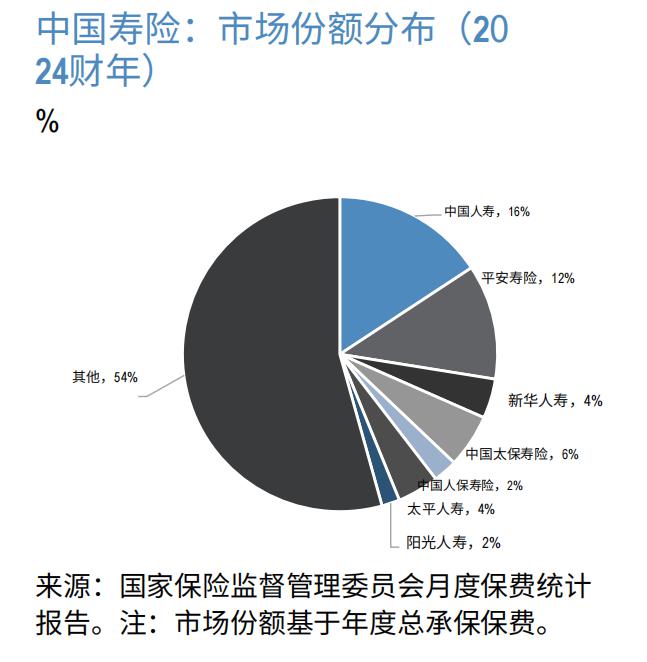
Core Viewpoint - The recent fluctuations in the A-share market around the 3600-point mark have drawn attention to insurance funds, which have become significant players in the market by frequently acquiring bank stocks. This shift is driven by a decline in the preset interest rate for ordinary life insurance to 1.99%, creating pressure for asset allocation amidst falling bond yields, leading to a potential transformation in investment logic for insurance stocks [1][8]. Group 1: Insurance Market Dynamics - The Chinese insurance market is characterized by a dual-track system of property and life insurance, with distinct participants, product forms, and profit logic, contributing to a diverse commercial model [2]. - In the property insurance sector, six major non-life insurance companies, including China Pacific Insurance and Ping An Property Insurance, hold a combined market share of 70%, focusing on quantifiable losses from risks like property damage and business interruption [2]. - The life and health insurance market is dominated by seven major companies, including China Life and Ping An Life, which contribute 46% of the premium scale, with products spanning life insurance, pensions, and health insurance [4]. Group 2: Profit Sources and Challenges - Investment spread is the core profit driver for Chinese life insurance companies, with a shift towards dividend-type policies to mitigate pressure from declining risk-free interest rates [6]. - The mortality/morbidity spread reflects the value of protection products, with a focus on accurate pricing and commission control, necessitating enhanced actuarial capabilities and channel management [6]. - The expense spread in the Chinese market is unique, with larger companies benefiting from economies of scale, contrasting with smaller firms that face higher marketing costs [6]. Group 3: Future Outlook and Valuation - Recent changes in the insurance industry have sparked discussions about whether it can replicate the valuation recovery seen in bank stocks, driven by improvements in fundamentals and valuation [8]. - The adjustment of preset interest rates is crucial for alleviating the "spread loss" pressure in the life insurance sector, with expectations of a decline in new business liability costs [8][9]. - Current internal insurance companies have a PEV (Present Embedded Value) below 1, indicating significant undervaluation, with companies like China Pacific Insurance and China Life being notably undervalued [9][10]. Group 4: Market Catalysts - The combined effect of policy guidance and the insurance companies' own needs is expected to accelerate the influx of incremental funds into the market, enhancing stability and long-term investment returns [11]. - The insurance sector's current improvement in fundamentals and low valuations may lead to a similar valuation recovery as seen in bank stocks if asset returns continue to improve and liability structures adjust smoothly [11].







央妈“呵护”流动性,7月29日,今日股市市场动态解析!
Sou Hu Cai Jing· 2025-07-29 00:42
Group 1 - The central bank's sudden interest rate cut has positively impacted the A-share market, with the Shanghai Composite Index closing at 3597.94 points, a slight increase of 0.12% [1] - The ChiNext Index showed the strongest performance, rising by 0.96% and reaching a new high for the year, with a technical target of 3674 points [1][3] - The PCB sector experienced a significant rally, with Shenghong Technology's stock price increasing by over 12%, bringing its total market value to 150 billion [7] Group 2 - The Shanghai Composite Index is steadily climbing along the five-day moving average, which has recently flattened and shows signs of a potential downward turn [5] - Historical patterns suggest that a downward turn in the five-day moving average could lead to a correction of 3-5%, translating to a drop of approximately 120 to 150 points for the Shanghai Composite Index [5] - The market is currently in a phase of high volatility, with strong competition between bullish and bearish forces, indicating that significant changes in market direction may not occur until key events unfold [3][5]
三大股指高位震荡 市场重回半年度业绩主线
Shang Hai Zheng Quan Bao· 2025-07-28 18:58
Market Overview - The A-share market showed high volatility, with the Shanghai Composite Index closing at 3597.94 points, up 0.12% [2] - The Shenzhen Component Index rose 0.44% to 11217.58 points, while the ChiNext Index increased by 0.96% to 2362.60 points [2] - Total trading volume in the Shanghai and Shenzhen markets was 17.423 trillion yuan, a decrease of 45 billion yuan compared to the previous Friday [2] PCB Sector Performance - The AI hardware sector, represented by PCB (Printed Circuit Board) concepts, led the market with significant gains, with multiple stocks hitting the daily limit [3] - Notable performers included Fangbang Shares, Junya Technology, and Pengding Holdings, with Shenghong Technology surging over 17% [3] - At least 10 PCB companies have released half-year performance forecasts, with Shengyi Electronics expecting a net profit increase of 432% year-on-year [3] - The demand for high-end PCBs is rapidly growing due to AI computing needs, with projections indicating a supply-demand gap for AI PCBs by 2026 [3] Non-Bank Financial Sector - The non-bank financial sector, including brokerage and insurance, performed well, with the Shenwan Securities Index rising by 0.68% [4] - Major brokerages like Zhongyin Securities and Huatai Securities saw significant stock price increases, with at least 12 brokerages forecasting over 100% growth in net profit for the first half of the year [4][5] - The insurance sector benefited from economic recovery, with a notable increase in the sales of savings-type products [5] Resource Sector Dynamics - The resource sector experienced significant divergence, with coal, steel, and oil sectors undergoing substantial corrections [6] - Futures markets saw sharp declines in black and new energy commodities, with major contracts for coking coal and lithium carbonate hitting the daily limit down [6] - Several brokerages have warned of trading risks in the resource sector, suggesting that the recent price surges were driven by policy expectations and market sentiment [6] Investment Themes - In the medium to long term, institutions suggest focusing on undervalued sectors within the "anti-involution" theme, including polyurethane, LED, and semiconductor precursor materials [7] - The "anti-involution" theme has begun to expand, with specific commodities like red dates experiencing price fluctuations [7]





保险公司调整人身险产品预定利率点评:引导行业分红险转型,有效降低负债成本和资产负债久期缺口
Hua Yuan Zheng Quan· 2025-07-28 14:07
Investment Rating - The industry investment rating is "Positive" (first time) [4] Core Viewpoints - The adjustment of the preset interest rates for life insurance products is a response to the regulatory policies set by the China Banking and Insurance Regulatory Commission at the beginning of the year [6][7] - The current research value for ordinary life insurance products is 1.99%, leading to a reduction in the maximum preset interest rates for various insurance products [4][5] - The adjustment is expected to effectively lower the liability costs for insurance companies and guide them towards transforming into dividend insurance products, which have a floating interest rate characteristic [7] Summary by Sections Industry Performance - The report highlights the performance of the insurance sector and the impact of the preset interest rate adjustments on the market [2] Regulatory Changes - The China Insurance Industry Association held a meeting to discuss the preset interest rates, resulting in a new maximum preset interest rate of 2.0% for ordinary life insurance products and 1.75% for dividend insurance products [4][5] Market Expectations - The adjustment of preset interest rates was in line with market expectations, although the asymmetric decline in traditional and dividend insurance rates was slightly ahead of market predictions [6] - The new preset interest rate limits will take effect on August 31, 2025, which is earlier than anticipated [6] Future Challenges - Insurance companies will face challenges in enhancing their sales capabilities for savings insurance as the gap between policy preset rates and bank deposit rates narrows [6] - The implementation of a new regulatory framework for insurance sales qualifications will require agents to hold relevant certifications for selling dividend insurance, adding pressure on companies to train their sales personnel [6] - The asset allocation requirements for dividend accounts will be higher compared to traditional accounts, testing the investment capabilities of insurance companies [6]
东吴证券:非银金融目前平均估值仍然较低 具有安全边际 攻守兼备
智通财经网· 2025-07-28 12:35
Core Viewpoint - The non-bank financial sector is currently undervalued with a safety margin, benefiting from economic recovery and rising interest rates, particularly in the insurance and securities industries [1] Non-Bank Financial Sector Performance - In the recent five trading days (July 21-25, 2025), the securities and insurance sectors outperformed the CSI 300 index, with securities up 4.90% and insurance up 1.81%, while the multi-financial sector declined by 1.65%, leading to an overall increase of 3.65% in the non-bank financial sector compared to a 1.69% rise in the CSI 300 index [2] Securities Industry Insights - Trading volume saw a significant year-on-year increase, with the average daily trading volume for July reaching 18,191 billion yuan, up 139.92% year-on-year and 18.72% month-on-month. The margin financing balance was 19,420 billion yuan, a 35.34% increase year-on-year [3] - The China Securities Regulatory Commission (CSRC) is focused on consolidating market stability and enhancing market vitality through reforms and improved regulatory effectiveness [3] - The average price-to-book (PB) ratio for the securities industry is projected at 1.4x for 2025, with recommendations for leading firms benefiting from active capital market policies, such as CITIC Securities and Tonghuashun [3] Insurance Industry Developments - The preset interest rate for traditional insurance has been lowered to 1.99%, which is expected to improve the liability costs for life insurance companies. Major firms like China Life and Ping An have announced reductions in their preset rates [4] - The insurance sector reported strong premium growth in Q2 2025, with a 5.4% year-on-year increase in original premium income for life insurance companies and a 15.2% increase in Q2 alone [4] - The insurance industry's valuation is currently at historical lows, with a projected P/EV ratio of 0.61-0.94 for 2025, maintaining an "overweight" rating for the sector [4] Multi-Financial Sector Overview - The trust industry reported a total asset scale of 29.56 trillion yuan by the end of 2024, a year-on-year growth of 23.58%, although profits fell by 45.5% [5] - The futures market saw a trading volume of 740 million contracts in June, with a transaction value of 52.79 trillion yuan, reflecting year-on-year growth of 28.91% and 17.40% respectively [5] - Public funds increased their holdings in the non-bank financial sector, with a 1.93% total allocation by the end of Q2 2025, indicating a slight increase from Q1 2025 [5]


2024年度寿险公司加权薪保比指标排行榜,薪保比已创近15年来历史新低!
13个精算师· 2025-07-28 11:46
Core Viewpoint - The 2024 life insurance industry has seen a decline in employee compensation and a historical low in the salary-to-premium ratio, indicating potential challenges in operational efficiency and profitability [2][14]. Group 1: Salary and Premium Ratio Analysis - In 2024, the total employee compensation in the life insurance industry was 108.5 billion yuan, a decrease of 4.6% year-on-year, with a salary-to-premium ratio of 3.4%, down 0.5 percentage points, marking a 15-year low [2][14]. - The "TOP7+1" companies (including major players like China Life and Ping An) had a salary-to-premium ratio of 3.3%, which is significantly lower than that of small and medium-sized insurance companies, which stood at 3.7% [17][18]. - The average salary-to-premium ratio for 70 life insurance companies over the past five years was 4.0%, with a median of 4.9%, and 11 companies exceeding 10% [5][28]. Group 2: Impact on Return on Equity (ROE) - The salary-to-premium ratio has a significant negative impact on a company's ROE, with each 1 percentage point increase in the ratio leading to a 0.37 percentage point decrease in ROE [24][25]. - The empirical model constructed to analyze this relationship included variables such as company size and channel type, confirming the negative correlation between salary-to-premium ratio and ROE [24][25]. Group 3: Historical Trends - The salary-to-premium ratio has shown a declining trend since 2018, with a notable acceleration in the decline for small and medium-sized insurance companies since 2019 [16][18]. - The ratio increased from 4.2% in 2010 to a peak of 5.3% in 2015, followed by a steady decline to the current levels [16][18]. Group 4: Employee Compensation Insights - The life insurance industry employed approximately 345,000 individuals in 2023, with an average compensation and benefits level of 330,000 yuan [10][22]. - The fluctuation in employee numbers has shown a slight decline, while average compensation has seen minor increases over recent years [10][22].
院外购买创新药也能走商保 多险企推外购药保障
2 1 Shi Ji Jing Ji Bao Dao· 2025-07-28 10:21
Core Insights - The rapid implementation of DRG/DIP payment reform and the normalization of drug procurement have led to a surge in demand for "out-of-hospital medication coverage" among patients [1][10] - Insurance companies are accelerating the iteration and upgrade of high-end medical insurance products, with "out-of-purchase drug responsibility" becoming a focal point of this product upgrade [1][4] Group 1: Market Dynamics - The out-of-purchase drug responsibility allows insurance companies to reimburse patients for medications purchased outside the hospital when necessary drugs are unavailable [2][3] - Major insurance companies like ZhongAn, Pacific Health, and Xinhua Insurance are launching innovative products to meet the urgent demand for advanced medications and special medical services [2][4] Group 2: Policy Impact - The DRG/DIP payment model has pressured hospitals to control costs, leading to cautious use of high-value original and imported drugs, pushing patients towards external purchasing channels [3][10] - The National Healthcare Security Administration has introduced measures to control unreasonable medical expenses, which has further influenced patient medication channels and cost-sharing models [2][7] Group 3: Product Innovation - Recent insurance products have incorporated out-of-purchase drug responsibilities, with companies like ZhongAn and Pacific Health offering comprehensive coverage without restrictions on disease types or medication lists [4][5] - Xinhua Insurance has made bold attempts in out-of-purchase drug responsibility, including a wide range of medications and specialized health management services [6][9] Group 4: Future Outlook - The collaboration between commercial insurance and basic medical insurance is crucial for developing a new payment ecosystem for innovative drugs [7][10] - The introduction of the "three exclusions" policy is expected to enhance the role of commercial insurance in covering high-value innovative drugs, providing a clearer boundary for insurance responsibilities [8][9]
爆发!4000亿巨头,罕见涨停!
Zheng Quan Shi Bao· 2025-07-28 09:10
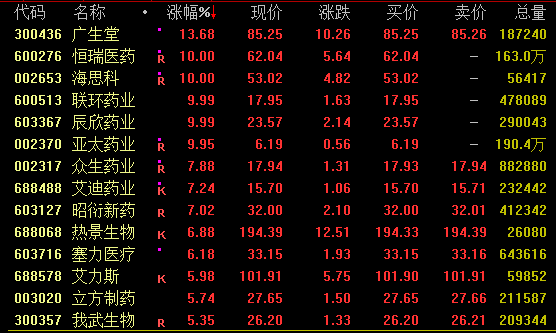
Market Overview - The Shanghai Composite Index experienced narrow fluctuations around 3600 points, closing up 0.12% at 3597.94 points, while the Shenzhen Component Index rose 0.44% to 11217.58 points, and the ChiNext Index increased by 0.96% to 2362.6 points [1] - The total trading volume in the Shanghai and Shenzhen markets was 176.65 billion yuan, a decrease of 52 billion yuan from the previous day [1] Insurance Sector - The insurance sector saw significant gains, with New China Life Insurance rising nearly 5% to reach a historical high, and China Life, China Ping An increasing by approximately 3% [3][4] - The China Insurance Industry Association announced a reduction in the guaranteed interest rates for traditional life insurance products, which is expected to improve the liability costs and net investment returns for life insurance companies [4][5] Innovative Drug Sector - The innovative drug sector showed strong performance, with companies like Guangsheng Pharmaceutical rising nearly 14%, and Heng Rui Medicine, Hai Si Ke, and Lian Huan Pharmaceutical hitting the daily limit [7] - Heng Rui Medicine's total market capitalization exceeded 400 billion yuan, indicating robust investor interest [7] PCB Sector - The PCB (Printed Circuit Board) sector was active, with companies such as Fangbang Co., and Chipbond Technology hitting the daily limit of 20% increase, and Shenghong Technology rising over 17% to reach a historical high [11][12] - The demand for high-end PCBs is expected to grow rapidly due to AI computing needs, with a projected supply-demand ratio for global AI PCBs in 2026 ranging from 80% to 103%, indicating a tight supply situation [13]

牛市旗手持续爆发!保险股涨得飞起,哪些利好在催动?
Bei Jing Shang Bao· 2025-07-28 08:49
Core Viewpoint - The insurance sector is leading the current market rally, with significant gains in stock prices for major companies like Xinhua Insurance and China Life, indicating a strong performance in the A-share market [1][3][4]. Group 1: Market Performance - On July 28, insurance stocks in the A-share market surged, with Xinhua Insurance and China Pacific Insurance rising over 4%, while China Life and Ping An increased by more than 3% [3][4]. - In the Hong Kong market, insurance stocks also performed well, with Xinhua Insurance's stock rising by as much as 7% [4]. - Year-to-date, Xinhua Insurance has increased by over 34%, Ping An by over 17%, China Life by over 3%, and China Pacific Insurance by over 14% [4]. Group 2: Factors Driving Growth - The recent surge in insurance stocks is attributed to improved performance and valuation recovery, driven by increased public awareness of insurance and rising premium income [4][5]. - The insurance sector's investment performance has also benefited from the stock market's recovery since September of the previous year, enhancing overall earnings [4][5]. - The latest traditional insurance preset interest rate research value is 1.99%, which has triggered conditions for a potential rate adjustment, indicating a favorable environment for the sector [4]. Group 3: Future Outlook - Analysts believe that insurance stocks still have growth potential, supported by strong savings demand and a gradual decrease in liability costs due to regulatory guidance and proactive transformation by insurance companies [5][6]. - The recent rise in the ten-year government bond yield to approximately 1.73% may alleviate pressure on new fixed-income investment returns for insurance companies as the economy recovers [5]. - The upcoming half-year reports are expected to show continued growth in new business value for life insurance, with increasing demand for health and pension insurance, and stable profitability in property insurance [5][6].

利好“炸场”!港A保险股热浪席卷,新华保险猛飙新高
Ge Long Hui· 2025-07-28 08:34
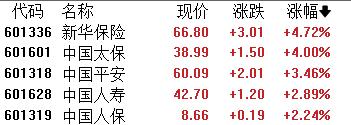
Core Viewpoint - The insurance sector in the A-share market experienced a significant surge, with major companies like Xinhua Insurance, China Pacific Insurance, and China Life Insurance seeing substantial gains, driven by favorable regulatory changes regarding insurance product interest rates [1][4]. Group 1: Market Performance - As of July 28, Xinhua Insurance's stock price rose by 4.72% to 66.80, while China Pacific Insurance and China Life Insurance also saw increases of 4.00% and 2.89% respectively [2]. - In the Hong Kong market, Yunfeng Financial surged over 7%, and AIA Group rose nearly 5%, with other major insurers following suit [3]. Group 2: Regulatory Changes - The China Insurance Industry Association indicated that the current benchmark interest rate for ordinary life insurance products is set at 1.99%, triggering a necessary adjustment in the maximum preset interest rates for new products [4]. - Major insurers like China Life, Ping An Life, and China Pacific Life have already announced reductions in their traditional life insurance product rates from 2.5% to 2.0%, and the guaranteed rate for participating insurance has been adjusted from 2% to 1.75% [4]. Group 3: Industry Outlook - Analysts predict that the adjustment in preset interest rates will alleviate the pressure on insurers' interest margins and lower liability costs, enhancing the profitability of new business [5]. - The dynamic adjustment mechanism for preset interest rates is expected to improve the liability costs and net investment returns for life insurance companies, thereby reducing asset allocation pressures and interest margin risks [5]. Group 4: Anti-Competition Measures - The insurance industry has been receiving signals to combat "involution," with the central government emphasizing the need to regulate low-price competition [6]. - The Guangdong financial sector has taken steps to prevent "involution" by issuing self-regulatory agreements to resist malicious price wars and ensure fair competition [6]. Group 5: Future Prospects - Analysts from CITIC Securities believe that regulatory guidance will encourage the development of participating insurance, allowing leading insurers to achieve healthy balance sheet expansion while reducing liability costs [7]. - The market outlook remains optimistic, with expectations of continued growth in new business value (NBV) for life insurers and significant improvements in the combined operating ratio (COR) for property insurers [7].