
NCI(601336)

Search documents
机构预期明年Q1及全年NBV增长较好,保险证券ETF(515630)涨超2.2%
Xin Lang Cai Jing· 2025-12-15 03:39
Core Viewpoint - The insurance sector is experiencing a strong upward trend, driven by regulatory adjustments and positive market expectations for future growth in net premium value (NBV) and profitability. Group 1: Market Performance - The CSI 800 Securities Insurance Index rose by 2.24%, with key stocks such as China Ping An increasing by 5.23% and China Taiping by 4.58% [1] - The Insurance Securities ETF also saw an increase of 2.27%, with the latest price at 1.44 yuan [1] Group 2: Regulatory Changes - The Financial Regulatory Bureau has adjusted risk factors for insurance companies investing in the CSI 300 Index, the CSI Dividend Low Volatility 100 Index, and stocks on the Sci-Tech Innovation Board, leading to a more favorable investment environment [1] Group 3: Positive Growth Expectations - Long-term interest rates have stabilized, with the ten-year government bond yield rising to 1.85%, which is beneficial for the growth of insurance companies' net assets and profit reserves [1] - The expected NBV growth for listed insurance companies is around 15% for the full year of 2026, with leading companies projected to achieve over 25% in Q1 due to better penetration through bank insurance channels and high-net-worth individual clients [1] - Insurance companies have seen equity returns between 20% and 30% since the beginning of 2025, with further benefits anticipated from mid-to-long-term pilot programs and the industry-wide OCI switch next year [1] - Current price-to-earnings valuations for most listed companies are between 0.5 and 0.7 times, which is within the historical 40-50% valuation range [1] Group 4: Index Composition - The CSI 800 Securities Insurance Index is based on the CSI 800 Index, selecting relevant securities from the insurance sector, providing diverse investment options [2] - As of November 28, 2025, the top ten weighted stocks in the index account for 63.12% of the total, including major players like China Ping An and CITIC Securities [2]




内险股早盘继续走高 新华保险及中国太保均涨超3%
Xin Lang Cai Jing· 2025-12-15 03:19
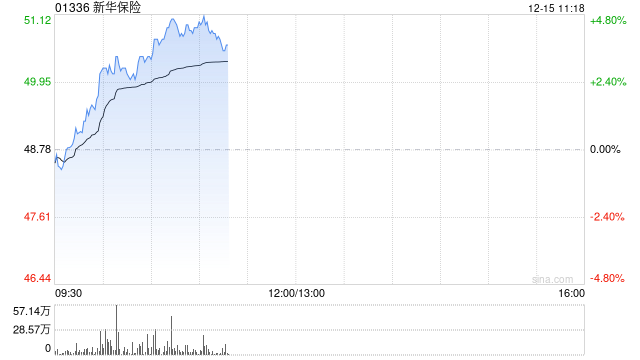
内险股早盘继续走高,截至发稿,新华保险(01336)上涨3.53%,报50.50港元;中国太保(02601)上 涨3.06%,报35.66港元;中国平安(02318)上涨2.82%,报65.55港元;中国人寿(02628)上涨 1.13%,报28.62港元。 内险股早盘继续走高,截至发稿,新华保险(01336)上涨3.53%,报50.50港元;中国太保(02601)上 涨3.06%,报35.66港元;中国平安(02318)上涨2.82%,报65.55港元;中国人寿(02628)上涨 1.13%,报28.62港元。 责任编辑:卢昱君 热点栏目 自选股 数据中心 行情中心 资金流向 模拟交易 客户端 责任编辑:卢昱君 热点栏目 自选股 数据中心 行情中心 资金流向 模拟交易 客户端 ...



内险股继续走高 新华保险(01336.HK)涨近5%
Mei Ri Jing Ji Xin Wen· 2025-12-15 03:00
每经AI快讯,内险股继续走高。截至发稿,新华保险(01336.HK)涨4.65%,报51.05港元;中国太保 (02601.HK)涨4.34%,报36.1港元;中国平安(02318.HK)涨3.37%,报65.9港元;中国人寿(02628.HK)涨 2.4%,报28.98港元。 ...
保险股逆势走强,中国平安涨幅超4%
Bei Jing Shang Bao· 2025-12-15 02:56
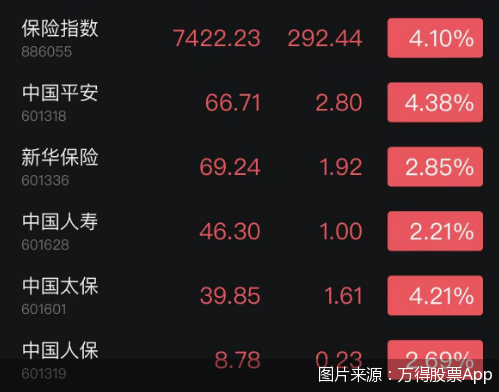
北京商报讯(记者 李秀梅)12月15日,A股三大股指低位震荡,保险板块逆势走强。截至北京商报记者 发稿,A股保险板块中,中国平安、中国太保涨幅均超4%,中国人寿、中国人保和新华保险涨幅也超 过了2%。 | 保险指数 | 7422.23 | 292.44 | 4.10% | | --- | --- | --- | --- | | 886055 | | | | | 中国平安 | 66.71 | 2.80 | 4.38% | | 601318 | | | | | 新华保险 601336 | 69.24 | 1.92 | 2.85% | | 中国人寿 601628 | 46.30 | 1.00 | 2.21% | | 中国太保 | 39.85 | 1.61 | 4.21% | | 601601 | | | | | 中国人保 601319 | 8.78 | | 图片来源:万得股票App | ...


内险股继续走高 新华保险涨近5% 机构预计开门红新单保费和NBV将实现双位数增长
Zhi Tong Cai Jing· 2025-12-15 02:48
Core Viewpoint - The insurance stocks continue to rise, with significant gains observed in major companies, indicating a positive market sentiment and potential for growth in the sector [1] Group 1: Stock Performance - Xinhua Insurance (01336) increased by 4.65%, reaching HKD 51.05 - China Pacific Insurance (601601) (02601) rose by 4.34%, reaching HKD 36.1 - Ping An Insurance (601318) (02318) saw a 3.37% increase, reaching HKD 65.9 - China Life Insurance (601628) (02628) grew by 2.4%, reaching HKD 28.98 [1] Group 2: Research Insights - Guojin Securities released a report indicating an upward trend in the "opening red" season, maintaining a positive recommendation for the sector - The report anticipates a significant number of fixed deposits maturing next year, making dividend insurance attractive for low-risk investors seeking long-term wealth preservation and growth - It is expected that the new single premium and NBV for the "opening red" will achieve double-digit growth, with large companies increasing their market share [1][1] Group 3: Regulatory Changes - Shenwan Hongyuan Securities published a report noting that regulatory authorities have recently lowered the risk factors for insurance companies holding long-term equity assets - This change is expected to release a substantial amount of incremental capital, estimated in the hundreds of billions, in the short term - The report highlights that with the replenishment of insurance capital and increased willingness to allocate, high-dividend stocks with stable returns and defensive attributes will become a key focus for investment [1][1]
港股异动 | 内险股继续走高 新华保险(01336)涨近5% 机构预计开门红新单保费和NBV将实现双位数增长
智通财经网· 2025-12-15 02:48
Core Viewpoint - The insurance sector is experiencing a positive trend, with significant stock price increases for major companies, driven by favorable market conditions and regulatory changes [1] Group 1: Stock Performance - Xinhua Insurance (01336) increased by 4.65%, reaching HKD 51.05 - China Pacific Insurance (02601) rose by 4.34%, reaching HKD 36.1 - Ping An Insurance (02318) saw a 3.37% increase, reaching HKD 65.9 - China Life Insurance (02628) grew by 2.4%, reaching HKD 28.98 [1] Group 2: Market Outlook - Guojin Securities maintains a positive recommendation, citing an upward trend in the "opening red" season, with expectations of double-digit growth in new single premiums and NBV due to the upcoming maturity of a large number of fixed deposits [1] - The attractiveness of dividend insurance is highlighted for low-risk investors seeking long-term wealth preservation and growth, with major companies expected to increase market share amid a shift in the industry [1] Group 3: Regulatory Impact - Shenwan Hongyuan Securities reports that recent regulatory adjustments have lowered risk factors for insurance companies holding long-term equity assets, potentially releasing over RMB 100 billion in incremental capital [1] - The report emphasizes that with enhanced capital allocation willingness, high-dividend sectors with stable returns will become a key focus for insurance capital [1]
机构称关注财富权益迁徙下的寿险价值重估,保险证券ETF(515630)涨超1%
Xin Lang Cai Jing· 2025-12-15 02:37
Core Viewpoint - The insurance sector is identified as a highly growth-oriented area within the financial industry, driven by leading companies leveraging scale, brand, and customer loyalty, with significant investment value highlighted [1]. Group 1: Industry Performance - As of December 15, 2025, the CSI 800 Securities Insurance Index rose by 0.92%, with key stocks such as China Pacific Insurance increasing by 3.06% and Ping An Insurance by 2.79% [1]. - The average growth rate of new business value (NBV) for listed insurance companies is close to 45% for the first three quarters of 2025, indicating a clear improvement in profitability due to cost optimization [1]. - The insurance sector is expected to benefit from economic recovery, policy support, and the appreciation of the RMB, providing sufficient momentum for valuation recovery [1]. Group 2: Asset Management and Investment Strategies - In a low interest rate environment, the characteristics of participating insurance products are becoming more prominent, with leading companies expected to drive new premium growth through their investment capabilities and product offerings [1]. - The insurance sector is experiencing a steady growth phase in operating cash flow, enhancing the certainty of asset under management (AUM) growth [1]. - The upward trend in equity market returns, supported by strong policy backing, is likely to expand insurance companies' equity investments and improve investment income [2]. Group 3: Market Composition - The CSI 800 Securities Insurance Index closely tracks the performance of selected securities within the insurance sector, providing diverse investment options for investors [2]. - As of November 28, 2025, the top ten weighted stocks in the CSI 800 Securities Insurance Index account for 63.12% of the index, with major players including Ping An Insurance and China Pacific Insurance [2].

A股保险股走强,中国太保涨近2%
Xin Lang Cai Jing· 2025-12-15 01:49
责任编辑:王馨茹 12月15日金融一线消息,A股保险股走强,中国太保涨近2%,中国平安涨超1%,中国人保、新华保险 等跟涨。 12月15日金融一线消息,A股保险股走强,中国太保涨近2%,中国平安涨超1%,中国人保、新华保险 等跟涨。 责任编辑:王馨茹 ...
A股保险股走强,中国太保涨近2%,中国平安涨超1%,中国人保、新华保险等跟涨。
Xin Lang Cai Jing· 2025-12-15 01:45
A股保险股走强,中国太保涨近2%,中国平安涨超1%,中国人保、新华保险等跟涨。 ...
公募销售新规落地,政银绑定深化下银行扩表动能有望复苏
Western Securities· 2025-12-14 12:55
Investment Rating - The report indicates a positive outlook for the insurance sector, recommending specific companies such as China Pacific Insurance, China Ping An, China Life (H), and China Taiping, while also recommending New China Life Insurance [4][17]. Core Insights - The financial industry experienced a mixed performance, with the non-bank financial index rising by 0.81%, outperforming the CSI 300 index by 0.89 percentage points. The insurance sector showed a notable increase of 2.36%, while the banking sector declined by 1.77% [2][11]. - The central economic work conference emphasized a proactive fiscal policy, which is expected to benefit the insurance sector by increasing infrastructure asset supply and improving credit risk perceptions [14][15]. - The report highlights the potential for valuation recovery in the brokerage sector, driven by regulatory changes that align public fund interests with long-term investor returns [18][19]. Summary by Sections 1. Weekly Performance and Sector Insights - The non-bank financial index rose by 0.81%, with the insurance sector outperforming the CSI 300 index by 2.44 percentage points [2][11]. - The banking sector underperformed, with a decline of 1.77%, attributed to macroeconomic policy expectations [3][21]. 2. Insurance Sector Data Tracking - The insurance sector's premium income showed steady growth, with life insurance and property insurance premiums increasing by 9.6% and 4.0% year-on-year, respectively [17][26]. - The report notes that the 10-year government bond yield decreased to 1.84%, which is favorable for the insurance sector's investment strategies [31]. 3. Brokerage Sector Data Tracking - The brokerage sector's PB valuation stands at 1.37x, indicating potential for valuation recovery as earnings improve [19][42]. - Regulatory changes in public fund sales are expected to enhance the industry's focus on long-term investor interests [18][19]. 4. Banking Sector Data Tracking - The banking sector's PB valuation is at 0.54x, suggesting it remains undervalued [21][25]. - The central economic work conference's focus on domestic demand and flexible monetary policy is expected to support the banking sector's growth [22][23].
