
ICBC(601398)

Search documents
2025年度中资离岸债承销排行榜
Wind万得· 2026-01-01 22:38
Core Viewpoint - The offshore bond market for Chinese entities in 2025 is characterized by "diversification and innovation," with a significant increase in the issuance of offshore RMB bonds as global investors continue to recognize RMB assets [1]. Group 1: Market Overview - The total number of new offshore Chinese bonds underwritten in 2025 reached 1,461, with a total issuance amount of $209.75 billion [1]. - The issuance of offshore municipal bonds totaled 305 bonds, amounting to $28.57 billion, while offshore financial bonds accounted for 817 bonds, totaling $82.49 billion [1]. Group 2: Underwriting Rankings - The top underwriters for offshore Chinese bonds in 2025 were: - Bank of China: 281 bonds, $14.70 billion [3]. - HSBC: 229 bonds, $12.09 billion [3]. - Industrial and Commercial Bank of China: 250 bonds, $8.24 billion [3]. - Citic Securities led in the number of projects underwritten with 496 bonds, followed by Citic Bank with 336 bonds, and Haitong International Securities with 322 bonds [9]. Group 3: Detailed Rankings - The detailed rankings for underwriting amounts and project counts are as follows: - For underwriting amounts: - Bank of China: $14.70 billion [20]. - HSBC: $12.09 billion [20]. - Industrial and Commercial Bank of China: $8.24 billion [20]. - For project counts: - Citic Securities: 496 bonds [9]. - Citic Bank: 336 bonds [9]. - Haitong International Securities: 322 bonds [9]. Group 4: Subcategory Rankings - In the offshore USD bond category, Bank of China led with 135 bonds totaling $7.65 billion, followed by HSBC with 107 bonds at $7.16 billion [29]. - For offshore municipal bonds, Guotai Junan International topped the list with 118 bonds and $2.41 billion, followed by Dongfang Securities with 78 bonds at $1.84 billion [35]. - In the offshore financial bond category, Bank of China again led with 153 bonds totaling $7.45 billion, followed by HSBC with 129 bonds at $5.61 billion [39]. - For offshore green bonds, Bank of China was the leader with 45 bonds totaling $1.96 billion, followed by Industrial and Commercial Bank of China with 51 bonds at $1.88 billion [43].



六大行明年起为数字人民币钱包余额计息,利率0.05%
Sou Hu Cai Jing· 2026-01-01 09:10
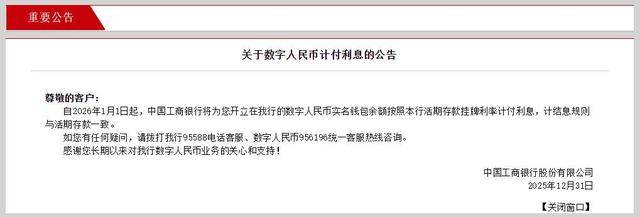
Group 1 - The six major state-owned banks in China announced that starting from January 1, 2026, they will pay interest on the balances of real-name digital RMB wallets at the same rate as current deposit rates, which is currently set at 0.05% [1] - This move makes China the first economy to offer interest on central bank digital currency [1]



财经观察|今日起,数字人民币开始计息!对你我生活有何影响?
Sou Hu Cai Jing· 2026-01-01 08:59
今天,数字人民币正式迈入"计息"时代,用户实名钱包里的余额能"钱生钱"了。 图片截取自工商银行官方网站 六大行集体官宣 图片截取自农业银行官方网站 2025年12月31日,工商银行、农业银行、中国银行、建设银行、交通银行、邮储银行集体发布关于数字 人民币重磅公告。公告称,自2026年1月1日(含)起,将为客户开立在该行的数字人民币实名钱包余 额,按照活期存款挂牌利率计付利息,计结息规则与活期存款一致。 这意味着,存放在这些钱包里的数字人民币,将和传统银行活期存款一样,开始产生收益。目前,几家 大行官网显示的活期存款挂牌利率为0.05%。 图片截取自工商银行官方网站 值得注意的是,并非所有数字人民币钱包都能享受计息。 数字人民币现金型1.0版迈入存款货币型2.0版,一大变化点是由央行对客户负债,变成了商业银行对客 户负债。为何会出现这一变化? 中国人民银行党委委员、副行长陆磊在撰文中指出,数字现金作为中央银行对公众的负债,理论上不需 要商业银行等金融机构参与运营维护。但是在研发试点中,数字现金与流通中纸币的权责关系存在明显 差异。商业银行是数字钱包开立、场景开发和技术维护不可或缺的运营者,其服务伴随数字现金流通 ...
六大国有行官宣:今日起,实施!
券商中国· 2026-01-01 07:51
Core Viewpoint - Starting from January 1, 2026, six major state-owned banks in China will pay interest on the balances of real-name digital RMB wallets at the same rate as current deposit rates, marking China as the first economy to offer interest on central bank digital currency [1][2][5]. Group 1: Announcement from Major Banks - The six major state-owned banks include Industrial and Commercial Bank of China, Agricultural Bank of China, Bank of China, China Construction Bank, Bank of Communications, and Postal Savings Bank of China [1][3]. - The current interest rate for current deposits is 0.05% [3]. - Only real-name digital RMB wallets (categories one, two, and three) will earn interest, while category four wallets, which are non-real-name and used for anonymous payments, will not [3][4]. Group 2: Digital RMB Usage and Statistics - As of November 2025, digital RMB has processed 3.48 billion transactions with a total transaction amount of 16.7 trillion yuan [4]. - There are 230 million personal digital RMB wallets and 18.84 million unit wallets opened [4]. - The cross-border payment business using digital RMB has processed 4,047 transactions, amounting to approximately 387.2 billion yuan, with digital RMB accounting for about 95.3% of the transaction volume in various currencies [4]. Group 3: Expansion of Digital RMB Scenarios - The People's Bank of China has introduced an action plan to enhance the management and service system for digital RMB, which will officially start on January 1, 2026 [5]. - The plan allows banks to manage digital RMB wallet balances similarly to deposits, providing the same level of security as traditional deposits [5][6]. - The interest payment on digital RMB wallets is expected to increase user willingness to adopt digital RMB and expand its usage scenarios, reinforcing China's leading position in the global exploration of central bank digital currencies [5][6]. Group 4: Implications for Users and Banks - Users will benefit from interest on their digital RMB wallets, similar to current deposits, which is expected to enhance their holding willingness [6]. - The interest incentive and improved ecosystem will encourage more merchants to accept digital RMB, enriching payment scenarios [6]. - For commercial banks, digital RMB deposits can become a source of usable funds, enhancing their promotional efforts and allowing for the development of new financial products [6].




工、农、建、交、邮储,国有大行集体官宣!
Sou Hu Cai Jing· 2026-01-01 07:34
Core Viewpoint - Starting January 1, 2026, major Chinese banks will pay interest on the balances of real-name digital RMB wallets at the same rate as demand deposits, highlighting a shift towards enhancing financial security and real-name verification in digital currency usage [1] Group 1: Policy Changes - Industrial and Commercial Bank of China, Agricultural Bank of China, China Construction Bank, Bank of Communications, and Postal Savings Bank of China announced interest payments on real-name digital RMB wallets [1] - The interest calculation rules for these wallets will align with those of demand deposits [1] Group 2: Wallet Types and Regulations - The announcement specifies that certain types of wallets, particularly the four categories of non-real-name wallets, will not earn interest [1] - Non-real-name wallets require only a mobile phone verification for activation and are primarily used for small anonymous payments, while real-name wallets require varying degrees of identity verification [1] - The emphasis on wallet types and interest rules indicates a stronger regulatory focus on financial security and consumer awareness regarding wallet limits and safety [1]
多家国有银行发布公告,数字人民币余额按0.05%付息
Xin Lang Cai Jing· 2026-01-01 06:24
Core Viewpoint - The People's Bank of China (PBOC) announces the transition of digital RMB from the "digital cash era" to the "digital deposit currency era" after ten years of research and pilot programs [1] Group 1: Digital RMB Development - The PBOC's new action plan will officially implement on January 1, 2026, introducing a new measurement framework, management system, operational mechanism, and ecosystem for digital RMB [1] - Major banks including Industrial and Commercial Bank of China, Agricultural Bank of China, China Construction Bank, Bank of Communications, and Postal Savings Bank will start paying interest on digital RMB wallet balances at the same rate as current deposit rates from January 1, 2026 [1] Group 2: Interest Mechanism - The introduction of an interest mechanism for digital RMB wallet balances is a significant highlight of the new action plan, aligning it with traditional savings accounts [1]
六大国有银行,集体宣布
Sou Hu Cai Jing· 2026-01-01 05:16
Core Viewpoint - Starting from January 1, 2026, the six major state-owned banks in China will begin to pay interest on the balances in customers' real-name digital RMB wallets at the same rate as current deposit rates, which is currently set at 0.05% [1][2]. Group 1: Digital RMB Overview - Digital RMB is a legal digital currency issued by the People's Bank of China, applicable in various scenarios such as transportation, dining, shopping, and bill payments [3]. - The pilot program for digital RMB has expanded from select cities to provincial levels, including major municipalities and several provinces [3]. Group 2: Implementation Details - The People's Bank of China has released an action plan to enhance the management and service system for digital RMB, effective from January 1, 2026, which includes interest payments on wallet balances [3]. - Digital RMB will be included in the deposit insurance scheme, providing the same security guarantees as traditional deposits [3]. Group 3: Wallet Classification - Digital RMB wallets are classified into four categories based on the level of real-name verification, with categories one to three requiring more stringent identity verification than category four [4]. - The balance limits for different wallet categories are as follows: category one has no limit, category two is capped at 500,000 yuan, category three at 20,000 yuan, and category four at 10,000 yuan [4][5]. Group 4: Banking Institutions - Currently, ten commercial banks are authorized to open digital RMB wallets, including the six major state-owned banks and four other banks [6].
六大国有银行公告:数字人民币实名钱包余额明起计付利息
Sou Hu Cai Jing· 2026-01-01 04:42
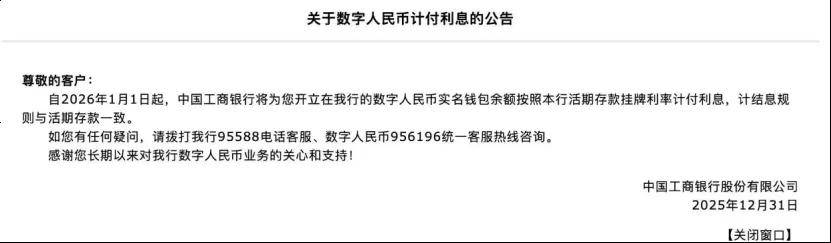
Core Viewpoint - Starting January 1, 2026, several major banks in China, including Industrial and Commercial Bank of China, Agricultural Bank of China, Bank of China, China Construction Bank, Bank of Communications, and Postal Savings Bank, will offer interest on the balances of digital RMB real-name wallets at the same rate as current deposit rates [1] Group 1 - The interest calculation rules for digital RMB wallets will align with those of current deposits [1] - China Construction Bank's announcement specifies that four types of wallets are excluded from this interest policy [1] - Bank of Communications states that if a customer opens a type four personal digital RMB wallet, the balance will not earn interest [1]
多家国有大行,集体公告
Sou Hu Cai Jing· 2026-01-01 03:32
Core Viewpoint - Digital Renminbi will start accruing interest from January 1, 2026, as major banks in China announce plans to pay interest on the balances of digital Renminbi wallets at the same rates as regular savings accounts [1] Group 1: Bank Announcements - Industrial and Commercial Bank of China, Agricultural Bank of China, and China Construction Bank will begin paying interest on digital Renminbi wallet balances according to the current savings deposit rates starting January 1, 2026 [1] - Bank of Communications will also pay interest on digital Renminbi wallet balances, including various types of personal and corporate wallets, based on its announced savings deposit rates, while balances in certain wallet types will not earn interest [1] Group 2: Regulatory Framework - The People's Bank of China has introduced an action plan to enhance the management and service system for digital Renminbi, which will officially launch on January 1, 2026 [1] - The action plan specifies that banks must comply with self-discipline agreements regarding deposit interest rate pricing for customer digital Renminbi wallet balances [1]
银行“抢滩”年终奖 跨年理财高收益获投资者青睐
2 1 Shi Ji Jing Ji Bao Dao· 2026-01-01 03:18
Core Insights - The article discusses the increasing demand for wealth management products as year-end bonuses are being distributed, highlighting a competitive marketing environment among banks to attract customers [1][2][4] Group 1: Bank Marketing Strategies - Banks are launching exclusive wealth management activities and products to capture the influx of year-end bonuses, with a focus on flexible redemption and low entry thresholds [2][8] - For example, Bank of Communications has introduced a series of wealth management products with an annualized return of 4.68%, allowing daily purchases and redemptions starting from 1 yuan [2][8] - Industrial and Commercial Bank of China is promoting three wealth management products, with one offering a near-month annualized return of 3.09% and a minimum investment of 1 yuan [2][8] Group 2: Product Design Trends - Mid to low-risk products are becoming mainstream for year-end bonus investments, balancing risk control with potential returns to meet the demand for stable investments [3][9] - The trend of lowering investment thresholds, such as allowing purchases from 1 yuan, is expanding the customer base to include ordinary investors with small amounts of idle funds [3][9] - Traditional deposit products are also being enhanced, with Tianjin Bank offering a three-year deposit with a higher annual interest rate of 1.85%, appealing to conservative investors [3][9] Group 3: Investor Preferences - Investors are showing a preference for stable wealth management options, with many prioritizing safety over high returns when managing their year-end bonuses [4][10] - A common strategy among investors is to allocate funds based on purpose, with approximately 10% for emergency cash, 30-40% for liquidity, and over 50% for medium to long-term investments [5][11] - The trend towards "cross-year wealth management" is noted, where investors seek flexible products that do not interfere with holiday spending while still providing higher returns than regular products [6][12]