ICBC(601398)

Search documents
单签最高盈利近40万元,2025年最赚钱十大新股出炉!
Zheng Quan Shi Bao· 2026-01-03 01:48
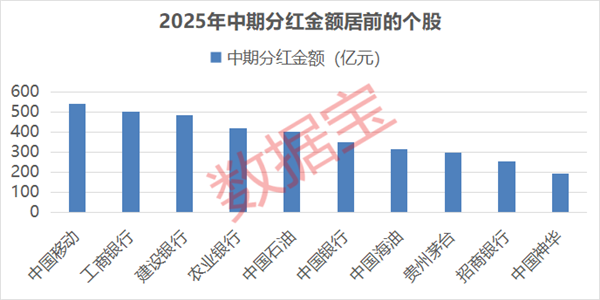
Core Insights - The article highlights that 37 listed companies have distributed dividends exceeding 10 billion yuan, with 5 companies surpassing 100 billion yuan in dividends, marking a historical high for the A-share market [1] - Notably, the "Big Four State-owned Banks" and China Mobile are among the companies that achieved this milestone, with Agricultural Bank of China, Bank of China, and China Mobile each breaking the 100 billion yuan barrier for the first time [1] - The total mid-year dividend distribution for 2025, including Q1, semi-annual, and Q3 reports, has significantly increased, with 1,113 companies participating and a total amount reaching 8,148.82 billion yuan, surpassing approximately 6,700 billion yuan in 2024 [1] - China Mobile, Industrial and Commercial Bank of China, and China Construction Bank lead in mid-year dividend amounts, distributing 540.87 billion yuan, 503.96 billion yuan, and 486.05 billion yuan respectively [1]



国有六大行集团宣布:数字人民币实名钱包余额按活期利率计息
Huan Qiu Wang· 2026-01-03 01:39
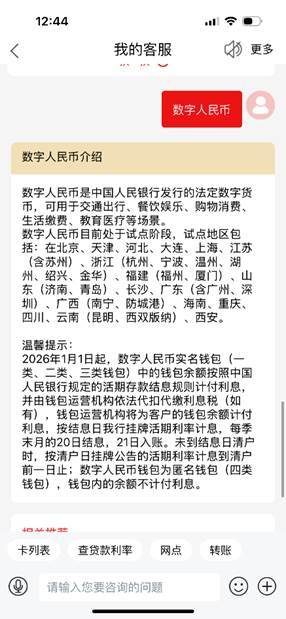
Group 1 - The six major state-owned banks in China will start paying interest on the balances of real-name digital RMB wallets at the same rate as current deposit rates, effective January 1, 2026 [1][3] - The current interest rate for current deposits is set at 0.05%, and only real-name wallets (categories one, two, and three) will earn interest, while anonymous wallets (category four) will not [1][3] - The People's Bank of China has introduced a new action plan to enhance the management and service system for digital RMB, which will officially launch on January 1, 2026 [3] Group 2 - The action plan allows banks to manage the assets and liabilities of digital RMB wallet balances independently, while ensuring the same level of security as traditional deposits through deposit insurance [3]

工商银行取得异常业务数据确定方法专利
Sou Hu Cai Jing· 2026-01-02 11:41
Group 1 - The core point of the article is that the Industrial and Commercial Bank of China (ICBC) has obtained a patent for a method, device, and equipment related to "abnormal business data determination," with the patent announcement number CN119316324B and an application date of June 2024 [1] Group 2 - ICBC was established in 1985 and is located in Beijing, primarily engaged in monetary financial services [1] - The registered capital of ICBC is approximately 35.64 billion RMB [1] - According to data analysis, ICBC has invested in 28 companies, participated in 5,000 bidding projects, has 986 trademark information entries, 5,000 patent information entries, and holds 77 administrative licenses [1]
工商银行取得基于诈骗资讯的知识图谱应用方法专利
Sou Hu Cai Jing· 2026-01-02 10:44
Group 1 - The core point of the article is that the Industrial and Commercial Bank of China (ICBC) has obtained a patent for a method and device related to the application of knowledge graphs, with the patent announcement number CN116521892B and an application date of April 2023 [1] Group 2 - ICBC was established in 1985 and is located in Beijing, primarily engaged in monetary financial services [1] - The registered capital of ICBC is approximately 35.64 billion RMB [1] - According to data analysis, ICBC has invested in 28 companies, participated in 5,000 bidding projects, has 986 trademark records, and holds 5,000 patent records, along with 77 administrative licenses [1]
工商银行取得GoldenDB数据库维护方法和装置专利
Sou Hu Cai Jing· 2026-01-02 10:38
Group 1 - The core point of the article is that the Industrial and Commercial Bank of China (ICBC) has obtained a patent for a method and device for maintaining the GoldenDB database, with the patent announcement number CN116932640B and an application date of May 2023 [1] Group 2 - ICBC was established in 1985 and is located in Beijing, primarily engaged in monetary financial services [1] - The registered capital of ICBC is approximately 35.64 billion RMB [1] - According to data analysis, ICBC has invested in 28 companies, participated in 5,000 bidding projects, has 986 trademark information entries, and holds 5,000 patent information entries, along with 77 administrative licenses [1]
农行涨幅领跑 6家上市银行2025年A股股价涨超20%
Zheng Quan Shi Bao Wang· 2026-01-02 06:10
Core Viewpoint - In 2025, the A-share banking sector index increased by 12%, with significant fluctuations throughout the year, including a strong performance in the first half, a pullback in the third quarter, and a recovery in the fourth quarter [1] Group 1: Overall Market Performance - The A-share banking sector index saw a cumulative increase of 12% in 2025 [1] - Agricultural Bank of China (ABC) stood out with a stock price increase of over 52.66%, making it the highest-performing bank in terms of stock price growth [1] - By the end of 2025, six banks had stock price increases exceeding 20%, including ABC, Xiamen Bank, Shanghai Pudong Development Bank, Chongqing Bank, Industrial and Commercial Bank of China (ICBC), and Ningbo Bank [1] Group 2: Market Capitalization - By the end of 2025, ABC's A-share market capitalization surpassed that of ICBC, making it the highest market capitalization bank in A-shares, although ICBC still held a higher total market capitalization when including H-shares [1] - The total market capitalization rankings of the six major state-owned banks were led by ICBC (2.63 trillion yuan), followed closely by ABC (2.61 trillion yuan) [3] Group 3: Valuation Metrics - ABC's price-to-book (PB) ratio exceeded 1 for the first time, breaking the long-standing trend of state-owned banks trading below book value, which contributed to the overall valuation recovery of A-share listed banks [3] - The PB ratio for ABC was reported at 1.00, indicating a significant improvement in its market valuation [2] Group 4: Growth Drivers - The recovery of ABC's PB ratio is attributed to the potential release of county-level business opportunities amid urban-rural integration, which is expected to drive credit growth more significantly than its peers [4] - The bank benefits from lower liability costs and superior asset quality in the county financial sector, supporting steady growth in asset scale and profitability [4]




工商银行取得用于路桥通行的控制方法专利
Sou Hu Cai Jing· 2026-01-02 04:56
声明:市场有风险,投资需谨慎。本文为AI基于第三方数据生成,仅供参考,不构成个人投资建议。 来源:市场资讯 天眼查资料显示,中国工商银行股份有限公司,成立于1985年,位于北京市,是一家以从事货币金融服 务为主的企业。企业注册资本35640625.7089万人民币。通过天眼查大数据分析,中国工商银行股份有 限公司共对外投资了28家企业,参与招投标项目5000次,财产线索方面有商标信息986条,专利信息 5000条,此外企业还拥有行政许可77个。 国家知识产权局信息显示,中国工商银行股份有限公司取得一项名为"用于路桥通行的控制方法、装 置、系统和设备"的专利,授权公告号CN116363875B,申请日期为2023年3月。 ...
工银科技取得全局序列号生成方法专利
Sou Hu Cai Jing· 2026-01-02 04:12
Group 1 - The State Intellectual Property Office of China has granted a patent to ICBC Technology Co., Ltd. and Industrial and Commercial Bank of China Ltd. for a method and device for generating global sequence numbers, with the announcement number CN114168607B and application date in December 2021 [1] - ICBC Technology Co., Ltd., established in 2019 and located in Shijiazhuang, focuses on software and information technology services, with a registered capital of 900 million RMB. The company has invested in 2 enterprises, participated in 345 bidding projects, and holds 788 patent records [1] - Industrial and Commercial Bank of China Ltd., founded in 1985 and based in Beijing, primarily engages in monetary financial services, with a registered capital of approximately 35.64 billion RMB. The bank has invested in 28 enterprises, participated in 5,000 bidding projects, and possesses 986 trademark records and 5,000 patent records, along with 77 administrative licenses [1]
工商银行取得分布式系统交易处理专利
Sou Hu Cai Jing· 2026-01-02 03:37
Group 1 - The core point of the article is that the Industrial and Commercial Bank of China (ICBC) has obtained a patent for a method, device, equipment, and medium for transaction processing in distributed systems, with the patent announcement number CN114372792B and an application date of January 2022 [1] Group 2 - ICBC was established in 1985 and is located in Beijing, primarily engaged in monetary financial services [1] - The registered capital of ICBC is approximately 35.64 billion RMB [1] - According to data analysis, ICBC has invested in 28 companies, participated in 5,000 bidding projects, has 986 trademark information entries, 5,000 patent information entries, and holds 77 administrative licenses [1]
2025年度牛股出炉!沪指年度收盘创近18年新高
Zheng Quan Shi Bao Wang· 2026-01-02 00:43
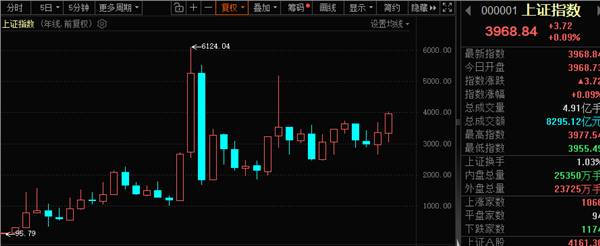
Group 1 - The Shanghai Composite Index closed at 3968.84 points, achieving an 11-day consecutive rise and marking the second highest annual closing in history, only behind 2007, and the highest in nearly 18 years [1] - Major A-share indices saw annual growth rates with the Shanghai Composite Index, Shenzhen Component Index, and CSI 300 Index increasing by 18.41%, 29.87%, and 17.66% respectively, while the ChiNext Index and Sci-Tech 50 Index rose by 49.57% and 35.92% respectively [3] - The total market capitalization of A-shares exceeded 108 trillion yuan, setting a new historical high, with seven stocks surpassing 1 trillion yuan in market value, led by Agricultural Bank of China at 2.45 trillion yuan [4] Group 2 - A total of 540 stocks in the A-share market have doubled in value this year, with Weiwei New Materials (688585) leading the gains with an increase of 1820.29%, driven by market enthusiasm following the acquisition by Zhiyuan Robotics [4] - Other notable gainers include *ST Yushun, *ST Yazhen, Shenghong Technology, Feiwo Technology, and Filinger [6] - Tianpu Co., Ltd. ranked second in annual growth with a cumulative increase of 1645.35% [7]