BANK OF CHANGSHA(601577)

Search documents
长沙银行(601577) - 长沙银行股份有限公司关于优先股全部赎回及摘牌的公告
2025-12-19 10:46
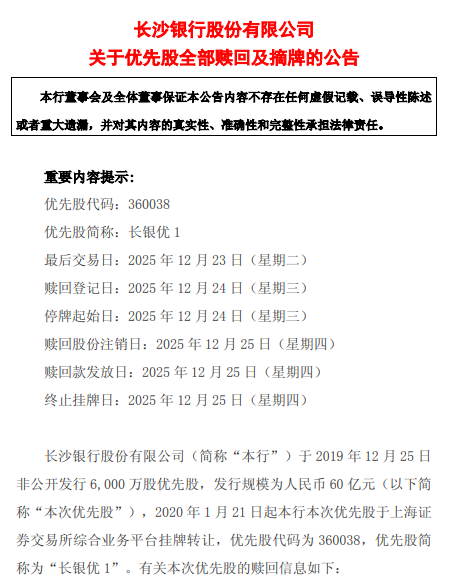
证券代码:601577 证券简称:长沙银行 编号:2025-065 优先股代码:360038 优先股简称:长银优 1 长沙银行股份有限公司 长沙银行股份有限公司(简称"本行")于 2019 年 12 月 25 日 非公开发行 6,000 万股优先股,发行规模为人民币 60 亿元(以下简 称"本次优先股"),2020 年 1 月 21 日起本行本次优先股于上海证 券交易所综合业务平台挂牌转让,优先股代码为 360038,优先股简 称为"长银优 1"。有关本次优先股的赎回信息如下: 一、本次优先股赎回履行的程序 本行董事会及全体董事保证本公告内容不存在任何虚假记载、误导性陈述 或者重大遗漏,并对其内容的真实性、准确性和完整性承担法律责任。 重要内容提示: 优先股代码:360038 优先股简称:长银优 1 最后交易日:2025 年 12 月 23 日(星期二) 赎回登记日:2025 年 12 月 24 日(星期三) 停牌起始日:2025 年 12 月 24 日(星期三) 赎回股份注销日:2025 年 12 月 25 日(星期四) 赎回款发放日:2025 年 12 月 25 日(星期四) 终止挂牌日:2025 年 1 ...
长沙银行:全额赎回6000万股优先股“长银优1”并摘牌
Xin Lang Cai Jing· 2025-12-19 10:42
Core Viewpoint - Changsha Bank announced its plan to fully redeem 60 million preferred shares, issued on December 20, 2019, on December 25, 2025, following approval from its board and regulatory authorities [1][3]. Group 1: Announcement Details - The preferred shares, referred to as "Changyin Preferred 1," have a par value of RMB 100 each, totaling RMB 6 billion [1][3]. - To ensure fair information disclosure and protect investor interests, Changsha Bank plans to apply for a suspension of trading for "Changyin Preferred 1" shares on December 24, 2025, with redemption and cancellation occurring on December 25, 2025 [1][3].

26家A股银行分红预案已出,总额突破2600亿元
Chang Sha Wan Bao· 2025-12-19 06:56
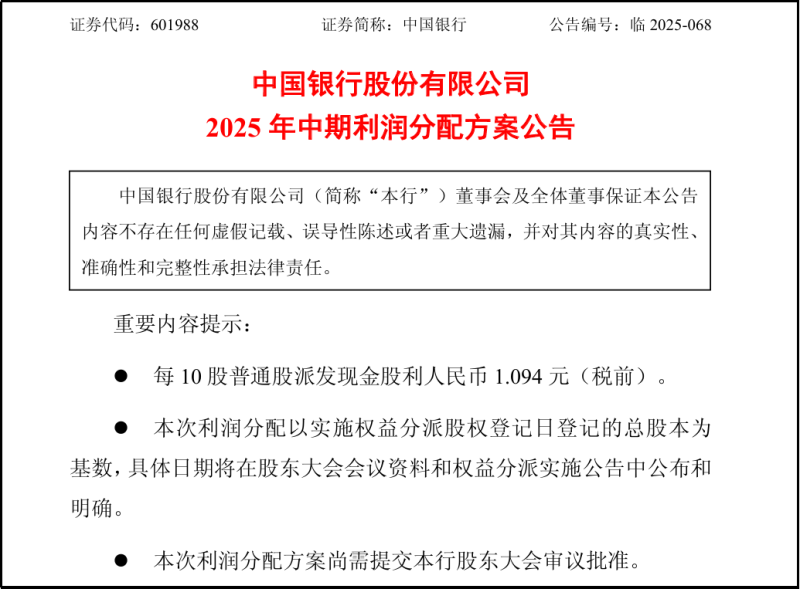
Group 1 - The core viewpoint of the news is that A-share listed banks are expected to distribute significant cash dividends, with a total expected amount exceeding 260 billion yuan, indicating a trend towards increased shareholder returns [1][2] - As of December 17, 2025, 26 A-share listed banks have disclosed their mid-term or quarterly dividend plans, surpassing the 24 banks that did so for 2024 [1][2] - The six major state-owned banks are the main contributors to this dividend distribution, with a total cash dividend expected to exceed 200 billion yuan, accounting for over 70% of the total dividends from all listed banks [2] Group 2 - The Industrial and Commercial Bank of China leads the dividend distribution with 50.396 billion yuan, followed by other major banks such as China Construction Bank and Agricultural Bank of China [2] - Several banks, including China Merchants Bank and Changsha Bank, are initiating mid-term dividends for the first time, with a total dividend amount of approximately 23 billion yuan [2] - The trend of high-frequency dividends aligns with national policy directives aimed at enhancing the quality of capital market development and protecting investor rights [3][4] Group 3 - The increase in dividend frequency is seen as a positive response to policy guidance, providing a model for other listed companies to improve their dividend mechanisms [4] - High-frequency dividends not only enhance shareholder satisfaction but also meet the investment needs of long-term funds such as social security and pension funds [4][5] - The banking sector's move towards mid-term dividends is expected to positively impact stock prices and the overall banking sector, signaling strong profitability and ample cash flow [6]



年内 7 家消金公司完成增资 中型公司补充资本需求仍强
2 1 Shi Ji Jing Ji Bao Dao· 2025-12-18 12:01
Core Viewpoint - The consumption finance sector is experiencing a "capital increase wave" starting from 2024, driven by regulatory requirements and market considerations [1][6]. Group 1: Capital Increase Activities - Changsha Bank plans to increase capital in its subsidiary, Changyin 58 Consumer Finance, by up to 1.55 billion yuan, raising its ownership from 56.66% to 80.82% [1][2]. - At least seven consumer finance companies have completed capital increases this year, with several firms raising their registered capital to the 1 billion yuan threshold [3][4]. - Notable increases include Ningyin Consumer Finance's capital rising from 2.911 billion yuan to 3.6 billion yuan and Hubei Consumer Finance's from 1.0058 billion yuan to 1.3589 billion yuan [3]. Group 2: Regulatory Context - The "Management Measures for Consumer Finance Companies" effective from April 2024 mandates a minimum registered capital of 1 billion yuan [4][5]. - The new regulations also require major shareholders to hold at least 50% of the shares, up from 30%, to enhance accountability [5][6]. - Current data shows that five consumer finance companies still have registered capital below 1 billion yuan, and nearly half of the major shareholders do not meet the 50% ownership requirement [5]. Group 3: Market Considerations - Industry insiders suggest that the capital increases are not solely driven by regulatory compliance but also by strategic market choices from shareholders [6]. - Some leading companies are significantly increasing capital to expand credit offerings and capture high-quality customer segments, indicating a proactive growth strategy [6][7]. - Analysts predict that while the capital increase trend will continue, the pace will become more rational and differentiated, with medium-sized firms needing to maintain ROE levels and larger firms exploring various capital-raising methods [7].
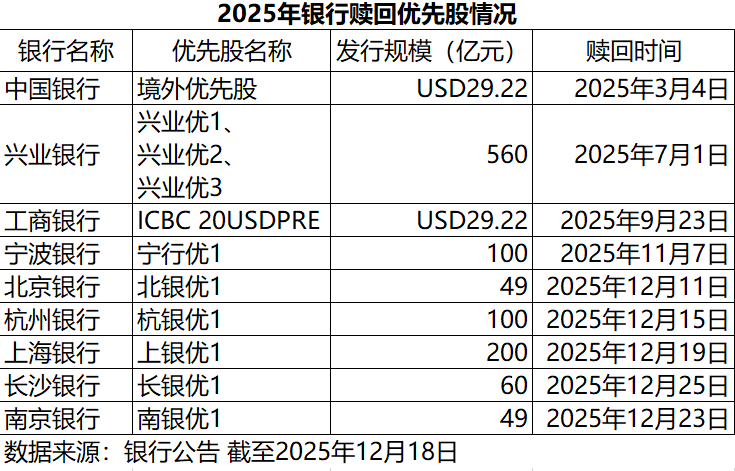
年内九家银行赎回优先股,权益类理财难寻“代餐”
2 1 Shi Ji Jing Ji Bao Dao· 2025-12-18 11:16
Group 1 - The core viewpoint of the articles indicates that since 2025, there has been an accelerated redemption of bank preferred shares, with several banks announcing their plans to redeem these shares, leading to a shrinking market for preferred stocks, particularly in the banking sector [1][4][7] - As of December 18, 2023, a total of 55 preferred shares have been issued, raising a total of 906.55 billion yuan, with bank preferred shares accounting for 35 of these, totaling 839.15 billion yuan [1][4] - The redemption trend is primarily driven by banks seeking to optimize financing costs, with significant redemptions occurring this year compared to only two last year [4][7] Group 2 - The preferred shares are a major component of bank wealth management products, with over 90% of equity investments in these products being allocated to preferred shares [2][10] - Due to the shrinking market for preferred shares, wealth management products are now looking for alternative investment options, as the supply of preferred shares diminishes [3][10] - The issuance of perpetual bonds has surged, with 69 perpetual bonds issued this year, totaling 821.8 billion yuan, indicating a shift in capital-raising strategies among banks [8][12] Group 3 - The redemption of preferred shares must comply with capital adequacy requirements, necessitating prior approval from regulatory authorities to ensure banks maintain sufficient capital levels [8] - The fixed and floating interest rates of preferred shares are subject to adjustments, with some banks reducing their dividend rates in response to changing market conditions [7] - The overall market for equity assets in bank wealth management has been declining, with the proportion of equity assets dropping from 4.8% in 2020 to around 2% by the end of 2023 [10][11]





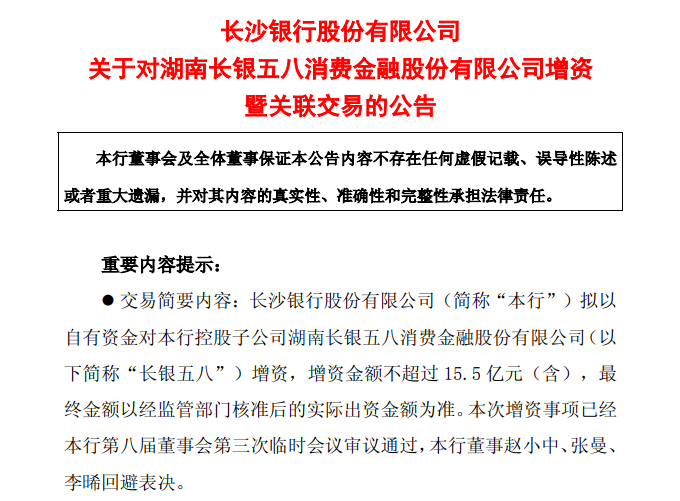
长沙银行拟对长银五八增资,增资后持股比例将提升至74.96%
Jin Rong Jie· 2025-12-18 07:48
Group 1 - Changsha Bank announced a capital increase of up to 1.55 billion yuan for its subsidiary Hunan Changyin 58 Consumer Finance Co., Ltd. at a price of 1.8877 yuan per share [1][6] - After the capital increase, the registered capital of Changyin 58 will rise from 1.124 billion yuan to 1.945 billion yuan, and Changsha Bank's shareholding will increase from 56.66% to 74.96% [4][5] - The capital increase is in response to the new regulatory requirements that raise the minimum registered capital for consumer finance companies from 300 million yuan to 1 billion yuan and increase the major shareholder's ownership requirement from 30% to 50% [4] Group 2 - As of December 31, 2024, Changyin 58's total assets were 29.62 billion yuan, with net assets of 3.58 billion yuan, and an audited net profit of 34 million yuan [4] - For the first three quarters of 2025, Changyin 58 reported total revenue of 1.67 billion yuan and an unaudited net profit of 21 million yuan [4]
A股银行股普涨,建设银行涨超2%
Ge Long Hui· 2025-12-18 05:24
Core Viewpoint - The A-share market has seen a broad increase in bank stocks, indicating positive market sentiment towards the banking sector [1] Group 1: Stock Performance - Suzhou Bank, Xiamen Bank, Shanghai Bank, Hangzhou Bank, Jiangyin Bank, China Construction Bank, and Chongqing Rural Commercial Bank all experienced gains exceeding 2% [1] - Zhangjiagang Bank, Nanjing Bank, Jiangsu Bank, Qilu Bank, Changsha Bank, Qingdao Bank, and Chongqing Bank saw increases close to 2% [1]
历史收益率远超近期表现!部分银行理财收益展示反差大,有何影响?
Xin Lang Cai Jing· 2025-12-18 00:19
Core Viewpoint - Some banks are displaying higher annualized returns on their wealth management products in their apps compared to the actual recent returns, leading to investor concerns about misleading information [1][7]. Group 1: Discrepancy in Returns - Many banks show annualized returns since inception that are significantly higher than the recent monthly returns, indicating a potential misrepresentation of product performance [1][7]. - For example, a product from China Construction Bank shows an annualized return of 2.28% since its inception, while its recent one-month return is only 0.75% [3][7]. Group 2: Market Conditions - The discrepancy in returns is attributed to a declining interest rate environment and poor recent performance in the bond market, which affects the underlying assets of these wealth management products [3][5]. - The annualized return for bonds has decreased significantly, with the year-to-date return at only 0.46% and a one-month return of -0.43% [11]. Group 3: Regulatory Perspective - Current regulations do not explicitly prohibit banks from showcasing higher historical returns, allowing them to prioritize displaying more favorable figures [3][9]. - The China Banking Association's guidelines emphasize the need for transparency and accurate representation of past performance to protect investors' rights [11]. Group 4: Concerns About Performance Display - There are concerns that the practice of highlighting higher historical returns may mislead investors about the stability and future performance of these products [6][12]. - Experts suggest that banks should standardize the timeframes used for performance display across similar products to avoid selective reporting [12].

锚定2026年!这些银行,提前布局!
券商中国· 2025-12-17 23:34
Core Viewpoint - Commercial banks are proactively preparing for the 2026 credit season by focusing on project reserves and customer management, indicating a strategic shift to enhance their operational foundations in a complex environment [1][2][3]. Group 1: Credit Strategy and Project Preparation - Several listed banks have begun to lay out their credit strategies for 2026, with some starting as early as the second half of 2025 to ensure a robust project reserve [2][3]. - Banks are conducting investor surveys to discuss their "early bird" strategies, credit focus areas, and measures to manage net interest margins and funding costs [3][4]. - Suzhou Bank and Jiangsu Bank have initiated project reserves and are aligning their credit strategies with regional economic transformations and key sectors [3][4]. Group 2: Net Interest Margin and Profitability Outlook - Analysts expect a positive trend in net interest margins for 2026, with many banks indicating that the pressure on margins is likely to ease, leading to a recovery in net interest income [2][6][7]. - Institutions like Ping An Securities predict that net interest income growth will rise to 4% due to improved pricing dynamics and reduced funding costs [6]. - The overall financial performance of listed banks is anticipated to surpass that of 2025, driven by a combination of interest margin stabilization and improved non-interest income [6][7]. Group 3: Sectoral Focus and Competitive Landscape - The "14th Five-Year Plan" is expected to guide banks towards focusing on manufacturing, technological innovation, and green finance, with a significant emphasis on digital infrastructure and sustainable energy [7][8]. - There is a notable divergence in the competitive landscape, with state-owned banks benefiting from their scale and lower funding costs, while joint-stock banks face increasing pressure from both state-owned and city commercial banks [8].


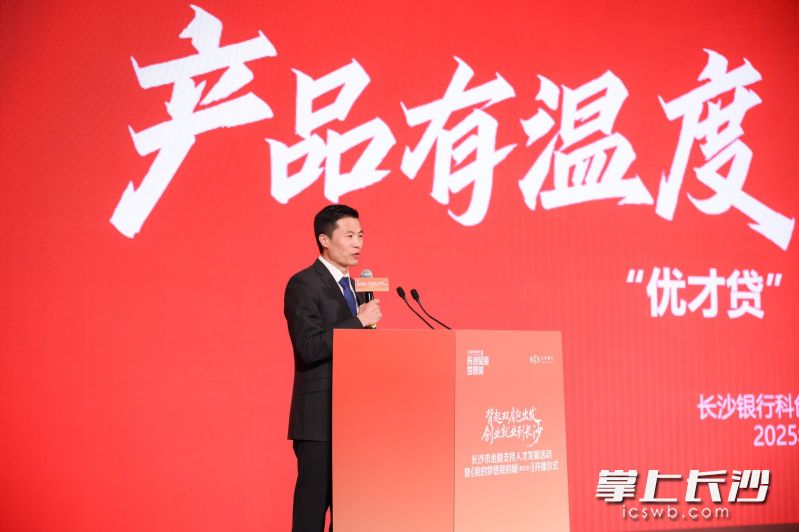
长沙银行优才贷累计投放突破30亿元,精准滴灌星城科创沃土
Chang Sha Wan Bao· 2025-12-17 16:01
Core Insights - The article highlights the success story of Li Jiarui, a young entrepreneur in Changsha, who received a 1 million yuan loan from Changsha Bank's "You Talent Loan" program, showcasing the bank's support for talent development and innovation [1][3]. Group 1: Financial Support for Talent Development - Changsha Bank has launched the "You Talent Loan" product specifically for high-level talents, which has disbursed a total of 3 billion yuan over nearly six years, supporting numerous outstanding talents and technology innovation enterprises [3]. - The loan application process is described as convenient and quick, providing essential financial support that allows entrepreneurs to focus on technological advancements [3]. Group 2: Company Profile and Financial Projections - Li Jiarui's company, Hunan Ningying New Material Technology Co., focuses on low-carbon chemical solutions, with its core product, a concrete carbon-reducing agent, significantly reducing cement usage and carbon emissions [3]. - The company has successfully applied its products in key projects and is projected to achieve a revenue of 30 million yuan by 2025, with a valuation of 200 million yuan after completing its angel round of financing [3]. Group 3: Changsha Bank's Commitment to Innovation - Changsha Bank's Sci-Tech branch has been dedicated to technology finance for 14 years, with 90% of its credit funds directed towards this sector, and 70% of its business consisting of credit guarantee loans [4]. - The bank has introduced a new product, "Little Lotus You Talent Loan," which offers 1 million yuan without collateral, aimed at better supporting young entrepreneurs [4]. - The bank has implemented various measures to ensure 100% reach, response, and satisfaction for talents, having served over a thousand enterprises in innovation and entrepreneurship competitions in the past three years, with loan disbursements exceeding 10 billion yuan [4].