
CPIC(601601)

Search documents
加码“银发经济” 国寿、太保等头部险企竞逐“大康养”生态
2 1 Shi Ji Jing Ji Bao Dao· 2026-02-06 09:31
Core Viewpoint - The aging population in China is rapidly increasing, with projections indicating that by the end of 2025, individuals aged 60 and above will reach 32.338 million, accounting for 23.0% of the total population, while those aged 65 and above will total 22.365 million, making up 15.9% of the population. This demographic shift is driving the growth of the elderly care industry, which is becoming a crucial component of the national social security system and a strategic focus for insurance companies [1][3]. Industry and Company Developments - The elderly care industry is characterized by both social welfare attributes and market potential, significantly influenced by national policies aimed at encouraging social participation and promoting integrated medical and elderly care services [3][4]. - The insurance sector is responding to the demand for elderly care by increasing investments in the industry, with 130 elderly community projects initiated during the 14th Five-Year Plan period [4]. - In 2025, over 10 elderly community projects were launched by various insurance companies, including China Life, Taikang Insurance, China Pacific Insurance, and others, indicating a growing trend in the sector [5]. - The "city center model" is emerging as a new choice for elderly care, with insurance companies shifting their focus from suburban locations to urban centers to provide better access to medical resources and proximity to family [6][7]. - Major insurance companies are competing to build a comprehensive "big health" ecosystem, integrating insurance payments, health management services, and capital investment to meet the complex needs of the elderly [8][9]. - China Life has initiated a "333 strategy" focusing on elderly care, health, and finance, with significant investments in health and elderly care projects across multiple cities [9][10]. - China Pacific Insurance has established a "big health" strategy, emphasizing a comprehensive ecosystem covering elderly care, health, and rehabilitation services [10]. - Ping An Insurance has upgraded its strategy to integrate financial services with elderly care, expanding its home care services to 75 cities and serving over 160,000 clients [10]. - Taikang Insurance has been active in the elderly community sector since 2009, with a significant presence across 37 cities and nearly 90,000 beds available [10]. - Insurance funds are increasingly penetrating the medical and elderly care sectors, with nearly 30 billion yuan invested in various sub-sectors, including biotechnology and medical devices, as of the third quarter of 2025 [11].






机构行为更新专题:理解‘平准基金’的三个视角
Guoxin Securities· 2026-02-06 01:20
Investment Rating - The report maintains an "Outperform" rating for the non-bank financial sector [5][4]. Core Insights - The report emphasizes that the intervention of stabilization funds has become a normalized and institutionalized mechanism in capital markets, which requires institutional investors to adapt their asset allocation strategies to include policy variables for long-term considerations [2][11]. - The shift from direct intervention in individual stocks to a focus on broad-based ETFs represents a strategic evolution aimed at maintaining market stability while minimizing distortions in price signals [3][52]. - The report highlights that the actions of the "national team" in stabilizing the market have led to a gradual formation of a "slow bull" market, improving the operating environment for non-bank financial sectors and enhancing long-term valuations for brokerages and insurance companies [3][12]. Summary by Sections Overseas Perspective - Stabilization funds are viewed as essential stabilizing forces in capital markets, with examples from Japan and the U.S. demonstrating their long-term operational roles rather than short-term emergency measures [2][11]. - Japan's central bank has become a major player in market interventions, with its ETF holdings reaching approximately 37 trillion yen by the end of 2025, indicating a shift to a normalized intervention strategy [14][20]. Domestic Practice - Since 2023, the central financial institutions in China have optimized their strategies by focusing on increasing holdings in broad-based ETFs like the CSI 300 and SSE 50, which has effectively reduced irrational market volatility and guided investors towards core market assets [3][12]. - The report notes that this transition from precise stock interventions to macro-guided asset combinations has laid a solid foundation for a long-term value return in the market [3][12]. Key Company Earnings Forecasts - The report provides earnings per share (EPS) and price-to-earnings (PE) ratios for several companies, all rated as "Outperform": - China Ping An: EPS 7.87 (2025E), PE 8.56 (2025E) [4] - China Life: EPS 6.07 (2025E), PE 8.02 (2025E) [4] - China Pacific Insurance: EPS 5.40 (2025E), PE 8.28 (2025E) [4] - CITIC Securities: EPS 2.21 (2025E), PE 12.83 (2025E) [4] - Guotai Junan: EPS 1.53 (2025E), PE 13.08 (2025E) [4] - Industrial Securities: EPS 0.39 (2025E), PE 17.69 (2025E) [4] - Dongfang Securities: EPS 0.69 (2025E), PE 14.84 (2025E) [4]



寿险银保渠道保费增速榜 透视三大阵营分化
Nan Fang Du Shi Bao· 2026-02-05 23:13
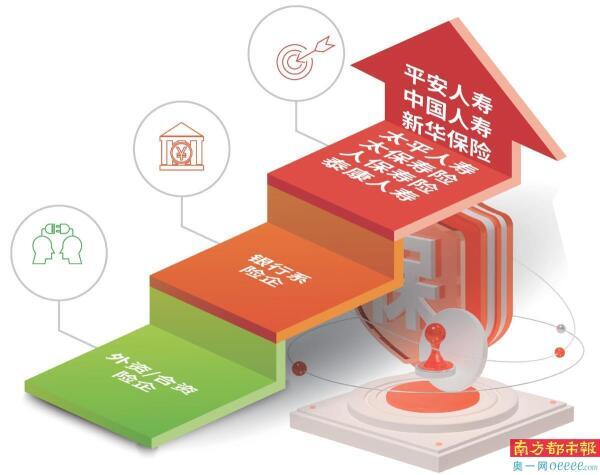
Core Insights - The article discusses the increasing trend of banks promoting insurance products, driven by the ongoing "deposit migration" and the urgent need for banks to boost their intermediary business revenue [2][6] - The insurance industry is witnessing a competitive landscape in the bancassurance channel, with significant growth in premium income, particularly among leading insurance companies [3][6] Group 1: Industry Trends - In 2025, the bancassurance channel for life insurance is expected to see an overall premium growth rate of approximately 10%, with leading insurers outperforming the industry average [3] - The "old seven" life insurance companies (including Ping An Life and China Life) achieved over 40% growth in bancassurance premiums, with Ping An Life leading at a remarkable 163% year-on-year increase [3][6] - The total premium income of the insurance industry surpassed 6 trillion yuan in 2025, marking a 7.4% year-on-year growth, with life insurance companies contributing significantly [6] Group 2: Competitive Landscape - There is a clear division among bank-affiliated insurance companies, with some experiencing significant growth while others face declines; for instance, Everbright Life Insurance saw a 111% increase, while others like China Merchants Life faced negative growth [4][5] - Foreign and joint venture insurers, although smaller in size, are achieving impressive growth rates by focusing on high-net-worth clients and long-term value services [5] Group 3: Strategic Developments - The removal of restrictions on the number of insurance companies a single bank branch can partner with has expanded product selection and improved matching with customer needs [7] - Insurers are actively enhancing their bancassurance channel strategies, with predictions indicating that new business value growth will be primarily driven by this channel in 2026 [8][11] - Major insurers are establishing extensive partnerships with banks, with China Life collaborating with over 100 banks and other companies also expanding their banking partnerships [9][11]

创新发展 | 中国太保举办首届科技创新大会,推动“人工智能+”战略落地
Sou Hu Cai Jing· 2026-02-05 13:52
Core Insights - China Pacific Insurance (CPIC) held its first Technology Innovation Conference themed "All in AI, Reshaping Insurance," marking a significant step in the implementation of its "AI+" strategy [1][3] - The company has officially launched three major strategies: "Health and Wellness," "Internationalization," and "AI+," with the "AI+" strategy being the core force to reshape the insurance value chain [3] Group 1: AI Strategy Implementation - CPIC aims to transform risk management from a "post-compensation" model to a proactive risk control approach, enhancing its role as a "stabilizer" and "shock absorber" for social development [3] - The company plans to improve service experience by ensuring technology delivers a brand promise of being "by your side" at every service moment [3] - CPIC is focusing on collaborative productivity and organizational synergy, with pilot projects for "AI-native subsidiaries" to transition from "human-driven" to "human-machine collaboration" [3] Group 2: AI Applications and Development - CPIC released the "Taibao AI Application White Paper," showcasing 23 cutting-edge cases that reveal its overall AI construction strategy [4] - The property insurance sector is targeting customer management, cost reduction, and efficiency improvement, planning over 60 business scenarios across nine areas, with a goal to create 10 benchmark AI products covering more than 100 business scenarios in the next three years [4] - The life insurance sector introduced the "Taibao Little Blue" intelligent matrix, focusing on empowering field staff, enhancing internal efficiency, and expanding internet business [4] Group 3: Future Vision - The conference signifies the full-scale implementation of CPIC's "AI+" strategy, aiming to transition from traditional compensation models to proactive risk management [4] - CPIC seeks to build an open and symbiotic insurance technology ecosystem, continuously leading the industry towards high-quality development and contributing to the construction of a strong financial nation [4]

中国太保:公司将密切关注黄金市场变化
Zheng Quan Ri Bao· 2026-02-05 12:17
Core Viewpoint - China Pacific Insurance (CPIC) emphasizes its commitment to prudent investment strategies and robust risk management in response to increased volatility in the gold market [1] Group 1: Investment Strategy - The company’s subsidiaries adhere strictly to regulatory requirements, focusing on medium to long-term asset allocation [1] - CPIC has established a clear decision-making authority and a comprehensive gold investment management system [1] Group 2: Market Conditions - Recent factors have led to significant fluctuations in gold prices, increasing uncertainty in the market [1] - The company will closely monitor changes in the gold market to enhance its risk management practices [1]
保险股跌幅居前 传大型险企将迎特别国债注资 机构称行业仍面临偿付能力
Zhi Tong Cai Jing· 2026-02-05 03:19
Core Viewpoint - The insurance stocks have experienced significant declines, with major companies like China Life, New China Life, and China Pacific Insurance seeing drops of 3.81%, 3.6%, and 3.14% respectively. The government is planning to issue approximately 200 billion yuan in special bonds to inject capital into large insurance firms, marking a potential first for such a move in China [1]. Group 1: Stock Performance - China Life (601628) shares fell by 3.81%, trading at 33.82 HKD [1] - New China Life (601336) shares decreased by 3.6%, trading at 60.2 HKD [1] - China Pacific Insurance (601601) shares dropped by 3.14%, trading at 38.24 HKD [1] Group 2: Government Action - The government plans to issue around 200 billion yuan in special bonds to provide capital to state-owned insurance companies like China Life and PICC [1] - This initiative could be announced as early as the first quarter of this year [1] - It represents a potential first for the issuance of special bonds aimed at injecting capital into insurance firms in China [1] Group 3: Industry Analysis - According to Industrial Securities, leading state-owned insurance companies require additional capital due to the lagging nature of the 750-day curve used in calculating reserves [1] - The 750-day curve is expected to continue declining, which will further pressure solvency despite interest rates remaining stable [1] - The recent increase in equity allocation by insurance companies is likely to exacerbate existing solvency pressures, indicating that the industry faces ongoing challenges [1] - From a regulatory perspective, the capital injection may aim to mitigate tail risks within the industry [1]
中国太保董事长傅帆:数智化转型是生存和发展的必答题
Zhong Zheng Wang· 2026-02-05 02:29
Core Viewpoint - China Pacific Insurance (601601) is launching a new strategic initiative focused on "AI+" to reshape the insurance value chain, emphasizing proactive risk management, enhanced service experience, and collaborative productivity [1][2] Group 1: Strategic Initiatives - The company has officially initiated three major strategies: "Health and Wellness," "Internationalization," and "AI+" [1] - The "AI+" strategy is identified as the core force for transforming the insurance value chain [1] Group 2: Key Focus Areas - The first focus area is to reshape risk management from a reactive to a proactive approach, transitioning from "post-compensation" to "pre-risk control and in-process reduction" [1] - The second focus area aims to enhance service experience by ensuring technology delivers a brand promise of being "by your side" at every service moment [1] - The third focus area involves transforming productivity and organizational collaboration through pilot "AI-native subsidiaries," moving from "human-driven" to "human-machine collaboration" [1] Group 3: Digital Transformation - The chairman emphasized that digital transformation is not optional but a necessity for survival and development [1] - The implementation of the "AI+" strategy will involve strong leadership, dynamic assessment, and a commitment to genuine digital transformation rather than superficial changes [1] Group 4: Collaborative Ecosystem - At the conference, China Pacific Insurance announced collaborations with Tencent Cloud, iFlytek (002230), Huawei, Baidu Cloud, and Alibaba Cloud to showcase advancements in various AI applications [2] - The company aims to leverage AI technology as a core engine to shift from traditional compensation models to proactive risk management, fostering a new open and symbiotic insurance technology ecosystem [2]
理赔服务见力度显温度
Jing Ji Ri Bao· 2026-02-04 22:17
Core Insights - The insurance industry is focusing on improving claims efficiency and addressing challenges related to slow processes, thereby enhancing its role as a social stabilizer and economic shock absorber [1] Group 1: Claims Efficiency - Multiple property insurance companies are shifting claims from a "back-end" function to a "front-end" service, making it a key indicator of their functional and service capabilities [2] - In 2025, China People's Insurance Company (CPIC) reported over 300 billion yuan in claims, with vehicle insurance making up a significant portion; the trend is towards increased online and automated processing of small claims [2] - The competition in vehicle insurance claims is evolving from merely the amount paid to the efficiency and method of payment, with a focus on remote assessments and online reporting [2] Group 2: New Energy Vehicle Claims - The rapid adoption of new energy vehicles is raising the bar for claims standards due to higher repair costs associated with components like batteries and sensors [3] - Insurance companies are enhancing their claims capabilities by collaborating with manufacturers and authorized repair networks, emphasizing the need for precise assessments and clear payouts [3] Group 3: Natural Disaster Claims - The recent earthquake in Tibet highlighted the insurance industry's ability to mobilize quickly for disaster claims, with CPIC initiating emergency mechanisms and processing claims efficiently [3][4] - The company reported handling 30,200 claims and disbursing 173 million yuan in payouts within a short timeframe, showcasing the challenges of disaster claims, such as communication disruptions [3][4] Group 4: Health Insurance Insights - Health insurance claims, particularly critical illness and medical insurance, are becoming focal points for insurers, with significant payouts reported [5][6] - In 2025, CPIC's health insurance claims included 424,300 cases totaling 20.1 billion yuan, with critical illness claims accounting for 10.53 billion yuan [5] - The most common critical illnesses vary by age group, indicating a need for insurers to adapt their products to emerging health trends [5] Group 5: Technological Integration - The insurance industry is increasingly adopting artificial intelligence to streamline claims processes, with many claims being processed within hours [8][9] - Companies like Ant Group and Tencent are implementing AI-driven solutions to enhance customer experience and expedite claims processing, including features like automatic document recognition and real-time claims updates [9][10] - The introduction of "one-day claims" for critical illnesses aims to address urgent financial needs for patients, demonstrating a commitment to customer-centric service [9]

中国太保(02601.HK)遭摩根大通减持174.46万股
Ge Long Hui· 2026-02-04 13:42
Group 1 - JPMorgan Chase & Co. reduced its stake in China Pacific Insurance (Group) Co., Ltd. by selling 1,744,609 shares at an average price of HKD 39.4277 per share, totaling approximately HKD 68.786 million [1] - After the reduction, JPMorgan's total holdings in China Pacific Insurance decreased to 276,420,141 shares, representing a decline in ownership percentage from 10.02% to 9.96% [1][3] - The transaction occurred on January 29, 2026, as per the latest disclosure from the Hong Kong Stock Exchange [1][2]

险企竞逐“消费医疗金”赛道,哪款产品适合你?
Mei Ri Jing Ji Xin Wen· 2026-02-04 12:42
Core Insights - The "Years of Peace Specific Disease Insurance" launched by Ping An Health has gained significant popularity, topping the premium issuance charts for two consecutive weeks in early 2026 [1] - The product's internal rate of return (IRR) is projected to exceed 3% over ten years, with some scenarios estimating around 5%, which is notably higher than similar products in the current market [1][3] - The average premium for this long-term health insurance product is several tens of thousands of yuan, contrasting sharply with the average premium of several hundred yuan for previous popular medical insurance products [1] Product Features - The product incorporates a consumer medical fund into the insurance contract, marking a new trend in the industry [1] - The IRR calculations are based on a combination of cash value and medical reimbursement accounts, with a projected medical reimbursement of nearly 3,000 yuan annually, totaling approximately 29,300 yuan by the tenth year [4] - The design features two independent accounts: one for cash value accumulation and another for medical coverage, which do not affect each other [4] Market Trends - The rise of this product reflects a broader trend in the medical insurance sector towards innovative offerings that combine insurance with service [2][6] - The industry is moving towards integrating advanced treatment methods and outpatient services into insurance coverage, with a focus on comprehensive health management [6] - Several other insurance companies, including Fosun United Health and Pacific Health Insurance, are quickly following suit by launching similar products that also include consumer medical funds [8] Competitive Landscape - The market currently features six popular products, each tailored to different demographic needs, such as age coverage and health disclosures [9] - The "Years of Peace Specific Disease Insurance" stands out for its lenient health disclosures, making it more accessible to individuals with common health issues [10] - Other products, like the "Fosun Health Yao Huo 3.0," offer features such as flexible coverage and additional medical funds, catering to high-net-worth individuals [9][11]